

Putting Meat On Your Sermon Outline Bones
We call this next step in sermon preparation putting meat on the bones because the basic outline that we created in the previous step created the bones. The meat includes the following elements in a sermon that won’t bore your listeners.
Illustrations that bring the ideas to life so people can see what you mean.
Explanation that educates people so that they can understand what you mean.
Proof or argumentation that validates your ideas so that people will know that what you say is true.
Application that helps your people see how these ideas matter and what they can do to live out what the message teaches.
The Four Questions to Ask About Each Idea
As you can see, we want to do four things with each idea in our message. Your sermon will hopefully include one Big Idea that governs the whole sermon. It’s the main thesis or main idea of the passage you’re preaching. For example, in our Proverbs 3:5-6 sermon, we decided that the Big Idea for the message would ask, “How does God fix our broken roads?” That’s the Big Idea, so we need to illustrate, explain, prove, and apply that idea. We do that by asking four questions.

What does the Big Idea look like? Illustration.
What does the Big Idea mean? Explanation.
Is the Big Idea true? Proof/Argumentation.
So what? What do I do with the Big Idea? Application.
In addition to the Big Idea, your message what icnlude some sub-points or movements. In part three of the previous step, we came up with an outline to develop the Big Idea about fixing broken roads, where the broken roades refers to the lives of those who trust in God wholeheartedly. That outline started with the bad examples of who to trust to fix your broken life. Then we said there’s only one solution to fix our broken lives. Finally, we give the overall Big Idea, arriving at it inductively.
So we will need to ask the four questions above about the first subpoint, which says that we can find bad examples of how to fix a broken life. We might illustrate it and explain it with a story of a time we trusted in something other than God to solve a big problem. We then have to prove that it’s a bad solution and show how it can ruin the lives of other broken people.
Next, we will need to illustrate that there’s only one trusted solution for fixing a broken life: trusting in the Lord and leaning on his understanding rather than our own (Proverbs 3:5). You may need to explain this, then prove it. Finally, you will ask the So What question.
Illustration Serves the Other Development Tools
An illustration provides the best way to explain, prove, and apply an idea. People can understand things better when they see what it means. They can better believe something when they hear stories that prove its truth. They can apply ideas more effectively when we present examples of how to apply them.
In Proverbs 3:5-6, the author states that we should not lean on our own understanding. That’s part of subpoint one, which says some people trust in the wrong things to solve their problems.
In my early adulthood, I made little money while also attending Seminary and struggling to support a wife and two kids. Instead of praying to seek the Lord’s help with our finances, we relied on credit cards and ran up a lot of debt. Then, when our credit cards reached their limits, we relied on payday loans. That’s when you give a company a post-dated check, and they don’t deposit it until that date. I’d date it for my payday and get $200, but write the check for $250. That’s a 25% loan for two weeks. On one occasion, the check bounced, and it got me into trouble. I had to face embarrassment and ask my church treasurer for an advance on the next payday. The illustration both shows the hearer what I mean and explains it. It will also help prove it. Then I can take that same story and give examples of what a wise person might do instead.
Put the Meat on the Bones
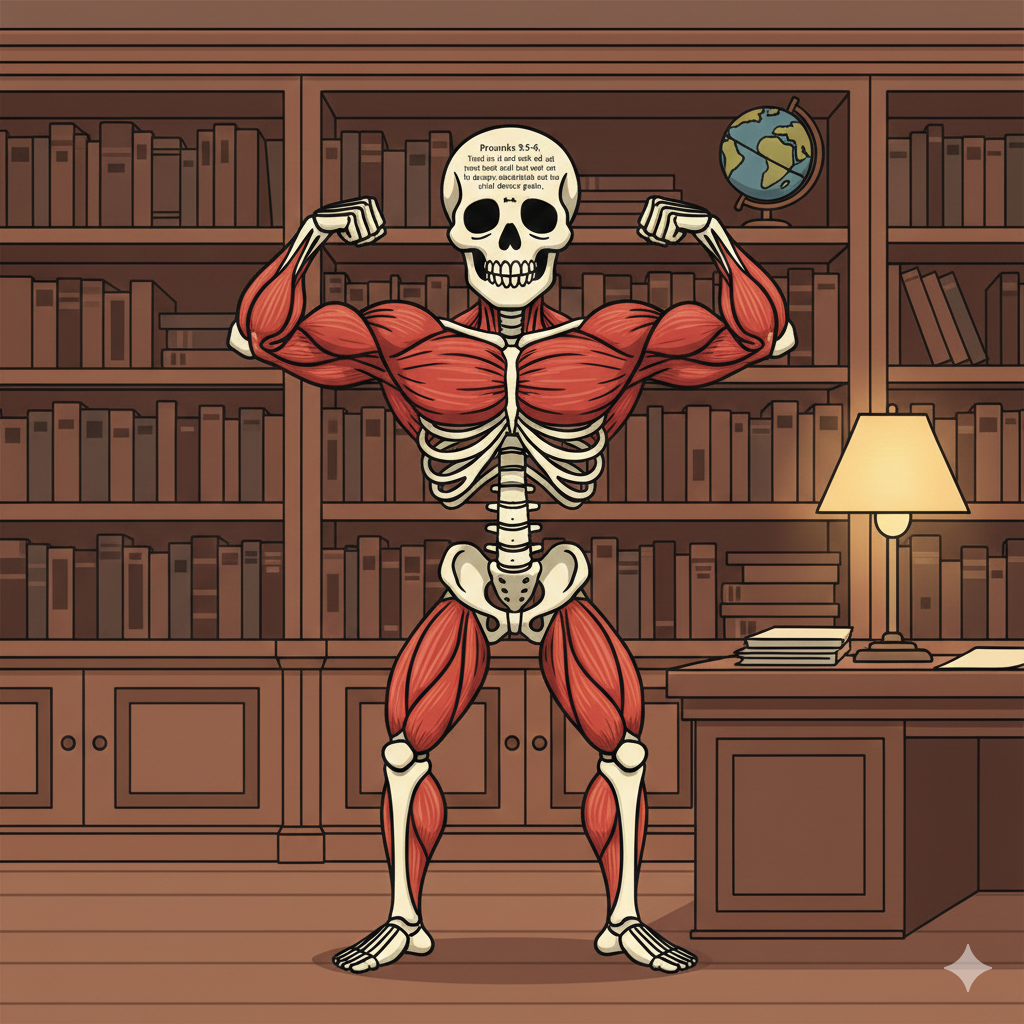
To complete this step, go through your outline and brainstorm ways to explain, illustrate, prove, and apply each subpoint. Do the same with the Big Idea, adding a strong illustration at the beginning to grab attention and introduce it. The sermon will explain and prove the Big Idea, one small part at a time. At the end, you will also apply the Big Idea with an illustration that shows what a person can do to apply the Big Idea in their lives. Wayne McDill calls this “Visualization” because it shows the listener how to apply that overall theme or Big Idea.
Once you have noted a few illustrations, proofs, and applications, decide which to include. Good “Meat” will do the following:
Relate to the preacher and audience without too much explanation. Don’t use investing ideas when speaking to the youth group, and don’t use sports illustrations when speaking to people who don’t like sports.
Won’t take long to develop. You don’t want to spend 20 minutes telling a story. If you can share the illustration or explain the idea in a minute to three minutes, it’s too long, and you need to find something else.
Make it fit the purpose. Sometimes we hear a great story and want to share it so badly that we make it fit, like a child pushing the yellow circle into the oval ball they play with.
Be very careful with self-congratulatory illustrations or examples. People get tired of hearing about how great you are. They also get tired of hearing what a loser you are. Balance and moderation are key.
Don’t insult others, especially those present. I never use my wife’s mistakes, failures, or sins in my sermons.
If you use an example or illustration from your personal life, ask your family, friends, and church members for permission.
An Example from Proverbs 3:5-6
Our three ideas in our sermon from Proverbs 3:5-6 say…
I. We can find many proposed solutions to obstacles faced - bad examples (leaning on your own understanding)
II. There's only one trusted source of accurate and up-to-date directions (trust the Lord with all your heart; in all your ways acknowledge Him)
III. When You Trust God's Directions, You Arrive at God's Destination
Let’s take the third example and do a few things. First, let’s decide if we need to rewrite the point ot make it more creative or memorable. We’re using the overall journey illustration, and part of taking a journey is following directions. So, I don’t think we need to rewrite the sentence.

Next, what do we need to explain and tie to the text? We will read it again and focus on the last line.
5 Trust in the Lord with all your heart,
And lean not on your own understanding;
6 In all your ways acknowledge Him,
And He shall direct your paths. (Proverbs 3:5-6, NKJV)
We would explain that following the first two parts of our sermon (avoiding bad solutions and following only God’s solutions), God will give us the kind of direction we can rely on and arrive where God wants us to be. We might use content gleaned from a word study on “direct” which could mean to straighten a crooked road or flatten a hilly road. Here are a few real-world analogies that might help.
Taking a hike on a hilly road and wishing it were flatter so I could complete the hike.
Driving a windy road in rural Wilkes County, NC, where I live, and explaining how the state highway department plans to straighten some of the roads.
A corn maze that makes it hard to find the end on a fall farm near my house.
Of those, I think the highway illustration resonates more with the people I speak to. It’s also one I could retell in a winsome, self-deprecating way. I grew up in an upper midwestern city. Milwaukee mostly had a grid of north/south and east/west roads. When I first moved to rural Kentucky and tried to drive the roads, I had to slow down. However, after several months, I got used to driving on our road and could fly down the hill we lived on. However, when my family visited from Milwaukee, they freaked out because they felt I was driving way too fast. My dad especially complained as he sat in the passenger seat, gripping the handles with a death grip.
If we put our trust in the Lord, those windy obstacles won’t disappear, but they feel less daunting because we know God will keep us on the road and steer us away from the consequences of poor choices. Now, I can testify to how God blessed me with this kind of direction, and I can also show people how to apply this truth. This helps me prove and apply the idea in one step.
Using Logos Bible Software in Sermon Development
I use Logos Bible Software in my Sermon Development. It’s a great source for word studies, illustration harvesting, and arguments to prove your ideas. You can even write the sermon directly in the program or in an online app. To get a Logos subscription, head over to my affiliate link. Get 60 days free to try it out, which is a no-brainer.