

How to Compel People to Listen to Your Sermon.- Part 2
If you fail to grab the attention of your audience, you could miss an opportunity to help Jesus change someone’s life for an eternity. We want to help you do just that.
In part 1, we talked about grabbing attention with a video introducing a speech. In part 2, we move from that hook into the heart of your message. The transition matters: it’s the bridge that carries interest into commitment.
Grabbing attention with a video like this created using Gemini AI can help.
A compelling introduction to a sermon should encompass several crucial elements, beyond the captivating opening that draws the audience’s attention. We hope to transform the audience from passive attendees into active listeners who will then take the message and apply it to their lives. To do so, we need to…
Expose the need our passage will address, or what Bryan Chapell calls the Fallen Condition Focus.
Introduce the Big Idea, subject, or content of the sermon.
Help the listener understand where you’re going.
The Need Element or Fallen Condition Focus
After you command the attention of your audience, you will need to answer the most important question a listener will have.
Why should I listen to you today?
We answer that by taking our Big Idea and strategizing how to introduce the need or sin problem people face. Imagine a person sitting across your desk in your church office or at a coffee shop. With concern in their voice, they ask you a question or tell you about a problem in their life. As you hear this need, sin, or struggle, you seek the Lord for wisdom from scripture to help your friend.
What would be the question the person asks or the situation they describe that leads you to share your sermon passage?
In our last post on Introductions, we referred to Romans 8:26. It reads…
26 Likewise the Spirit also helpeth our infirmities: for we know not what we should pray for as we ought: but the Spirit itself maketh intercession for us with groanings which cannot be uttered. 27 And he that searcheth the hearts knoweth what is the mind of the Spirit, because he maketh intercession for the saints according to the will of God. Romans 8:26–27, KJV
What Big Idea would you suggest? How does the Holy Spirit bail us out when our pain blocks our prayers?
Brainstorm possible problems, sins, or struggles that this verse could help with. If you have personal experience with this, consider telling your story. Maybe you know someone who dealt with a similar problem. Share their story, but make sure you have permission if the person in the congregation knows them.
Considering that you could tell a story about this problem, you might want to use the story attention-grabbing strategy from our previous post on Introductions.
You can also combine other strategies, such as “Imagine” or “raise your hands”. What if you said, “Imagine that your oldest son just got into a car accident and you don’t know if he will survive. How would you respond? Raise your hands if you’ve ever faced something like that, and when you tried to pray, you just couldn’t? Emotion overwhelms you, and you can’t even think about what to ask God to do!”
Introduce the Big Idea
The best preaching understands that each passage communicates one Big Idea. Some preachers call this the message, the central thought, the thesis. Whatever you call it, it’s a single sentence that shares the main idea of a passage in a way that’s easy to understand and remember.
As a disciple of the Haddon Robinson school of preaching, I’ve searched for the Big Idea in all my sermons. We talked about discovering it in a previous post.
Now that you’ve captured attention and engaged your audience by showing why they should listen, you will want to introduce the Big Idea, or at least help them see where you’re going.
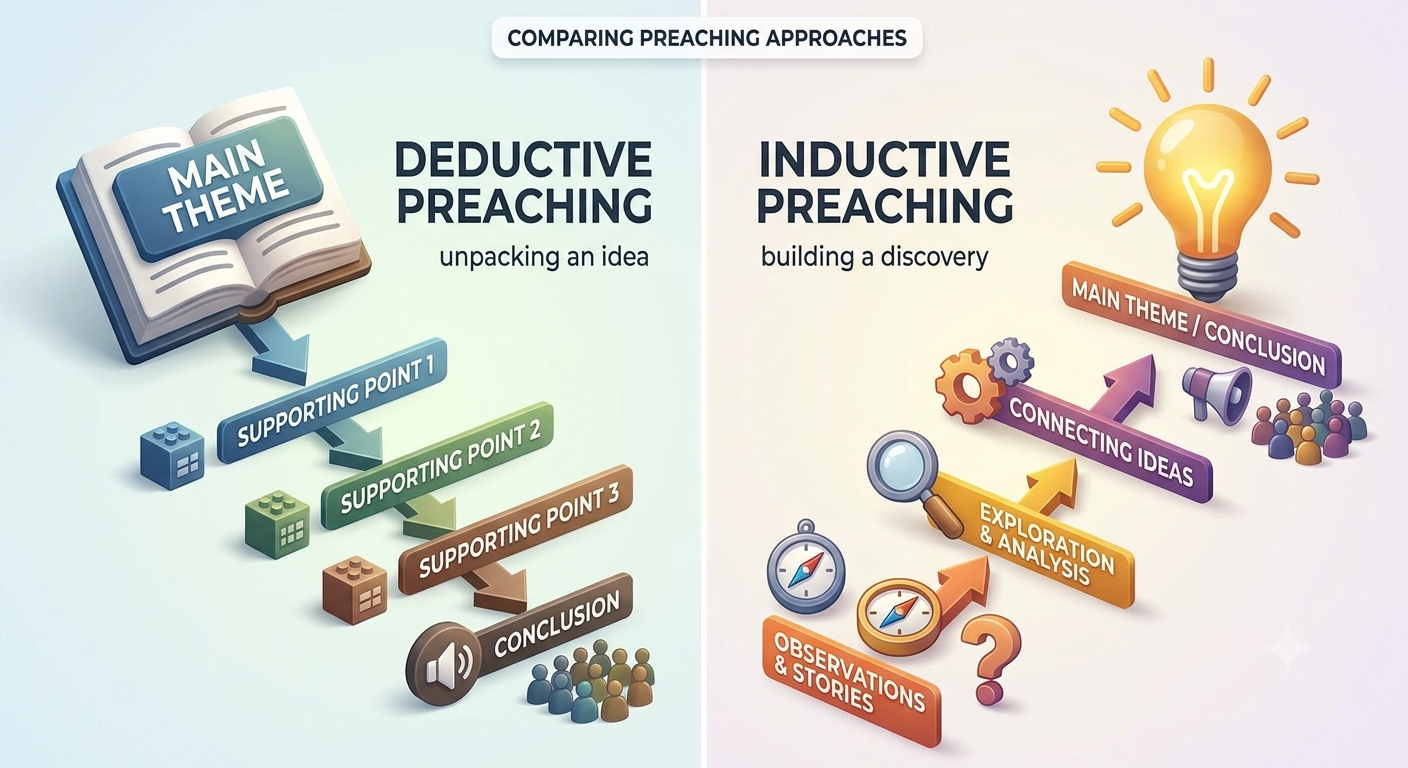
Deductive Preaching starts with the Main Idea or Big Idea and explores it in a few traditional points. Inductive begins with observations or anecdotes and explores the ideas before coming up with a Big Idea or Main Theme at the conclusion.
We find two schools of thought on the outline style of preaching. One introduces the Big Idea early on, and the remainder of the sermon will expound on that idea. We see traditional 3-point preaching in this.
In our post on discovering the Big Idea, we used Proverbs 3:5-6 as an example.
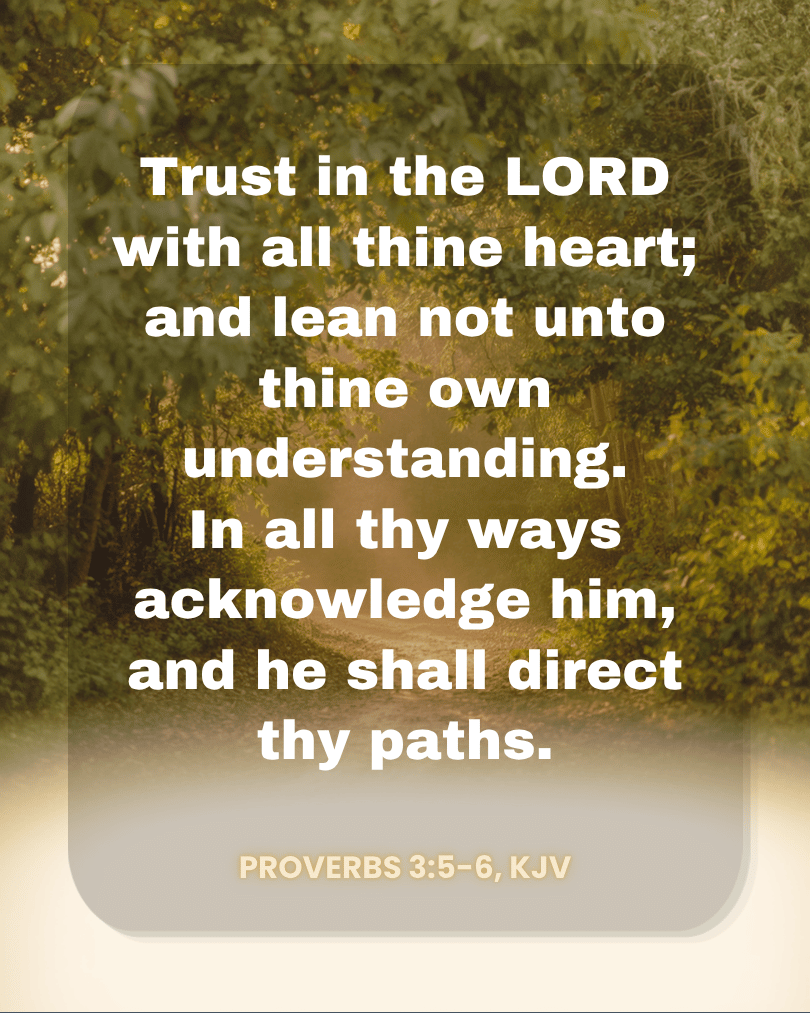
We said the subject and complement were as follows:
Subject: How do believers trust in the Lord?
Compliment: The Lord's believers trust Him with all their hearts by relying on His understanding and direction.
You might introduce a sermon on this passage by saying, “Raise your hand if you’ve ever struggled to trust God when it looks like there’s no answer to your problem?” So you admit that’s a challenge.
Then tell a story about how you’ve struggled in this area. Now you’ll transition to the Big Idea by saying, “There’s hope because God knew we’d struggle at times and gave us a nugget of wisdom in Proverbs 3:5-6 that tells us we can trust God fully by relying on His understanding and guidance. That’s the first school of thought on sermon structure, which we call a deductive approach. We start with the Big Idea, and the body of the message will expound on it.
The second school of thought takes an Inductive approach. We move from the parts to the whole.
In an inductive sermon structure, you introduce the Big Idea, not by stating it as we did previously. Instead, you ask the question that leads to the Big idea and spend the rest of the sermon looking for the answer.
You might ask, “How can we trust God when it seems like everything’s falling apart?”
Where Are We Going
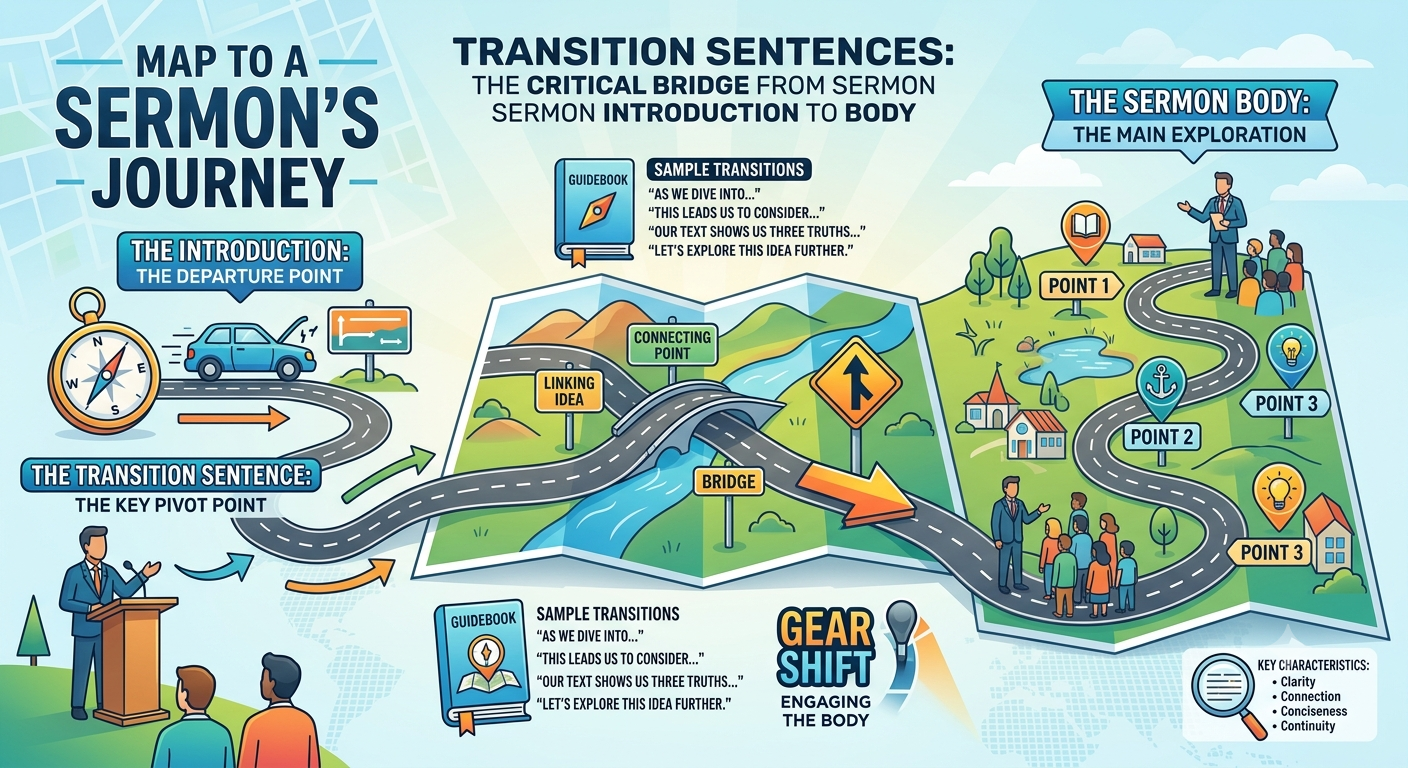
The Transition Sentence takes us from the Introduction to the body of the sermon.
The final part of the Introduction transitions from the Introduction elements covered above to the body of the message. This will depend on the kind of structure we’ve chosen.
As we said, some sermons expound on the topic in an Inductive approach while others use a Deductive approach.
A Deductive approach might use a transition statement that tells us where we’re going. It might sound like this:
Even thought it seems like things are falling apart, we can trust God with everything we’ve got and by not trusting in our own understanding and direction.
Then we will read the passage and present the first part of the sermon's body. What most preachers call “Point One”.
Get Bryan Chappel’s Christ-Centered Preaching
Click the cover to buy the book using my partner link with Logos.
Bryan Chappell, in Christ-Centered Expository Preaching, lists 6 elements useful for good attention-grabbing introductions.
Involve their imaginations.
Involve their sense of wonder.
Involve their appreciation of the past.
Involve their fear of the future.
Involve their outrage.
Involve their compassion.
If you want to benefit from Chappell’s book, take a look at the 3rd Edition of Christ Centered Expository Preaching or the 3-course Mobile Ed bundle.
Each of the above tools works much like the 5 strategies explained above. You won’t use each of Chappel’s six tools.