

Tools for Sermon Development in Logos Bible Software - Part 1 Explanation
Every good message includes 4 essential tools for Sermon Development. We look at Explanation and using Logos 10 to find out what a passage or topic means so we can explain it to our audience.
Every sermon should include four essential tools of Sermon Development. We looked at these in the last post here on this site as we study how to develop a sermon. Now, let’s look at how to use Logos Bible Software to explain a text. We’ll look at illustration, proof, and application in three other parts of this series on how to develop a sermon outline that we can transform into a great message.
If you read our previous post that defined each of the four essential aspects of Sermon Development, you know that one helps achieve the other three. An influential preacher uses many illustrations to explain his sermon's ideas. Illustrations show what we mean so the hearer can understand the passage.

Jesus Used Illustrations to Explain His Teaching
Read scripture, and you'll see Jesus used illustrations called Natural Analogies in his parables. He explained the concept of faith using the example of the Temple Mount and mustard seeds, two things his listeners would know about. You either have faith, or you don’t.
20- So Jesus said to them, “Because of your unbelief; for assuredly, I say to you, if you have faith as a mustard seed, you will say to this mountain, ‘Move from here to there,’ and it will move; and nothing will be impossible for you. 21- However, this kind does not go out except by prayer and fasting.”
Matthew 17:20-21, NKJV
Jesus explained the concept of faith using the Natural Analogy of a mustard seed. We might want to make this point in a sermon on this passage.
Today, we talk about degrees of faith, from weak to strong. However, Jesus taught that faith is binary. You either have it or you don't. You believe, or you don't. A mustard seed is the smallest seed that people commonly saw in Jesus' day. He might have even had one to show the audience.
A Modern Example of an Illustration Used to Explain Faith in Sermon Development
Since people today don't often plant mustard seeds, we might use a different Natural Analogy that we commonly experience, like a slight switch.

Photo by Mikhail Nilov
The average homeowner controls her overhead lights with a binary light switch with only off and on positions. It’s unlike a dimmer switch, which turns a light on in degrees of light. You can slide the switch up to ten percent for a romantic evening, halfway for average use, or 100 percent when you’re looking for a lost earring.
Jesus didn’t have two kinds of light switches. He didn’t have any light switches. Instead, he used a mustard seed. You either have faith, or you don't. You can't get less than that tiny seed's worth of faith. If you have it, then you can do something extreme, like commanding the Temple Mount to hurl itself into the nearby Dead Sea. That would seem insane to those listening to him and modern audiences if the temple still existed. But he said, if you have as much as a mustard seed of faith, you could command such a thing, and the Temple Mount would obey. This assumes you're acting in God's will; He'd need to want the temple mount thrown into the sea by an ordinary person's command.

The mustard seed illustration explained Jesus’ teaching about the binary nature of faith. He used a real-world or natural analogy to accomplish this.
Exegetical Guide in Logos Bible Software for Sermon Development
When I first discovered Logos in version 3 almost 20 years ago, the Guides sold me on the value of the software. Enter your passage, and Logos finds all the tools or books in your library that refer to a passage or topic. You can do this with the Exegetical Guide and discover many language study tools to help you understand the passage. Then, you’re ready to explain these Biblical ideas to your audience.
To open the Exegetical Guide, use either the right-click menu or the Guides button on the toolbar when selecting your passage. See the screenshot below.

You'll see a list of the different sections in the Exegetical Guide. These include tools for language study.

The WORD BY WORD Section of the Exegetical Outline
I focus on using the WORD BY WORD section. It shows your passage in both Greek or Hebrew on the left and English on the right (see below). Click a word to jump to that word's entry in the section. Each word's section shows the Greek or Hebrew lemma, an icon that, when clicked, will pronounce the word, a transliteration, and a simple translation.

The second line shows the parsing info. On the third line, you get the Sense info, a kind of translation that shows how the text uses the word in context. After the Sense, you get a list of your lexicons, which displays a short translation. Click on any of the blue links to get more information.

For example, in our passage on Matthew 17:20-21, we see the word for seed in the WORD BY WORD section. You can click the blue link to open NTGED if you own it and read more about the word translated seed in The New Testament Greek English Dictionary from Gilbrant, Thoralf. 1991. The New Testament Greek-English Dictionary comes as part of The Complete Biblical Library. There you find under "New Testament Usage" the following:
In all of its New Testament occurrences kokkos is used figuratively. Even with faith the size of a small mustard seed, one can live a miraculous life.
Gilbrant, Thoralf. 1991. “Κόκκος.” In The New Testament Greek-English Dictionary. The Complete Biblical Library. WORDsearch.
The above might help you as you study and try to explain the idea of a mustard seed representing such an infinitesimal amount of faith to explain that you either have faith or don't have faith. If you have it, you can move mountains, like the Temple Mount, which eventually happened in 70 AD after Jesus made the temple sacrifice moot.
If you don't own the NTGED or the Complete Biblical Library, head over to Logos to get it (Affiliate Link).
Passage Guide in Logos Bible Software for Sermon Development
Like the Exegetical Guide, the Passage Guide starts by asking you to enter your passage. The Guide will then show you different kinds of content when compared to the Exegetical Guide. It focuses less on language study and more on references like Commentaries and other tools like Biblical People, Places, and Things or Sermons and Illustrations. Let’s take a look.

Follow the same procedure as opening the Exegetical Guide. Select the passage, right-click it, and choose the Reference on the left list of the popup and the Passage Guide on the right list. The Guide will open and search all of your books in the Passage Guide categories for the selected Reference.
Alternatively, open the Passage Guide from the Guides button on the toolbar of Logos 10 using the same steps above when opening the Exegetical Guide.
Using Search Results to Explain an Idea in Logos 10
Let's use our Matthew 17:20 example from above. With the Passage Guide open as instructed in the previous section, begin opening tools by clicking on them in the Guide. I prioritized the New American Commentary so the Matthew volume sits atop the list of commentaries near the top of the Passage Guide.

When you read the section on verses 19-20 you'll see the author of the commentary writes:
“Nothing will be impossible for you” must thus be interpreted as nothing Jesus has given you the authority to do, such as this exorcism.22 Obviously, many other things are impossible for believers—based on the limitations of their humanity and of God’s will. As v. 22 immediately makes plain, even Jesus’ own miracle-working abilities did not permit him to escape the cross despite repeated temptation to do precisely that.
Blomberg, Craig. 1992. Matthew. Vol. 22. The New American Commentary. Nashville: Broadman & Holman Publishers.
This helps us explain that faith is not like a blank check. We can use the ideas presented in the commentaries and then give an illustration of a blank check to help our listeners understand that godly, Biblical faith is not an unlimited promise to let us do anything we please outside God's plan.

You'll find other excellent lists of resources in the Passage Guide. Look at the Cross References section, which refers to Luke 17:6, the parable of the Mustard Seed, modified by Jesus to refer to the miraculous ability to transplant a mulberry tree. The Passage Guide also includes links to the Factbook. So you could head down to the Biblical Things section of our Passage Guide. There, you'll find links to images from the Factbook.
You will also find these sections in other Guides like the Sermon Starter Guide and Topic Guide.
Power Lookup to Learn What a Passage Means for Explanation in Sermon Development
Users often forget the Power Lookup tool, but it works like a kind of Guide to search for content on a selected text or word. Right-click on the Passage and either choose the Selection or Reference on the left side of the popup. Scroll down to the Lookup section on the right side of the popup. You'll find Power Lookup.

The Power Lookup window opens in a small section along the right side of the Logos screen. It includes links to and short previews of things like...
- Footnotes
- Bible passages
- Commentaries
- Language tools
The Power Lookup panel links to the Bible you have active and moves when you move to a new passage. This helps when studying longer passages.
Note that all links to Logos resources are Logos Affiliate Links. I will receive a small percentage of the price if you purchase them using my links.
4 Exciting Tools in Logos Bible Software to Find Great Sermon Illustrations
We teach you how to use 4 exciting tools in Logos 10 to discover great sermon illustrations. They will help you paint pictures with words.
Logos Bible Software includes many valuable tools to help preachers find sermon illustrations as they write sermon outlines. Good sermon development always includes sermon illustrations, which the preacher can use to explain the text, prove its truthfulness, and then apply the text to the lives of their audience. So, we'll look at 4 useful tools in Logos to help you find good sermon illustrations.
For those who don't already own Logos 10, head over to my affiliate link and order one of the great packages, which include the tools you read about below. I recommend getting Logos Gold or higher to get the most bang for your buck.
4 Tools in Logos Bible Software to Help Find Great Sermon Illustrations
Let's look at the list of XX tools you can use in Logos Bible Software to find great sermon illustrations, and then we'll examine each one more fully.
Click the list item above to jump directly to the section that focuses on that tool, or just read about them in order below.
1. Factbook Collects Many Tools in One
Users can open many of the tools in the list above directly, but the Factbook will put them in one window with links to open them to your topic, passage, idea, person, place, or thing. That's the benefit of Factbook; it puts everything in one place. So, let's look at what tools you'll find.
In our previous posts on the 4 Essential Tools for Sermon Development, we looked at the passage about faith. Jesus uses the illustration of a mustard seed to show the binary nature of faith. You either have faith, or you don't. That's the point of the tiny seed used in Jesus' illustration. Modern science can measure the volume of a mustard seed, but most in 1st-century Israel would conceive of measuring a mustard seed's volume.

We open the Factbook from the Logos 10 toolbar (see above). Then, type an idea you want to illustrate in the search box. Hit enter, and the Factbook shows all it can find in the Factbook search tools. Some of the things you'll find in the Factbook include...
- Key Article - Each Factbook idea comes with a Key Article, often from a Bible Dictionary. Faith's Key Article is the entry for Faith from the Lexham Bible Dictionary.
- Further Reading - You'll see articles about your topic from other books or resources. For example, "Faith" shows the Lexham Theological Wordbook article.
- Media - the Factbook finds media related to your search, like videos or graphics.
- Key Passages - think of a cross-reference tool finding all the instances of your topic in the Bible with Key Passages and then a See Also section with other passages. They all appear as links you can hover over or click to open.
- Biblical Senses - if you search for a word with an original language like faith and the Greek word pistils (transliteration of the Greek term sometimes translated faith) that is translated as your word, then the Factbook lists Biblical Senses, which show the kind of word and the basic usage in Scripture.
- Dictionaries - articles from your dictionaries covering your topic or word.
- Journals - a search of your journals related to the topic or word.
- Sermons - sermons about your topic that may include great Sermon Illustrations.
- Preaching Resources - mostly sermon illustration databases.
- Biblical Events - you can discover places related to your passage or subject. This might not help us with faith.
- Biblical Books - maybe you're studying a book and want information about the book, the author, and the book's audience.
- Theological Topic - find information in your library about a topic like faith.
- Greek and Hebrew Words - some original language terms come with "word pictures," which help us understand a topic or an idea because the word etymology illustrates the concept concretely.
- Other Books from Your Library - a broad search for your word in your library.
- Factbook Tags - other books with Factbook tags related to your topic.
- Logos Store Links - links to buy books related to your search.
- Other Tools and Links - links to run one of the Guides on your topic or word.
The results listed in a Factbook search differ depending on what you search for.
How to Make Use of the Factbook Results
Some of the above will offer more fruitful results when looking for Sermon Illustrations. For example, Preaching Resources seems like a great way to find illustrations. However, Sermon Illustration Databases often include stale or boring illustrations that modern listeners can't relate to.

I took an illustration from these collections and researched online to learn more. For example, a search for faith shows an entry in the book 1000 Illustrations for Preaching & Teaching. We read about a man named Stewart Alsop who had leukemia. If you search for him and his book mentioned in the illustration database, you can find and read it. You can also read the Wikipedia page about him. Search Google or select the title and author name in the article, right-click, and choose Selection on the left part of the menu and Wikipedia on the right. As a result, this might give you better context about him and help you craft a more effective illustration of the concept of faith.

Other tools in the list above contain great information that you can use to explain your idea and illustrate it to appeal to the mind and the imagination. You'll even find media to display if you use a multimedia system in your worship or teaching environment. Key Passages will take you to cross references where you can let the Bible illustrate your concept. Share an example of faith from the life of someone like Abraham, who, in Genesis 12, was called to leave his home and wasn't told where he was going.

You'll find more images and videos with different searches. Faith is more of a concept than a person, place, or thing. If I'm preaching from the story of Moses in the book of Exodus, I can find media showing plagues, maps of Egypt, or the Israelites' exit. Make sure you also look for Factbook icons in the text of your Bible passage. The above screenshot shows three icons related to Pharaoh and two for the Egyptians.
2. Use Logos Guides to find Great Sermon Illustrations
The Factbook shows a lot of cool content. However, the Logos Guides give us similar results. Find content related to a passage, a topic, a specific word, counseling issues, or theological topics. Logos includes the following Guides...
- Exegetical Guide - for language study of a passage.
- Passage Guide - seeks a wide range of content based on a passage.
- Topical Guide - search your library for a Topic.
- Sermon Starter Guide - takes the Guide concept and finds content to help you prepare a sermon.
- Bible Word Study Guide - like the Exegetical Guide, but focuses on one Biblical word.
- Counseling Guide - focuses on counseling issues.
The Passage Guide, Topical Guide, and Sermon Starter Guide offer the best hope for finding great sermon illustrations. You can open these Guides from the Guides button on the toolbar. The most recently used items will appear at the top, but all of them will appear in the menu's Guides section. Also, each guide will let you search for one part of that guide. Scroll down to the Guide name in the menu and click it to show the sections of the Guides. Click on one, like the

To find some of the Guides, open to your passage and right-click on it. Click on Reference in the left part of the menu and then click on the Guide in the right. You'll see Passage Guide near the top, but if you scroll down on the right, you'll also see things like Sermon Illustrations and a few more Guides further down the list.

Using the right-click method, you can also search for a word or phrase in a passage. Instead of clicking Reference in the right-click menu, choose Selection. You'll find Guides on the right side of the menu. If you search a word you'll find the Bible Word Study Guide at the top and other Guides as you scroll down.
You'll find a wealth of potential Sermon Illustrations in the resulting search.
3. Sermon Builder and New AI Sermon Assistant
The Sermon Builder came with Sermon Illustration tools for a while. Logos added a new feature that uses artificial intelligence to overcome sermon writer's block. This new AI-powered tool requires a subscription to Logos Pro, which costs $9.95 and gives early access to new features like this new Sermon Assistant. See their official description of the Sermon Assistant in the Logos Community Forums.

Open a sermon you're already editing. Click on the Sermon Assistant button in the box's toolbar on the right of your sermon text. Next, choose Illustrations under Sermon and type an idea into the Idea box. You can also copy from the sermon and paste it here. Click Generate, and you'll see the resulting Sermon Illustration ideas. (see screenshot above).

If you like the illustration shown in the search results, hit the Insert or the Copy button. Insert places where your insertion point sits in the sermon text. Copy places it on the clipboard, letting you move the insertion point and paste it manually.
Next to the Sermon Assistant button, you'll see a Quotation icon. Click it to open the Popular Quotes tool, which works like the Sermon Assistant. It finds quotes from your library related to what you type into the box on that screen.
4. Don't Overlook Your Interactive Media and Your Library of Books
The above tools will help you find sermon illustrations, but some people overlook their books and features in Logos. For example, I'm going to do a demonstration of the Passover Seder for two churches in my Association of churches. I own the Rose Guide to the Feasts, Festivals and Fasts of the Bible. Under the Passover section, an excellent graphic shows the Seder Plate with descriptions of each item. This visual illustration will help me teach this feast.

To find these illustrations, search in one of the Guides as described above or open one of your dictionaries, a lexicon, or study Bibles, which often include charts, graphs, maps, or images.
Here's a list of books or features that include images useful to illustrate ideas or sermon points:
- Dictionary
- Encyclopedia
- Study Bibles
- Sermon Collections
- Media Collections
- Handbooks
- Atlas
- Illustration Books
- Bible Backgrounds (IVP, Zondervan, etc)
How Do You Find Great Sermon Illustrations?
How do you use Logos to find Sermon Illustrations? Please comment below to help out the community. I'll edit this article and cite you. If you know of a good YouTube video covering this how-to, share the link, and I'll take a look and update the article with the best videos, too.
Sermon Development Always Include These Four Essentials
Effective preachers will also include these four sermon development strategies to help their hearers understand, believe, and apply the text.
I don’t care how entertaining, interesting, or exciting your sermon seems to your audience. You fail your congregation if you don’t include these four essential elements in your sermon development. They are essentials because you have to include them. Can I make it any clearer? You have to do these four things!! They help you learn how to develop a sermon outline effectively.
What four elements should you include in your sermon development, regardless of what kind of sermon you preach? Developing an idea means making it understandable, memorable, and visible. Then, the truth needs to be doable. So, we explain, illustrate, and prove an idea. Finally, we show them how they can apply the truth by doing something, believing something, or understanding something.
Why are these so important to call them essential? A listener must understand what the preacher means and where the scripture says what the preacher said. Then, if I don’t see it, regardless of how much you explain it, the idea won’t come to life and plant itself in the audience's memory.
Not every listener will believe a statement just because they understand it and see it in scripture and they see examples. However, the more concrete the preacher makes their idea, the more the listener will believe it. Eventually, he must prove it’s true for a skeptical listener to accept and live the truth. If they do, we need to help them understand how they can live the truth.
Sermon Development Includes Clear Explanation
There’s a reason why “plain” is at the heart of Explanation. Not really, but that’s one way to think about it. When you state a truth, you must explain what it means. This becomes more important when using creative sermon ideas or sermon points. It’s best to avoid cutesy or gimmicky sermon points if they make things less clear and require you to spend extra time explaining the statement.
Please see part 1 of this series on Explanation.

To explain an idea, you need to make it clear or plain. What does it mean to say, “Discipleship is the heart of growth in Christ?” What do you mean by discipleship, heart, and growth?
The heart could mean something that pumps blood throughout the body. It illustrates driving growth and giving life to your spiritual existence. But most of us would likely mean that it’s central to our spiritual existence, like the heart sitting at the center of the body and circulatory system.
In a recent sermon, I said, “Jesus Empowers Us to Fulfill Our Purpose,” from Matthew 28:18, where Jesus said, “All authority is given to me in heaven and on earth.” Jesus empowers us thanks to his authority. He gave us the proper authority to go and make disciples and teach them.
An Example of Explanation
My sermon answered, “Why did God leave us behind after saving our souls?" We make disciples and stay in communion with Jesus until he returns, or we go to Him in death (v. 20).
To effectively clarify a spiritual truth like the one from my sermon on the Great Commission, the preacher should explain each part of the idea that a listener could misunderstand without it. What do we mean by empowering us? How does empowering us aid in fulfilling our purpose? If the sermon hasn't explained that the Great Commission is part of our purpose, we must do so now.
One tool a preacher reaches for when explaining ideas is natural analogies. These are real-world things that make abstract ideas clearer. We also call these sermon illustrations. So, let's look at that category of sermon development.
Sermon Development Includes Illustration
We've all seen or even used one of those books of stale old sermon illustrations. Back in the nineties, I used a program on my computer that collected sermon illustrations in a database. The illustrations in those books or that program often told stories of 19th-century missionaries or historical figures from the Civil War or Revolutionary War. They were boring and out of date.
Your life and experience provide the best source for natural analogies or sermon illustrations.

Photo by Kenaz Nepomuceno on Pexels.com
A sermon illustration includes anything that one can visualize. Illustrations in books show what the words say. A human anatomy book might illustrate how blood flows through the heart and to the extremities. A book about auto repair will show the proper fuel pump installation on a 2017 Honda Ridgeline.
A sermon illustration aims at the imagination. It shows what an idea looks like. It tells a story about how to live a life of kindness by telling how a friend showed the preacher kindness even though he didn't deserve it. The hearer can see how they might apply this truth, or they can see what the preacher means by kindness.
Illustrations will explain an idea, showing what it means. This clarifies the idea and gives examples of how to live out an idea by applying it. In other words, an illustration can explain, prove, and apply the truth.
Examples of What Many Call Sermon Illustrations
Before we move on to the sermon development element we call proof, let's look at an example of what is not a sermon illustration.
Too many of those sermon illustration websites, books, or databases include quotes by famous Christians or historical figures. Unless that quote includes a natural analogy or a story that shows us something, it isn't a sermon illustration. It might explain, prove, or apply an idea, but quotes are not illustrations unless they appeal to the imagination.
Illustrations can effectively prove ideas. So, what do we mean by proof?
Sermon Development Includes Proof
If explanation appeals to the mind and illustration appeals to the imagination, then proof appeals to the will. We explain by answering, "What does it mean?" We illustrate by answering, "What does it look like?" We prove a truth by answering, "Is this true?"

Image = hardcover and link = Logos Bible Software link.
Haddon Robinson wrote in Biblical Preaching, my favorite text on Expository Preaching:
An initial response of those of us who take the Scriptures seriously is to ignore this question. We assume that an idea should be accepted as true because it comes from the Bible. That is not necessarily a valid assumption. We may need to gain psychological acceptance in our hearers through reasoning, proofs, or illustrations. Even the inspired writers of the New Testament (all of whom believed that the Old Testament was a God-breathed witness) sometimes established the validity of their statements, not only by quoting the Old Testament but by referring to common life as well.
(Robinson, Haddon W. 2001. Biblical Preaching: The Development and Delivery of Expository Messages. 2nd ed. Grand Rapids, MI: Baker Academic. p. 80)
Strategies for Proof
Some effective strategies for proving a truth include:
- Illustrations that show how an event validated the truth in someone's life.
- Quotations from a trusted source that the hearers would believe.
- Statistics, facts, and figures.
- Logical arguments, which philosophers interestingly call proofs.
- Appeal to "a prior" knowledge, which means using ideas we all assume are true.
Most preachers will assume a truth that comes directly from scripture carries enough weight that it should not need proof. "The Bible says it, that settles it." However, if a church does a good job of appealing to non-believers, then a preacher might address people who don't believe the Bible is necessarily true. Also, believers might struggle to maintain their faith in the authority of the Bible. These people need proof! A modern preacher will appeal to Scripture and rely on the convicting power of the Holy Spirit, but will also appeal to the above kinds of proof to bring people to the point of trusting Scripture.
Once the hearer understands what we mean, can see what it looks like, and understands that the ideas are true, then we need to help them see and understand how to live what the Bible says.
Sermon Development Includes Practical Application
One preaching professor said, "If you don't apply the text, you didn't really preach it." I fully agree with this.
Imagine you take your car to a mechanic and he diagnoses the problem. You need to replace the fuel pump. The mechanic explains that the car won't run properly without a new fuel pump. He convinces you with a fantastic argument proving the need for a new pump. Then, the mechanic explains what the fuel pump does and what fixing it would do for the engine. He convinced you, and you're ready to swipe your credit card.
If you don't apply the text, you didn't really preach it.
Unknown Preaching Professor
The mechanic then turned around and walked away, saying, "Thanks for stopping by."
What do you do now? He never explained how you could get the fuel pump fixed or what it would cost. You can't fix it without direct application from the mechanic.
A sermon must also include application for the same reason. If the listener doesn't know what to do now, then you failed in the preaching task. "You didn't really preach."
Examples of Practical Application in Sermon Development
Sermons always include clear, concrete examples of how to apply the truth of the text. My sermon on The Great Commission from Matthew 28:18-20 ended with four ways the listener could apply the text. I told them to begin praying for one person they knew needed to hear the Gospel. Second, I suggested they learn how to share the Gospel. Third, I offered a tool called Life on Mission, an app that takes a person through the Gospel and invites the person to trust Jesus for salvation and forgiveness. You can also buy the book that shows how to present the 3 Circles Gospel Presentation (affiliate link at Amazon). Finally, I suggested that they ask the Lord to give them a chance to be a witness to their friend, not by inviting them to church, but by inviting them to trust Jesus.

Application can take on multiple forms including doing something. That's the most common form of Application as Sermon Development. You ask the congregation to do something based on the message you preach.
Application also means believing something. Sometimes, the passage simply asks us to believe something about God or his Kingdom.
Finally, some sermons ask us to understand something that we need to understand to change our behavior, character, or beliefs.
How to Use ChatGPT to Make Sermons More Interesting But Not More Biblical
You shouldn't use ChatGPT to study your passage but you can use it to make it more interesting. We look at how AI can help in sermon prep.
Everyone's amazed at the usefulness of ChatGPT while also concerned about it replacing so much in our culture. This includes good sermon preparation. Should pastors and preachers use ChatGPT to prepare their sermons? We will examine how to use ChatGPT to make sermons more interesting but not more Biblical.
Will the artificial intelligence tool make your sermons more interesting? How about more biblical? Can you even trust it?
I started using ChatGPT in my sermon preparation, but not how most people might think.

The Ethical Concerns Over ChatGPT for Sermon Preparation
Ethical preachers do their best to let the hearer know they didn't come up with the content on their own unless they did it on their own.
I once preached a narrative sermon telling a third-person story about a marathon running in the Corinthian games. It was an in-depth story that made my key points based on a passage from 1 Corinthians. I wrote it. It was original to me. So, I never cited anyone.
After the message, a church member told me she loved that story and couldn't remember where she first read it, but was glad I told it. I didn't have the heart to contradict her, so I said, "Thank you!" I left it there. But I wrote it.
At the same time, I heard a preacher quote an entire chapter from a Max Lucado book verbatim while he preached a revival at my church. After that service, I approached him and said, "I enjoyed listening to that. I, too like to read Max Lucado's books." I wanted him to know without being too confrontational that I knew he just passed off non-original work as his own.
Do You Always Cite Sources?

That brings us to the question of citing sources. Do you always cite every source you glean information from? Do you say, "The New American Commentary says..." about a passage? I don't always do that. If the material is unique and especially creative, I will clarify that I found this somewhere else. If it's ordinary and you can find the same content in five different Lexicons or Bible dictionaries, then it's not that revolutionary. You don't need to cite it.
That leads us to ChatGPT. Too much of the content we discover doesn't come with good citations. You can ask for references, but sometimes the information is wrong. So, ethical preachers should carefully use content from ChatGPT.
I don't use the tool for learning about language study, historical information, or other content I can find using something like Logos Bible Software. It's not good for that. Don't do it!
If you ask ChatGPT to write a full outline, you must cite it. It could be interesting, especially if you can find a way to connect that to the message. You might say, "I used ChatGPT to develop this outline." Some won't care, while your "lazy" sermon prep will scandalize others. However, in the end, you could make a point about life that ChatGPT illustrates. I can't imagine such an illustration, but you might.
I say that because...
ChatGPT Won't Replace Good Exposition of Scripture
Use your Bible Software or your seminary language study skills to learn what the author of Hebrews means by "Faith is the substance of things hoped for, the evidence of things unseen."
- You don't know whether you can trust the sources for studying Greek or Hebrew languages.
- You don't know whether you can trust the sources for church history, hermeneutics, or English-based dictionaries.
Fill in the blanks with any source. ChatGPT doesn't provide good sources, so you'll need to cite ChatGPT, and the tool often gets things wrong. A site called Analytics India Magazine posted a list of problems with ChatGPT. This ranged from bias to factually false info to bad math.
Don't use ChatGPT to study your passage. It's not good at it. If you have any experience preaching or training in exposition, then you're better at studying scripture than ChatGPT.
Use ChatGPT to Make Sermons More Interesting by Finding Illustrations
ChatGPT does a decent job of finding good sermon illustrations. Everyone knows a good sermon illustration will help you create interest. So you can use ChatGPT to make sermons more interesting by asking for great sermon illustrations.

Ask for historical or news-based examples of your topic. For example, ask ChatGPT, "What's a good example of a news story that took place since 2010 that shows what it is like to forgive?"
You'll notice a clipboard icon right of the answer when you get your answer. Click it to copy the content and then paste it into your sermon. Here's what the site offered when I wrote the above question.
One notable news story that demonstrates the power of forgiveness is the case of Rachel Denhollander, a former gymnast and lawyer, who in 2018 became the first woman to publicly accuse Larry Nassar, the former USA Gymnastics national team doctor, of sexual abuse. Denhollander's brave decision to come forward eventually led to Nassar being convicted and sentenced to up to 175 years in prison.
During Nassar's sentencing hearing, over 150 women shared their stories of abuse, and some even expressed forgiveness towards their abuser. In her victim impact statement, Denhollander said, "I pray you experience the soul-crushing weight of guilt, so you may someday experience true repentance and true forgiveness from God, which you need far more than forgiveness from me."
Denhollander's statement not only showcases her own strength and resilience, but also highlights the power of forgiveness. The courage and empathy displayed by her and the other survivors in offering forgiveness, despite the immense pain and suffering they endured, is a testament to the healing potential of forgiveness. This case gained widespread attention, opening up conversations about the importance of acknowledging and addressing sexual abuse in sports and other institutions.
ChatGPT
Other examples could include things like...
- What's a good quote from one of our founding fathers on the value of learning?
- Give me a literary example of mercy.
- Are there any movies from the last five years that show the value of family?
Remember that when ChatGPT gives you a result, you can narrow the results. When I typed the third prompt, I asked it not to give me any Disney movies. It included the movies Coco and Onward, both Disney films.
Use ChatGPT to Make Sermons More Interesting by Finding Just the Right Words
I don't make a big deal out of sermon titles. We don't publish them in our bulletin or post them on the church sign. However, I sometimes state them if they're interesting and grab attention. If you want to do that, ChatGPT can reword your sermon title or the Big Idea sentence (main idea of the sermon) in a more memorable way.
I asked ChatGPT, "what's a catchy way to say Approved by Faith" since that's my subject for an upcoming Bible study on Hebrews 11:4-6. Here's the response I received:
A catchy way to say "Approved by Faith" could be "Faith-Certified" or "Blessed by Belief." These phrases maintain the essence of the original statement while adding a touch of flair and memorability.
ChatGPT response.
I like Faith-Certified because it not only sounds interesting but sparked an idea for an opening illustration about getting certified. Some authority says you're qualified in a particular area when you receive certification. You could pick programming, something from a job some congregation members hold, the certification to do CPR and save lives, or maybe to use a powerful tool safely.
Best Visual Preaching Tools for Bringing Sermons to Life
I'm not an artist, but I use visual tools to make my sermons more interesting. Let's take a look at the best tools for Visual Preaching in order to bring your sermons to life and appeal to all ages while you preach.
Visual Preaching - What It Means?
In the Matthew visual Bible, actor Bruce Marciano portrayed Jesus as a smiling jovial Jesus. This seemed different from past actors' portrayals.
In the Sermon on the Mount, he portrayed Jesus' teaching about removing the log from your own eye before complaining that another person suffers from a speck in their eye. In other words, deal with your own struggles with righteousness which might look worse to onlookers, before judging people for their failures.

Bruce Marciano illustrated this by holding a large stick up to his eye and giggling as he said the words of Jesus in Matthew 7:5.
Hypocrite! First, take the beam of wood out of your eye, and then you will see clearly to take the splinter out of your brother’s eye.
Matthew 7:5, CSB
The object lesson Jesus used exemplifies Visual Preaching. That's something anyone can do regardless of technical skill or artistic ability. Preachers use these in children's sermons all the time. My first "sermon" used an object lesson of a toy airplane. I talked about how Jesus lifts us up and helps us soar above our sin like wings on an airplane. It wasn't a masterpiece, but it was Visual Preaching. I was nine years old.
Visual Preaching Made Easy
You can easily add visual elements to any sermon using the following:
- Object Lessons - an object lesson more powerfully illustrate ideas in a sermon because it's more memorial than a photo or video.
- Items Handed Out to Listeners - I once passed out Hershey's Kisses to illustrate the idea that something small, like a tongue, can have a big impact. Hershey's had an ad campaign that said "Big things come in small packages." I told the congregation not to open it or eat it till I instructed them to do so. Then we all ate it at the point in the sermon when I discussed the idea from James 3:5, which says, "So too, though the tongue is a small part of the body, it boasts great things. Consider how a small fire sets ablaze a large forest." (CSB)
- Images or Video Shown On a Screen - Instead of quoting someone, find a photo that you can display. While talking about children, present videos or photos of kids playing or interacting. We'll talk about where to find these photos or videos in the section below.
Can you think of other sources of visuals you can use in preaching? Comment below your ideas and share how you used any of the above examples.
Sources of Images for Visual Preaching
Copyright affects how we use photos and where we can find them. Using your own photos taken with your camera or smartphone will not infringe on anyone else's copyright. We'll discuss this below.
If you don't take good photos, don't have a photographer, or don't plan early enough to assign a photo shot list, then you can find them online. I get photos for free using one of three sites.
- Pixabay
- Pexels
- Google Image Search using creative commons or commercial license images
Using Google Image Search
Google Image Search returns thousands of photos on almost any topic you can find. However, you'll face a few issues. First, search carefully. Some seemingly innocent search teams can return illicit pornography, violent imagery, or other offensive shots. You can restrict Google search to family-friendly search results. They call it SafeSearch, and you can learn how to turn this on in Google Support.


Click on the Settings link in the lower right corner of the Google search page on your computer and select Search settings in the popup menu or click this link. Then click on the Turn on SafeSearch check box on the resulting page. Now scroll down and click on the Save button. A box will pop up saying you've changed your settings. Click OK.

Next, go back to the Google search page and search for the image you want. For example, let's search for a cross in order to find a photo of the cross. If you search from the main page, then Google will show a list of websites with some thumbnails on the right. Either click on the Images link below the search box (#1 in the screenshot above) or click on one of the thumbnails in the section to the right (#2 in the screenshot above).
Filter Image Search Results

Change the copyright and size of results by clicking on the Tools link below the right end of the Google search box. A menu pops up below the row that reads Size, Color, Type, and Usage Rights. You will change these, but we'll first select Size. From the popup menu, choose Large so you'll only get large enough images to display on a screen at church.
Next, choose Usage Rights. The popup menu has three options.
- All - the default that you'll see if you don't make changes to this filter.
- Creative Commons licenses - images that the copyright owner said others could use under Creative Commons so long as you don't change the image.
- Commercial & other licenses - images that the copyright owner allows for use in business and nonprofits, like a church. Choose this option.
Right-click to save the image. Your browser will read something like Save image as or Save image to with a folder on your drive where you download files to. This changes depending on the browser you use.
How to Use Pixabay or Pexels in Visual Preaching
Find higher quality free images on services designed for sharing images to use in things like presentations. Two sites that offer these for free include Pixabay and Pexels. Both sites offer a large database of high-quality photos that users of the sites upload and generously let other users download and use in their work. They hope you'll give attribution so that people might come and find their work.

Pixabay offers...
- Photos
- Illustrations
- Vector images
- Videos
- Music
- Sound Effects
They started sharing photos, which means the other categories of files include fewer files. You might still find good files for use in your preaching if you need some looping video with a sound effect and/or music. Photos usually grab attention more than computer generated illustrations, which look too much like the old clipart that sometimes looks less professional.
Pexels lists Photos and Videos as options. You won't video as much here, but the filtering helps you limit your results to what you want. For example, you can limit photos by orientation from portrait to landscape. Landscape fits with presentations better most of the time.
Other Free and Paid Media Sites for Sermon Presentations
I don't use stock photos that users pay for because they're often too expensive. A preacher can usually find what they need using sites like Pixabay, Pexels, or Google Image Search. There are others we didn't list. However, if you need an image you can't find on free sites, then consider looking for them using services like...
Capterra offers a list of 20 great sources for images useful in the church. If found a few of the above using an article on the site.
Custom Photos and Videos
Why not create your own visual elements? Most of us carry a great camera with us everywhere we go. It's part of our iPhone or Android phone. After studying your sermon, make a list in an app on your device of some pictures you could use in your sermon delivery. Take photos while out and around in order to supplement the content of the sermon.
Do you have a good photographer in your church or family? Ask them to help you out and send them a shot list at the beginning of each week or, better a week to two ahead of time. It will require some planning, but it's worth it.
Let's look at some examples. I'll soon preach 2 Timothy 4:2, which says...
Preach the word; be ready in season and out of season; correct, rebuke, and encourage with great patience and teaching.
2 Timothy 4:2, CSB
The issue of preaching "in season and out of season" might inspire the preacher to use a sermon illustration about harvesting vegetables from a garden. If it's the right time of the year, you could take a photo of your garden or someone else's garden using your phone camera. To illustrate the idea of great teaching, you could take a photo of one of your Sunday school teachers standing in front of their youth or adult class. Only creativity limits the photographer.
Consider also using video. Video loops work great as backgrounds for verses, especially if the looping video illustrates the main idea of the verse. Below you will see a video tutorial on how to create a looping video.
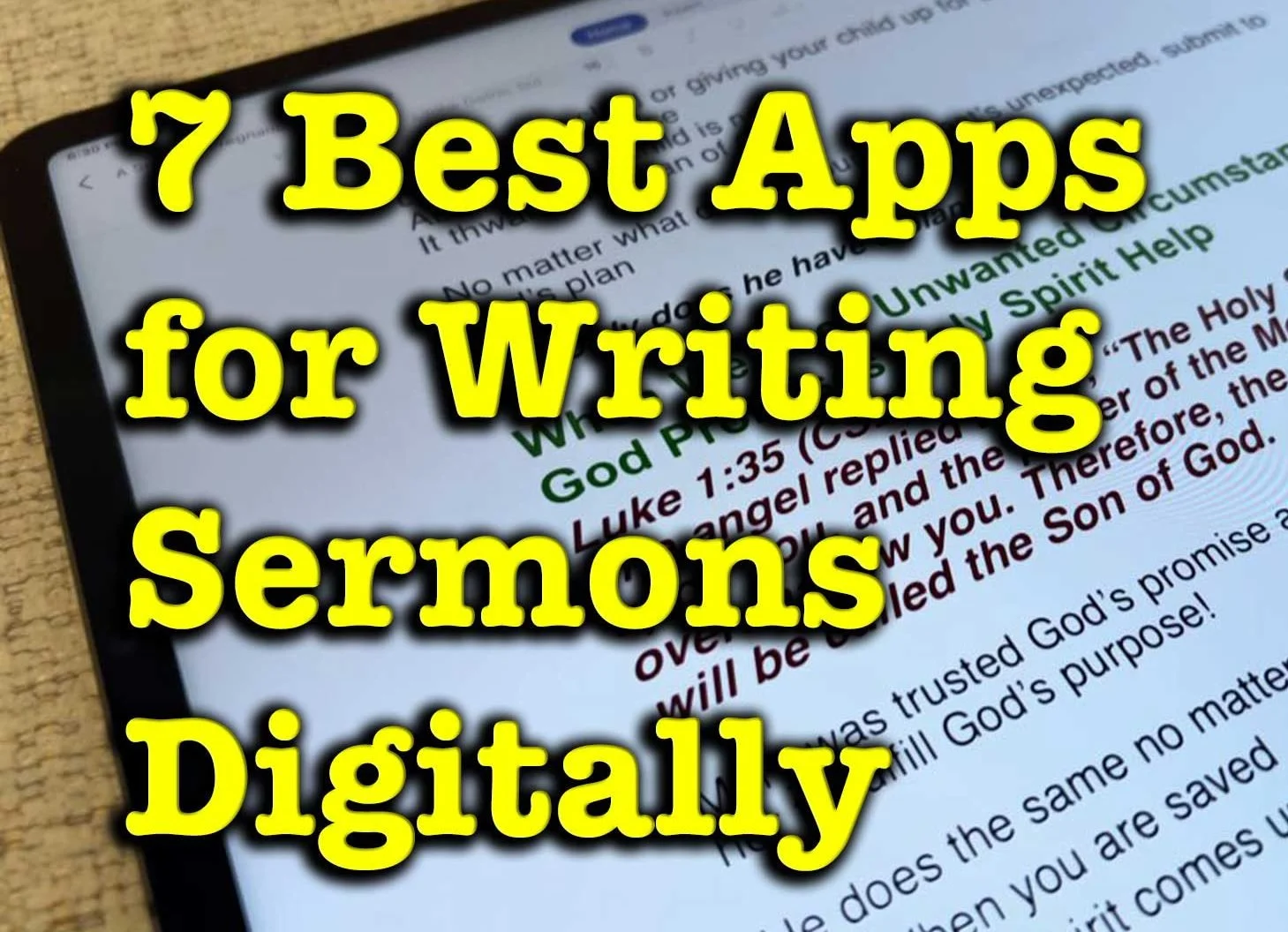
7 Best Apps for Writing Sermons Digitally
What are the best apps for writing sermons? We have a bunch of options in 7 categories for sermon writing tools.
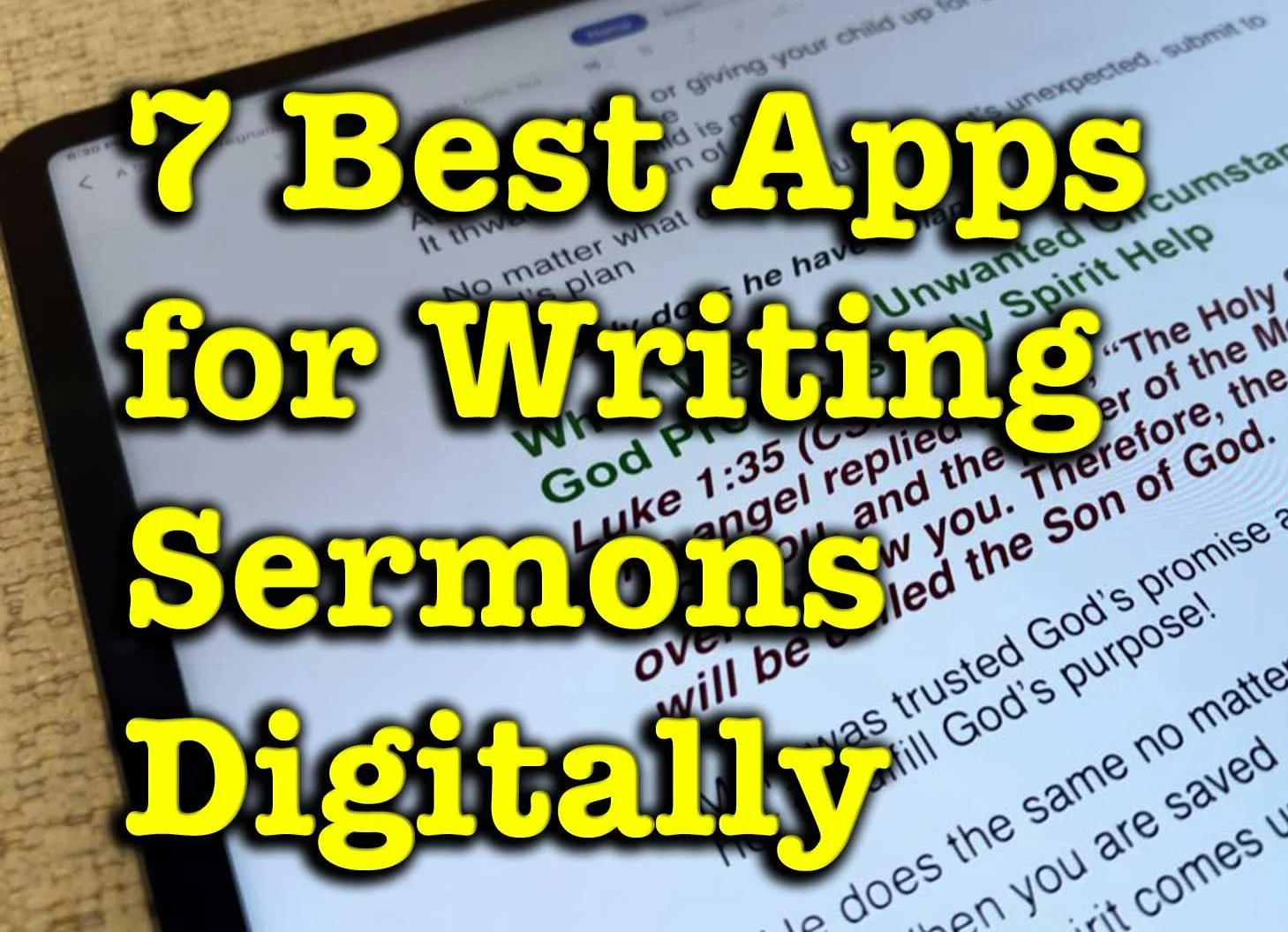
What tools do you use to write your sermons digitally? We've got the best apps for writing sermons digitally and we'll explain why each works great and recommend the best single option.
Most of us no longer write out sermons by hand or type them on an old-fashioned typewriter. We write in Bible study software, a word processor, a notepad app, a note program, or some other software.
Microsoft Word or Another Word Processor are Some of the Best Apps for Writing Sermons Digitally
The granddaddy of word processors comes from Microsoft. Most people who use a word processor write with Microsoft Word. Other options include a form of the open-source OpenOffice, like Libre Office Writer. OpenOffice is the foundation for Libre Office. It's a great tool if you use Linus or want a powerful tool that you can get for free.

and then open the notes on an iPad or Android tablet to preach from them.
If you write your sermons with one of these powerful word processors, you will likely come up with your sermon outline, copy and paste text from a Bible program or the Internet, and formate it for preaching.
When I write in Microsoft Word, I format the document with large text for each major sermon division (read points). Each sermon has large green text so I can see it in the pulpit easily as I preach with my sermon notes open. Bible quotes use large bright red text and standard quotes from people or commentaries use large purple text.
The sermon syncs to my iPad using OneDrive and I open it in Word. The iPad sits on my podium so I can look down and check my notes as I preach through the sermon.
This works with an Android tablet or a Windows computer like a Microsoft Surface tablet.

If you're all in using Apple Hardware and software, go with Apple Pages and iCloud sync. It works well even if Pages doesn't come with all the powerful features of Word or one of these open-source word processors.
Android and Chromebook users can take advantage of Google Docs and Drive.
Remember that Microsoft Word costs at least $6.99/month for the basic Microsoft 365 subscription. You can often find deals online on eBay or Amazon, but be careful that you're buying from a reputable buyer.
Bible Study Software Sermon Writing Tools

Open the Sermon Builder to create one sermon.
Logos 9 includes a useful Sermon Manager to create your sermon preaching calendar for weeks to years out in advance. Then, you open a single document with a tool called the Sermon Builder. This was a huge part of the Logos 9 upgrade. They worked to overall the sermon writing and organizing features to make it more usable.
Logos 9 users will love the way the built-in Sermon Builder syncs with their Proclaim worship presentation software. If you use it in your church, then you can create sermons in Logos 9 and it will sync to Presentation for the date the preacher is scheduled to preach that sermon.

Using Logos and Proclaim together lets the preacher publish his sermon online in text mode. Plus the church can record both audio and video to publish podcasts or worship service videos.
Accordance Bible Software also lets users write inside the software. The Papers option works best. The video below shows how to create and edit Papers in Accordance 12 and later.
You could also use things like Notes files and most Bible study apps. But the above two options work best for creating sermons that you can store inside the program and search later to reuse part or all of the sermon.
The cost of Bible software varies wildly depending on which vendor you buy from, what package of tools you purchase, and whether it's on sale.
To get Logos 9 10% off, I'd appreciate you using my affiliate link at www.logos.com/KevinPurcell where you can buy a package and get a few free books too. I get a commission which helps me do my work here on this site and on my YouTube channel.
Tools like Olive Tree and Laridian PocketBible are free to cheap to get the basic app.
Note Apps Built Into Your Operating System are Useful Apps for Writing Sermons Digitally
As I said above, you could just write plant text or simply formatted text in a Note attached to a passage inside your Bible study program. If you use something Like Olive Tree or PocketBible, this might offer the best option.

Writing in a note gives you a simpler option when compared to complex word processors or advanced Bible software with a Sermon Builder or Paper feature like Logos or Accordance mentioned above.
Notability or Other iOS Apps for Writing Sermons by Hand
For users on iOS and Mac, try out the great note-taking apps like Notability on iPad and macOS. You can write using your handwriting, or typing. When you're finished you can export the results as a PDF or image file.
There's a segment of users who enjoy mind mapping their sermons. I'm not one but I've read about them. People like this will organize their sermon notes by putting the major subject in the center of the screen in a circle or box. Then they will draw lines away from the center to another shape for each major sermon division or point. Under each or around each they show their explanation, proof, and application for each main sub idea in the sermon. Add an introduction and conclusion and you've got a visual method of displaying the sermon.

Above you'll see a visual form of those from my friend Antoine Wright who visited my church and did what he called a "Sketch Note" of my sermon that day. You could do something like this for your sermon notes. If you're not artistically inclined like Antoine, then you can use text or print instead of images.
You could use other note-taking apps like Apple Notes, Good Notes, and more.
Samsung Notes or Other Apps for Writing Sermons by Hand on Galaxy Android Devices
Another option for Android and Samsung users is Samsung Notes. It's built into Samsung's version of Android. I like using it because it's simple and easy to learn. However, it has fewer features than Notability. If you could use. Notability on an Android device I would.
Use Samsung Notes to create notes with handwriting or type using a keyboard. The strategy is the same as it is for iOS handwriting apps.
Sermonary for Online Sermon Writing the Best of Online Apps for Writing Sermons Digitally
A final option includes a website that lets you write online called Sermonary. Here's how it works. Create a new sermon and then add your sermon elements. Add sermon divisions or points. Then create subpoints for the explanation, proof, and application.

Sermonary includes Templates for different styles of sermons. You can use...
- 3 Point Sermons
- Andy Stanley's ME-WE-GOD-YOU-ME format
- Running commentary format
- Defender's Outline for an apologetics sermon
- Children's Leader
- Youth Pastor

The service adds resources to help you preach the word including some visuals, sermon series ideas, and more.
Sermonary costs nothing for the basic editor. Add more features and you'll pay $19/month or $69/month for a bundle with Sermonary and Ministry Pass. That adds sermon series ideas, visuals for presentations, holiday sermons, plus sermon illustrations.
In addition to Sermonary, instead, you could use any online writing tools like...
- Google Docs
- Word Online
- Grammarly
Text-based Writing Tools with Markup to Write Sermons in Plain Text

Some people prefer simple text editors. Almost every computer or mobile device includes a text-based writing app like Notepad on Windows, Apple Text Edit on macOS, and Apple Notes on iOS, iPadOS, or macOS.

If you're an Android user, you might find a good text editor, but sometimes you need to download one from the Google Play Store. Consider Writer Plus a great Android text editor available on both iOS and Android. Use it as a basic text editor or add markdown to format your text. The app is free with the option to donate via in-app purchase.
Recommendation for Writing Sermons
If you have access to Microsoft Word, then go with it. It's cross-platform meaning you can move from iOS to Android to Windows to Mac and back. Second, it's not tied to one Bible study program. The death of Bibleworks and Wordsearch recently proves we should move carefully deeper into one platform's ecosystem. I like to keep as much as possible separate from my Bible software.

What Do We Mean by Creative Digital Sermon Preparation?
In our series on Creative Digital Sermon Preparation, what do we mean by "creative" or "creativity"? This post answers that part of the equation.

We started this series on Creative Digital Sermon Preparation with an overview and introduction to the series. Now we take another look at the overall idea after hitting step one, prayerfully choosing a text. What do we mean by "Creative Digital Sermon Prep."
See our series on Creative Digital Sermon Preparation!
I assume readers understand what we mean by sermon preparation...
- Choosing a passage under God's direction.
- Studying the text using Inductive Bible study.
- Planning to present the message of that text.

That's sermon preparation. We add the term digital because we use digital tools instead of analog paper books and Bibles. This series covers the process of digital sermon prep using Logos Bible Software. We'll then take a stab at it with Accordance and Olive Tree and maybe some others. If you don't use Logos, what do you use? Comment below.
How do we prepare creatively? And then how do we present the message creatively? Here's what I mean by Creative Digital Sermon Preparation and Preaching.
Creativity Pictured
Young Kevin sat in the auditorium listening to Pastor Bob Stiles preach. He couldn't wait to get out of there and eat lunch. Maybe mom would let them go to the Italian place with the great spaghetti and garlic sticks with butter sauce.

"Everyone take out the Hershey's Kiss our ushers passed out before the service began," Pastor Stiles directed. Kevin already ate his. Mom looked at him, wondering where Kevin put his. Kevin looked up at her and smiled as innocently as he could.
"Why did that old man want me to eat a Hershey's Kiss? They're pretty good."
He enjoyed his 25 minutes earlier. Now he wished he had another.
"They say 'Big Things Come in Small Packages.' Remember that the next time you eat a Hershey's Kiss or any other small piece of chocolate candy," the pastor said, unwrapping a Kiss. "The tongue is tiny but can deliver a ton of pain when we say unkind words meant to stab at the heart of a loved one."
Just then, a video played on the screen showing a man building a fire while a narrator read the passage from James 3:1-12.
So too, though the tongue is a small part of the body, it boasts great things. Consider how a small fire sets ablaze a large forest.
(James 3:5, CSB)
For the first time, little Kevin paid attention to the sermon, at least during the sermon.

A few days later, Kevin and his Uncle Mike stood in line at the CVS, waiting to pay for some medicine Uncle Mike needed for his bad back. Kevin looked at him, wondering, "Will he say, 'Yes?'" He did, and Kevin grabbed a small bag of 6 Hershey's Kisses from the rack below the checkout counter.

He wanted Hershey's Kisses after the pastor mentioned them in church Sunday. After Uncle Mike paid, Kevin tore into the bag, unwrapped his first Kiss, and gobbled it up like a starving vagrant.
"Get your fat little brat out of the way," a heavyset older woman yelled at Kevin's Uncle. Did she mean him? He never really considered himself fat, but he was plump. The pain of her words pierced his heart.
Creative Digital Sermon Preparation in Biblical Hermeneutics
As we preach, the creative elements of the sermon make them memorable. In the fictitious example above, a sermon on James 3 grabbed little Kevin's mind. Days later, when he experienced what the pastor exemplified by his candy analogy, it meant more to Kevin. He learned thanks to Pastor Stiles's small object lesson on the potency of the tongue. Candy grabs a boy's attention more than eloquent speech.
A motion video of words from a Bible verse with sound instead of accenting the words grab attention more powerfully than reading the text from a paper Bible. A multi-sensory experience where the audience hears the message, sees the message, feels the massage, and even tastes the message, will tattoo itself to the heart more indelibly than a traditional spoken word.
Creativity in sermon preparation and delivery empowers the message as nothing else can. That's why we want to creatively study the word, looking for the multi-sensory aspects of the text, and take note of those examples so we can creatively reproduce them for our audiences.
Examples of Creative Digital Sermon Preparation for Communicating the the Bible
The Bible is rife with creativity and objects lessons. The Eden tree served as an object lesson of boundaries, commitment, and the temptation of Adam and Even. The flood taught Noah a lesson through an experience of all the senses as no sermon could. God used a dove to illustrate a message of waiting on God to act. The rich sensory experience of sacrifice stamped the idea of atonement on the Israelites' hearts as they smelled, heard, felt, saw, and in some cases tasted that atoning sacrifice.

The Lord's Supper and Baptism are two of the most important worship rituals of the church. We experience them a rich multi-sensory experience that we will unlikely never forget. Who can't remember their own baptism as the water poured over the face and then dripped off a robe or t-shirt and shorts? We taste a tiny cup of juice or wine, depending on our traditions.
Baptism and the Lord's Supper were commanded by Christ for many reasons. I believe that he commanded us to do them in part as a means of indelibly stamping the truth on our hearts reinforced by the sense of taste, touch, smell, site, and hearing.
Find the Sensory Signals in Scripture and Communicate Using Senses
Expository preachers argue that we communicate the Scriptures' messages by letting the message of God's word direct our words as we preach. We don't bring our opinions into the Big Idea of the text. We let the words in the passage direct our main points and message.

I usually preach expository sermons. So, I support the idea of letting the text speak. However, I think we miss another way that the text should direct our message. Let the tone, sensory imagery, creativity, and word-picture of the text direct our presentation methods. A convicting message from a text will contain a more prophetic tone as we preach. A lighthearted story filled with humor should also contain humor. When a Psalm uses strong sensory images, the sermons should grab hold of those same or similar sensory images.
Spotting the art in Scripture becomes part of our preparation while we study a passage. Learn the Big Idea of a text and learn how the Bible communicates the Big Ideas by tickling our five senses.
6 Best Online Bible Study Sites in 2020 - Part One
With Wordsearch about to bite the dust, we lose one of the best online Bible study sites probably by the end of 2020 or early in 2021. So, that means we need to reexamine the online platform for studying God's word.
Five years ago I wrote, "Bible study's going online, not entirely, but increasingly so." Today online bible study is more mainstream, but still not the primary way most people study their Bibles. However, it's better than ever in 2020.
So here's the first 3 of my 6 best online Bible study sites that you can use on a Chromebook, a tablet, or even a smartphone. Fire up any web browser and study your Bible. You'll find that you might not need to run one of the complicated Bible study suites that you install on a Mac or Windows computer.
Why Use Online Bible Study Sites?

With limited storage these computers can't handle huge libraries from the complex Bible study programs like Logos, Accordance or Olive Tree to name some of the most popular.
BibleStudyTools.com

We first look at BibleStudyTools.com. What makes this a viable option for intermediate level Bible study software? Users can search the Bible, read it, track daily Bible reading plans and share scripture via copy/paste or links to post to popular social media outlets. Almost every online Bible can do those things. Here's what this site offers in addition to the basics.
Bible Study Tools adds some public domain tools like ...
- Commentaries
- Dictionaries
- The International Standard Bible Encyclopedia
- Old and New Testament Greek Lexicons
- Classic sermons from past scholars and preachers

The site includes a number of modern and public domain Bible translations. The list of Bibles includes...
- ASV
- CEB
- Douay-Rheims Catholic Bible
- ESV
- God's Word
- Good News
- CSB
- Jubile Bible 2000
- KJV
- Lexham English Bible
- NASB
- NIV
- NKJV
- NLT
- NRSV
- RSV
- The Message
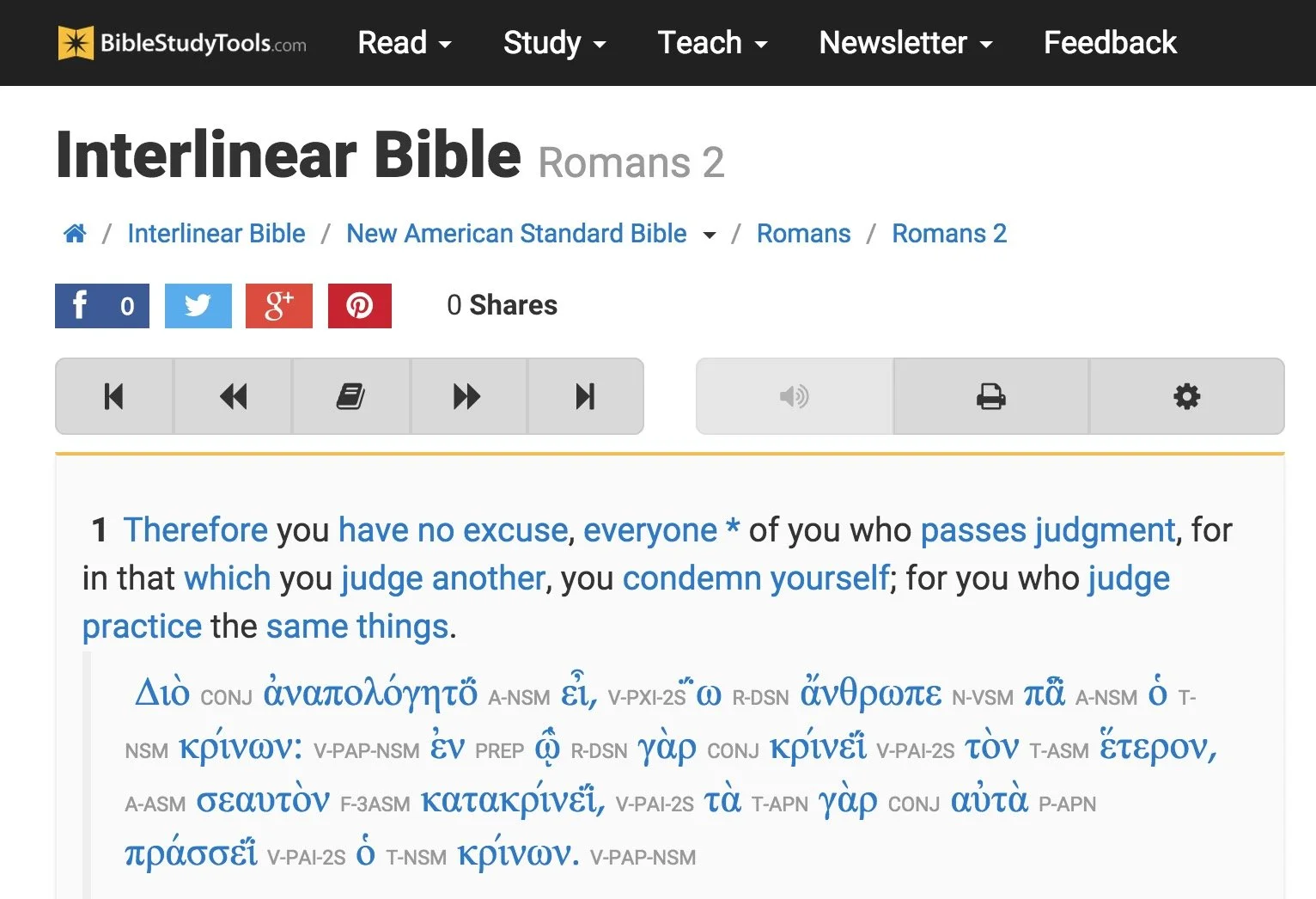
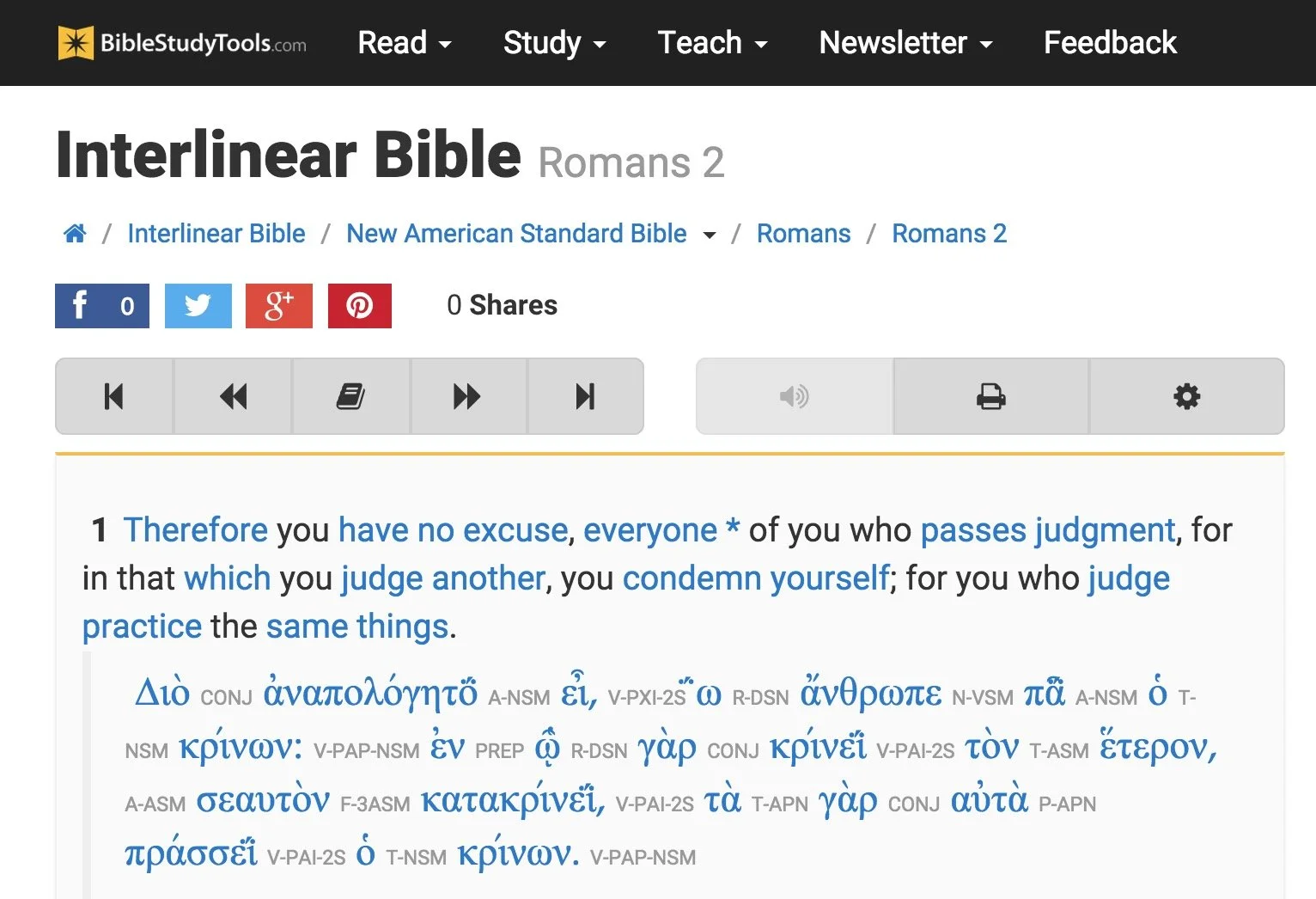
There's also some limited original language study. You can use an Interlinear Bible for languages study.
The site will collect user notes and highlights for those who sign up for a free account. The Bible student can mark up their Bibles and save their study findings for future reference.

While the site doesn't offer as many modern reference tools, a user with simple needs can get a lot done. Read a text, highlight it and write observations in a note attached to a verse. Then open the interlinear Bibles based on the KJV and NASB to do some original language study. Search the text for some cross references related to the topics in the passage. This gives any Bible student a good start in understanding their passage.
The Interlinear Hebrew text comes from Biblia Hebraica Stuttgartensia from United Bible Societies. The Greek text comes from Center For Computer Analysis of Texts, University of Pennsylvania based on Nestle Aland 26.
Here's a demo of the old 2015 site. Look for an updated video soon.
After these early steps, open some commentaries, dictionaries or the ISBE and learn more about the passage and what others said years ago. Record those findings in the notes. Then find the passage's Big Idea and come up with an outline using an online word processor like Google Docs or Office 365's version of Word online.
If I had to compare the site to a piece of Bible software, I'd say it can do almost as much as e-Sword with a few modern translations added to it.
Bible Hub

The next of these six best online Bible study websites comes from Online Parallel Bible Project in the form of BibleHub.com. The interface looks a little cluttered, but it's still a useful site with plenty of resources. In fact, it's a deceptively useful tool.
Enter a Bible reference in the top search box and the site opens the verse in all the translations and commentaries available in the left column. Along the right column we find some helpful tools like the context of the passage, cross references and Treasury of Scripture Knowledge.
Here's a demo of the old 2015 site. Look for an updated video soon.
Across the top of the site there's a toolbar that helps people navigate to specific passages in any of the supported translations. The site includes a large collection of modern and public domain translations. The toolbar also includes some public domain commentaries. Access them through drop down lists.
The toolbar buttons put many of the tools a click away. We get a parallel Bible button, cross references and a context button that shows the single verse within the pericope. In addition there's links to a few specific commentaries and more.
Like the other sites, Bible Hub lets me share to Facebook, Twitter and Google+. It includes some nice pictures, maps and outlines.
Biblia

Logos Bible Software users will want to go first to Biblia.com. The site offers a simplified version of what the company offers their customers in their Logos 9 Webapp. You'll need to own one of their expensive software packages or subscribe to Faithlife Connect to access the webapp. You can also check it out because it's very powerful for an online site. We'll look at it in part two of this article.
Biblia gives users access to their Logos Bible Software library online and a selection of tools and features even if you just sign up for a free account. You'll want to pay to really make good use of Biblia. And in that case you'd do better to use the Logos 9 Webapp. However, mobile users may like Biblia since it has a very nice Mobile version of the site.
Here's a demo of the old 2015 site. Look for an updated video soon.
The left hand column includes four tabs with the following features:
- Home - Shows reading plans and the About Biblia list of links.
- Library - List of books available to a user whether they pay for the suite of Faithlife Bible tools, subscribe to Faithlife Connect or sign up for a free account.
- Search - Search one book or other books in the library.
- Notes - Shows notes on a particular verse or book passage from the Faithflife.com community, but not a Logos Bile Software user's notes created in the computer program or mobile apps. You also have to sign into even see this tab.
The main part of the Biblia screen includes two window pane. The user can open books in either side. For example, open a Bible in the center column and a commentary on the right. The two will sync up to the same verse when a user turns the feature on using instructions explained below.
Use a mouse wheel or swipe on a laptop trackpad to scroll through the Bible from Genesis 1:1 all the way to the end of Revelations 22.

Click on the menu button (three dots) in the upper right corner of the window pane to show view settings. The user can do the following:
- Change the font size
- Sync the two panes
- Open the book's table of contents
- Change the reading view from column, stretched across both pans or full-screen reading view
- Toggle the community notes from other Faithlife users (but not personal notes from the computer or mobile apps_
The sharing tool will let you post to Twitter or Facebook, get a link to the verse on Biblia.com to post online or email, and an embed code to post to a website. See image below.

Here's part two of this roundup of the 6 best online Bible study sites.
How Use Logos Important Passages Guide to Create Sermon Series
How can preachers us the Important Passages Guide in Logos 8 to help them craft exciting sermon series on a given topic in the Bible? We'll show you how.
Would you like to preach a sermon series on a topic in the Bible but also want to preach expositorially? You can use Logos Bible Software and the Important Passages Guide to select passages to study and preach for a sermon series on a topic. Each sermon will cover one passage, but the series serves as a topical sermon series instead of preaching through a book of the Bible as many Expository preachers prefer.

I was going over the new features in Logos 8 recently and forgot about the Important Passages Guide. As I looked over this new tool in Logos 8, it hit me - this would work great for picking passages to study and preach while crafting a sermon series on a particular topic.
Most expository preachers like to preach through books of the Bible. I am one of those. But I also like to choose passages that cover a topic and then study the passage covering that topic to preach expository messages on them. We'll show you how to put together a sermon series on passages found using the Important Passages Guide in Logos 8.
What is the Important Passages Guide in Logos?

Logos added the Important Passages Guide when it released Logos 8 back in 2018. Users will see it from the Guides Menu on the Logos toolbar. Find it quickly by typing in the Guides search box the first part of the guide's name "Important" and it will show up as the first item in the Bible Reference Guides section. You can also scroll down to the Bible Reference Guides section.

When it opens, it looks totally blank. Type a passage into the box at the top of the new window like John 3:16. It will search the index and find passages related to the topics in that verse.

After searching for a passage, you'll see the results that will like the image above. You see a few things.
- The top line says "References of All Types To all passage" - these help you choose what will show up in the list of passages. Click on All Types to change the types of passages. Click on To to change whether the passages will go out from the selections below or to the selections below. More on these options below.
- The Add menu lets users add types of datasets. Click it to see what you can add.
- Under each passage you see hyperlinks to various kinds of content found in Logos. These links will open the Factbook. For example, the above image shows the Factbook entry for God: Love. You'll see other kinds of links.
- The links at the bottom of the window will...
- Show more passages found
- Save the list as a Passage List
- Open all of the found passages in your top Bible translation
The To and From links in part 1 above will change the list of passages as follows:
- To - To finds cross references from other passages that link to your passage. So if a passage links to John 3:16 it will show up in this list.
- From - All cross references in your various translations that go out from John 3:16 will show up when you select From.
How to Use The Important Passages Guide to Choose Sermon Topics
I often read a passage in my quite time or while I'm listening to another Bible teacher or preacher and think, "That passage make a great sermon." Then as I look at the passage it leads me to look up others and inspires me to preach a series of 3-6 sermons or more on that topic.
You can quickly find a lot of passages from the Important Passages Guide by entering the verse that inspired you into the search box of the guide. Then read through the resulting searches.
Take this a step further by adding various kinds of datasets. Click on the Add button and choose something like Topics. This gives you more passages from that dataset. A dataset refers to sets of information that Logos organized around that kind of info. In this case, they collected the Topics together into the Topics dataset.
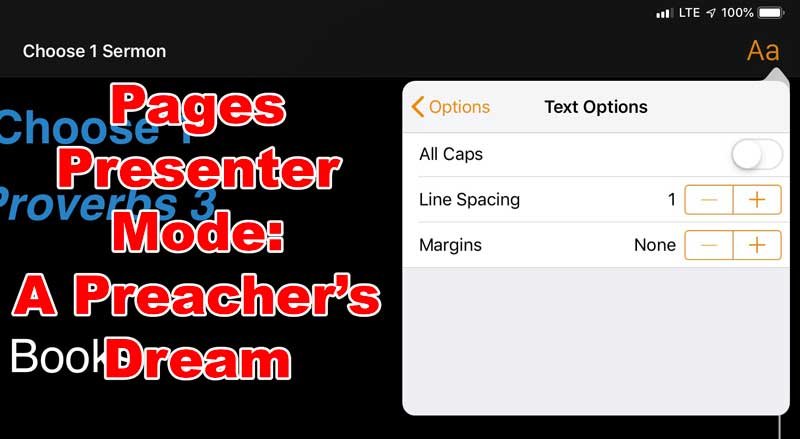
Apple-Pages Presenter Mode for Preaching is Awesome
Apple Pages Presenter Mode works great for teaching and preaching. Here's how to set it up.
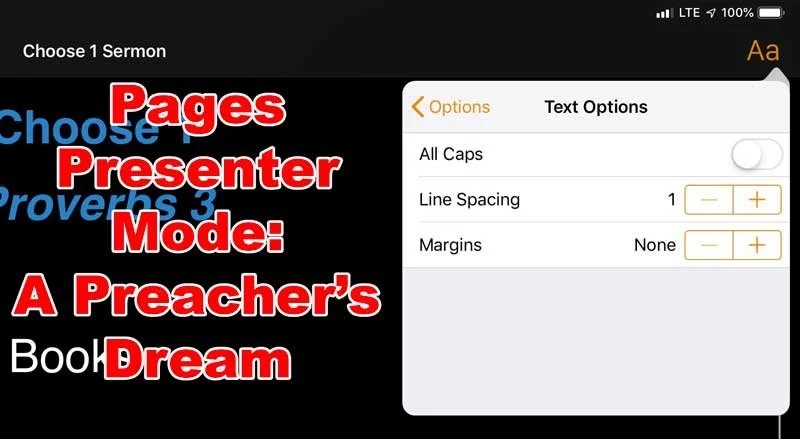
I recently discovered the Pages Presenter Mode in Apple's iWork app for the iPad. It's awesome! So, here's how to turn on it on on your iPad so you can use it every time you teach or preach from your iPad.
The Pages Presenter Mode changes the way your document looks in Pages. You can use it on both iPhone and iPad. However, it works great on an iPad. The look of the document changes depending not he settings you choose in the mode.
Turn on Pages Presenter Mode

Turning on Pages Presenter Mode is easy. Open your document in Pages on our iPad or iPhone. In the upper right corner you'll see the menu button. It looks like three dots. It shows the Pages menu, which includes a slew of options. In the third section of the menu you'll see the Presenter Mode menu option. Tap it to turn it on.
The look of your Pages document changes. By default it gives the user a black background with text white, unless you've given it a different color in your formatting. So, red text stays red or yellow text stays yellow. But the black text turns white.
If you like the way the text and formatting looks and don't want the text to scroll automatically, then you're done. Just scroll through your text while you preach as you might if you preached from the Pages document.
Pages Presenter Mode Settings

Preachers or teachers that want to change the look of Pages Presenter Mode can tap on the Aa icon in the upper right corner of the screen. A menu pops up with six options as follows:
- Text size (smaller to larger)
- Background color (white, gold, dark gray, black)
- Font face - tap to show the available font faces that work in Presenter Mode
- Text Options
- Auto Scroll
- Scroll speed (slower to faster)

The Text Options item includes three settings. You can change the text to All Caps, if you think that's easier to read. Traditional prompters use all capital letters, so those used to this in traditional teleprompters. There's also an option to change the Line Spacing. I prefer to use single Line Spacing, but some want wider Line Spacing. Finally, you can change the Margins from smaller to larger Margins. Tap the plus or minus icons in the Line Spacing and Margins options.
The Auto Scroll settings will turn on this feature. With it turned on the text will slowly scroll up the screen as you speak. This works great for people who read their text as they speak. I don't believe preachers or teachers should preach that way. It's difficult for listens to pay attention to a preacher reading text unless the preacher possesses an extreme level of reading skill. Few do.
When a person turns on Auto Scroll, they can control the spread. The last option has a bar that you can drag from slow to fast. The slow end on the left shows a turtle with a rabbit on the right. That's a fun touch.
My Recommendations
I discovered Pages Presenter Mode only a week ago because Apple highlighted it in the App Store. This past Sunday I used it to preach my Sunday morning sermon and it was fantastic. I love this newly discovered feature in Pages.
Here's how I set up my Presenter Mode settings.
- Black background
- Helvetica font
- All Caps turned off in Text Options
- Line Spacing set and single space in Text Options
- Margins set to 5% on iPhone in Text Options or 10% on iPad, the device I use 95% of the time
- Auto Scroll turned off
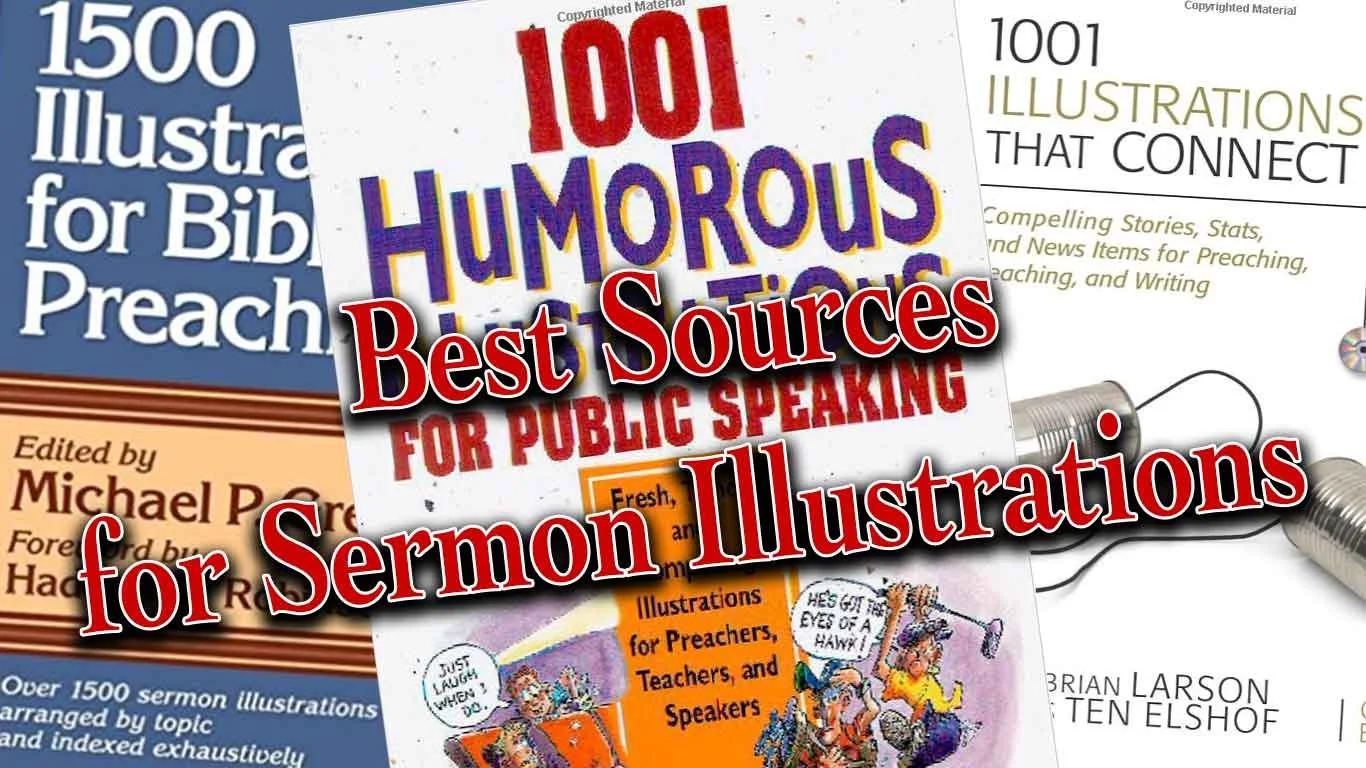
7 Great Sources for Sermon Illustrations
Do you need to find the perfect sermon illustrations to bring life and grab attention for the message for modern-day listeners with limited attention spans? I do and so I seek them from many sources, but a few websites help me find them.In the old days preachers would sometimes find sermon illustrations by consulting books that collected these illustrations by topic and sometimes by scripture reference. These books often suffered from a big problem; they were stale and usually dominated by old missionary stories or quotes of preachers from the 19th century. However, we still bought the books because in Saturday night emergencies we might find something we can use. These illustrations seldom will amaze listens, but they'll get the job done.
Problem with Sermon Illustrations Sites
Today's sermon illustrations databases suffer the same problem as those old illustration books. They can get stale and don't always show us the most interesting or exciting stories or quotes. There's good news because website publishers can update them. Some will also ask users to give their own sites. A few of these offer an incentive, like paying them or giving them access to the site at reduced or free rate.Aside from poor content, users struggle to search the database effectively. Google has billions of dollars to throw at improving their search features, yet they still fail more than succeed in delivering quality results on page one. It's no wonder that even the best funded sermon illustrations websites still struggle to produce useful search results.In spite of the weaknesses of these sites dedicated to sermon illustrations, we'll look at the best sites for finding good sermon illustrations. Not all of them will be these dedicated illustration database sites.
Preaching Today
 My favorite website for finding sermon illustrations comes from Christianity Today. PreachingToday.com gives preachers more than a database of sermon illustrations. It includes...
- Sermon Illustrations - database searchable by keyword, scripture passage and general search. It shows passages that it might fit and topics for preaching. Some even include links to photos that the preacher can display as part of a sermon presentation. If it refers to a movie scene it gives the scene time code (when it occurs in the movie).
- Sermons - database of sermons also searchable the same way the user can search illustrations database with both outlines, sermon series and full text sermons. Search by text, theme, or key word.
- Skill Builders - tips and articles for improving the preaching craft. This can include creative ideas for preaching, tips on how to preach better and more.
- Holidays - section devoted to both holidays and events of the church year like baptism, funerals, etc. that groups all the content available (Illustrations, sermons, videos, and images) by holiday or church event.
- Videos - videos that churches can use in their church if they do presentations.
Preaching Today doesn't come free. Get one year for $69.95 for two for $119.95. You can get some things for free, but not a lot. I pay for a subscription gladly because I have found plenty of fresh and interesting illustrations. Here are the site's strengths:
- Fresh illustrations
- Narrow the search by things like...
- Kind of illustration - the source, audience, type (humor, quote, stats, stories, et. al.)
- Word or Phrase v. Keyword - search the text of the illustrations for the word grace or find all illustrations about keyword grace even if it doesn't include the word grace itself.
- Searching for illustration also searches the other areas (sermons, videos, and more) and shows them in tabs at the top fo the page.
- If you use an illustration you can record this and it will remember that you did so you don't reuse them repeatedly.
Now for the cons:
- Sometimes a search returns illustrations that doesn't really seem to relate to your topic, keyword or passage even though they claim to.
- The cost of the site will keep some from using it.
I often find a true story on Preaching Today and then I'll do a Google search of the story, especially if it's a news story. Then I can fill in details and rewrite the illustration to better fit my preaching idea. I can also find media that fits to display during my sermon. Of course obey all copyright laws.
Google News
As I said above, I'll often find a good news story in a sermon illustrations from Preaching Today, but I need more information. I'll head over to Google and do a search. When. the main page shows few valuable results, then I click on the News tab and often find more pertinent information.Google News will let me find current events to illustrate my preaching idea. This gives the sermon fresh content and they'll come alive in listeners' minds. That's what makes Google News such a valuable tool and it's free. In the example above (see image) I searched for the term "redemption". We get some dictionary definitions and then link to the Internet Movie Database description of the movie titled Redemption. Down the page (not seen above) the results offered very little useful content. I can keep clicking for the next page of results or I can click on the News tab (see the middle tab in image above) and it shows stories about redemption.The second result took me to a NASDAQ news article about redemption of "senior notes". Reading the article helps me think the term redemption as a financial concept, which sparks ideas about relatable sermon illustrations. People might not understand the concept of this article since it covers complex economic issues. However, it serves to spark thoughts about more relatable ideas like covering debt to "redeem" someone's property that might be in foreclosure. I have a friend and family member who went through this. I can relate to it, so many of the people in my audience probably will too.
WingClips
Movies dominate culture, especially very popular blockbusters. They often include interesting scenes that we can use to illustrate our sermon ideas. WingClips partners with the movie studios to let users show these clips without breaking copyright laws. Along the left hand column you'll notice the themes they cover and it shows the number of clips on that theme. You can also search for clips by keyword, movie title, category (meaning film genre like action adventure or animated) and scripture reference. The scripture reference doesn't always work. I'm preaching through Ezekiel so I clicked on Ezekiel 7:25-26 since I'll soon preach that text. WingClips had a link for that passage but showed no results. Stick with the themes. I searched for redemption and came up with a number of useful clips from movies like Les Miserables, The Mummy and Courageous.Most of the clips come in HD and show user ratings (5-star scale) along with written reviews. Preview the clip and see other clips from the same movie on a clip page.WingClips offers some free illustrations and a free subscription. However, to really get the most out of the site, you'll have to either subscribe or pay for clips. They offer subscriptions either monthly or annually. See the image below for costs.
  Monthly subscription prices are as follows:
- $10/month for one clip a month.
- $16/month for 2 clips a month.
- $29/month for 4 clips a month.
If you prefer to save money and will pay annually the cost as follows:
- $89/year for 10 clips a year
- $165/year for 20 clips a year
- $299/year for 40 clips ay ear
If you prefer, you can buy clips one at a time without a subscription. They cost...
- $15 for one clip
- $25 for 2 clips
- $48 for 4 clips
- $219 for 20 clips
Compare paying monthly, annually to buying clips as needed and you'll see that you save some money by subscribing annually. I'd suggest starting out by subscribing to the 10 clips/year and then buy more clips as you need them. If you find you're using more you can upgrade to the 20 or 40 clips per year at any time.
Pixabay
 Frederick R. Barnard once said, "A picture paints a thousand words." Pictures can say quickly what we want to express in our sermons. Here's how I use them in my preaching.
- To illustrate main points - I create a slide with a picture that illustrates the concept of my preaching point. I may never even reference the photo if it obviously says what I want to say (see image above).
- Represent a Sermon Illustration - If I'm sharing a quote, I'll put a photo of the person on the screen with the quote or with a key phrase from the quote. If I'm telling a story about a guy in a fishing boat, then I'll find a photo of a fishing boat to display as I tell the story.
- Comics - these are good ways to share a joke. Just let the people read it. I'm not a great joke teller. Off-the-cuff humor is my thing. So comics are sometimes more powerful than telling a joke. I use this primarily at the beginning of a sermon. I tell the person running my presentation to put the joke up while I'm praying before my sermon. Then I just turn and look at it as I give the audience a chance to read it or look at it. Then I will turn back to the crowd and start preaching, often referring to the joke in the comic.
- Backgrounds to my sermon Bible text - put an image behind a verse that represents what that verse says.
Those are a few ways I use images. I include from 10 to 30 slides in most sermons. I get most of these images from a site called Pixabay, which gives users free images they can download and use under the Creative Commons license agreement. Creative Commons means you can reuse it so long as you give the original creator of the photo credit. Users can search Pixabay's free database of images. Users add to the database and then other users can download the images and use them in their work. The site's free to use. If you're a skilled photographer or artist please consider adding to the site.
 I searched for redemption as I have on the other sites. It showed the above results, including some "adult content" meaning some of the photos show nudes. By default Pixabay blacks out such content and you have to click them to see them. I just ignore them. When the images on the site don't match what I'm looking for, I will either search using a different synonymous term or I'll use the sponsored links to Shutterstock that show up at the top of the page (see below)
 When I find an image I like, then I'll save it and put it in my presentation software. We use MediaShout. I'll usually put something like "Used by permission from Pixabay.com USERNAME - by Creative Commons". If I need to add text for a quote or for my sermon points, then I'll add the attribution on Photoshop or Affinity Photo on my iPad.
freesound
To add some spice to sermon illustrations, my friend Wes Allen who's part of the Theotek Podcast team, uses sound. For example, he said that he was once talking about a criminal investigation and so he used the Law Oder TV show sound. In another instance he was talking about the great cloud of witnesses from Hebrews and used a crowd roar to illustrate it audibly (listen below). I've used sound in this way maybe 2 or 3 times in my life. But it sounds like an interesting tool and church presentation tools like MediaShout can play sound easily.Wes uses freesound as his preferred place to find audio clips. It has a large database of free sound clips. Like Pixabay, it requires attribution since it's a Creative Commons license. Just create an account, sign in and search. Download the audio clip of your choice and play it with an image displayed. On the image show something like this...
Image sed by permission from Pixabay.com USERNAME; Sound used by permission from freesound.org USERNAME - by Creative Commons.
Here's a crowd cheer from freesound user Veridiansunrise; used by permission by Creative Commons. If I used this for a sermon, I'd cut it down since it's pretty long.
Bible Software Illustration Databases
Most of the better Bible software programs include sermon illustrations or let you buy databases of them. For example, Rick Mansfield from Accordance uses his collection in Accordance Bible Software. Rick uses the Research Search function of Accordance. He said:
I run a research search through this group I’ve made according to the subject I’m looking for.
Here's a video where Rick demonstrates how he does this in Accordance.Logos and WORDsearch also offer similar features, so check your Bible software to see if it includes these kinds of tools. If the program doesn't have illustration databases or you don't own any, search your general library for a topic. For example, search redemption in books other than the Bible, commentaries and dictionaries. You will probably find devotional books, Christian Living books and more that cover that topic with stories by the authors.
Personal Experience
You can always access the most important source for sermon illustrations - your personal experience. Wayne McDill offers a great tool for brainstorming sermon illustrations in his book 12 Essential Skills for Great Preaching. Here's how it works.
- Write down your theological idea, such as: Jesus redeemed us by his blood.
- Convert that idea to a non-theological idea: someone acts to free us from our own mistakes through a personal sacrifice.
- Now think of how that might happen in various areas of life, like...
- Family
- Politics
- Sports
- Neighborhoods
- Schools
- Work
- Church
- History
- Current Events
- Now pick two or three that you think you can relate to and your audience can relate to and write out a story to illustrate the idea of personal sacrifice to free someone from their mistakes.
 Here's an example from my personal history.
At Christmas my mom would always make Christmas sugar cookies and my three sisters and I got to help decorate them. One of the favorite decorations were the chocolate Jimmies, little chocolate slivers that to be honest looked like rabbit droppings. However, they tasted great so we often ate them before they made it to the cookies.One year, when I was very young, my mom got home from somewhere and discovered that someone at all the chocolate Jimmies. She was not happy because she made us all promise we would stay away from the sugar cookie decorations while she was out.Nobody admitted their guilt so she sent us all to our rooms. I hated being sent to my room, because like most kids in the seventies, I wanted to play outside. After about an hour I decided that I didn't want to spend another minute in my room, so I worked up some fake tears and then walked down the hall looking as repentant as I could. I found my mom in the kitchen and told her, "I'm sorry. I at the chocolate Jimmies."She was so moved by my performance that she forgave my theft and commuted her intended sentence of grounding the guilty party the rest of the week. I got to go outside.There was one problem. I didn't eat the Chocolate Jimmies. For years, my mom kept telling the story of how sweet I was that day. I never admitted to my deception until I was grown and married. During a Christmas gathering of the family, the story came up. It was then that I admitted to my lie.By then my mom didn't hold that against me. However, none of my three sisters would admit they did it. Either they were liars or more likely forgot. But what I'll never forget is how much my mom chose to forgive me on that day and years earlier. It thought I was really doing something great by admitting to something I didn't do. I thought I was being sacrificial to end this house arrest. But I wasn't the real hero, my mom chose to forgive me not once, but twice.Jesus in his grace will forgive us not just one or twice, but anytime we confess our sins and repent. He's always faithful to forgive us because he also took the blame for something he didn't do. He didn't do it selfishly, l like me. He did it selflessly to redeem me from my prison of sin and hell.
Logos Bible Software Sermon Prep Part Three: Concordance Tool
We've already looked twice at the topic of choosing a text, but let me take a third swing at a tool that you should consider using for Logos Bible Software Sermon Prep. We'll take a look at the Concordance Tool in this third part of the series. I began looking at picking topics and picking passages in parts one and two. Now, how can the Concordance Tool help us in choosing passages to preach or teach.Here's the secret of this powerful tool...
The Concordance Tool Video
My video below shows the basics of the Concordance Tool in Logos 7. https://www.youtube.com/watch?v=asQzvrTeMc4&feature=youtu.be
Benefits of the Concordance Tool in Logos
You may need to put away the old idea of a concordance while still using the principles to figure out what it does. The Concordance Tool, like a traditional Concordance, lists every word in a Bible translation, but here's the cool part of the Logos 7 Concordance Tool. You can change the list based on your own limitations and even use it to create a "concordance" for books other than Bibles. I used to own a hefty NASB Exhaustive Concordance (see above), since that was my favorite translation when I began preaching. I stopped using the huge physical book because Bible software is an exhaustive concordance by itself and its far more convenient than a 5 pound book. So why do we need a tool in Logos or any other program that calls itself a "concordance tool"?First, the Concordance Tool is customizable. I'll show you how to do that below or watch my video demo above.Second, users can create lists of Greek or Hebrew words even in an English Bible if. The tool uses the Strong's tags to do this.Third, you can also index more than just the English words of a Bible translation. It creates lists of other things like lemmas, roots of words, and Biblical entities like people, places and Biblical things. You can even search for references which are tags that link to other books, like a Bible reference in a footnote or in a Concordance or maybe even in a Christian Living book, like something by a popular author.The benefits listed here means the Concordance Tool helps us with picking a passage to preach because we can choose to teach or preach on a particular topic by opening the tool and searching for the most often used words in a book of the Bible. Let's say I want to focus on the idea of redemption, but I don't want to do a topical study of redemption. I want to select a series of passages that focus on the idea or subject of redemption. I could just search for redemption in the Logos search tool. But if I open the Concordance Tool, I can learn one particular author repeatedly discusses redemption.
How to Use the Concordance Tool in Logos
To get started open the Concordance Tool in Logos from the Tools menu. You'll find it in the second column under Reference. Click it to open it. The tool shows the last report generated or runs one if you haven't already used it.
 At the top of the window you'll see the book control drop down that usually shows the cover of the book with a small down arrow to the lower right corner. Click it and you'll see controls like the text size slider, the Find command, print, and the Close command among others.Next to the book control menu you'll see a link that shows the present book or Bible translation (see below). Click that Resource Reference link to change it. The Resource Reference search box shows up with a list of all library resources that you can use to run a Concordance Tool report. You can use a Bible in English or Greek/Hebrew. You can also run a Concordance Tool report on other books like commentaries or books by a single author. This results in an index of all the words in that book, if you do a Word report. More eon that below.
 Let's say you want to work in the NASB 1995 Update. Then, either find the book in the list or type in NASB in the search box and it will show all books with your search string in the title. Click to open the Concordance Tool using the book.
 Next you'll see what to index with the Concordance Tool. Click on the second link over (see above) to create an index. You can create one using one of the following:
- Word - the basic tool that works like a traditional concordance.
- Lemma - finds lemmas instead of words
- Root - finds roots instead of words or lemmas
- Sense - finds senses instead of the above
- Biblical Entity - finds persons, places, things, artifacts or measurements
- Reference - finds reference links
The last link lets the user narrow the search range. For example, in the screen shots here I've run the tool on the NASB 95 Update translation. So, when I click the last link it offers to let me narrow the range from All Passages to just ports of the Bible. You can pick your most recent passage selections or the common ones found in Logos. You can also create a new one by typing in the range at the box below the list labelled New reference range. If you plan to use that range again, give it a name in the Title box below the range box and then click the Save button. It will now show up in the list above the boxes.Along the left there's box that lets the user limit their Concordance Tool index. It's called the REFINE box or section. This changes dynamically based on what you've selected in the three drop down boxes at the top. For example, the index below shows the NASB95 Update with a Word index of All Passages.
 Along the left you can refine the search by omitting things, choosing certain languages only and searching in only parts of the text. So let's do an index of only English by clicking on English. Then only index the Words of Christ and only the Gospels (from the top).
Using Concordance Tool on Commentaries
You can use the Concordance Tool in a commentary on a book to find out what the commentary author seems to think is the most discussed topic. Run an index on a commentary on a particular book of the Bible. Then refine the search using the Refine box on the left. The index Logos creates will show what words the commentary uses most. Look for key theological terms to help you see what that commentary author focused on in that book. This can help you find passage in that book that cover that topic.The index above shows that I ran the tool on a commentary on Matthew. I refined the search to show English only and then limited it also to Heading Text. This shows that there are 6 headings in this commentary that talk about healing. A good sermon or Bible study series might be the healing stories in Matthew. We also see 4 headings with the word Blind in it. Could you do a topical study on Jesus giving sight to the Blind? Those are a couple of ideas.Use this same technique with any book in your library. This will help you find illustrations too. We'll cover that more when we get to the topic of adding illustrations to our sermons and Bible studies.
How This Helps Find Texts to Preach
So why would I use the Concordance Tool for helping find passages to teach or preach?The resulting index (see screen show above) shows the words or word groups (take a look at the second hit, a word group) that show up most in our refined search. If you click on the arrow next to a word, then you'll see a list of the passages that include that word or word group. The image above shows the list under "come comes; coming" which is the fourth most used word/word group in this refined index. So maybe, you'd want to do a sermon series on Jesus is Coming and select passage about why he came, when he might be coming back or what he said about his second coming.Drop down a few and you'll see the word group "go going" which you can also do a similar series but on why we should go or how Jesus wants disciples to go on his behalf.
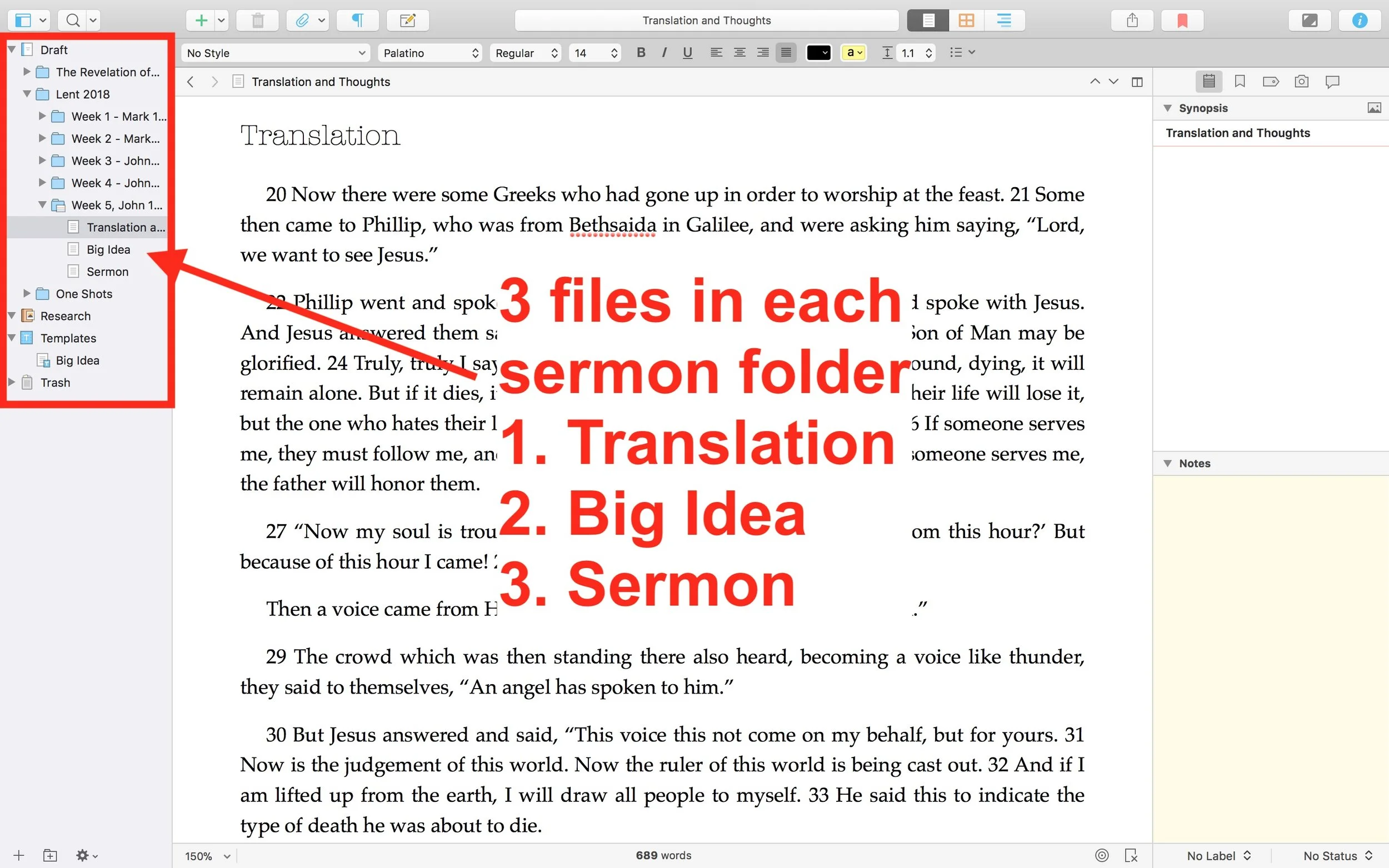
Using Scrivener to Write Sermons
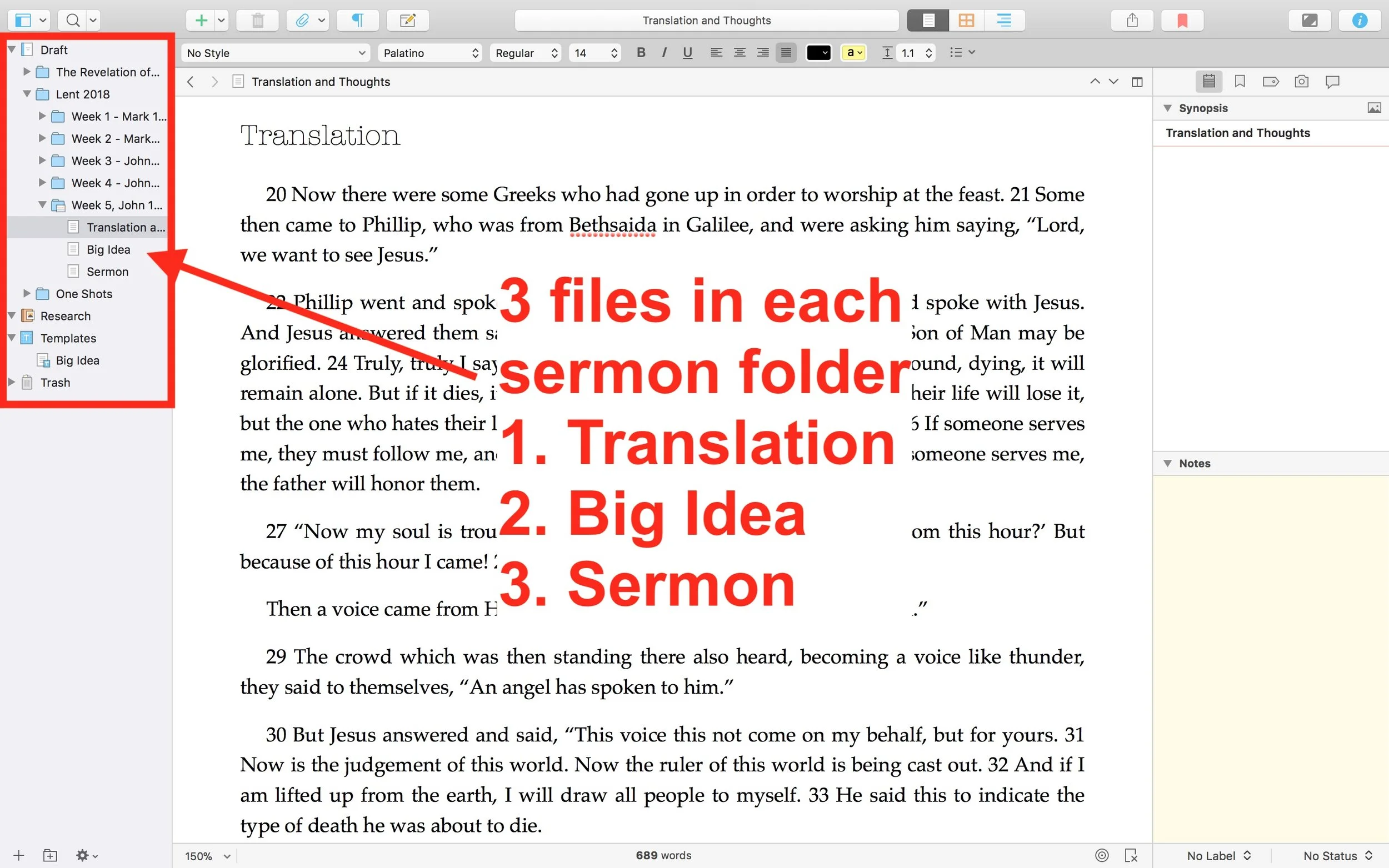
Preachers use different tools to write their sermons, from Microsoft Word, a simple text editor, word processors built into Bible software or something like Scrivener. Wes Allen, one of the Theotek Podcast contributors and American Baptist Church pastor, uses Scrivener to prepare his sermons. We talked about his workflow and why he uses the program in a recent Theotek Podcast that we recorded live on our Theotek Podcast Facebook page.Scrivener is a word processor. That's the simple way to describe it, but there's more to it than that. Some people think of the program as a tool for writing books or long form documents, like a doctoral dissertation. Wes uses it that way, but also uses it for shorter form documents, like his weekly sermons. That's because the built-in organization and writing tools work better for him that what most preachers probably use - Microsoft Word.https://www.youtube.com/watch?v=SHDYJdkAAic&t=30sPlease watch the video above from our YouTube Channel. In it Wes talks about...
- The way to format text using styles
- Setting up templates for outline forms
- Using the dual pane view to see the text of the sermon next to the other documents
- Organizing the files and folders
- Exporting for use in preaching and writing books from a sermon series
... and more!
Scrivener Organization for Sermon Prep
 He uses one Scrivener file per year. He then creates folders inside Scrivener for each sermon series or season. This lets him organize things easily within Scrivener. Under each series or season, he creates folders for each sermon. Then in those folders he places three documents (see image above).
- Translation of the primary text - he creates his own translation of the Greek or Hebrew text.
- Big Idea - the main idea of his message explained in a single document.
- Sermon Text - this document where he writes the sermon itself.
My Scrivener Organization
I really like this way of organizing each sermon. However, I don't do a full translation of my sermon. So I might organize things in Scrivener similarly, but in a slightly different way that better fits how prepare my sermons.First, I will organize my sermons around sermon series instead of year. That's because I sometimes preach through a book of the Bible and this might take more than one year or I might start it in September, take a break for the holidays, and then go back to it in January. Organizing that series by year would break it into two files. So, instead, I'd create a Scrivener file for First, Second and Third John, the last sermon series I recently finished just before the Easter season in February.Next, in each sermon folder I plan to create one Scrivener document for study notes called Text Notes. I create these notes in my Bible software while I'm studying the text. Then, I'll copy and paste the text of the Bible passage and the notes into the Text Notes document in Scrivener. I usually use one of a few sermon outlines and I will create templates in Scrivener (see the video to see what I mean by templates) for each of these formats.
- Motivated sequence
- One-point inductive
- Negative options indicative outline
Motivated Sequence Outline
A Motivated Sequence outline comes from the book 12 Essential Skills for Great Preaching by Wayne McDill, my seminary professor who taught at Southeastern Seminary. Here's the outline for this kind of sermon:
- Attention Getter - a way to grab the audience's attention with an anecdote, controversial statement or quote, joke or video.
- Need Element - some call this the Fallen Condition Focus; it's a way of showing the way the passage deals with our problems, which draw people into listening to your sermon and show the answer from the passage.
- Solution - the body of the message will offer the solution to the need mentioned above with as many outline points as needed to cover the ideas in the passage.
- Explanation - explain how text solves the problem.
- Illustration - illustrates the meaning of the text's main ideas and illustrate how to put the ideas into action.
- Proof - shows that the ideas are true since people don't just assume that the Bible is true like we believers do.
- Application - clear and concrete ways to apply the ideas presented.
- Visualization - show what the solution looks like with an illustration, story or video that helps people see how to apply the message.
- Appeal - tangible way or ways that the audience can respond to the message with specific and concrete steps.
Inductive Sermon Outlines
The other two outlines I use are inductive outlines. They both offer a single main idea. The one-point inductive approach will follow the outline below:
- Grab attention.
- Share a need that the passage solves.
- explain that need
- illustrate how that need affects the hearers
- Explain how the how the passage deals with the need.
- sharing details first
- then offer the main idea
- Illustrate how that passage solves that need.
- Prove the idea
- Apply the passage's solution in that Big Idea with an appeal to the audience to do something with the idea.
The last outline follows a negative solutions offered by people and then turns to the way the passage shows that God solves this problem. It is also inductive and a single main idea presented after exploring some ways the humans try to solve the fallen condition focus. These come from the passage just as the main idea.
Logos Bible Software Sermon Prep Part Two: Choosing a Text to Preach
Many preachers prefer to preach a topic found in multiple texts that the preacher expounds during a single sermon. I prefer to look for a single Bible text and that one text will dominate the sermon. In this second part of our series on Logos Bible Software Sermon Prep, we'll look at how the program can help the preacher choose a text to preach an expository sermon. The first part focused on using Logos to find a good sermon subject, for Topical Preaching or Topical Textual Preaching.This method of preaching will dominate the rest of our sermon prep series.
UPDATED: I added the Lectionary Tool at the end of this post.
What is Expository Preaching
I don't have the space look at the benefits of expository preaching versus topical preaching. Check out Lifeway's helpful list of 9 Benefits of Expository Preaching by Tony Merida. However, let me quickly define what I mean by this. Expository preaching includes the following:
- One single text dominates sermon's content.
- The main message comes out of the text. Some call this the Big Idea, as Haddon Robinson did in Biblical Preaching.
- The text will also dominate the tone and style of preaching. Poetry should have a poetic feel while narrative should include the story as a primary part of the sermon. Positive tone should not result in a harsh sermon.
- The preacher will explain, illustrate, prove and apply the Big Idea of the text while preaching that text.
What Kind of Text Are You Looking For?
Your expository preaching can include the following:
- A single passage or pericope of scripture, like my sermon this week on John 13:31-35.
- Part of a book like The Sermon on the Mount or Jesus' Farewell Discourse in John.
- A full book of the Bible like John's Epistles.
I've preached through all three taking anywhere from a single message to multiple years. This week I'm preaching on John 13:31-35 but I'm not preaching through John or through one section like the Farewell Discourse of Jesus in John's Gospel. I've preached through the Sermon on the Mount, but not through the book of Matthew ... yet. And last year I preached through John's letters. All of the above sermons or series of sermons were expository sermons and my Logos Bible Software sermon prep benefitted from the tools explained below.https://www.youtube.com/watch?v=MV9Viuw_xgc&feature=youtu.be
Tools for Finding a Text in Logos Bible Software Sermon Prep
Logos Bible Software sermon prep will use a number of tools to help you choose a single text or a longer part of a book or a full book of the Bible. In our earlier post we looked at finding a topic to preach. Topical preaching isn't my favorite way to preach. I don't go so far as some to say it's sinful or evil. However, we should use it sparingly.You can use the same tools used in the earlier post to find a single passage for your expository sermon instead of using them to find proof texts for a topical sermon with multiple texts. So head over to that post and use those steps for finding a single text on a particular topic.To find a text for an expository sermon, you can just start reading the Bible and get inspired by what you've read. Or you can hear someone quote a passage or read a book that refers to one. However, you pick that single passage you'll want to start reading it.
One Bible
 My first step is narrowing the text (choosing where to begin and end my sermon). I start by reading the text in context multiple times. In your Logos Bible Software sermon prep process, open your favorite translation. Go to your library by clicking the library button, second from the left next to the home button on the toolbar. Or click in the command box and type Go to John 13:31-35 or whatever your chosen text might be. Read the text in context as follows:
- Narrative - read the story and read those passages before and after.
- Poetry - find the beginning and end of the poem and if it's in context of another genre then read the parts before and after. Psalms are a single unit of text by themselves so just read the chapter.
- Proverbs - read the chapter and decide if your Proverb is part of a collection of Proverbs about a subject, then pay attention to the other Proverbs about this topic. If it's not part of a section of Proverbs on a single topic, then read your single Proverb (note some Proverbs might include multiple verses).
- Didactic - teaching passages like the epistles require us to find the letter's overall argument and then look for this particular part of the argument to find how your text fits in the overall argument. This overall argument might include the entire book or a large section of the book, like Romans 1-11 or Ephesians 1-3.
- Prophetic - find the overall prophecy, often in poetic genre and other times as part of a narrative. One prophetic message will become one preaching text.
- Legal - read laws in context of their overall application, like laws about the priesthood in Leviticus or the feast days, etc. and choose your text-based on this overall section.
You can do this in any software. Logos doesn't do it better or worse than any other program. You can even do it in a paper Bible (shudder to imagine it).
Passage Analysis Tool
Checking out multiple translations can help you decide what verses to include in your passage. Logos Bible Software Sermon Prep will benefit from the Passage Analysis Tool. Go to Tools and click on Passage Analysis. Type your passage into the command box in the upper left corner. It will visually show the boundaries of the various pericopes in your top translations. Next to the command box you'll see a drop down box that reads "Pericope Sets". Click it to choose your translations by putting a check in the check box of your preferred translations. If you own too many books with pericopes, you may need to scroll to show them all. (What is a pericope?) After you finish choosing your translations, they will show up in columns in order of your rankings. Along the left you'll see links to the text that you can click to open your preferred Bible to that verse.The columns will show boxes that represent a pericope. For example, in the image above, notice that the ESV (dark blue column on left) has more pericopes than the NLT (green column third from the right above). Click on a pericope box and it opens in your top translation, but not that specific translation that you clicked. I'd expect it to open in that translation, but it doesn't for some reason.How does this help in choosing your text? You can see how all the various translation teams chose to break up the pericopes. They often vary wildly as in our chosen passage in John 13 above. The ESV, HCSB, NKJV, NRSV and UBS4 all agree that John 13:31-35 forms a single unit or pericope. However, the NASB, NIV 1984, and NLT all include John 13:31-38. If you scroll up you'll see that all but the NASB 1995 agree that the pericope begins with verse 31 (see below)..
 The two steps above should help you find a single pericope. You can probably preach single sermon on that passage. Or it may take too long to preach in a single message and you decide to break it up into a series covered over a few weeks.
Sermon Starter Guide
If you're still struggling to choose which verse to include in your expository sermon in your Logos Bible Software Sermon Prep work, then consider firing up the Sermon Starter Guide. Thanks to Graham Criddle in the Logos forums for this suggestion. You'll find it under Tools in the menu. Click on Sermon Starter Guide from the list along the left of the box that pops up. This opens the guide to the passage in your open Bible. You can type in your text and run the guide.
 For this step, we'll focus on three sections of the Sermon Starter Guide. Look at the Sermons, Sermon Outlines and Outlines sections. Under each you can see how other preachers or scholars have divided the passage and preached it or handled it in a commentary. You'll have to own books that include these three kinds of information. Open them and read over them to see what these other preachers chose as their text.At this early state, be careful to use these tools only as a guide for picking your sermon text. Don't read too much of the content because it might push you in the wrong direction and keep you from discovering your own Big Idea or sermon thesis.
What's Next
Now that you've looked at the text in multiple translations, checked out the Passage Analysis Tool and looked over the Sermon Starter Guide, it's time to pick the beginning and ending of the text.You'll want to consider another issue. How much can you cove run the time given. I preach in a traditional Baptist Church and the people typically expect about a 25 to 35 minutes sermon. I can stretch that to 45 on occasion. On Wednesday evening we have an hour and prayer requests take up about ten minutes, so I can easily go 50 minutes since it's a discussion time and not just my lecture.Choose the first and last verses and stick with your choice. Prayer will also help throughout the process, before, during and after you preach.
Pick a Book or Longer Passage to Preach
The above steps help preachers pick a passage for a single sermon. How do we find passages or books to preach in our Logos Bible Software sermon prep? Use the topical search steps from part one of this series and look at the context of the passages that you discover. You may find that an entire section will make up a good sermon series through a chapter of the Bible. For example, let's say you searched for a passage on prayer. You opened the Sermon Starter Guide and typed in Prayer. It returned the Lexham Theological Workbook. You opened it and found John 15:7. After reading the passage, you decide that you want to cover the entire topic of John 15 on remaining in Jesus. Or maybe you see a group of Psalms and so you decide to pick a few of them to preach through Psalms on Prayer.
 Maybe you like to preach through books of the Bible. Search for some topics that you're concerned about in your church. Use the following steps to search through your commentaries. If you don't already have a Logos Collection that includes your commentaries, create one using the steps in the company's helpful Logos Pro Training on the topic.Open the Logos Search feature from the search button on the toolbar. Choose a Basic search and then click the link labeled Everything, Type the name of your new Collection the box that pops up. Click it from the list that shows up below the search box. Now click in the Search box and type the topic. You'll find commentaries that include that word. Focus on the Introduction sections of the commentaries. You may find that a book fo the Bible talks a lot about a topic. Consider preaching through one of those books based on this search method.
Logos Lectionary Tools
I neglected to include the Lectionary Tool in the original version of this article because I'm not a lectionary preacher. However, many users will want to use it.Even if you're not someone who follows it regularly, it can offer some suggestions for preaching passages when you're not coming up with any ideas using the above tools or when a topical search (from part one) doesn't help. The lectionary follows the church calendar, so it's a good way to keep in step with the rest of Christendom. Logos includes various lectionaries and you can add them to your Home Page. I've done that and you can see it in the upper left corner. Edit your Home Page by clicking on the tiny gear icon in the upper right corner next to your name.
 This opens a new window that pops up. See it below. Along the left there's a list of things you can include on the left column of the Home Page. The list on the right of the pop up will show items to include I the main section of the Home Page.
 For the purpose of this article, notice the various lectionaries included. I have my mouse over the Revised Common Lectionary, one of the more popular lectionaries used today. I have the Christian Worship Three Year Lectionary selected. You can choose more than one or just your favorite by putting a check mark in the box next to the name.Now that you've selected your favorite lectionary or multiple lectionaries, click outside the pop up box to close it. The Home Page will refresh to update to the new settings. The lectionary will show up in the upper left. Click on the verse to open a new desktop Layout. You can also open this using the Layouts menu item from the toolbar. Click on Layouts. Make sure the Home Page Layouts section is open in the Layouts pop up. Then choose Lectionary.
 The Layout will open your Lectionary on the left to that entry. In the center you'll get two window panes. The top pane has your top 5 Bibles listed in the Library prioritization list in their own tabs. The bottom pane opens your top Commentary that includes that verse in one pane and your top devotional in the other pane showing the date of that lectionary entry.The smaller column on the right shows two panes. The top will do a search to find books in your library that include references to the passage from the lectionary. The bottom pane shows a Bible Explorer Tool window open to that passage. The Explorer gives you things like Biblical People, Places, Events, Thing and Media. You'll also see sections for your content, cross references and commentaries for that passage.If you're a lectionary preacher, then you likely already know that you can preach on one of the passages or include more than one. When I have used the lectionary to pick a passage, I just read them all and choose one that I want to preach.
Sermon Prep Part 5: Theotek Podcast #069
We're in the home stretch in our series on writing your sermons and Bible studies using digital tools like Bible study software or online Bible sites. This episode covers tips and trips for actually writing the sermon outline or manuscript. How can digital BIble study tools help in forming your notes and outline?https://www.youtube.com/watch?v=akZN22Rls6YSome of this can be done on an iPad. The new iPad Pro plus the Microsoft Word iPad app makes it easier than ever. See below.
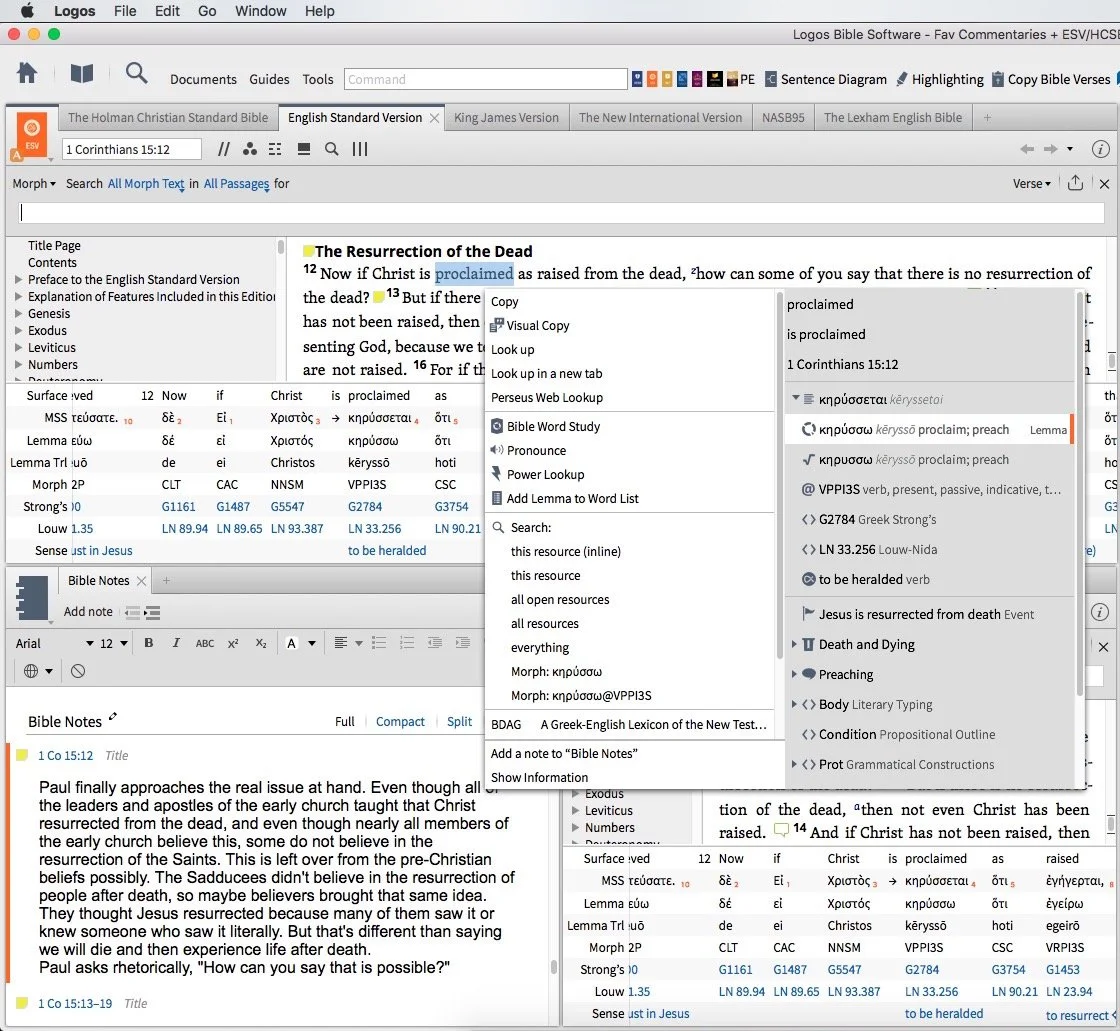
Sermon Prep Part 4: Theotek Podcast #068
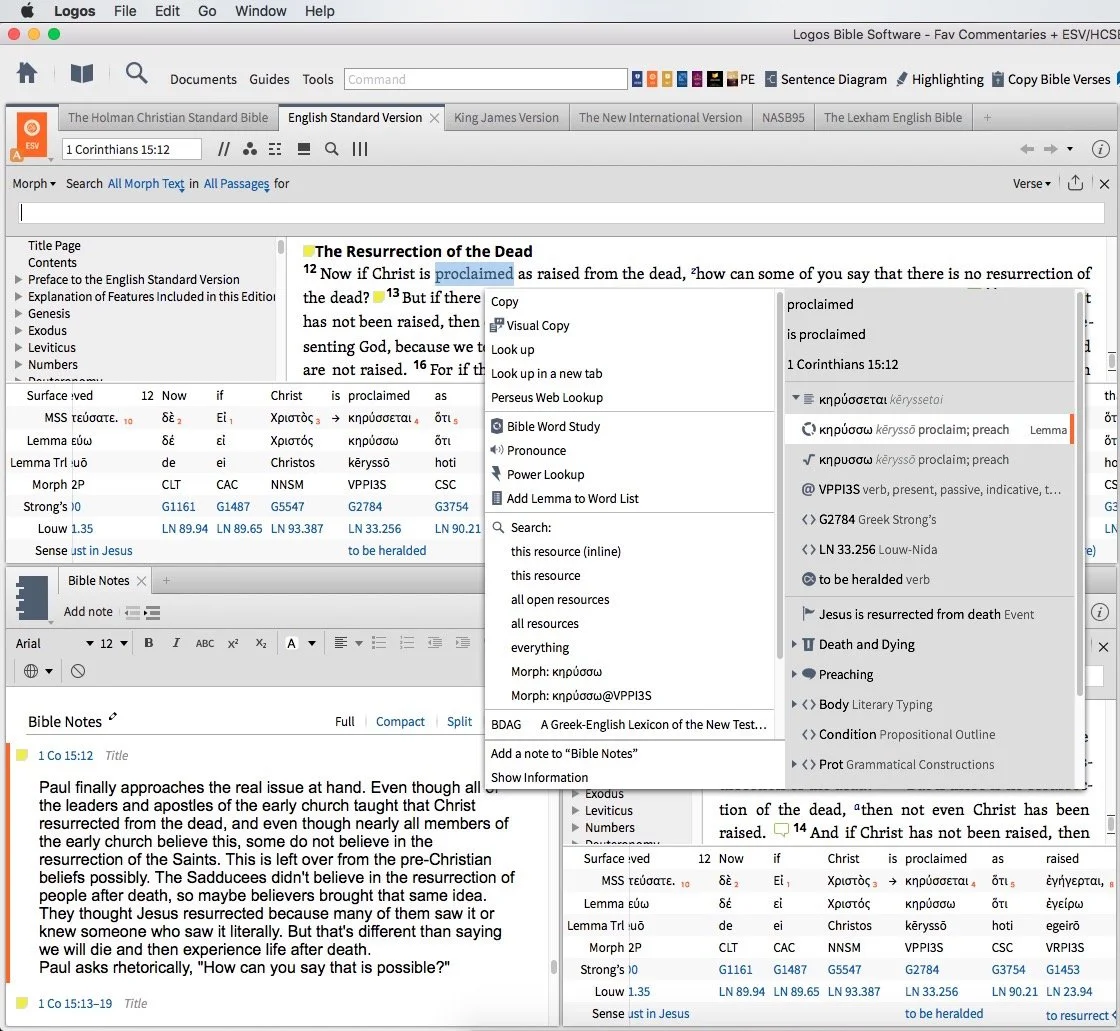
We talked about using Digital study tools to do word studies. Specifically we looked at Accordance Bible Software, Logos Bible Software and Bible Reader from Olive Tree.https://www.youtube.com/watch?v=W-v8fk3uhhMWe focused on studying the Bible in English using the tools built into Bible software that help users find the Greek or Hebrew words behind our English translations. Good language study tools focused on Greek and Hebrew tagging using Strong's numbers helps users get at the Biblical meaning of each word and words in context. Regardless of which software you use, start with a text that includes Strong's tagging. Usually they will let you right-click or double-click or even triple-click the word you want to study.Start this process by searching for a word and read it in context in the different places it's used in the Bible. Then use your software's built-in word study tools. For example both Accordance and Logos show you how the author uses words with graphs and charts that show how many times a word gets used in each book of the Bible or how many times the original word gets translated one way versus another. The next step, after searching the word, is to look up the word in Greek or Hebrew Lexicons. Most Bible software tools include some in base packages. Users can buy more advanced tools.Finally, if you still need some help, look up the word in an English Bible dictionary. Start with exegetical dictionaries like the Holman Treasury of Key Words or the AMG Complete Word Study Dictionary of the Greek or Hebrew.
Our Favorite Things
 This week in "Our Favorite Things" we got some interesting recommendations. First, Antoine recommended the 29 Watt Apple USB-C charger to charge your iPad Pro. It charges the iPad in about an hour, but costs $49. It also requires a USB-C to Lightning cable which adds $35. He still loves the speed of the charging and wished Apple included this charger with the iPad Pro.
 Rick recommended a similar device, the PowerCore+ 26800 & PowerPort+ 1 charger. It includes QuickCharge technology and with 2.4amp USB ports. It's got 3 ports and can even charge the MacBook or other USB-C devices that need a lot of power. The 26,800mAh battery handles almost anything you can throw at it.I showed off a new feature in the latest Developer Preview version of Windows 10. Microsoft has what they call the fast ring and slow ring for beta testers of their operating system. The fast ring version added a new feature that shows up in the system tray. The icon for this feature looks like a pen with a drawn line. Tap or click on it and a new pen-focused menu pops up with a few options as follows:
- Sticky notes
- Sketchpad - a white board
- Screen sketch - the ability to do a screenshot that opens into an editor with pen/pencil drawing on the screen shot
- Recently used - a few of the most recently opened Windows 10 Universal apps
- Suggested - pen/stylus focused apps from the Windows store
- Connect your pen - a link to the Settings where you can connect your Bluetooth Surface Pen or other stylus
 Microsoft calls this the Windows Ink Workspace.In the "Least Favorite Things" folder, I talked about Vufine. This was originally a Kickstarter project that I mistakenly backed. They call it an HD wearable display that fastens to your glasses and shows a tiny screen inside the little device that sits just off the front of your glasses. It comes with a cheap, flimsy pair of plastic glasses if you don't wear glasses regularly.The problem is the Vufine is to tiny it's nearly useless for anything. Some use it connected to a GoPro to see what the GoPro sees. But using at an actual display is nearly impossible since text is so small.
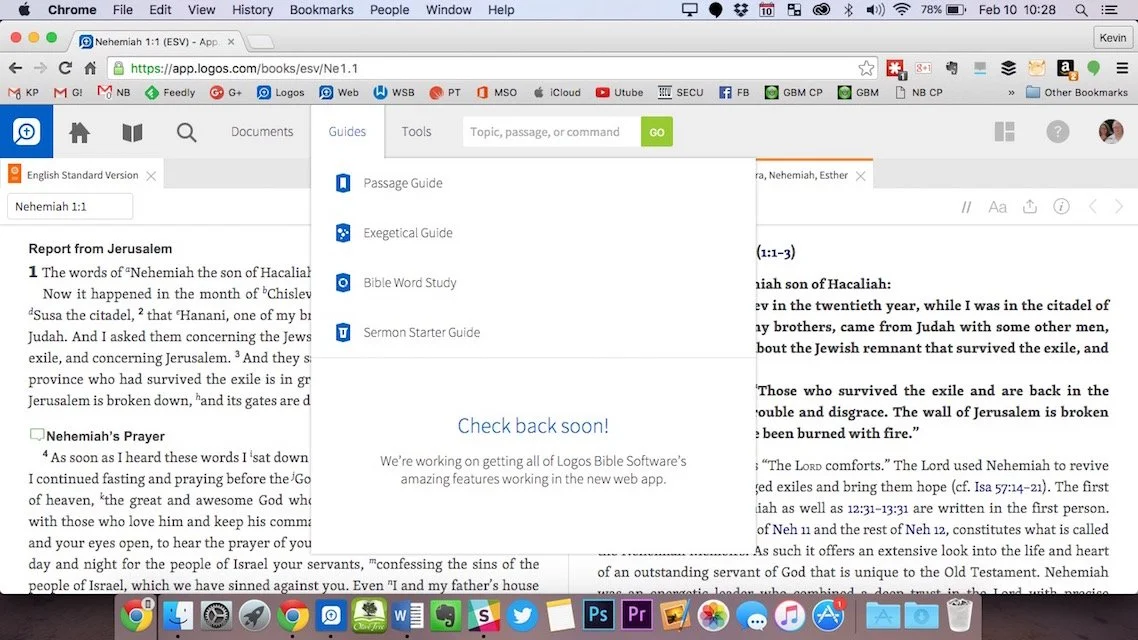
Digital Sermon Prep Part 1: Theotek Podcast #065
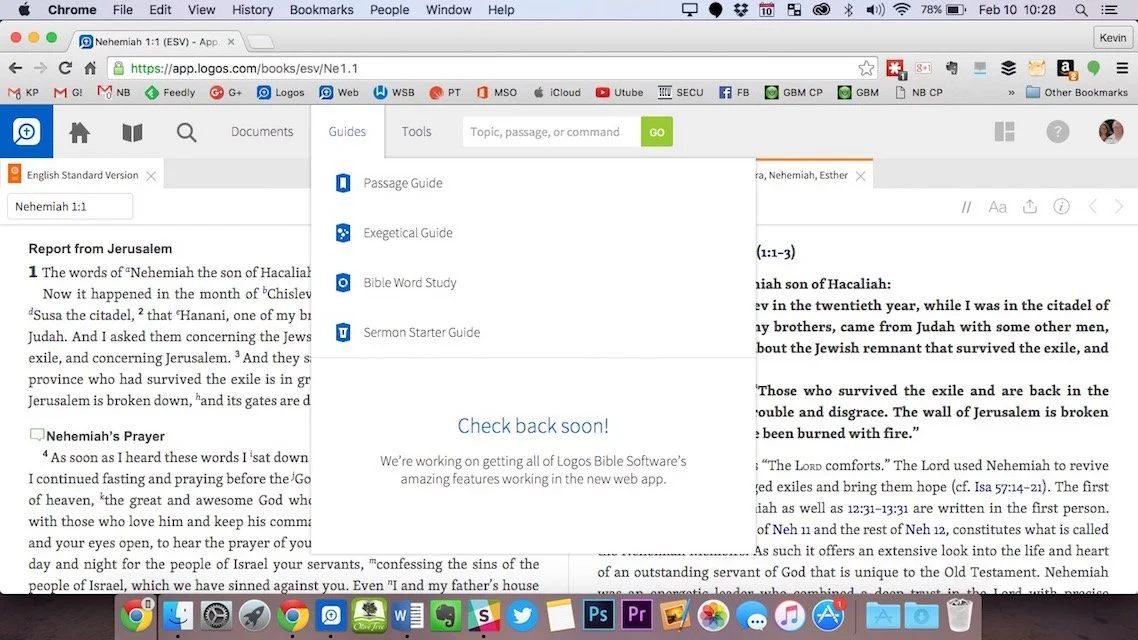
We started a series in this week's Theotek Podcast on doing digital sermon prep. Our team will take you through our steps of sermon prep using Bible software and digital tools.In this first step we focused on choosing a passage. Software packages come with tools to help you figure out what verses to include in your passage, or as the scholars call it, pericope. Then we look at other aspects of sermon prep. Watch the video below or listen to the audio version at the end of this post.https://www.youtube.com/watch?v=nb3ljTSXL3g&list=PL1-Xf_HZquDEcTTK8MLMMdmwvB--o1ShY&index=2We didn't have any recommendations in Our Favorite Things this week.
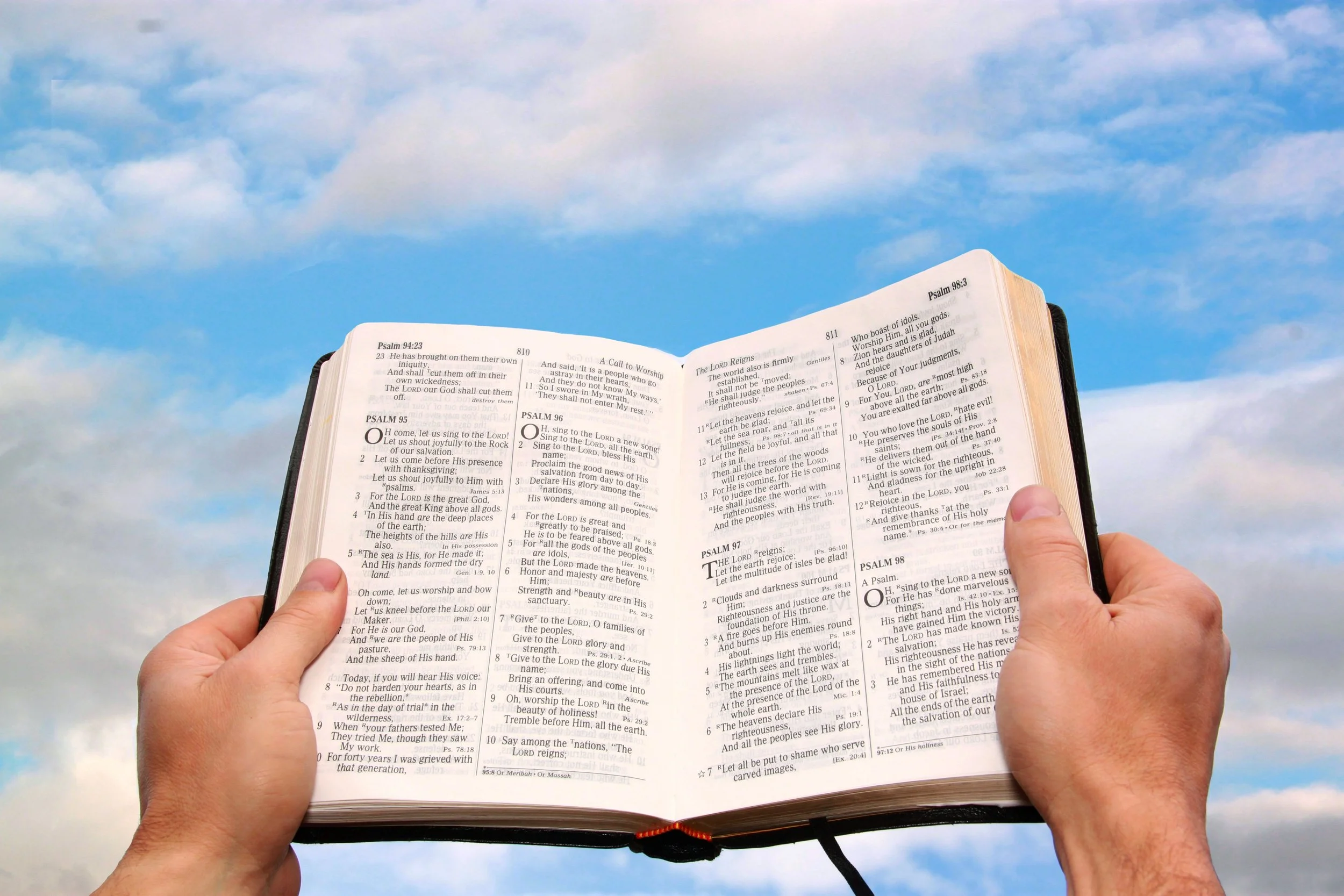
Finding Sermon Illustration Content on Theotek Podcast #054
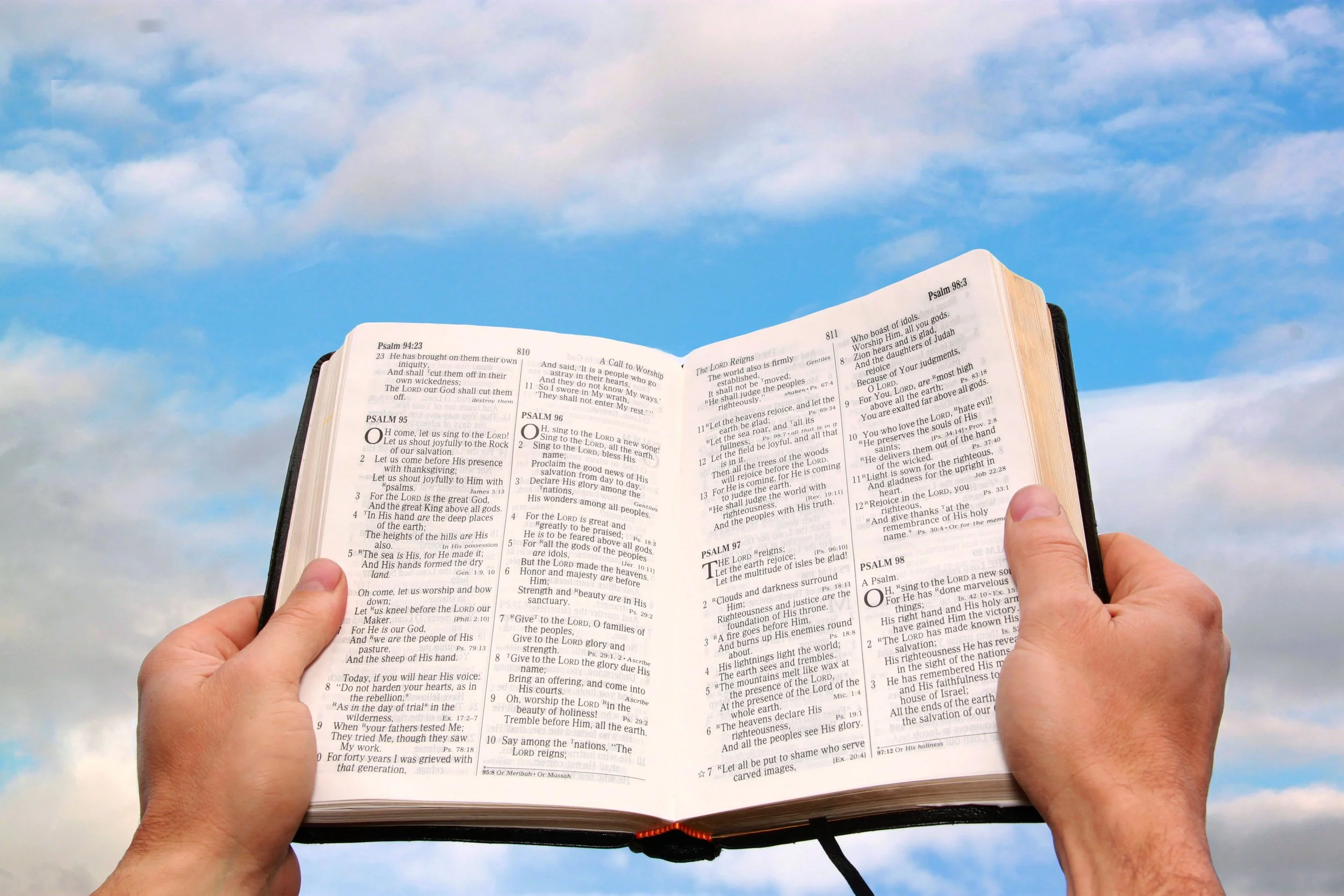
Looking for a good sermon illustration your next sermon idea? We talk about our process and then recommend some sources for explaining, proving and showing what application of our messages looks like.https://www.youtube.com/watch?v=EKVPCmmQk00In the old days our preaching professors taught us how to manage a sermon illustration database. We had file cabinets or notebooks or file folders with clippings from the paper or photo copies of books we read. Then people started putting these on their computers with software like the program sold by the original makers of QuickVerse Bible Software. Bible Illustrator linked some databases of illustrations to the Bible text from QuickVerse and made them searchable via keyword. Others put them in the old Cards application that came pre-installed with Windows 3.1. A lot of people put them in a word processor or text file. Then the Bible software companies started to include sermon illustration databases in their programs. We showed some books like this available in Accordance Bible Software. Logos and WORDsearch and most of the other big names in Bible software offer these collections.Unfortunately, most of the sermon illustration books or databases available online, in Bible software or even in book form totally stink. They're stories from the 1800s or incredibly generic. How many times do we find one that doesn't fit, but it's close and it's really good.Listen below or watch the YouTube video of our podcast above and learn how we find fresh content from our own experiences, from a Google search or pictures and video files that make that sermon illustration come to life.
Preaching With an iPad Pro: Theotek Podcast #046
What is the new Apple iPad Pro like for studying the Bible, preaching or teaching? Rick Mansfield (@thislamp and thislamp.com) got one this week and we asked him a lot of questions about using it. Watch or listen below to hear his thoughts.https://www.youtube.com/watch?v=16v6TwpaPvEJust a summary of Rick's conclusions. First, he likes the side-by-side feature so that he can hold his Accordance Bible app next to Microsoft Word. This will help with both Bible study and preaching. The Keynote app and Word can sit on-screen at the same time. He uses the notes feature in Keynote, but after the podcast was over he tested and found out that you can run a Keynote presentation mirrored to an Apple TV and open Word in side-by-side mode. Second, he tested out the iPad keyboard and looks forward to getting one to use. He didn't like the Logitech keyboard case as much because it seems harder to remove from the iPad Pro.We talked about the Pencil, which is hard to come by until December. Wes tested it out at his local Apple Store and found that it was a great experience. They've done a good job of making it work well and feel more like writing on paper than older styli.At the end of the podcast I shared some first impressions of using the Apple TV 4th generation. It's a nice media device and the remote is both good and bad. Siri works great and AirPlay still works as well as before.

iPad Sermon Preperation: Tools Apps and Tips

Ever thought about doing a little iPad sermon prep?A lot of preachers carry around an iPad or some other tablet these days for checking email, surfing the web, playing games, streaming video or taking notes. Many of us also use them for simple Bible study on the go. However, can a preacher study and prepare an entire sermon or Bible study using no other device than an iPad? In other words, from start to finish, ignore their laptop or desktop computer and commit entirely to iPad sermon prep? If you've ever been tempted to retire the laptop and get out of the office, this is for you. Let's look at the following:
- Tools needed to use an iPad or other tablet for reading, studying and preaching the Word of God
- Apps that will help the preacher study, organize and then write their sermon/Bible study
- Tips for doing all of this well
https://www.youtube.com/watch?v=bFdN4bjcnQASo grab your iPad and read on...
Accessories Needed for iPad Sermon Preparation
First, grab a Bluetooth keyboard if you're serious about iPad sermon preparation. Some people may want to use their iPad's software keyboard, but typing on a screen doesn't work as well as typing on a physical keyboard. Connect your keyboard to the iPad using Bluetooth. It's simpler and easier than trying to connect one using USB. Also, the battery on my iPad doesn't run out that fast and I never turn Bluetooth off.You can choose from three styles of keyboards.
- Keyboard case integrated with your iPad case.
- Full-size case that the user carries along with their iPad.
- Small, foldable or roll up keyboard.
Each comes with strengths and weaknesses. According to Gear For Gaming, the case approach gives us an all-in-one package to carry around. However, the user's still holding the keyboard when they're not using the case. We've got a recommendation that fixes this problem.Using a full-size keyboard gives the user a better typing experience. We've got two recommendations that feel great while typing and let the user hook up to three different devices. That lets you type on a tablet and a phone and then put it on the desk at home and use the same keyboard with your desktop. We'll explain how this works later.Taking along a full-sized keyboard means less convenience and portability. It's too many things to carry. A laptop with a keyboard attached might work better. Still, read on because we've got a couple of suggestions that are still very portable.The final option is smaller than a full-sized keyboard. These are small foldable keyboards that often fit in your pocket. They are hard to type on quickly.First, look for a Bluetooth keyboard and second decide which of three styles you think you'd prefer. The best keyboard cases come from Logitech because they're thin and light. They usually feel great while typing. Logitech just released the Logitech Blok case. It looks a lot like Microsoft Surface Pro 3 with its kickstand back. The keyboard fits on the tablet along with the snug and thin case. When it's time to type open it up and even detach it so the screen's not too close. This also means you can remove it while using your iPad as a tablet only.https://www.youtube.com/watch?v=TcEuKDRJalIPeople who prefer a full-sized keyboard should look at the Apple Bluetooth Keyboard ($69) and get a carrying case for it or get one that will hold both the iPad and the keyboard.
 Logitech also makes a great nearly full-sized keyboard. It's the Logitech Easy-Swtich Bluetooth Keyboard, model K811 for $100. It connects to 3 devices. It has a selector switch for Android, iOS and Windows. However, it also connects to an Apple computer and comes with an Apple keyboard configuration with the COMMAND and OPTION keys and shortcuts for iPad.
 A third keyboard option also fits the "full-sized" mold. The Microsoft Universal Mobile Bluetooth keyboard is my favorite of the bunch because it's small and less expensive than the three of the above options at only $79.95. It comes with its only carrying box and unfolds when we're ready to type on it. It also connects to multiple devices at once.Since I hate the tiny fold up keyboards and the roll up keyboards, I don't have a recommendation. You can find these usually for $20-$50 at Amazon or your local office/electronics store.My friend Antoine Wright of Mobile Ministry Magazine and a co-host of Theotek Podcast would scream at these suggestions. He'd wonder why not forget the keyboard and just use a stylus. Draw and write notes. And I agree with him.
 A few great options let you do fine-tipped drawing and handwriting. The larger tipped stylus that most people use are terrible. I hate them and never use one. But these feel more like writing with a real pen.
https://www.youtube.com/watch?v=LuhIg72nI2k
Apps that Help Preachers Study and Write Sermons
Get a good Bible study app. That's obvious, but remember that not all Bible apps do the same task. I always prefer full Bible study apps over the simple Bible readers. The best Bible apps on the iPad don't necessarily do the best job of supporting advanced Bible study. Logos Bible from Faithlife goes toe-to-toe with Olive Tree's Bible Study as two of the most popular Bible study apps for advanced research. A few other great contenders include...
 Each of these coms with strengths and weaknesses. The best option usually depends on what the preacher uses on the computer. Logos users should use the Logos apps. Olive Tree users should get their app. You get the idea. However, try downloading all of these. Each offers a free version and you may get some good content. That's especially true if your desktop application doesn't offer a good iPad app, like Bibleworks or PC Study Bible.In addition to Bible study apps, look for a good word processing app and maybe a presentation app. Do you use Microsoft Office on a computer? Then give their iPad apps a try. To get the full experience the user will need an Office 365 subscription. Office 365 costs between $60 and $100 per year or less if you shop around.Apple makes Pages and Google offers Google Docs. Each comes with strengths and weaknesses, so try them out and see what you like.Some people prefer one of the many note taking or mind mapping apps for taking notes on an iPad while studying their Bible app. Also, do forget that some of the above Bible apps have great notes features that you can write in instead of using a separate app.
 Here's a list of great note taking apps.
- Evernote - ubiquitous note taking and syncing app.
- Apple's update Notes app offers more features in iOS 9
- iA Writer - be sure to get the cheaper of the two. The $20 version doesn't add enough to make it worth twice the price. It handles mark down, something my friend Wes Allen, a fellow Theotek co-host, will love.
 Don't forget hand writing or digital inking as a writing tool. There's a bunch of great apps that let the user write. Here's a list of my favorites.
- Notability
- Metamoji Note
- Penultimate
- Paper by FiftyThree
- Apple's new Notes app also does handwriting and drawing now. Scroll down on the page in the previous link to see what's coming.
 Some people prefer using a mind-mapping tool. I don't use one, so I'm not a great source for the best options. My friend Rick Mansfield (from Accordance and my co-host on Theotek Podcast) told me about a post about mind-mapping for sermon prep.
 See more about mind mapping in the tips below.
Tips for Using an iPad while Preaching or Teaching the Message
Once you have a good keyboard and/or stylus, your preferred Bible study app, a good word processing too, handwriting app, or mind-mapping tool, here are some tips for effectively doing Bible study and writing on the iPad.
- Learn to multitask. Apple gives iPad users two ways to switch between apps. Use double tap or the swiping gestures to go back and forth between apps. In iOS 9 on iPad Air and iPad Air 2 users can dock a second app by swiping in from the right side of the screen.
- Write in the Bible app's notes feature if you want side-by-side user environment. I mentioned this above. This might not be the best way to write your preaching notes so when finished copy and paste the notes to a word processor for formatting.
- Copy and Paste Bible text or quotes from the app to the word processor. To preach or teach from an iPad get in the habit of copying the text of the Bible into the word processor so there's no need to deal with turning pages in a physical Bible.
- Use Mind Mapping apps for a different approach to sermon or Bible study notes. Mind Mapping refers to using visual organization of ideas. Get an awesome stylus to draw a circle on the screen of your inking app. Then write your Big Idea in the center. If you don't know what a "Big Idea" is, then stop what you're doing and read Biblical Preaching by Haddon Robinson. If you still don't understand, then get The Big Idea of Biblical Preaching by Keith Wilhite and Scott Gibson. If you still don't understand then go back to your seminary or Bible college and ask for your tuition money back.
- Sources for Illustrations. There's a wealth of great content online for teaching and preaching, from online Bible study sites to news sites that offer useful illustrations. Use Wayne McDill's tool for finding illustrations from 12 Essential Skills for Great Preaching. Avoid the canned sermon illustrations books and sites that become out of date soon after they're published. Also, look at PreachingToday.com for som great up-to-date illustration material.
- Remember visuals. People learn better when we combine at least senses in the teaching or preaching experience. So look for ways to include the sense of sight, smell, touch and even taste while teaching or preaching. Take note of them when you think about your sermon's Big Idea and concepts. In ascending order of effectiveness from the least effective to the most effective senses for memory are hearing, seeing, touching, tasting and smelling. If someone hears you preach and sees an image, they will remember what you say longer. Add one of the other three and they may never forget it.
- Use a presentation tool. The iPad offers a great collection of presentation tools from Keynote and PowerPoint to Prezi or Haiku Deck. Go here to see a great list of alternatives to Keynote and PowerPoint.