


Clickbait Title About Closing Down Theotek and KevinPurcell.org
I think I'll shut down KevinPurcell.org and Theotek. Or maybe I won't. Anyway, here's what coming from this site and my writing here.

Ever see those YouTube headlines from some popular creators that say, “I want to quit YouTube?” Marques Brownlee did it recently. I intentionally didn’t watch it because I hate these. But now I’m doing a blogger’s version of that same thing as I contemplate closing down Theotek and KevinPurcell.org.
The Origins of KevinPurcell.org and Theotek

My first post on KevinPurcell.org hit the web before 2015. Like way before. However, those original posts are gone. I checked the Internet Archive and found one from June 18, 2003. You can see that it's pretty ugly and does not have great content.
At some time my site began to focus more on Bible software, church technology, and the Theotek YouTube show that I produced along with a few friends. That’s when my site took off and grew from dozens of hits per month to thousands of hits, sometimes on a single post.
The Theotek video blog and audio blog eventually died due to a lack of interest on the part of my friends and eventually me. Will it ever come back? I won’t say never.
The last post on KevinPurcell.org focused on deals for Logos Bible software. I became a Logos affiliate, which means I get a percentage of sales generated from my website and YouTube channel.
The Beginning of the End? Or Not! Closing Down Theotek
Unfortunately, I writing about Bible tech bored me as the market contracted and we lost BibleWorks and WORDsearch. Then Olive Tree and Accordance went stale with few updates. That left Logos for the exciting stuff. But I got tired of only covering Logos Bible Software. My attention often loses focus. Squirrel!
Last summer something significant happened. The Brushy Mountain Baptist Association in Wilkes Country, North Carolina called me to become their Director of Missions. If you’re not in Southern Baptist Life, think about area superintendents or bishops, but without much authority. I work with our 40 churches to help them strategize ways to reach their communities for Christ. I also support pastors as a kind of pastor to pastors. Add other strategic missions and evangelism and you get a Director of Missions, or as some call the position - Associational Missions Strategist.
This new position keeps me in my office more and allows for less freedom in how I organize my day. I don't mind the new structure. I can still come and go as I need, but I feel responsible for being available to the churches. That means I’ve got less time to write here on this site. It’s not like there’s been a huge outcry of readers begging me to come back and get started again. So, I’ve done what most do. I focused on what calls for my attention louder and what pays the bills. This site doesn’t; it’s been a labor of love from the start.
What Does the Future Hold?
I won't be closing down Theotek or KevinPurcell.org. However, it will look and taste different. Well, it won't taste like anything which I guess is the same.
Now that I've created a workable rhythm in my work as a Director of Missions, I've considered putting more time into this site. However, I'm not excited about writing about Bible software, church technology, and similar subjects. My old partner, Church Tech Today covers that with a growing collection of experts who do a better job than me. Follow them for that sort of news and help.
What can you expect from Kevin Purcell and Theotek? I'm going to write about what excites me. A mix of subjects that I think will help people navigate the complex world of technology with a few detours through church life. I think eventually it will focus on what "Nerd Ministers" or church leaders might find interesting. When I do cover Bible software, it will focus on Logos and maybe occasionally other programs or apps if I find something interesting to share or review.
Join me along the way as this site moves in a slightly new direction. I'll write a lot of the content on Fridays, my day off from the Association. But you'll see it land usually at the beginning of the week. Videos on my YouTube channel might focus more on tech reviews or software reviews in general. So be sure to go over there and subscribe. You won't see as many videos like the one above, but you will see some.
6 Tips for Productivity in Ministry
You can waist time or excel at productivity in ministry. We have 6 tips to find the right balance between productivity without workaholism.
Everyone wants to achieve a level of productivity in ministry. Recently the Theotek podcast covered this subject with 6 tips for ministry productivity. We didn't cover things like use To-Do lists or the best calendar apps. That's easy to find other places. Instead, we focused on ways to make yourself more productive in ministry. These are for pastors or others serving the church on staff, as a volunteer, or in an organization that supports the church as a para-church organization.
Our 6 Tips for Productivity in Ministry comes from the latest Theotek podcast episode of the same name. Kevin Purcell and Rick Mansfield share 3 tips each to help make you more productive.
Always Have a Backup Plan
Rick Mansfield told us a story of how he used the Kobayashi Maru scene from Star Trek to cheat the system when a professor tried to test his preparedness while he was presenting in a class during his college years.
If you're using technology in ministry, ask yourselves, "What if the technology doesn't work?" Pastors need to create a backup plan. When might this apply?
- When you're preaching from your iPad or another tablet, have a paper copy of the sermon notes.
- If you plan to teach using a visual presentation, make handouts if the tech doesn't work.
- While driving to a new location, use GPS on your phone. How will you get to where you're going?
Productivity in Ministry Using Bible Software
Use your Bible software's research tools to quickly search for all the content related to your preaching passage. Here's what that means in the top Bible software research programs.

- Accordance - Info Pane shows your passage in your Commentaries, Topics lists, Word lists that you can search, Study Bibles, your own tools that you create and then define.
- Logos - Guides that search your whole library or parts of your library depending on the guide you're using, like the Exegetical Guide (Greek and Hebrew tools) or the Passage Guide (varied tools that help you study a passage).
- Olive Tree - Resource Guide finds content for the current verse displayed in the Bible window in all of your various library tools like commentaries, Bibles, topic lists, and more.
- e-Sword - 4-pane view that shows your passage in all translations, all your commentaries, dictionaries, and notes all in tabs to show every book installed.
If your preferred Bible software isn't listed above, search your help features or comment below, and we'll try to help you find the equivalent feature in your preferred Bible software.
Learn Your Professional Tools Like a Pro
Rick shared that pastors and ministers should learn to use their professional tools like a professional. For example, if you're a preacher and you use Bible software, then take advantage of the high-quality training available for free from companies like Accordance, Logos, and Olive Tree.

- Accordance offers excellent live webinars, and if you participate, you'll also get some discounts on new books or resources.
- Accordance also has what they call eAcademies, which show practical ways to use Accordance Bible software in topics related to the software. For example, they offered an academy called "Hebrew Fundamentals: The Participle" in May 2021. You can still find these online.
- Accordance Tutorials Feature built into the software shows you how to do things from beginner to advanced options.
- e-Sword has a Training page on their website. And they let you download them so you don't need to maintain an Internet connection to view their training.
- Logos has a support site too, and it includes Logos Training, which shows you how to use all the features with videos.
- Morris Proctor is the official trainer of Logos and he hosts live camps where users can get a crash course in using Logos. He also offers a subscription site called MP Seminars, which costs $20/month, and you can watch all of his training videos. If you would like to know more about this service, check out my review.
- Olive Tree doesn't offer as many avenues for training. You can take a look at their Help site.
- PocketBible from Laridian has some online help at their FAQ site.
Do you use church management software? Maybe you don't have to maintain it or work with it, but you should still understand all it can do. Go to your company's website and find some training to familiarize yourself with the basic functions. Add to that your worship presentation tool.
Don't forget that you don't just use Bible, church, or worship software. We recommend two other useful sites for more common software, like your computer's operating system, creative editing and creation software, and your office suite. First, YouTube is free. You can probably find some videos teaching you how to use your software. Second, take a look at LinkedIn Learning. It used to be called Lynda Learning, named after the founder. They host extensive, professional videos on using all kinds of tools like Adobe products, Microsoft products, and more. It cost about $30/month.
Remember the 4th Commandment
Remember the Sabbath day, to keep it holy. Six days you shall labor, and do all your work, but the seventh day is the Sabbath of the LORD your God. In it you shall not do any work, you, or your son, or your daughter, your male servant, or your female servant, or your livestock, or the sojourner who is within your gates. For in six days the LORD made heaven and earth, the sea, and all that is in them, and rested on the seventh day. Therefore the LORD blessed the Sabbath day and made it holy.
Exodus 20:8-11
Few pastors or ministers would consider killing someone or having an affair. They'd be embarrassed to learn that someone discovered they lied or lusted or coveted their neighbor's wife. We would never admit idolizing any other thing as a god. However, we seem to brag about working too hard and neglecting the 4th commandment.
We pastors and ministers almost brag about neglecting weekly rest, relaxation, and recharging as the 4th commandment intended. God rested to remind us we need it. So rest regularly. Unplug and disconnect from anything that gives you stress.
How can tech helps us keep the 4th commandment? First, don't answer your phone or text messages unless they are immediate emergencies. In other words, when a member is on a deathbed, you probably need to jump into ministry mode. For example, suppose the youth room has a toilet leaking. You might need to rush to the church building. However, if a member wants to complain, they can complain in your office on Monday afternoon or after the midweek prayer time. So, use your phone to schedule meetings and set reminders.
Use your phone or tablet to find ways to schedule or plan vacations or weekend day trips on Saturday or on Monday.
Can you think of other ways that tech will help you rest, relax, and recharge weekly? Let us know in the comments below.
When Possible Don't Let Tech Replace In-person Ministry
People who enjoy or love technology let it replace face-to-face ministry. For example, during Covid, we had to separate and use Zoom for meetings or make calls instead of visit people in their homes or at the hospital.
Now that most of the Covid restrictions are living, we should try to minister in person. Don't let tech replace personal interactions.
Find Extra Time During Time-Wasting Activities
This sounds crazy, but you waste a lot of time that robs you of productivity in ministry like...
- Waiting in the car to pick up the kids
- Driving down the road
- Waiting for someone to arrive at a meeting
- Sitting alone at lunch, breakfast, supper, or snack time

You get the idea. Use these times for more than checking email, Twitter, or Facebook. Always have your phone ready to open to a book or your current preaching passage. Take five minutes to do some word studies. Highlight, take notes, clip content, or copy/paste to a note document so you can later find the research.
You can also listen to books from Audible or even audiobooks in Bible apps. I seldom turn on my radio in the car. Instead, I hooked my phone up to the Bluetooth in my car and mounted a Magsafe Apple Charger. I snap my iPhone 12 Pro Max onto the charger and unlock the phone and open up my audio listening app of choice.
The worst time sucks for audio include podcasts that aren't productive. Find good sermons or leadership podcasts. Or listen to books that don't need your eyeballs to gain benefit. I love biographies, history books, and stories with redeeming quality.
How to Subscribe to Podcasts in Your Favorite App
If you want to enjoy the new Theotek podcast, we'll show you how to subscribe to podcasts in various apps or with an RSS link.
You hear a lot about podcasts, but how do you listen to them easily without going to the podcast's website? We'll look at how to subscribe to podcasts in your favorite app, like Apple Podcasts, Google Podcasts, Spotify, or my favorite, Pocket Casts.

Listeners can easily subscribe to podcasts by opening their podcast app of choice and search for it. If you own an iPhone you have an accept podcast app already. Apple Podcasts come installed on your iPhone. If you removed it or it's not there, just search the App Store on your iPhone or iPad and download it.
How to Subscribe to Podcasts in Apple Podcasts

Fire up the app, hit the Search tab in the lower right corner, and type in the Podcast title. If you type in Theotek, it should be the first one on the list, but the jerks at Apple prioritize other shows not named Theotek, so slide right to find it. Tap the cover art as seen above and then hit the three little dots menu button in the upper right. Choose Subscribe.
How to Subscribe to Podcasts in Pocket Casts

My favorite podcast app works so much better than Apple's app. Pocket Casts finds the right Theotek podcast when you search the title. Open it up and tap on Discover instead of Search like you did in Apple Podcasts. Type in the tame Theotek or another podcast title. Tap on the cover art that shows our faces and hit Subscribe.
I don't use Google Podcasts or Spotify, the other most popular apps. Unfortunately, the Google Podcast app doesn't find the right Theotek podcast. It finds the old one that we used to host on our website. So you'll need to use this link to subscribe to Google Podcasts from the web. Here's a link for the podcast on Spotify.
How to Subscribe to Podcasts Using the RSS Feed Link

If you want to subscribe to the Theotek podcast or any other podcast using an RSS feed, then you'll need to find the feed link for the podcasts. For example, here's Theotek's RSS feed link.
https://anchor.fm/s/4739b4e8/podcast/rss
You can also go to the Anchor.fm website to find links to your favorite Podcast service.
Every podcast has a unique URL called an RSS feed. A URL is a website address like www.kevinpurcell.org for this site. However, an RSS feed tells a Podcast app or an RSS reader important information to find a new episode of a podcast and tell your podcast or newsreader to get the new episode.
I use an app called Pocket Casts. The app finds every episode each time the app sends a message to the website asking if there's new content. If there's new content, the RSS feed replies saying, "Yes. We have a great new episode, and you can download it at this address."

Using Pocket Casts, users can add a new RSS feed by going to the Search tab and paste the RSS feed into the search field. Hit the Search button, and it will show you the Podcast. Tap it to go to the page. Tap the Subscribe button in the upper right corner.
Other apps or services have similar methods of subscribing to a podcast. For example, Google Podcasts allows you to add them on the website - podcast.google.com.

In the upper left corner of Google Podcasts website, you will see a link that reads + Add by RSS Feed. Click it to add the podcast RSS feed URL manually.
How to Add a Podcast RSS Feed Link to Apple Podcasts

Using Apple Podcasts, you can subscribe with an RSS feed too. Tap on the Library tab at the bottom of the page. Then find the Edit button in the upper right corner. Tap it and select Add a Show by URL... at the bottom of the list.
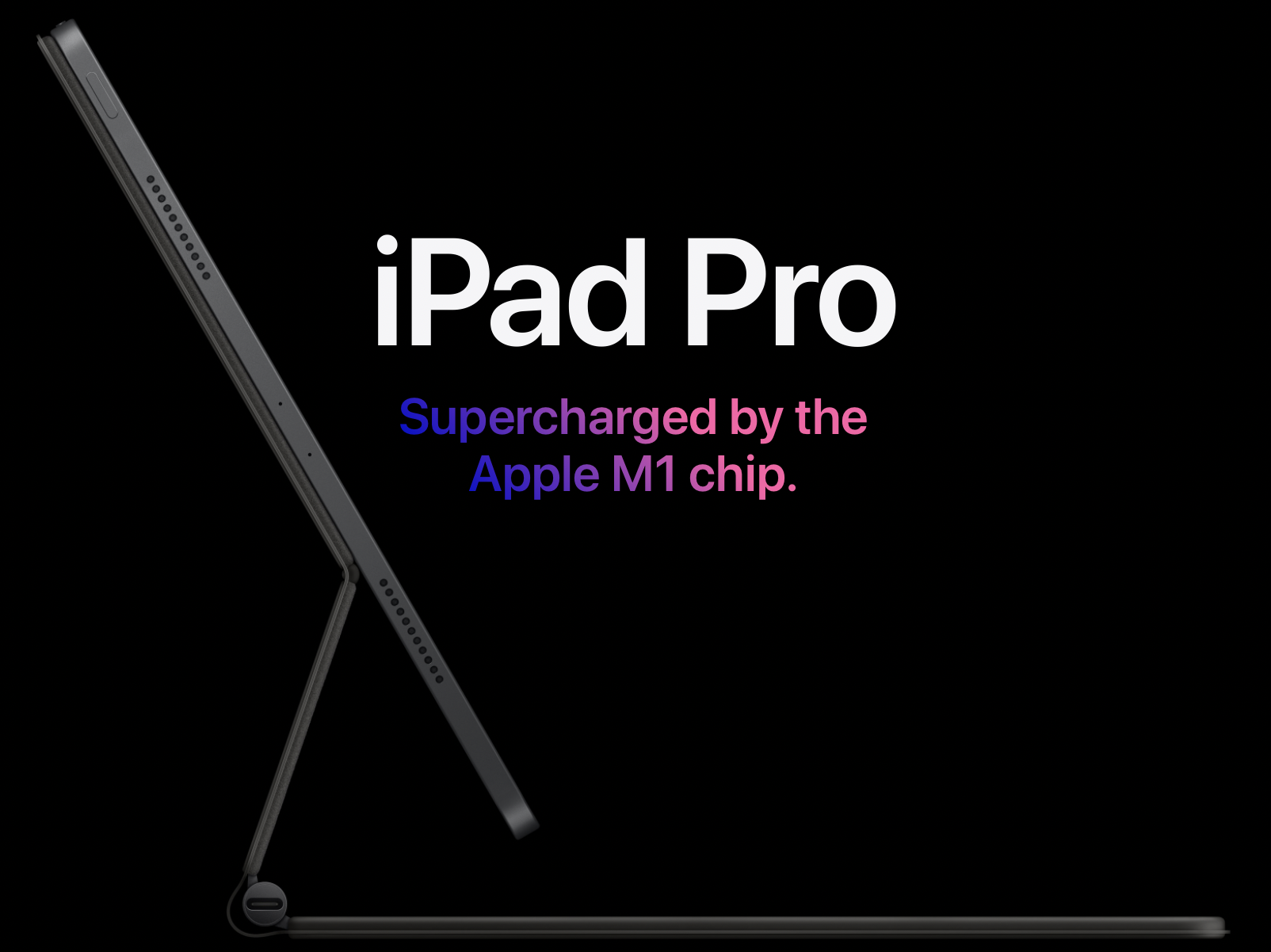
Apple Spring Loaded Event with New iMacs, iPads, and iPhones - Who Cares?
Our new episode of Theotek covers the Apple Spring Loaded event where Apple announced iMacs, iPad Pros, and more. Find out what Rick and Kevin thought and hear the opinions of their two guests.
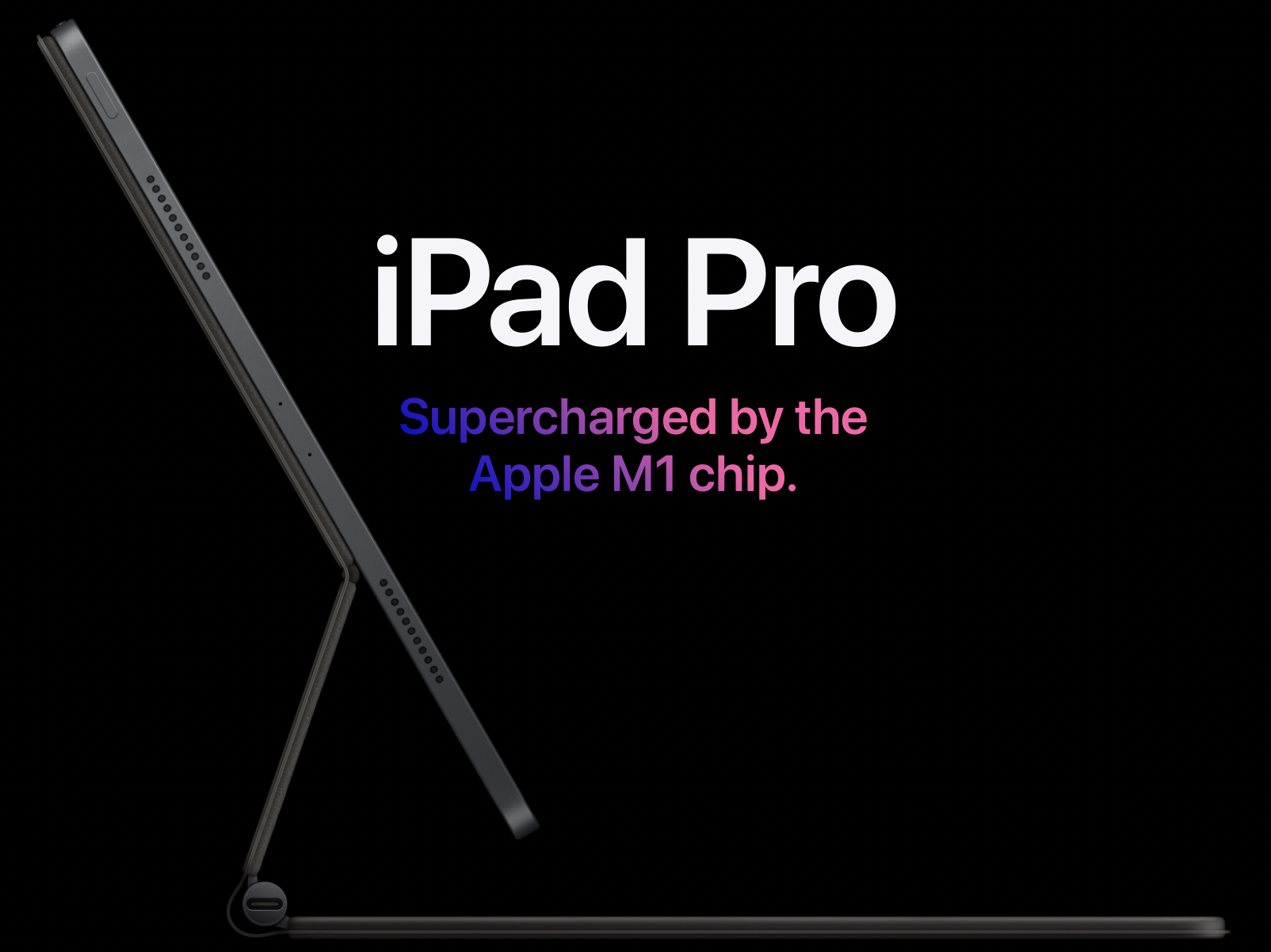
On Tuesday, April 20, 2021, Apple released their Apple Spring Loaded announcement video in which they showed off a lot of new tech toys. We saw a set of new colorful entry-level iMacs with the new M1 chips, an incredibly thin design that makes it look like an oversized 24-inch iPad on a stand. Also, they showed off an updated 2021 iPad Pro in both 11 and 12.9-inch sizes. They boosted the quality of the displays and added a Thunderbolt port for high-speak communication with displays and storage.
Apple Spring Loaded - Theotek Episode #002 with Kevin and Rick
My friend Rick Mansfield and I released our second episode of the new and improved Theotek, a podcast about ministry tech made easy. This show covered all things Apple Spring Loaded.
We invited our friends, including Antoine Wright, who works with government agencies designing websites and user interfaces. LaRosa Smith also joined us. He now works as a contract designer of Bible study books for companies like Olive Tree Bible Software. He just published his second book, Bible Study Tips, which carries the same name as his YouTube show, in which he teaches the Bible and how to study the Bible. Here's one of his videos below:
Theotek Facebook Page

Please consider going over to our Theotek Facebook page. Due to naming rights, we call ourselves Theotek Media over there. Please like the page.
In the future, we plan to do a live feed of us recording our podcasts. You can watch all the fun behind the scenes as well as hear our content live. Use the above link or search for TheotekMedia.
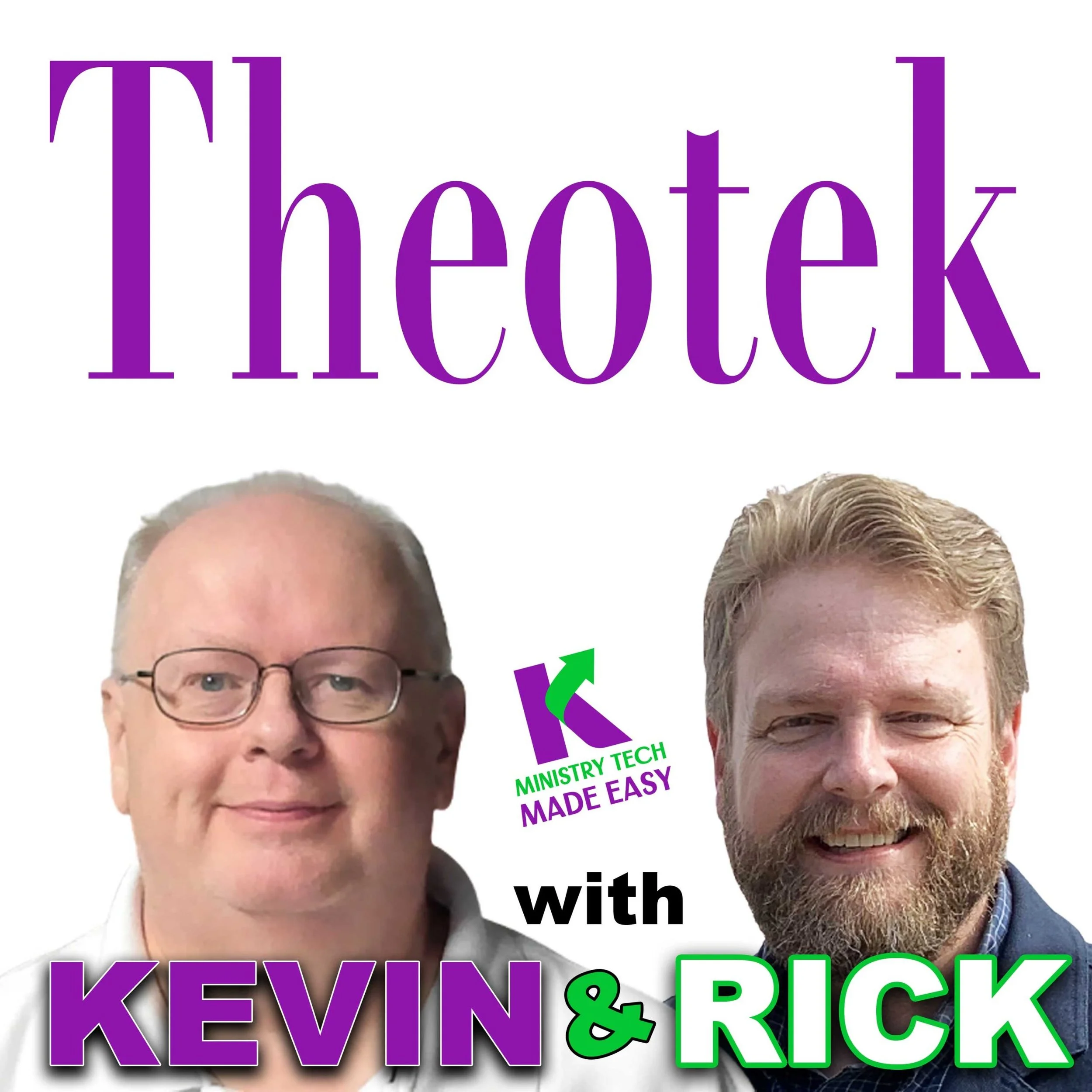
The New Theotek is Back - Find Out Where You Can Listen
The new Theotek is back. This time we're going all-in with an audio podcast only. No video this time around. Find out where you can find us and what's included.
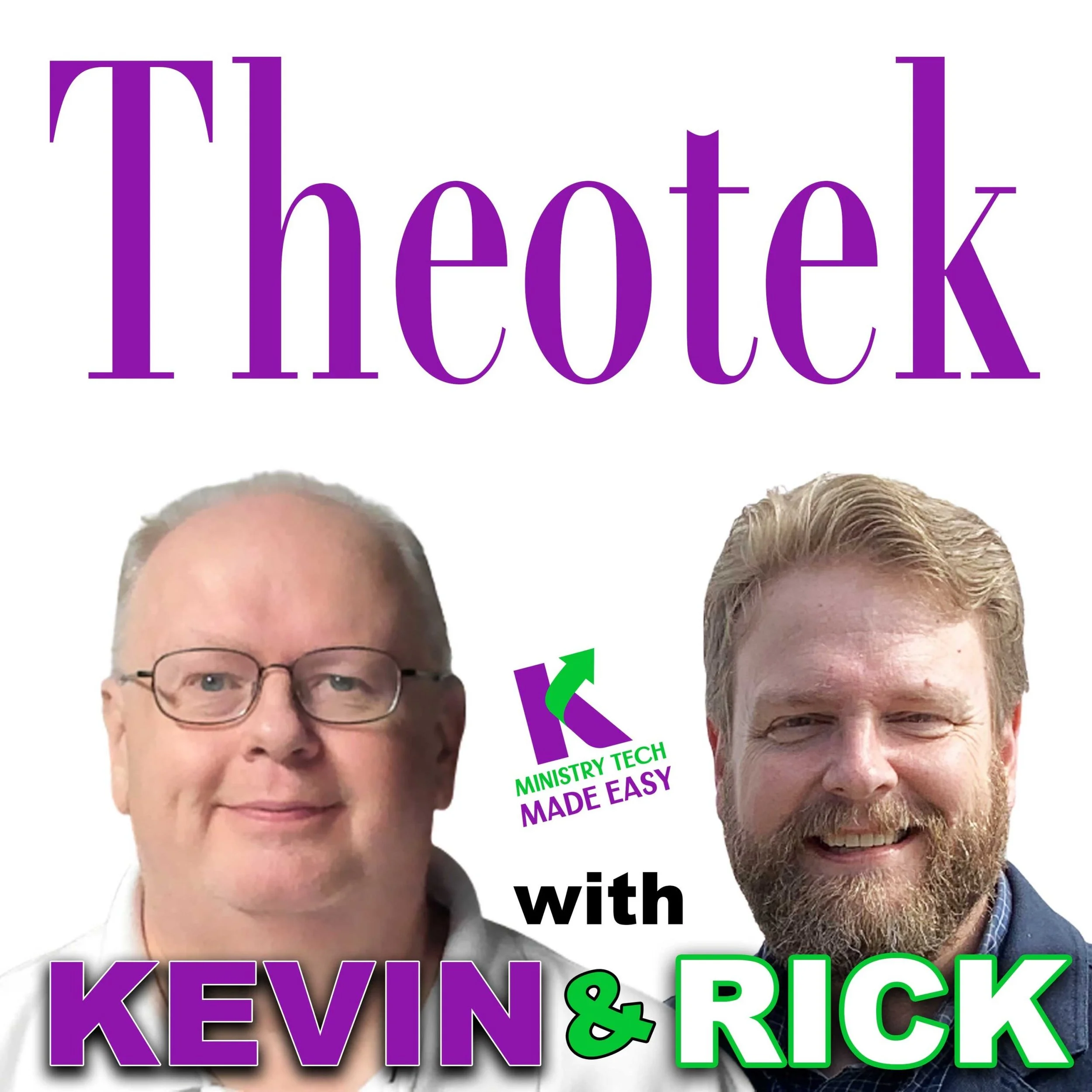
The day you’ve all been waiting for arrived this week with them new Theotek Podcast. I don’t know if it’s 2.0 or 3.0. In fact it might be the fifth iteration. But this time it’s better than ever, simpler, shorter, worth your time. Read on to find out how to find it, what you can expect from each episode, and who you’ll hear as you listen.

Theotek: the New Format and Who’s Included
The original Podcast was a live video format on Google Hangouts that we then saved to YouTube. You can still watch those old podcasts on YouTube. Sort by date and you'll see the videos about 3 years ago.
We also did the podcasts in audio form here on this website and you could find it on Apple and other places. That’s now dead, but they are still available.
For the new Theotek, we're going all-in with an audio podcast. Will we ever go back to video? We'll see. If enough of you ask for it, then sure. We might. For now, it's all audio, and we're hosting it on Anchor.fm.
Now you’ll want to subscribe to the new podcast using many different platforms. Use one of these links below or search for the podcast by Title. If you do that, be careful not to select the old one. The old one is called "Theotek Podcast" with my name under the title, and it's not separated, so you'll see it as KevinPurcell. Don't subscribe to that one. Instead, look for just Theotek, and my name reads as "Kevin Purcell" separated.
This time around, there’s just a pair of us. I’m one host, and Rick Mansfield from Accordance Bible Software will join me. We will occasionally add some of our friends who helped us create the old Theotek Podcast.
Where to Find Theotek
Here’s the list of links to use to subscribe on your chosen platform:
12 Days of Logos Deals and Demo in Logos 9
The 12 Days of Logos brings steep discounts on Logos Bible Software books and tools as well as packages. Use the link in this article to save up to 60%.
Every year Faithlife offers what they call the 12 Days of Logos, where they offer 12 different products for steep discounts. That benefits you if you want to buy any of these 12 products for Logos 9. We'll take a look at them and give you some tips as to which ones you should consider and maybe avoid.
What are the 12 Products Available This Year?
On our list this year, we get some really great books and tools for Logos 9 and Logos Bible Software, which you can use with their latest desktop version of Logos 9 or you can get it on their mobile Logos 9 Mobile app. They also work on the web app.

Here's the list of the 12 products and how much they cost. If you want to buy one of these, I ask you to consider using my affiliate link because it helps me continue my work of writing reviews and how-to articles about Bible software and ministry-related tech topics.
- Bible for Everyone Commentary Collection (35 vols.) 62% off, $119.99 sale price
- Challies Recommends: Best Old Testament Commentaries (55 vols.) 50% off, $442.99 sale price
- Romans-Philemon, 21 vols. (New Testament Technical Commentary Collection) 65% off, $232.99 sale price
- New Studies in Biblical Theology Series Collection | NSBT (50 vols.) 52% off, $299.99 sale price
- NIV Application Commentary: New Testament | NIVAC (20 vols) 55% off, $199.99 sale price
- New International Commentary: Old Testament | NIC (28 vols.) 51% off, $499.99 sale price
- Popular Patristics Series Collection (53 vols) 54% off, $229.99 sale price
- Ancient Christian Reference Collection (55 vols.) 50% off, $549.99 sale price
- Smyth & Helwys Bible Commentary | SHBC (36 vols.) 55% off, $499.99 sale price
- Welwyn Commentary Series | WCS (56 vols.) 60% off, $199.99 sale price
- New Covenant Commentary Series | NCCS (16 vols.) 54% off, $99.99 sale price
- The Life Application Bible Commentary (17 vols.) 60% off, $49.99 sale price
Let me highlight a couple of the above books. I use the New International Commentary: Old and New Testament sets regularly. Faithlife is offering the Old Testament package for only $500, a 51% discount. That's steep. It's both an easy to understand commentary, but has a technical level of information for advanced Bible students and people who teach and preach the Bible.
The NIV Application Commentary: New Testament comments on the text and then offers some practical application to the commentary. This helps the average Bible student or the teacher/preacher alike. You'll pay only $200, a great price for this product.
The Life Application Bible Commentary focuses on real-world use of the teachings of scripture to help Christians in their growth. It comes in at 60% off.
Deals on Logos 9 Packages

In addition to the above tools, you can also get one of the Logos 9 packages available from Faithlife with some deals. Logos identifies them by colorful names like Silver, Gold, and Platinum. You can follow my affiliate link, which gives me a 5% commission to help me continue writing helpful reviews and how-to articles about Bible software and ministry tech.
![Accordance 13 Upgrade with 8 Exciting New Tools [Video]](https://images.squarespace-cdn.com/content/v1/690ba83ee90436386a0306e7/1762379317898-OE0KTDPYUU970RNR91MB/image-asset.jpeg)
Accordance 13 Upgrade with 8 Exciting New Tools [Video]
Accordance Bible Software recently updated their advanced Bible software to Accordance 13. It comes with some incredible new features to make this powerful Bible software package even more useful. Check out the brief descriptions of 8 new features demonstrated in the included video. Mark Allison and Rick Mansfield joined me on Theotek on Youtube.
Accordance 13 Upgrade Demo Video
Accordance 13 Dark Mode

The upgrade to macOS 10.15 Catalina included something called Dark Mode. Accordance adopted this with their software. If you love Dark Mode on a Mac then you'll likely love it in Accordance 13.
The way the company implemented Dark Mode lets you customize it so that if you don't want it in certain places you can turn it off. However, by default the entire user interface will show in Dark Mode when you turn it on.
Dark Mode does not work yet in the Windows version of Accordance. But it should come soon.

To turn on dark mode in Accordance you'll need to first turn it on in macOS System Preferences. Open System Preferences from the Dock or from the Apple Logo in your menu bar. Click on General and then click on either Dark Mode to turn it on all the time. You can also use it only in dark environments by using the Auto setting next to Dark Mode.

Now go to Accordance 13's settings from the Accordance menu in the upper left on your menu bar on your Mac and click on Preferences. Then open the Appearance setting screen in the list on the left of the preferences box. Now click on Automatically adjust to system dark mode. This will turn on Dark Mode if you turn it on in the Mac System Preferences. When you set this preference, it will require you to restart Accordance before it takes effect. Choose the Restart Now button unless you want to wait to apply it the next time you launch the program. After you click Restart Now you will have to click on the OK button to restart the program and you'll see the new Dark Mode.

6 New Themes in Accordance 13
Accordance 13 also adds new themes. These change the coloring and fonts used in the user interface. You can't choose these new themes if you keep the program in Dark Mode. The new Themes will work on Windows.
Switch to a new Theme from the same Appearance screen in Accordance Preferences. On Windows it will show up on the Edit menu. On Mac it's in the Accordance Menu.
Click on the General Theme drop down box (see image above). You'll see 6 options. Click on one and click the Preview button. Now you'll see the new theme applied.
Search Inside Accordance 13 Preferences

The Accordance 13 Preferences contains hundreds of options that the user can change, but finding them can get difficult. When you type in the box it starts showing possible entries guessing what you want. You can click one of the entries in the drop down list and it takes you to that page in the program's Preferences.
Built-in Accordance 13 Tutorials

Accordance has a vast array of Built-in Tutorials ready to help you learn to use the features in Accordance 13. In Windows, click on the Help menu and find Tutorials. A fly out menu shows up with a long list of them. In the top you will see them grouped by Difficulty level. Click on Easy, Intermediate or Advanced to see more Tutorials based on t hose levels of skill.
Below the Difficulty section you'll see them grouped by Topic. Click on a Topic to see the Tutorials related to that Topic.
Highlighting in Accordance 13

The new Highlighting feature brings some exciting new ways to mark up your Bible. You'll see the same old highlighting colors and icons, but now you've got some new ways. You can even use an Apple Pencil, if you own one. We'll show you how below.
Click on the Highlight toolbar button to open the dialog box. On top fo the box you'll see buttons for Highlighter, Pen and Eraser. The first one, called Highlighter shows your usual tools for highlighting words and verses.

The second one is labeled Pen. lets you draw circles and squares to name a couple. The program detects what you're drawing and cleans it up to make it look pretty. Then, if you want, you can also draw straight or curved lines to connect words. You can also draw arrows.
The lines and shapes can get challenging to draw accurately with a mouse or trackpad. A Windows machine with a Pen, like the Surface Pro, might make this easier. You can also use the new Sidecar feature in macOS 10.15 Catalina if you have a recent model Mac and iPad with Apple Pencil.
Eraser does as it says - erase your highlighting. Click it to get rid of hour highlights.
Highlighting Whiteboard Feature

Another Highlighting tool lets you draw all over the place like a whiteboard and marker. These don't get saved, but you can use this to teach with Accordance displayed on a screen or by recording your screen and uploading the video somewhere.
Turn on Whiteboard by checking the little box labeled Whiteboard Drawing to the right of the drawing color options in the Highlighting dialog box. After your done, you can clear the drawings by clicking on the Clear Whiteboard button.
To save the videos do a screenshot and then add that image to an Accordance Note. I'll create a video on this soon, so check back on this page or my YouTube channel for that video.
Accordance 13 Text Search Command

The Text Search command is a new way to enter special search features in Accordance 13. This helps you find things in your grammatically-tagged texts like the grammatically tagged Greek New Testament or BHS Tagged Hebrew Bible. This especially benefits users who don't know Greek or Hebrew because they can search for grammar tags while they're in an English text.
First, open a English Bible with Greek or Hebrew tags like the ESV with Strong's. Then open the Text Search box.

To open the Text Search Command box, go to the the Search menu and find Enter Command in the menu. A fly out menu shows up with Text on the list. Click it to open a new dialog box. Or you can use the Shift+Command+T to open the box.
Now you can use this to search by adding commands to help you find things based on grammar tags. The drop down box at the top lets you search in various Bibles. Pick a Greek or Hebrew Bible with grammatical tags like the Greek NT Tagged.
Now you'll see that both the Enter Command and Enter Tag boxes are active. They are drop down boxes that let you add either kind of search feature to the search box. Perform your search now using one or both.
Accordance 13 Amplify to Constructs
There's another new way of searching called the Amplify to Construct feature. This feature lets you create really complex searches using a graphical user interface.

Access this feature by selecting the some text that you want to search, like "God of peace" found in Romans 15:33. Select it and right-click and choose Construct and then choose one fo the four options. You will only see Word if you are using an English Bible with only Strong's tagging. You can also find this by using the Amplify menu and choosing Construct.
This opens a new dialog box that lets you change the search and add more features to your search. We don't have to room to show you all that this can do, so be sure to watch the YouTube video at the top where Rick Mansfield demonstrates the feature more in depth.
PDF Import in Accordance 13
Now users can import their PDF documents into Accordance 13. This is not perfect but works well with simple PDFs.

Import a PDF document by clicking on the User Tool button on the tool bar. If you don't have it, add it by right-clicking the tool bar and drag the button to the tool bar. A menu pops up and you'll choose Import... from the list.

Users can also import using the New menu. Click it and choose Import User Tool....

Regardless of which method you use to start the import process, it will open a new Import to Tool dialog box. In the drop down box at the top select PDF and then OK. The program will give you a copyright warning. Click OK and find the file on your hard drive.
After it imports the Accordance 13 displays the new User Tool. You can edit it just like you do any other tool or your notes.
Mouse Over Highlighting Between English, LXX and Hebrew Bible
Now with Accordance 13 you can open an English text with tags, a Hebrew Bible and the LXX and as you select a word in Hebrew it will show you that word in the other two.

Open a tagged Hebrew Bible, a Septuagint that's also tagged, and an English Bible with tags. Then hover over a Hebrew word and see what word that corresponds to in the Greek and English.
This helps users study Hebrew and Greek words even if they don't really know Hebrew or Greek.
Logos Sermon Prep Part Five: Taking Notes for Observations and Questions
Logos Bible Software helps preachers and teachers prepare their messages thanks to some useful Logos sermon prep tools, but the Notes feature gets more use than any other feature besides offering a library of Bibles, books and reference books. I use Notes extensively for the following:
- Recording my thoughts about a text.
- Keeping rack of ideas for how to preach a passage.
- Record things learned in research of a text.
- Write down questions I need to research.
I use a process called Inductive Bible Study in my Logos sermon prep, where the student reads the text and thinks about the context of the passage before every consulting third-party tools like lexicons, Bible dictionaries, atlases, concordances and commentaries. Those tools help me check my conclusions, find information I couldn't get from my simple observations and learn about things like cultural backgrounds, geography, and language studies.https://www.youtube.com/watch?v=MzyYMcxTIzc&feature=youtu.be
Taking Notes in Logos Sermon Prep
Bible software notes attach text and more to a specific word, phrase, verse or passage. Some programs will also let you record them as topics unattached to anything in a book. In Logos, you can also add notes to other kinds of books and even to tools, like a Passage Guide generated for a passage of Scripture.I attach notes to the passage I'm studying, a range of verses or a single verse. I almost never attach them to a single word in a verse, but you can if you like.Logos lets users create a new Note document for each message or keep on document for all notes attached to a book or the Bible. If I were starting over today, I'd attach one note to each book of the Bible. Instead I have a large notes document called Bible Notes and record all of my notes in that document. I create other documents for other books I read.
Creating and Using the Notes Document in Logos
 To get started, create a new note document, if you don't already have one you want to use. Open Logos and then click on Documents from the toolbar. Then in the window that pops open click on Notes. A new window opens with the new notes document in it. It has the title "Untitled Notes". Click that name in the new document and it turns into an editable text box. Give it a name like Sermon Notes or Ezekiel Notes. I call mine Bible Notes.The ensuing Notes Document will look like a simple word processor. It has the same control box in the upper left corner that all Logos windows show. Click it to see the menu that pops up. Users can sort their notes using different things like name, reference, and date to name a few. This also lets users print their notes or export the note as a passage list or sermon document.
Purpose of Making Observations
After I read and re-read my passage, I take notes on the passage using nothing but the English text at first. I do my language study at a later date. This has a few benefits.
- My first thoughts are not clouded by the views of another researcher.
- This lets me think through the text for myself with the Holy Spirit's inspiration only at first.
- I am going through my passage again, which helps me to internalize the message of the text.
What kinds of observations do I make? I record thoughts and ideas about almost every word in a verse. Let's take John 3:16 as an example.
John 3:16, CSBFor God loved the world in this way: He gave his one and only Son, so that everyone who believes in him will not perish but have eternal life."For" connects this verse with the previous passage. This tells us why Jesus was "lifted up" (John 3:15).God is the one who actively showed us his love in the work he did in giving us his son.The term "loves" shows this is an ongoing, active love. Is this present tense and from agape?God's love is directed not just at his people or Christians, but the entire world. The world refers to all of humanity making his love universal even if salvation isn't universal.How does he show that love? "In this way" denotes the means of his demonstration is presented in the ensuing phrases.
The above observations only cover the first part of the verse. I will go over the entire verse putting a note for nearly every word and definitely every phrase.The underlined part of the observations shows a question that I will need to find an answer by doing a word study of the word "loved". It's a good idea to mark the questions so you can easily find them in your research phase. When I do the research, I will add the answer either replacing the question with the answer or putting the answer right after the question and then removing the marking (underlining in this case).Finish this step by going through every word or phrase in your passage. I also add a note to the entire passage by selecting the range of verses and choosing adding a single note to all the verses using the steps below. In that passage note I will write about the context of the passage showing how it fits in the chapter, the book and the entirety of the Bible. I'll also give a brief outline fo the passage showing the flow of thought. Later I'll come back to this note and record my passage Big Idea.
Working with Notes Documents in Logos
 When you discover something you want to record in a note, create a new note for that verse, word or passage. You can do this by selecting it and right-clicking it. Then choose either the "selection" or the passage in the right-hand column of the pop-up. Use selection (the top item in the list), which shows the text of the words you selected, if you want to add notes to those words or a word and not to a passage. The note will attach to that translation of the Bible only. For example, I've got the Christian Standard Bible open above. If I open the same passage in the KJV, that note won't show up because it's attached the note to the words I selected in the CSB and note the verse reference.To add the note to a verse reference that will show up in any translation that includes that verse, choose the reference. It will attach the note to say John 3:16 instead of that translation of John 3:16. That way when I close CSB or open KJV the note will still show up.After you pick between selection or the passage, click on Add note, Add note to "Bible Notes" or Add community note.
- Add note - this is a new feature that relates to the new Notes features that Faithlife is adding to Logos. These notes will show up in the desktop, the mobile apps and the Logos Web app. Logos is in transition and the new notes feature will become the default soon. Some users might not see this yet in their installation of Logos. You can convert your old notes to the new version when it ships in the final form. For now, I'd avoid this I you don't use the web app.
- Add note to "Bible Notes" - you will add your note to the Notes Document you created above. Its title will show up instead of "Bible Notes". If your preferred Notes Document doesn't show up in the pop-up, then open the Notes Document first from the Document's menu.
- Add community note - Community Notes are public to all people who use them. You can turn these off or on from the Visual Filters toolbar button in the Bible's window. It looks like three dots arranged in a triangular shape (see below).
 I add all my notes to my "Bible Notes" document and will convert them later when the new notes feature gets launched. I'll write a full review and how to article about the new notes feature when it ships, so keep an eye out here.
Other Ways to Record Thoughts and Research
In addition to a Notes Document, users can record research or thoughts using other kinds of documents in Logos. I don't use these features as much, but other users swear by them and use them more than notes. They include...
- Clippings - select text from a commentary, dictionary or other reference tool while studying your passage and shave it to a Clippings Document. Think of this like note cards that you used to use while researching a paper in college or seminary. Clippings helps copy a bunch of snippets of information from other books. At this phase we're focused on the Bible text only, so it's not the best tool for the Observations phase of inductive Bible study.
- Passage List - keep a list of key passages. You might use this to keep cross references from a search performed on a word in your passage.
- Sermon - write your sermon within Logos and then export it or preach from the document in the mobile version of Logos. You can also convert a Notes Document into a Sermon Document.
- Word List - Like a Passage List, but for Greek or Hebrew words instead of passages. Make a list of every theological term in a passage to help you know what word studies you need to do after you've finished taking notes on the English text.
Logos Sermon Prep Part Four: Text Comparison Tool in Inductive Bible Study
The next step on Logos Bible Software Sermon Prep helps us actually learn what the passage we've selected means by reading it repeatedly using the Text Comparison Tool. We're talking about Inductive Bible Study.
What is Inductive Bible Study?
 The phrase Inductive Bible Study refers to studying the Bible hoping to discover the meaning of the text without any prejudices or preconceived notions brought to the task. Seminary students will remember studying the terms eisogesis and exegesis. We call Inductive Bible study exegesis in scholarly circles. It means studying the text and discovering the meaning based on the words, concepts, setting, writer's intent, audience and context. Eisogesis is the opposite. If a student fails to let the word speak for itself, then they might read into the text what's not really there.A lot of heresy comes from eisogesis or reading into the text what's not there. We take verses out of context or don't study them based on the original author's intent, context, setting or the meanings of terms used that we might misunderstand in our time.Inductive Bible Study leads me to discover what God's saying to me and my audience. That's why it's the best approach to Bible study for Logos Bible Software sermon prep.
Theotek Podcast
https://youtu.be/Jx-PYaR_y0o
Steps of Inductive Bible Study in Logos Sermon Prep
You can do Inductive Bible Study using physical books and a notepad or you can use any competent Bible software. Logos Bible Software helps us study the bible inductively thanks to a number of tools. This part focuses on the Text Comparison Tool. The full list of Inductive Bible Study steps include the following:
- Reading the text repeatedly
- Observing what's in the text without any other tools at first
- Ask good interpretive questions
- Diagram the sentence in Greek, Hebrew or English to see the structure of the author's thoughts
- Find answers to questions and check the accuracy of our observations using the tools in Logos Bible Software
- Discover the Big Idea of the text
We started the process with selecting a text covered in three steps (first, second and third steps). Now, it's time to read it repeatedly and we'll show you how using Logos.
Read the Text Repeatedly
We're going to work with Ephesians 1:3-14 as our text. I'm teaching through the passage during my Wednesday night Bible study at church. We already talked about multiple tools and ways to choose the text, so for this step, we'll assume that's a good text to choose, especially since it's one long sentence in Greek.Start by opening your favorite translation and prayerfully read though it in your favorite translation. I say "prayerfully" because you should begin by asking the Holy Spirit to guide your study.You should probably also read the text in context.
- Read the entire chapter.
- Read the whole book if it's not too long - Paul's letters, the Pastoral Epistles, shorter prophetic books.
- Read sections in longer books like the chapters before and after at least.
Use Multiple Translations
 Read the passage itself in a few translations. I always use ...
- Christian Standard Bible - This is my favorite translation. Below I'll explain the value of various translations. I like the CSB because translators targeted a readable translations that's as close to word-for-word without sounding too wooden.
- English Standard Version - A slightly more literal translation that is also very readable.
- King James Version - The standard that most people grew up with in my church and is often the most recognizable translation for popular passages. It's more literal.
- New American Standard Bible - A very literal and highly accurate modern translation. I prefer the 1995 update.
- New International Version - Not a paraphrase, but the translators focused more on readability than literal translation. I prefer the 1984 version.
- New Living Translation - The old Living Bible was a paraphrase, but they updated it in the 1990s and went for more of a translation. However, it is the least literal of these translations with a thought-for-thought approach.
The Range of Translations from Literal to Readable
If you think of translations or paraphrases as sitting on a spectrum, then put the original Greek or Hebrew text to the left of the range. Translation that sit closer to the Greek or Hebrew text show up on the left. We call these "word-for-word" translation. Above, I mentioned that I use the KJV and the NASB in my reading to get this more literal look at the text in English.On the opposite end of the spectrum you find the paraphrases, like the Living Bible, the Good News Bible, The Message or the Amplified Bible. We call these "thought for thought" translations. We use these translations almost like commentaries. They helps us get an idea of what the passage means, even though they don't show us the word-for-word translation of the text.Most modern translations sit closer to the middle of the spectrum between literal and non-literal. Translators like to use the word dynamic or dynamic equivalent. That's a marketing term that makes the ESV, the NIV, and the CSB sound like they're equivalent. They're not as literal as the KJV or NASB, but not as interpretive as a paraphrase like the Living Bible or The Message. See this spectrum for many translations in the image below. The Eccentric Fundamentalist offered this nice graphic, which illustrates where the various translations sit on the spectrum. I don't endorse all that the author says about the translations, but I really like the graphic shown above.
The Text Comparison Tool
How do we read the passage repeatedly using Logos Bible Software tools? You could open the passage in about five or six translations and read them. However, we can do better than that using a tool called the Text Comparison Tool. Before we do, let me suggest setting up a Layout as follows. First, start with a blank layout. Click on the Close all panels button (see above). It looks like a small X inside a circle between the Layouts button and the question mark help button on the right end of the Logos Bible Software toolbar.
 Next, open the Text Comparison Tool from the Tools menu. You now see a screen that shows your top five Bible translations in vertical columns. To change what you see in the columns, click on the hyperlink in that window's toolbar just right of the reference box. A drop down menu appears.
- Type in the text reference in the reference box.
- Click on the hyperlink next to the Text Comparison Tool window. A drop down menu like the one above appears.
- Type in your translation abbreviation.
- Click the box to put a check mark in it when it appears at the bottom of the drop down menu.
- Repeat this until you have all of your chosen translations in the Text Comparison Tool's toolbar above the drop down.
You will see a window with all of your chosen translations in the order you added them. You can now read through each column. However, you might want to see the differences between the various translations. To do that quickly, Logos gives you three options in the Text Comparison Tool.
- Show differences - toggles whether to show or hide differences between the various text compared to the base text (left most translation).
- Show base text - toggles between showing the wording of the base text next to the text of each translation or just show a red circle next to the words that are different from the base text.
- Shows the comparison in either columns or as interlinear. You must certain translations as your base text for this to work. For example, the KJV works fine as seen below, but the Young's Literal doesn't.
 The above shows the Interlinear style Text Comparison Tool. It has the Show differences turned on. Without the Show differences, you'd only see the text without the base text showing up next to the wording that's changed in each row.
 Notice how there's a little red dot next some of the words in the NASB95 column above. This denotes a difference between this translations and the KJV1900 base text.
 In the image above we see the texts in column style. I turned on the Show differences toggle and it puts the words of the base text (KJV1900) next to the words in the NASB95 with a line through them. As an example, in verse 3 we see the word "
hath" with the line through it next to "has" in the NASB95 column.
Save a Layout in Logos
 Now that we have the Text Comparison Tool set up the way we want it, let's add our favorite translations and a Notes document window. Arrange the Text comparison Tool the way you want it. I have it across the bottom half of the screen. Open your favorite Bible. Then open a Notes document. You will use the notes document to record any observations you make you as reread the text repeatedly in your various Bibles.To open a Bible, click the library button and then search for your translation by typing in the abbreviation. Click the title of the translation when it shows up and it will open. If you already have a preferred Notes document, open it from the Documents button on the toolbar. Type the name run the search box. Then click on the title to open it. Now arrange the Bible and the notes document the way you want. You can create a new one for each sermon or for all of your notes in a book of the Bible, the New Testament in general or for the whole Bible. I don't recommend the last one. Your document will get too big.
 We'll save the layout. Click on the Layouts button on the top right of the Logos Bible Software toolbar. In the drop down window, click on Save as named layout. A box opens right there. Type your name and hit Enter.From now on your can open this layout by clicking the Layout button on the toolbar. Then click the Saved Layouts in the column on the left. A list will pop up. Click on the name of the layout you saved in the step above.Now read through the text in each column. If you want, record your thoughts about the differences between the translations by create a note on each verse, for a single word, or for the entire passage. I do this by right-clicking the verse in my favorite Bible. A menu pops up. Select the verse reference in the right column of the pop up menu. Then select Add a note to "your notes document". A new note will show up in the notes document window. Start typing in it.
Next Steps
In our next few parts to this series, we'll look at recording observations in a notes document. You already started this as you reread the text. Then we'll look at questions that the text might present. You'll record those too and start to look for answers in the phase after our inductive study. In the last part of the inductive study, we'll create diagram or outline of the text.
Logos Bible Software Sermon Prep Part Three: Concordance Tool
We've already looked twice at the topic of choosing a text, but let me take a third swing at a tool that you should consider using for Logos Bible Software Sermon Prep. We'll take a look at the Concordance Tool in this third part of the series. I began looking at picking topics and picking passages in parts one and two. Now, how can the Concordance Tool help us in choosing passages to preach or teach.Here's the secret of this powerful tool...
The Concordance Tool Video
My video below shows the basics of the Concordance Tool in Logos 7. https://www.youtube.com/watch?v=asQzvrTeMc4&feature=youtu.be
Benefits of the Concordance Tool in Logos
You may need to put away the old idea of a concordance while still using the principles to figure out what it does. The Concordance Tool, like a traditional Concordance, lists every word in a Bible translation, but here's the cool part of the Logos 7 Concordance Tool. You can change the list based on your own limitations and even use it to create a "concordance" for books other than Bibles. I used to own a hefty NASB Exhaustive Concordance (see above), since that was my favorite translation when I began preaching. I stopped using the huge physical book because Bible software is an exhaustive concordance by itself and its far more convenient than a 5 pound book. So why do we need a tool in Logos or any other program that calls itself a "concordance tool"?First, the Concordance Tool is customizable. I'll show you how to do that below or watch my video demo above.Second, users can create lists of Greek or Hebrew words even in an English Bible if. The tool uses the Strong's tags to do this.Third, you can also index more than just the English words of a Bible translation. It creates lists of other things like lemmas, roots of words, and Biblical entities like people, places and Biblical things. You can even search for references which are tags that link to other books, like a Bible reference in a footnote or in a Concordance or maybe even in a Christian Living book, like something by a popular author.The benefits listed here means the Concordance Tool helps us with picking a passage to preach because we can choose to teach or preach on a particular topic by opening the tool and searching for the most often used words in a book of the Bible. Let's say I want to focus on the idea of redemption, but I don't want to do a topical study of redemption. I want to select a series of passages that focus on the idea or subject of redemption. I could just search for redemption in the Logos search tool. But if I open the Concordance Tool, I can learn one particular author repeatedly discusses redemption.
How to Use the Concordance Tool in Logos
To get started open the Concordance Tool in Logos from the Tools menu. You'll find it in the second column under Reference. Click it to open it. The tool shows the last report generated or runs one if you haven't already used it.
 At the top of the window you'll see the book control drop down that usually shows the cover of the book with a small down arrow to the lower right corner. Click it and you'll see controls like the text size slider, the Find command, print, and the Close command among others.Next to the book control menu you'll see a link that shows the present book or Bible translation (see below). Click that Resource Reference link to change it. The Resource Reference search box shows up with a list of all library resources that you can use to run a Concordance Tool report. You can use a Bible in English or Greek/Hebrew. You can also run a Concordance Tool report on other books like commentaries or books by a single author. This results in an index of all the words in that book, if you do a Word report. More eon that below.
 Let's say you want to work in the NASB 1995 Update. Then, either find the book in the list or type in NASB in the search box and it will show all books with your search string in the title. Click to open the Concordance Tool using the book.
 Next you'll see what to index with the Concordance Tool. Click on the second link over (see above) to create an index. You can create one using one of the following:
- Word - the basic tool that works like a traditional concordance.
- Lemma - finds lemmas instead of words
- Root - finds roots instead of words or lemmas
- Sense - finds senses instead of the above
- Biblical Entity - finds persons, places, things, artifacts or measurements
- Reference - finds reference links
The last link lets the user narrow the search range. For example, in the screen shots here I've run the tool on the NASB 95 Update translation. So, when I click the last link it offers to let me narrow the range from All Passages to just ports of the Bible. You can pick your most recent passage selections or the common ones found in Logos. You can also create a new one by typing in the range at the box below the list labelled New reference range. If you plan to use that range again, give it a name in the Title box below the range box and then click the Save button. It will now show up in the list above the boxes.Along the left there's box that lets the user limit their Concordance Tool index. It's called the REFINE box or section. This changes dynamically based on what you've selected in the three drop down boxes at the top. For example, the index below shows the NASB95 Update with a Word index of All Passages.
 Along the left you can refine the search by omitting things, choosing certain languages only and searching in only parts of the text. So let's do an index of only English by clicking on English. Then only index the Words of Christ and only the Gospels (from the top).
Using Concordance Tool on Commentaries
You can use the Concordance Tool in a commentary on a book to find out what the commentary author seems to think is the most discussed topic. Run an index on a commentary on a particular book of the Bible. Then refine the search using the Refine box on the left. The index Logos creates will show what words the commentary uses most. Look for key theological terms to help you see what that commentary author focused on in that book. This can help you find passage in that book that cover that topic.The index above shows that I ran the tool on a commentary on Matthew. I refined the search to show English only and then limited it also to Heading Text. This shows that there are 6 headings in this commentary that talk about healing. A good sermon or Bible study series might be the healing stories in Matthew. We also see 4 headings with the word Blind in it. Could you do a topical study on Jesus giving sight to the Blind? Those are a couple of ideas.Use this same technique with any book in your library. This will help you find illustrations too. We'll cover that more when we get to the topic of adding illustrations to our sermons and Bible studies.
How This Helps Find Texts to Preach
So why would I use the Concordance Tool for helping find passages to teach or preach?The resulting index (see screen show above) shows the words or word groups (take a look at the second hit, a word group) that show up most in our refined search. If you click on the arrow next to a word, then you'll see a list of the passages that include that word or word group. The image above shows the list under "come comes; coming" which is the fourth most used word/word group in this refined index. So maybe, you'd want to do a sermon series on Jesus is Coming and select passage about why he came, when he might be coming back or what he said about his second coming.Drop down a few and you'll see the word group "go going" which you can also do a similar series but on why we should go or how Jesus wants disciples to go on his behalf.
Using Scrivener to Write Sermons
Preachers use different tools to write their sermons, from Microsoft Word, a simple text editor, word processors built into Bible software or something like Scrivener. Wes Allen, one of the Theotek Podcast contributors and American Baptist Church pastor, uses Scrivener to prepare his sermons. We talked about his workflow and why he uses the program in a recent Theotek Podcast that we recorded live on our Theotek Podcast Facebook page.Scrivener is a word processor. That's the simple way to describe it, but there's more to it than that. Some people think of the program as a tool for writing books or long form documents, like a doctoral dissertation. Wes uses it that way, but also uses it for shorter form documents, like his weekly sermons. That's because the built-in organization and writing tools work better for him that what most preachers probably use - Microsoft Word.https://www.youtube.com/watch?v=SHDYJdkAAic&t=30sPlease watch the video above from our YouTube Channel. In it Wes talks about...
- The way to format text using styles
- Setting up templates for outline forms
- Using the dual pane view to see the text of the sermon next to the other documents
- Organizing the files and folders
- Exporting for use in preaching and writing books from a sermon series
... and more!
Scrivener Organization for Sermon Prep
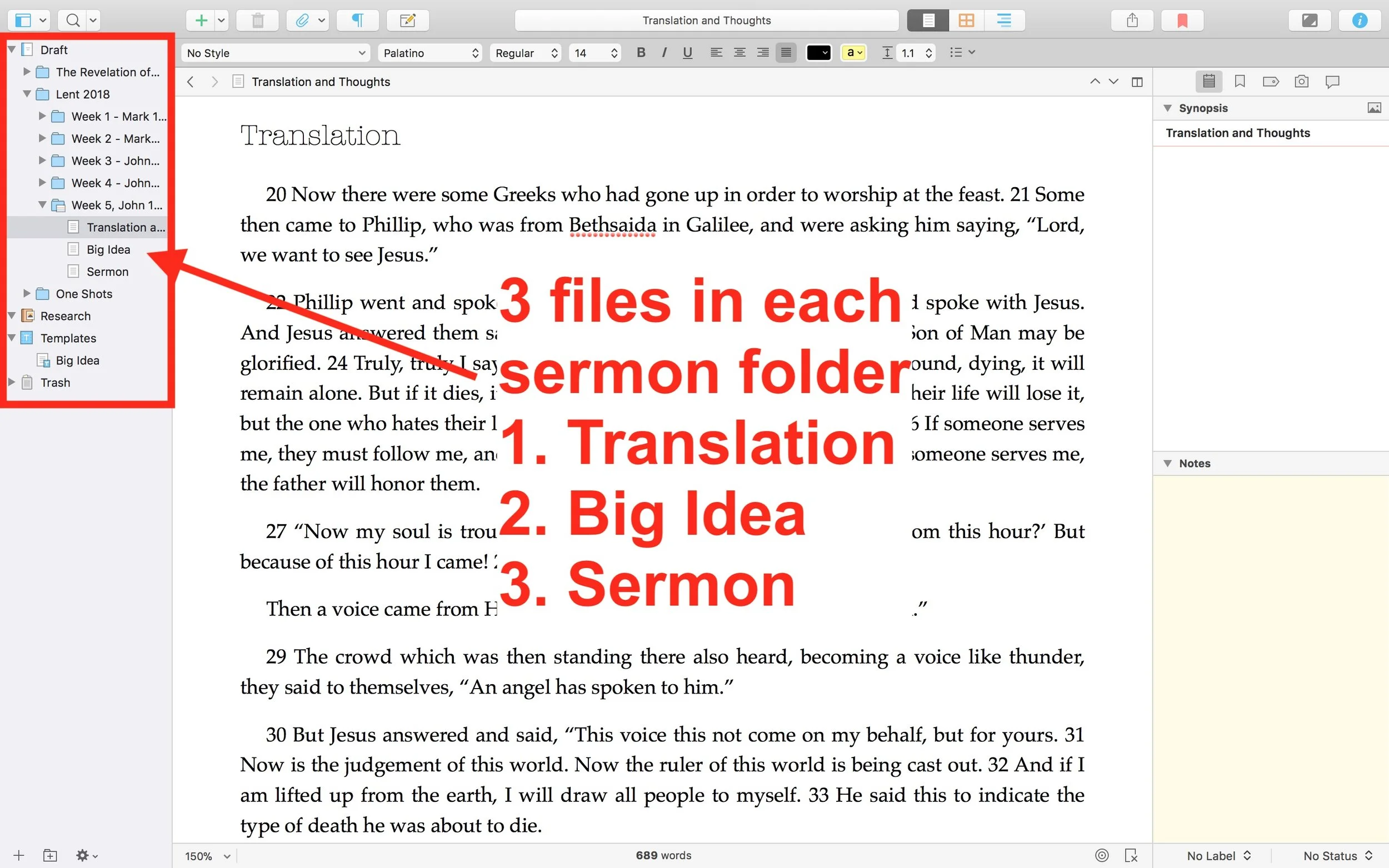
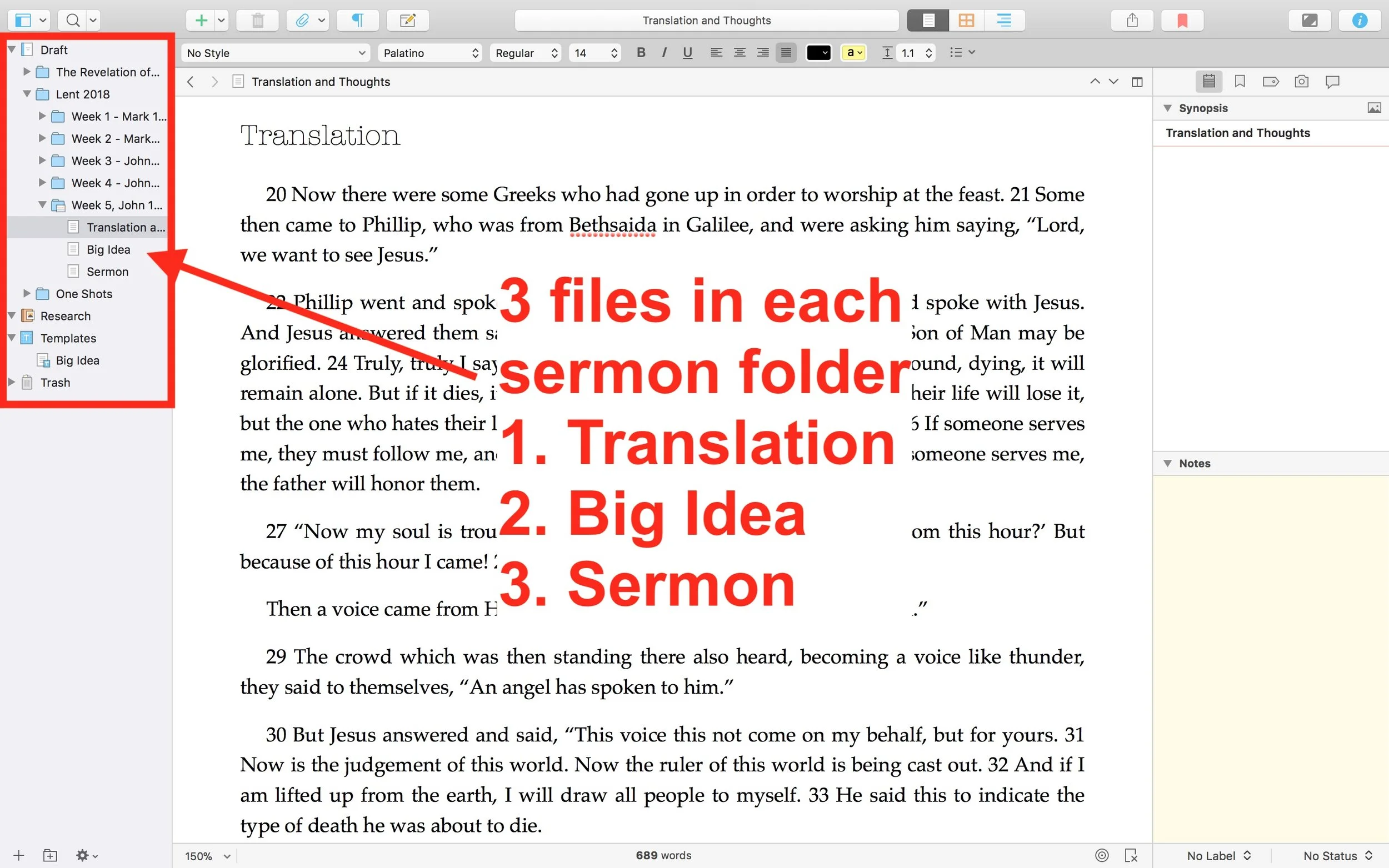
 He uses one Scrivener file per year. He then creates folders inside Scrivener for each sermon series or season. This lets him organize things easily within Scrivener. Under each series or season, he creates folders for each sermon. Then in those folders he places three documents (see image above).
- Translation of the primary text - he creates his own translation of the Greek or Hebrew text.
- Big Idea - the main idea of his message explained in a single document.
- Sermon Text - this document where he writes the sermon itself.
My Scrivener Organization
I really like this way of organizing each sermon. However, I don't do a full translation of my sermon. So I might organize things in Scrivener similarly, but in a slightly different way that better fits how prepare my sermons.First, I will organize my sermons around sermon series instead of year. That's because I sometimes preach through a book of the Bible and this might take more than one year or I might start it in September, take a break for the holidays, and then go back to it in January. Organizing that series by year would break it into two files. So, instead, I'd create a Scrivener file for First, Second and Third John, the last sermon series I recently finished just before the Easter season in February.Next, in each sermon folder I plan to create one Scrivener document for study notes called Text Notes. I create these notes in my Bible software while I'm studying the text. Then, I'll copy and paste the text of the Bible passage and the notes into the Text Notes document in Scrivener. I usually use one of a few sermon outlines and I will create templates in Scrivener (see the video to see what I mean by templates) for each of these formats.
- Motivated sequence
- One-point inductive
- Negative options indicative outline
Motivated Sequence Outline
A Motivated Sequence outline comes from the book 12 Essential Skills for Great Preaching by Wayne McDill, my seminary professor who taught at Southeastern Seminary. Here's the outline for this kind of sermon:
- Attention Getter - a way to grab the audience's attention with an anecdote, controversial statement or quote, joke or video.
- Need Element - some call this the Fallen Condition Focus; it's a way of showing the way the passage deals with our problems, which draw people into listening to your sermon and show the answer from the passage.
- Solution - the body of the message will offer the solution to the need mentioned above with as many outline points as needed to cover the ideas in the passage.
- Explanation - explain how text solves the problem.
- Illustration - illustrates the meaning of the text's main ideas and illustrate how to put the ideas into action.
- Proof - shows that the ideas are true since people don't just assume that the Bible is true like we believers do.
- Application - clear and concrete ways to apply the ideas presented.
- Visualization - show what the solution looks like with an illustration, story or video that helps people see how to apply the message.
- Appeal - tangible way or ways that the audience can respond to the message with specific and concrete steps.
Inductive Sermon Outlines
The other two outlines I use are inductive outlines. They both offer a single main idea. The one-point inductive approach will follow the outline below:
- Grab attention.
- Share a need that the passage solves.
- explain that need
- illustrate how that need affects the hearers
- Explain how the how the passage deals with the need.
- sharing details first
- then offer the main idea
- Illustrate how that passage solves that need.
- Prove the idea
- Apply the passage's solution in that Big Idea with an appeal to the audience to do something with the idea.
The last outline follows a negative solutions offered by people and then turns to the way the passage shows that God solves this problem. It is also inductive and a single main idea presented after exploring some ways the humans try to solve the fallen condition focus. These come from the passage just as the main idea.
Logos Bible Software Sermon Prep Part Two: Choosing a Text to Preach
Many preachers prefer to preach a topic found in multiple texts that the preacher expounds during a single sermon. I prefer to look for a single Bible text and that one text will dominate the sermon. In this second part of our series on Logos Bible Software Sermon Prep, we'll look at how the program can help the preacher choose a text to preach an expository sermon. The first part focused on using Logos to find a good sermon subject, for Topical Preaching or Topical Textual Preaching.This method of preaching will dominate the rest of our sermon prep series.
UPDATED: I added the Lectionary Tool at the end of this post.
What is Expository Preaching
I don't have the space look at the benefits of expository preaching versus topical preaching. Check out Lifeway's helpful list of 9 Benefits of Expository Preaching by Tony Merida. However, let me quickly define what I mean by this. Expository preaching includes the following:
- One single text dominates sermon's content.
- The main message comes out of the text. Some call this the Big Idea, as Haddon Robinson did in Biblical Preaching.
- The text will also dominate the tone and style of preaching. Poetry should have a poetic feel while narrative should include the story as a primary part of the sermon. Positive tone should not result in a harsh sermon.
- The preacher will explain, illustrate, prove and apply the Big Idea of the text while preaching that text.
What Kind of Text Are You Looking For?
Your expository preaching can include the following:
- A single passage or pericope of scripture, like my sermon this week on John 13:31-35.
- Part of a book like The Sermon on the Mount or Jesus' Farewell Discourse in John.
- A full book of the Bible like John's Epistles.
I've preached through all three taking anywhere from a single message to multiple years. This week I'm preaching on John 13:31-35 but I'm not preaching through John or through one section like the Farewell Discourse of Jesus in John's Gospel. I've preached through the Sermon on the Mount, but not through the book of Matthew ... yet. And last year I preached through John's letters. All of the above sermons or series of sermons were expository sermons and my Logos Bible Software sermon prep benefitted from the tools explained below.https://www.youtube.com/watch?v=MV9Viuw_xgc&feature=youtu.be
Tools for Finding a Text in Logos Bible Software Sermon Prep
Logos Bible Software sermon prep will use a number of tools to help you choose a single text or a longer part of a book or a full book of the Bible. In our earlier post we looked at finding a topic to preach. Topical preaching isn't my favorite way to preach. I don't go so far as some to say it's sinful or evil. However, we should use it sparingly.You can use the same tools used in the earlier post to find a single passage for your expository sermon instead of using them to find proof texts for a topical sermon with multiple texts. So head over to that post and use those steps for finding a single text on a particular topic.To find a text for an expository sermon, you can just start reading the Bible and get inspired by what you've read. Or you can hear someone quote a passage or read a book that refers to one. However, you pick that single passage you'll want to start reading it.
One Bible
 My first step is narrowing the text (choosing where to begin and end my sermon). I start by reading the text in context multiple times. In your Logos Bible Software sermon prep process, open your favorite translation. Go to your library by clicking the library button, second from the left next to the home button on the toolbar. Or click in the command box and type Go to John 13:31-35 or whatever your chosen text might be. Read the text in context as follows:
- Narrative - read the story and read those passages before and after.
- Poetry - find the beginning and end of the poem and if it's in context of another genre then read the parts before and after. Psalms are a single unit of text by themselves so just read the chapter.
- Proverbs - read the chapter and decide if your Proverb is part of a collection of Proverbs about a subject, then pay attention to the other Proverbs about this topic. If it's not part of a section of Proverbs on a single topic, then read your single Proverb (note some Proverbs might include multiple verses).
- Didactic - teaching passages like the epistles require us to find the letter's overall argument and then look for this particular part of the argument to find how your text fits in the overall argument. This overall argument might include the entire book or a large section of the book, like Romans 1-11 or Ephesians 1-3.
- Prophetic - find the overall prophecy, often in poetic genre and other times as part of a narrative. One prophetic message will become one preaching text.
- Legal - read laws in context of their overall application, like laws about the priesthood in Leviticus or the feast days, etc. and choose your text-based on this overall section.
You can do this in any software. Logos doesn't do it better or worse than any other program. You can even do it in a paper Bible (shudder to imagine it).
Passage Analysis Tool
Checking out multiple translations can help you decide what verses to include in your passage. Logos Bible Software Sermon Prep will benefit from the Passage Analysis Tool. Go to Tools and click on Passage Analysis. Type your passage into the command box in the upper left corner. It will visually show the boundaries of the various pericopes in your top translations. Next to the command box you'll see a drop down box that reads "Pericope Sets". Click it to choose your translations by putting a check in the check box of your preferred translations. If you own too many books with pericopes, you may need to scroll to show them all. (What is a pericope?) After you finish choosing your translations, they will show up in columns in order of your rankings. Along the left you'll see links to the text that you can click to open your preferred Bible to that verse.The columns will show boxes that represent a pericope. For example, in the image above, notice that the ESV (dark blue column on left) has more pericopes than the NLT (green column third from the right above). Click on a pericope box and it opens in your top translation, but not that specific translation that you clicked. I'd expect it to open in that translation, but it doesn't for some reason.How does this help in choosing your text? You can see how all the various translation teams chose to break up the pericopes. They often vary wildly as in our chosen passage in John 13 above. The ESV, HCSB, NKJV, NRSV and UBS4 all agree that John 13:31-35 forms a single unit or pericope. However, the NASB, NIV 1984, and NLT all include John 13:31-38. If you scroll up you'll see that all but the NASB 1995 agree that the pericope begins with verse 31 (see below)..
 The two steps above should help you find a single pericope. You can probably preach single sermon on that passage. Or it may take too long to preach in a single message and you decide to break it up into a series covered over a few weeks.
Sermon Starter Guide
If you're still struggling to choose which verse to include in your expository sermon in your Logos Bible Software Sermon Prep work, then consider firing up the Sermon Starter Guide. Thanks to Graham Criddle in the Logos forums for this suggestion. You'll find it under Tools in the menu. Click on Sermon Starter Guide from the list along the left of the box that pops up. This opens the guide to the passage in your open Bible. You can type in your text and run the guide.
 For this step, we'll focus on three sections of the Sermon Starter Guide. Look at the Sermons, Sermon Outlines and Outlines sections. Under each you can see how other preachers or scholars have divided the passage and preached it or handled it in a commentary. You'll have to own books that include these three kinds of information. Open them and read over them to see what these other preachers chose as their text.At this early state, be careful to use these tools only as a guide for picking your sermon text. Don't read too much of the content because it might push you in the wrong direction and keep you from discovering your own Big Idea or sermon thesis.
What's Next
Now that you've looked at the text in multiple translations, checked out the Passage Analysis Tool and looked over the Sermon Starter Guide, it's time to pick the beginning and ending of the text.You'll want to consider another issue. How much can you cove run the time given. I preach in a traditional Baptist Church and the people typically expect about a 25 to 35 minutes sermon. I can stretch that to 45 on occasion. On Wednesday evening we have an hour and prayer requests take up about ten minutes, so I can easily go 50 minutes since it's a discussion time and not just my lecture.Choose the first and last verses and stick with your choice. Prayer will also help throughout the process, before, during and after you preach.
Pick a Book or Longer Passage to Preach
The above steps help preachers pick a passage for a single sermon. How do we find passages or books to preach in our Logos Bible Software sermon prep? Use the topical search steps from part one of this series and look at the context of the passages that you discover. You may find that an entire section will make up a good sermon series through a chapter of the Bible. For example, let's say you searched for a passage on prayer. You opened the Sermon Starter Guide and typed in Prayer. It returned the Lexham Theological Workbook. You opened it and found John 15:7. After reading the passage, you decide that you want to cover the entire topic of John 15 on remaining in Jesus. Or maybe you see a group of Psalms and so you decide to pick a few of them to preach through Psalms on Prayer.
 Maybe you like to preach through books of the Bible. Search for some topics that you're concerned about in your church. Use the following steps to search through your commentaries. If you don't already have a Logos Collection that includes your commentaries, create one using the steps in the company's helpful Logos Pro Training on the topic.Open the Logos Search feature from the search button on the toolbar. Choose a Basic search and then click the link labeled Everything, Type the name of your new Collection the box that pops up. Click it from the list that shows up below the search box. Now click in the Search box and type the topic. You'll find commentaries that include that word. Focus on the Introduction sections of the commentaries. You may find that a book fo the Bible talks a lot about a topic. Consider preaching through one of those books based on this search method.
Logos Lectionary Tools
I neglected to include the Lectionary Tool in the original version of this article because I'm not a lectionary preacher. However, many users will want to use it.Even if you're not someone who follows it regularly, it can offer some suggestions for preaching passages when you're not coming up with any ideas using the above tools or when a topical search (from part one) doesn't help. The lectionary follows the church calendar, so it's a good way to keep in step with the rest of Christendom. Logos includes various lectionaries and you can add them to your Home Page. I've done that and you can see it in the upper left corner. Edit your Home Page by clicking on the tiny gear icon in the upper right corner next to your name.
 This opens a new window that pops up. See it below. Along the left there's a list of things you can include on the left column of the Home Page. The list on the right of the pop up will show items to include I the main section of the Home Page.
 For the purpose of this article, notice the various lectionaries included. I have my mouse over the Revised Common Lectionary, one of the more popular lectionaries used today. I have the Christian Worship Three Year Lectionary selected. You can choose more than one or just your favorite by putting a check mark in the box next to the name.Now that you've selected your favorite lectionary or multiple lectionaries, click outside the pop up box to close it. The Home Page will refresh to update to the new settings. The lectionary will show up in the upper left. Click on the verse to open a new desktop Layout. You can also open this using the Layouts menu item from the toolbar. Click on Layouts. Make sure the Home Page Layouts section is open in the Layouts pop up. Then choose Lectionary.
 The Layout will open your Lectionary on the left to that entry. In the center you'll get two window panes. The top pane has your top 5 Bibles listed in the Library prioritization list in their own tabs. The bottom pane opens your top Commentary that includes that verse in one pane and your top devotional in the other pane showing the date of that lectionary entry.The smaller column on the right shows two panes. The top will do a search to find books in your library that include references to the passage from the lectionary. The bottom pane shows a Bible Explorer Tool window open to that passage. The Explorer gives you things like Biblical People, Places, Events, Thing and Media. You'll also see sections for your content, cross references and commentaries for that passage.If you're a lectionary preacher, then you likely already know that you can preach on one of the passages or include more than one. When I have used the lectionary to pick a passage, I just read them all and choose one that I want to preach.
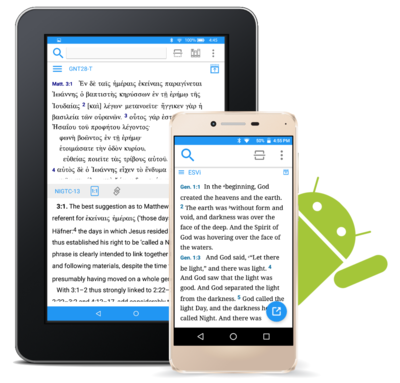
Accordance Mobile Bible App Goes Android
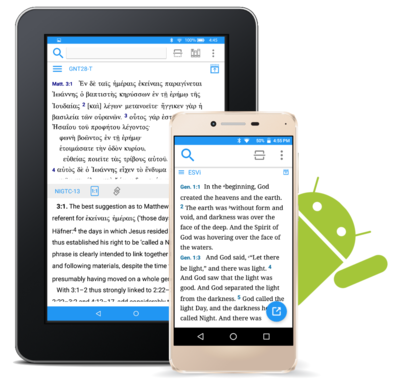
The Accordance Mobile Bible app for Android hit version 1.0 and it's available to download now and side load on your Android device. You can watch our latest Theotek Podcast where Mark Allison and Rick Mansfield showed off the app. Go over to our new Facebook Page and hit Like and you'll get updated each time we go live with a new podcast. Watch it below on Facebook or on YouTube under that.Here is the YouTube vide. Hit subscribe to get new videos after we record them live on Facebook.https://www.youtube.com/watch?v=82aJbwremE0You can download the app and side load it on Android. Get it from the Accordance Blog. Accordance will post it in the Google Play Store sometimes soon. You can follow the Theotek Podcast on Twitter to get an update when it's ready to God or follow Accordance on Twitter. You can also follow me.The Accordance Mobile app is only a book reader and searching tool at this point. Things like languages study, highlighting and notes will be added at a alter date.
Bible Updates and Facebook Live: Theotek Podcast #104
Learn about Bible updates and the future of the Theotek Podcast in this week's show.In my previous post, I shared that we're changing our official home of the Theotek Podcast to Facebook Live. This is the first episode that we recorded using Ecamm Live over Facebook Live instead of using Google Hangouts and YouTube Live. Give it a watch below and go on over to our new Facebook Page where you can find all of our podcasts going forward. In this episode Rick Mansfield showed up of the updates that came in Accordance Bible software 12.2.2, bringing a build-in web browser. I love this new feature because it mean I can use Accordance and access my Logos books and WORDsearch books all from one program.https://www.youtube.com/watch?v=yQpNkluS04c&feature=youtu.beAfter that I shared updates to Laridian's PocketBible app for iOS and Logos Bible mobile app updates. I'm working on a full review. Go follow me on Twitter to get notice when that review goes live over at Church Tech Today.Here's the list of "Our Favorite Things" - the things recommend because we love them.
- DJI Spark Drone - a small 1080P drone that's compact and takes awesome photos and videos.
- LG UltraFine 5K Display - high-end display that's NOT 4K but 5K resolution.
- History of QuickVerse/Parsons Technology - history of QuickVerse Bible software and Parson's Technology from Craig Rairdin, the founder.
- SizzlingKeys - an app for controlling iTunes in a compact form.
- Ecamm Live and Call Recorder - software we used to record our Skype conversation directly to Facebook Live.
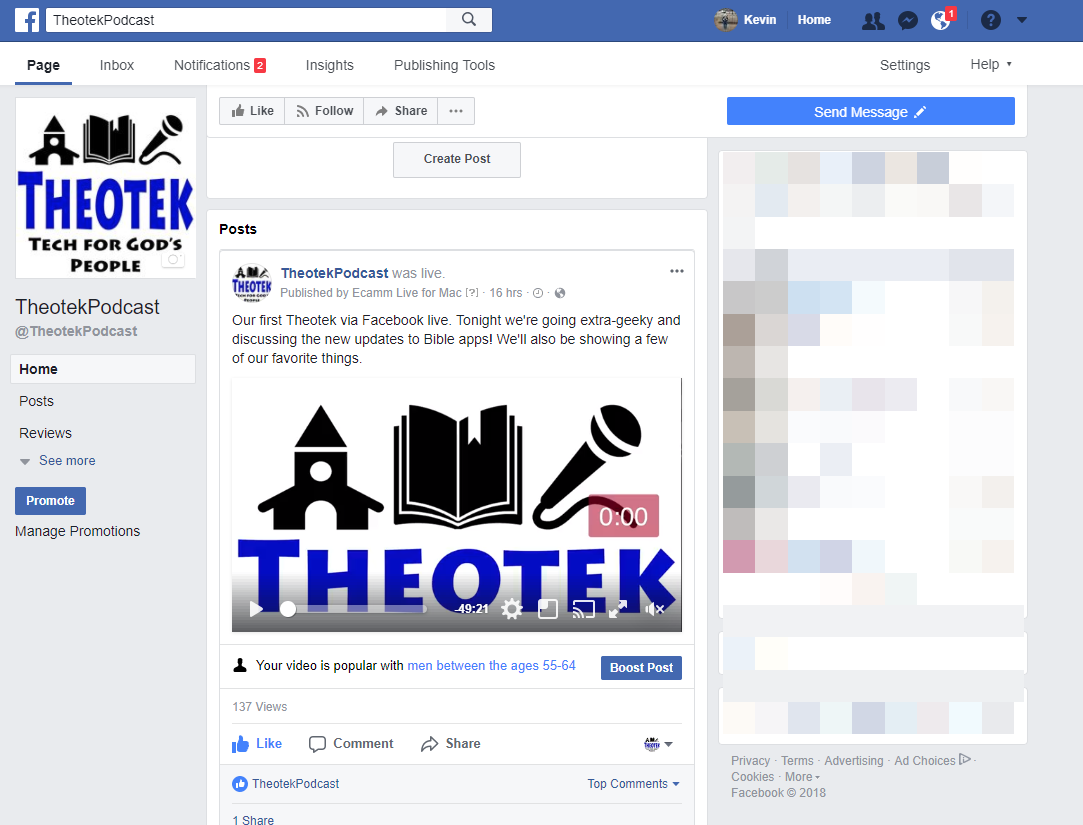
Theotek Podcast Changes Coming
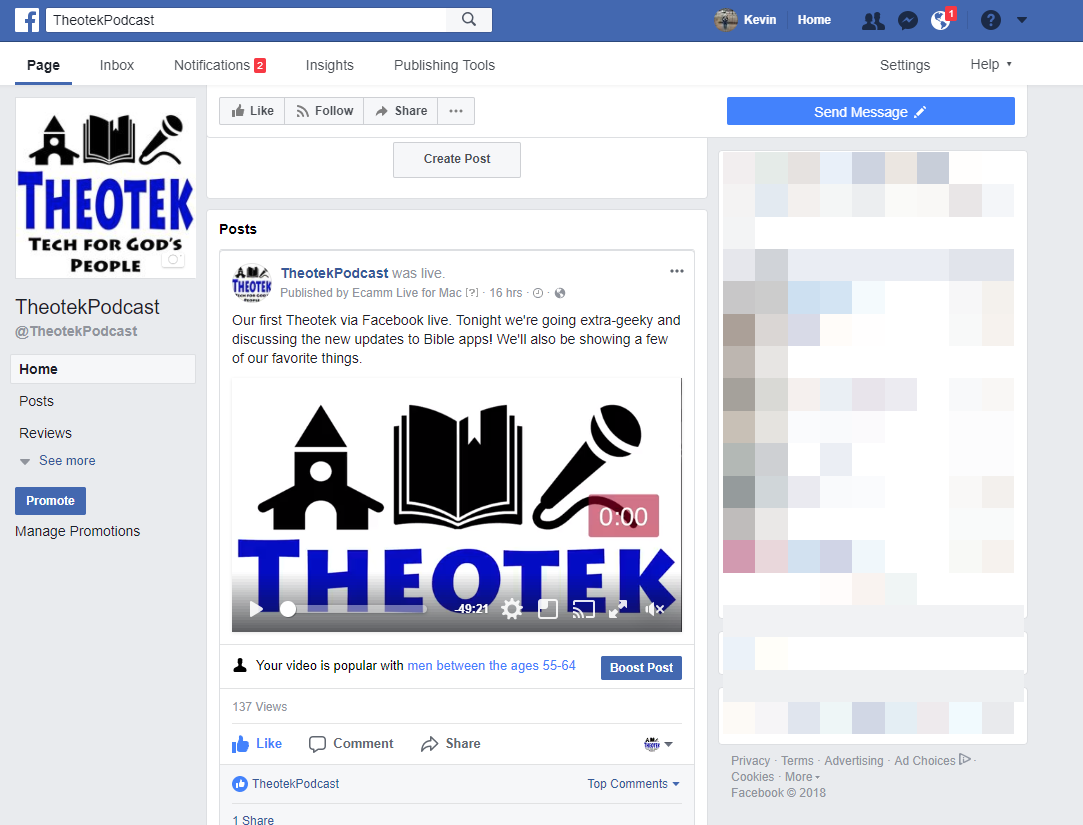
Over three years ago the Theotek Podcast got its start as a trio of tech lovers took the YouTube and recorded what we first called Theotek News. You can see that first episode below. At first LaRosa Johnson, Antoine Wright and I discussed Bible software and more. It was pretty rough. That was when I was still writing for Christian Computing Magazine, Antoine still had the Mobile Ministry Magazine and I was into Google+ big time. LaRosa announced the sale of Olive Tree to Harper Collins. What a blast from the past.https://www.youtube.com/watch?v=45DlwIjM_OoLater we added Wes Allen and then Rick Mansfield and recently Mark Allison. We often branch out of Bible or Church software and technology into the realm of general technology. But we've kept at it for over 100 shows.Now it's time for a change. It seems Google's changing the way they want customers to use Google Hangouts On Air. We feel like it's no longer a reliable tool for recording our Theotek Podcast. Going forward we're going to use Facebook Live through our new Theotek Podcast Facebook page. The team will get together over Skype and Wes will record it on his Mac using Ecamm Live software, a great tool for streaming live to Facebook or YouTube, but not both. It costs $40 for the basic program. Then you add their Call Recorder for Skype which costs another $40. We tried it with our show this week and it worked really well.We'll still be active on Twitter @TheotekPodcast and you can still watch for a while at YouTube. Going forward that YouTube Channel will primarily consist of my stuff, like a review I did of the Google Pixelbook recently. By the way I also wrote about using the Pixelbook for Bible Study here on this site.Please consider subscribing over at Facebook. Follows us on Twitter. Here's my statement on the YouTube channel.https://www.youtube.com/watch?v=ED-1fGXMD_Q

2017 Theotek Christmas Gift Guide: Theotek Extra

The Theotek team offers up some of our favorite gift ideas for the 2017 Theotek Christmas Gift Guide in this Theotek Extra. In this gift guide, three of our team members share their options for great Christmas presents for the Geek on your gift list. Here's the video of our gift guide. We didn't do an audio version since this is such a visual show. Watch the video below and then check out the links for each item in our round-up after the video.https://www.youtube.com/watch?v=4bET5tX0A9g&feature=youtu.be
Wes Allen's Gift Guide Suggestions
 Wes showed off his TASCAM DR-40 4-Track Portable Digital Recorder. He uses it for professional reasons, since he often records video and audio for his work with the ABCNJ tech ministry. Here's a sample video that Wes shot using the recorder.https://www.youtube.com/watch?v=MGuy5e2qaIA&feature=youtu.beThat sounds pretty good. Here's another sample test recording audio in various situations.https://www.youtube.com/watch?v=Tqwe8_XTXok&feature=youtu.beThe recorder costs a little over $170 at Amazon. Wes recommended this as one of Our Favorite Things during a past show.
 Wes also shared the newest version of Scrivener, a great writing tool for people creating a little more complex projects, like a book or research paper. He uses it also for sermon writing and keeps them all in a single folder by year in Scrivener. Literature and Latte just released version 3.0 for Mac and is working on the Windows update. Get it for $45 unless you own a earlier version. Then you can update it for $15 off. The iOS version costs $20.
Mark Allison's Gift Guide Suggestions
We get a few recommendations from Mark Allison. He started things off with the TPU Docking Stand Holder for the 38mm Apple Watch. It holds the Apple Watch on your night stand or desk and you can use it like an alarm clock with the watch plugged in and display set to turn on showing the time. It only costs $6.34 on eBay. Next we get the Anker SoundCore Bluetooth Speaker for $32.99 on Amazon. This Bluetooth battery-powered speaker lets you play your music from a phone or tablet on the go or at home. He loves his. It comes in black, blue or red.Mark also recommends getting an SSD for your computer. He picked one up from Newegg, but you can find them anywhere. He said that the one he has isn't necessarily the best. Get one that fits your storage needs and size of your laptop. Putting one in your computer shouldn't take too much technical skill. The hardest part is replacing the boot drive and getting all your software back on the drive. Also, many newer computers don't have user-upgradable drives. For example, you can upgrade the new MacBooks or MacBook Pros. These can cost as little as under $100 and as much as over $1,000 for extremely fast drives. He said that getting a more costly drive usually means faster performance and more storage.
 The last thing Mark recommended didn't have anything to do with tech. It's Millie's All Natural Organic Gluten-Free Vegetable Sipping Broth. It's like tea without the tea. These come in tea bags and you pour hot water over them and let them soak about 3 minutes. As of the time of this post, they're not available where he gets them, on Amazon. They offer other flavors that are available now, like Thai Lemongrass for $15 for a pack of 12 bags. You can ask Amazon to email you when they're ready.
Kevin Purcell's Gift Guide Suggestion
 I picked just one gift to recommend. I just picked up the DJI Spark mini drone. It's a high-end consumer grade drone with a 12MP camera that also shoots in 1080p video. The battery lasts about 15-20 minutes. It's on sale for $399 now, but normally costs $499. I recommend getting the bundle that includes a remote control that connects to your phone or tablet. It also has the propeller guards and extra battery, which you'll likely need.
Other Great Gift Options
If you need a few more recommendations, we've got some ideas. First, consider gift cards. Find out what platform the person uses for their smart phone. Get Apple Gift Cards for iPhone, iPad and Mac users. Get Google Play Gift Cards for Android users. We also love Amazon Gift Cards. That way we can pick out whatever we want. Also consider giving them some store credit for their favorite Bible software from Logos, Accordance, Olive Tree, WORDsearch and others.
Creative Tools for Ministry: Theotek Podcast #103
If you work on a website for your church or ministry or if you create images, videos or art for worship, then this podcast is for you. We talked about the creative tools that we use and what we think of Adobe's recent update to their Creative Cloud suite. Plus watch the podcast to find out about alternatives if you don't like the subscription model of paying for your creative apps.https://www.youtube.com/watch?v=PC-1vkB5TsQIf you're interested in the new tools from Adobe, check out their website to learn more. We talked mainly about photography programs Lightroom and Photoshop since that's what we use most. But the other apps got some love and they added a new subscription storage option.
Alternatives to Adobe Creative Tools for Ministry
 MacPhun does a great job with some of their new apps. They now offers something called Luminar 2018 and it works on both Mac and Windows. Luminar does Raw photo file editing. It has the advanced features of Photoshop and Lightroom built into Luminar. Pre-order for $60 or upgrade from $40. And for HDR tools check out MacPhun's Aurora package. These are both great creative tools for ministry.For iPad and Mac users Pixelmator does a nice job. They also will offer Pixelmator Pro which give you a single window interface and it does what it does really fast. It's not as good at text and Lightroom may do a better job with some adjustments, but the app on iPad and on Mac is a great option.
 Final Cut Pro from Apple is an expensive alternative. It's a one time only fee, but the price is $300. However, that's 6 months of the Adobe Creative Cloud subscription. It only runs on a Mac.
 LumaFusion on iPad gives the user a great user interface, a powerful video editor and lets you edit with a finger. That gives me precision editing that I can't get with my mouse. It includes a multi-track editing interface. You can have 3 tracks for video, audio and images. Then add 3 more audio tracks for things like voice overs or music.Most people think of Camtasia as a screen recorder. It is, but it also allows for simple video editing with simple titles and call-outs. It's great for creating videos of software.On the audio editing side of things Adobe offers Adobe Audition. However, Ferrite is in iOS audio editor that we can use for some great audio projects.For Windows and Mac, use the free and open source program called Audacity. It's powerful and simple at the same time. The supporting community makes a lot of plug-ins.On the Mac there's Sound Studio by Felt Tip Software. It's an excellent option for sound creative tools users.Those who need to create websites might user Dreamweaver form Adobe. However, we mentioned a few alternatives for web design.
- WordPress is a content management system and a web host, although you can self host using the files from WordPress.org.
- Rapid Weaver for Mac is the most like Dreamweaver. It's a piece of software on your Mac that creates websites.
- Squarespace is like WordPress because it's a content management system. You'll have to use their servers as your host and it costs a little.
Our Favorite Things
We've got a few more recommendations. We always offer "Our Favorite Things" which are recommendations from the Theotek team. Here's the list of Our Favorite Things.https://www.youtube.com/watch?v=wUuSYpW4ZIoAntoine visited the National Museum of African American History and Culture in Washington DC. Here's their own description of the museum.
The National Museum of African American History and Culture is the only national museum devoted exclusively to the documentation of African American life, history, and culture. It was established by Act of Congress in 2003, following decades of efforts to promote and highlight the contributions of African Americans. To date, the Museum has collected more than 36,000 artifacts and nearly 100,000 individuals have become charter members. The Museum opened to the public on September 24, 2016, as the 19th and newest museum of the Smithsonian Institution.
 People who need a great text editor for Mac will love BBedit. Mark Allison recommends it for text editing and for programming.Rick didn't recommend the Samsung Galaxy Tab S3 he got to test out Accordance Bible on Android because he hates the limitations of Android tablets and Samsung's launcher. Samsung puts an overlay on top of Android called TouchWiz on his tablet and now it's called Samsung Experience on their latest phones. Since he does a lot of the training for Accordance, he wanted to share his screen to record help videos for their new Accordance Android app. Samsung doesn't let you connect an HDMI adapter like other devices. So he found a tool called AirServer Connect in the Google Play Store that lets him share the screen to Reflector. It tricks Reflector into thinking the Android device is an iPad or iPhone. Reflector tricks the device into thinking your computer's an Apple TV. There's also a version for iOS and on the Amazon App Store.Wes decided to "waste time" with his pic. He chose the Stranger Things video game based on the hit Netflix Original series that recently released in season two. It's a fun time waster on Android and iOS.
 My pick this week was the new Kindle Fire. I got the 10-inch version, but they offer an 7 and 8 inch mode. It's faster than the earlier version and seriously fun. You can also install the Google Play Store with some tricks found here. The 10-inch starts at $150 but you can get the 7-inch for only $50 and the 8-inch for $80. They have a durable 7-inch version for kids that starts at $100 and comes with a 2-year warranty that lets you replace it even if the kid drops and breaks the screen. I really love mine.
iPhone X First Look: Theotek Extra
Rick Mansfield got in line early on launch day and snagged an iPhone X. We wanted to get a look, so we recorded this Theotek Extra. Here it is for your enjoyment.

Made by Google: Theotek Podcast #102
Google took to the state and announced a slew of new gadgets for geeks like us to drool over. In this episode of the Theotek Podcast, we talked about the new Google tools. We had some strong opinions about them so watch below or listen at the bottom of this post.https://www.youtube.com/watch?v=qYi0yivQRToIn all Google announced some phones, a new Chromebook, a few new Google Home devices and other accessories. Here's the list of the products with links to the Google device store pages for each item.
New Google Products
- Google Pixel 2 and Pixel 2 XL Phones - $649 for the smaller Pixel 2 and $849 for the larger Pixel 2 XL
- Google Home Mini - $49
- Google Home Max - $399
- Google Pixelbook Chromebook - $999 for the 128GB drive model with 8GB or RAM and a 7th Gen Intel Core i5; add $200 for 256GB drive and $650 for 512GB and a Core i7 processor; also add $99 for the stylus.
- Google Daydream View VR Goggles - $99 for new version
- Google Clips Camera - $249
- Google Pixel Buds Bluetooth Earbuds - $159





Apple iPhone 8 and iPhone X Announced: Theotek Podcast #101

Apple announced all their new gear a couple of weeks ago. Our team talked about the new iPhone 8 and iPhone X. We'll also talked about Apple TV and Apple Watch. Watch below or listen at the bottom of this post.https://www.youtube.com/watch?v=xMlSkcDIFEQ
Apple Products Pricing and Availability
- Apple iPhone 8 and 8 Plus - starting at $699 and $799
- Apple Watch Series 3 - starting at $329 or $399 with LTE
- 4K Apple TV - $179 with 32GB or $199 with 64GB
- Apple iPhone X - preorders go live on October 31 and ship November 3 for $999
Should You Upgrade?
Should you upgrade? That's the big question that people should answer. Here what our team recommends.From LaRosa Johnson...
Upgrade only if you can afford to buy it outright and your current phone is no longer working.
From Wes Allen...
If your phone is still functioning and allowing your workflow without getting in the way then, there is no need to upgrade. If you want to push the limits and want to pass on an older phone to someone while it’s still useful, then an upgrade can be a good idea.I have a 4K tv and am not getting the new unit. Also, I’m very happy with my 6s plus
From Rick Mansfield...
I can only speak for myself. I won’t upgrade to the new AppleTV because I don’t have a 4K television. If my current gen 1 Apple Watch ever gets lost or if the battery does not last the full day for multiple days in a week, I will get the new one with LTE. I’m getting the iPhone X because I’m in the Apple Upgrade program (so why not?), and I can legitimately write it off on my taxes because I use it for work extensively.
From Mark Allison (the new guy) ...
I had an Apple Watch Series 1 and liked it a lot, but sold it to buy a Garmin Fenix 3, that was a more capable watch for the things I like to do - hiking, mountain biking and other outdoor activities. The new Apple Watch includes an altimeter, which means it can record elevation accurately. It’s also water-resistant, a feature added in the last version of the watch, which makes it a more compelling upgrade for outdoor enthusiasts. I’m not happy about paying $10/month for the LTE version. Paying $120 a year for a watch adds up. Still, it’s nice to be able to make a call without a phone, and the call quality is supposed to be excellent.I have an iPhone 7, and I’m not planning on upgrading. iPhone 8 doesn’t have enough compelling features (in my mind). The iPhone X looks nice, but I’m more inclined to wait a year until they have all the kinks worked out. That’s saying a lot, because I typically get any new phone that Apple introduces. I guess I’m just happy with the iPhone 7 and don’t feel a strong compulsion to spend the money for features I’m not excited about.I have the original AppleTV and the newer one too (not the 4K version). I don’t have a 4K television, so it wouldn’t make much sense for me. If I had a 4K TV (and when I purchase one, it will have HDR, which I’m more excited about than 4K) I’d certainly get the latest version of the AppleTV.
 Here's my take. I love the latest greatest and am often upgrading faster than I ever need to, but the iPhone 8 is so boring an upgrade that I have no interest in it. I'll stick with my iPhone 7 Plus. The iPhone X is a terrible design. I hate the "notch" and think it's a ridiculous mistake. It's a rip off of the Samsung Galaxy S8+ with the Apple logo and all the cachet that goes with that. For some, they want the latest greatest Apple phone and can afford it. That's Rick's stance above. For most of us we should probably not upgrade if we're being frugal and good money managers. LaRosa said only get it if you can pay outright for it. At $1,000 for the X and $700 or higher for the 8, that's few people.As for the Apple Watch, only get one if you're an iPhone user and want a smartwatch and don't already own the earlier generations of Apple Watch. Same for the Apple TV.Remember that if you have an old device, sell it yourself on eBay, Craigslist or Facebook. Don't sell to the device trade-in services like Gazelle. Selling yourself is a pain, but you'll get more money. You'll often get enough to buy the new phone for half or even one-third the cost using the money from the sale of your old device.