

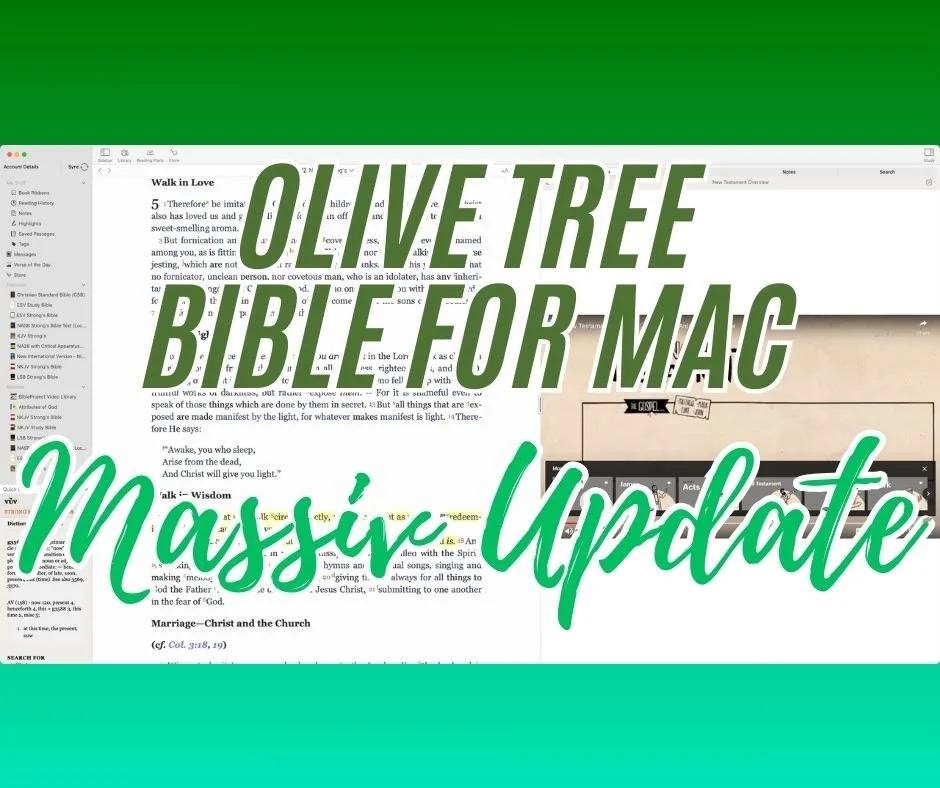
Olive Tree Bible for Mac with MASSIVE Update 3 Years in the Making
Olive Tree update their Bible. study app to make it look and work more like the iOS and iPadOS app. It now only has a few minor differences.
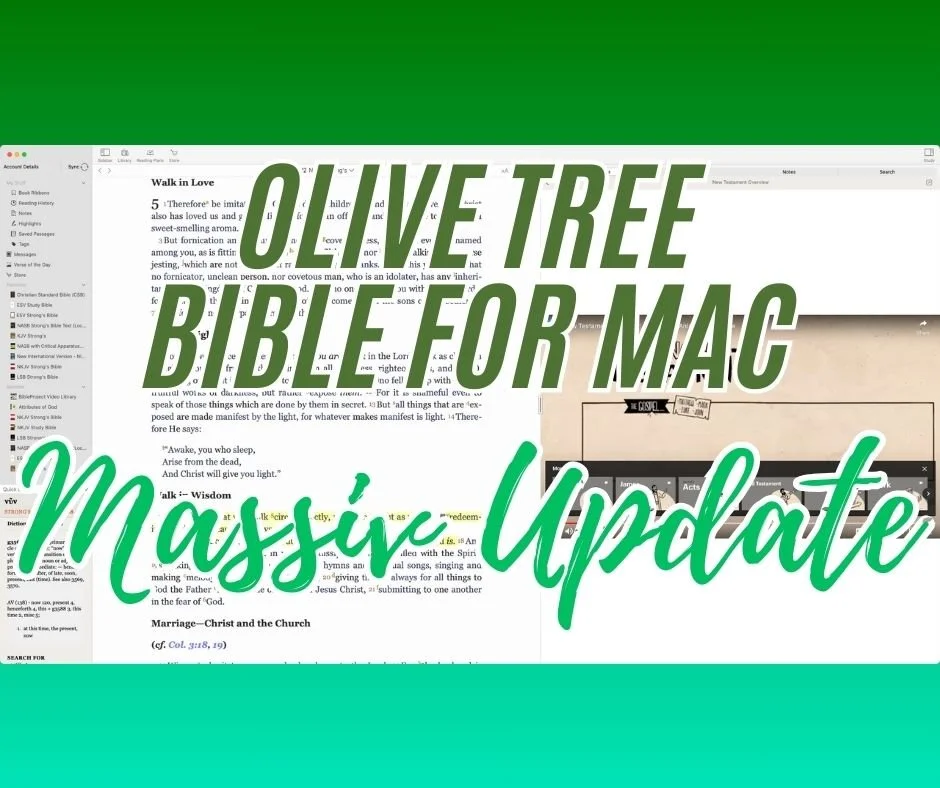
According to the Mac App Store page, the Olive Tree Bible app on the Mac desktop has received a "MASSIVE update three years in the making."

The jump to version 7.16 brings the iOS mobile app and the Mac app together with a similar look and feel. The app on Mac and iOS always looked similar. However, Olive Tree updated the Mac version to behave like what you'd see on an iPad. Here's what's new.
Audiobook Access on Olive Tree Mac Desktop

Your library provides access to audiobooks and other audio features. Open the Library from the button in the toolbar. Click on Add Filter and choose Audio. Your audiobooks will appear there. Open one and start listening. The controls let you jump to parts of the book.
The above steps also work on your iPad and iPhone. If you want, you can click the minimize button in the audio player and the player will show in your sidebar.
Access Video from the Resource Guide
When you open your Resource Guide, you may find video content. Scroll down till you see the Videos section of the guide. Click to open a video and it will play in the guide. You can also pop the video out using the button int he upper right corner of the player.

When you pop open the video player, you can jump to YouTube if the video comes from YouTube. Additionally, you can maximize a video. If you're playing it for your small group, you can see the full-screen video.
Other Changes in Olive Tree
The Message Center, which should probably be called the ad section, also appears now. It's in the left sidebar. The app also offers an improved Store and Shopping experience.
The Quick Details section from the lower left corner looks and acts just like the mobile app.
The Resource Guide gets some speed improvements. Everything will scroll faster, especially if you have a slightly older Mac.

The My Stuff section shows up in the left Side Bar towards the top, as seen above.

PocketBible for iOS and Mac Adds ChatGPT to Autostudy
There's a new version of Laridian's PocketBible for iOS, iPadOS and Mac that fixes some bugs, adds new features like an improved Reading Mode, and more importantly integration of ChatGPT AI Insights.

Laridian announced that they added ChatGPT to their Autostudy feature. This feature is available to subscribers of the company's Advanced Feature Set, which gives users more features than the free Bible study tool.

PocketBible for iOS is available on the App Store for iPhone and iPad and runs on Macs. The new version is 4.18. Find the full list of updates using the previous link.
How to Use Autostudy in PocketBible
The app's Autostudy feature helps users study their Bible with a simple report on a word or verse that the user selects. It's similar to the Guides in Logos, the Resource Guide found in Olive Tree.

To use Autostudy, hold down on a verse or double-tap a word. A toolbar with an icon that looks like a graduate's cap will pop up. Tap that to see the Autostudy window. Then tap on Show Results to see your Autostudy report.

The row at the top shows the content of your Autostudy. Swipe to see the rest of the row. Tap a category to jump to that category in the Autostudy list.
Autostudy includes the verse or passage report, which shows the following...
- Text from each of your Bibles (shown above).
- Strong's numbers.
- Dictionary definition of every word in the passage.
- Greek or Hebrew word definitions.
- Commentary entries from all the commentaries you own.
- Cross-references from Treasure of Scripture Knowledge or other cross-reference titles you own.
- Your user-created notes.
Autostudy for each word includes ...
- Definition from your selected dictionaries.
- Number of times that word is found in your Bible.
- Strong's number info if you own a Strong's tagged tool.
A new feature in the recent update offers Autostudy Devotions features, which include...
- Reading for today.
- Text of Bible passages referred to in your devotional.
Laridian includes a couple of nice features in PocketBible's Autostudy. Users can customize the report's look, which you see under Customize CSS when you run a report. They can also customize the order of content from within an Autostudy report.
ChatGPT Integration in Autostudy
Adding ChatGPT to Autostudy adds a lot of content to the app that a smaller company like Laridian could never add alone. In fact, big companies would likely struggle to add such far-reaching content.
From Laridian's Craig Rairdin...
We’ve spent a lot of time over the last year and a half designing prompts and instructions that cause it to give responses that are Bible-based and Bible-first. It avoids dogma and denominational bias and favors what it clearly reads in the Bible. It uses biblical terminology where political correctness would prefer non-biblical alternative language.

To use Autostudy, users must first subscribe to the Advanced Feature Set and turn on the AI feature in the settings. To do so, they tap and hold on a verse and then tap on the Autostudy button in the toolbar that appears.

In the Autostudy's first window, find Content and Order near the top. Tap it to open it. Ensure there's a checkmark in the AI Insights item at the bottom of the list (#1 above). You can also turn off other items by removing the checkmark. Hit Order (#2 above) in the upper right corner to change the order of the items in Autostudy.
Now, when you tap the Show Results item on Autostudy's first screen, it will find all the content it can from your library and ChatGPT. This takes longer than a regular report that doesn't use AI.
Example of AI Insights Results for Commentary
To give you an example of the results of AI Insights in PocketBible, I ran an Autostudy on John 3:3. Here's what the AI Commentary offered.
The Gospel of John, traditionally attributed to the Apostle John, is unique among the four Gospels in its theological depth and focus on the identity of Jesus as the Son of God. Written in the latter part of the first century, likely in Ephesus, it aims to strengthen the faith of believers and present a clear understanding of who Jesus is. John’s Gospel addresses a broad audience, including both Jewish and Gentile readers, and highlights the necessity of spiritual rebirth, a theme central to John 3:3.
In this verse, a conversation takes place between Jesus and Nicodemus, a Pharisee and member of the Jewish ruling council. This dialogue occurs at night, indicating Nicodemus’s cautious interest in Jesus and the disruptive nature of Jesus's teachings to the established religious order. The phrase “born again” introduces a pivotal theological concept that reflects on the necessity of spiritual transformation.
The context surrounding this verse encompasses the introduction of Jesus's public ministry and the manifestations of His divine authority, characterized by miraculous signs. John 3:1-21 emphasizes the contrast between human understanding based on earthly standards and the spiritual insights required to comprehend the Kingdom of God. Nicodemus, representing the religious elite, approaches Jesus, seeking clarification about His teachings and miracles, which sets the stage for Jesus's profound statement regarding the need for rebirth.
The phrase “unless one is born again” underscores the necessity of a radical inner transformation that is not achievable through human efforts or religious observance alone. This rebirth is explicitly spiritual, highlighting that entry into God's Kingdom requires a renewal of the heart and mind, an action attributed to the work of the Holy Spirit as described later in John 3:5-7.
The practical application of this teaching is substantial. It emphasizes the fundamental Christian belief in the necessity of conversion and the transformative power of God’s grace. For modern readers, it serves as a reminder that spiritual renewal is not merely a one-time event but an ongoing process of growth and reliance on God's spirit. It invites believers to examine their own spiritual lives, acknowledging that true faith encompasses a personal relationship with Christ and a transformation reflected in their thoughts, actions, and purposes.
The passage, therefore, teaches that understanding spiritual truths and entering into a relationship with God begins with an acknowledgment of one’s need for renewal, making it clear that human wisdom alone is insufficient for salvation. It aligns with the broader biblical narrative that presents salvation as a gift from God, to be received by faith and resulting in a changed life (Ephesians 2:8-10).
That's not bad! I wouldn't replace a solid, reliable commentary, but it's a nice supplement.
Other AI Insights that you get from PocketBible include...
- Bible Dictionary - a summary of info about the word or phrase studied.
- Inspirational Thoughts - a reflection for that day's Bible reading or other Bible passages.
- Applying Today's Verses - practical application for the day's Bible reading.
- Today In Christian History - info from church history.
Other New Features in PocketBible Update

Laridian added a new Reading Mode, removing distractions from the text so the reader can read their Bible. This mode removes the toolbars, toolbox, and other window stuff around the text. You open Reading Mode by tapping the button on the Toolbar with two arrows (second from the right).
If you wish to remove verse numbers, go to the app settings (the menu button is on the right of the toolbar) and choose Settings under the PROGRAM section. Tap on Hide Verse Numbers in the first section.
Finally, as with most apps or software, this update includes many bug fixes or minor feature changes.
How to Get PocketBible for iOS and Mac and Advanced Feature Set
You can download PocketBible for iOS or iPadOS in the Apple App Store on your iPhone or iPad. For Mac, get the app from Laridian's website. Both apps are free. The Advanced Feature Set costs $.99/month or $99/year through an in-app purchase or on the company's website.
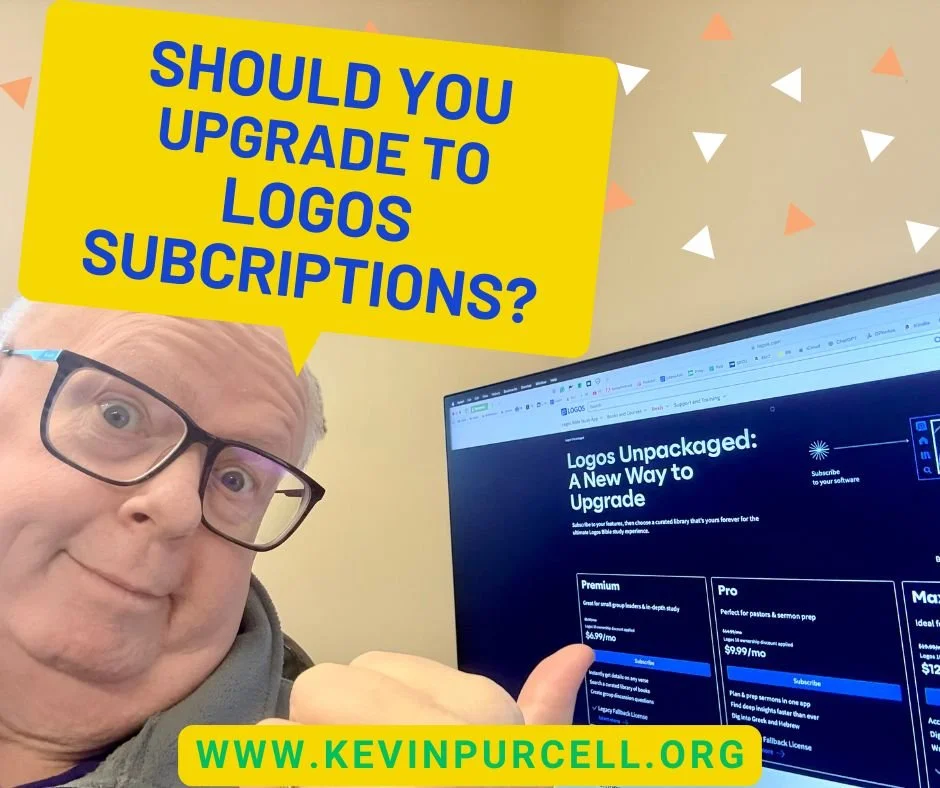
Logos Subscriptions Bad or Good for Your Bible Study?
Should you upgrade to the one of the new Logos subscriptions or stay put? We'll show what they offer and how to save money.
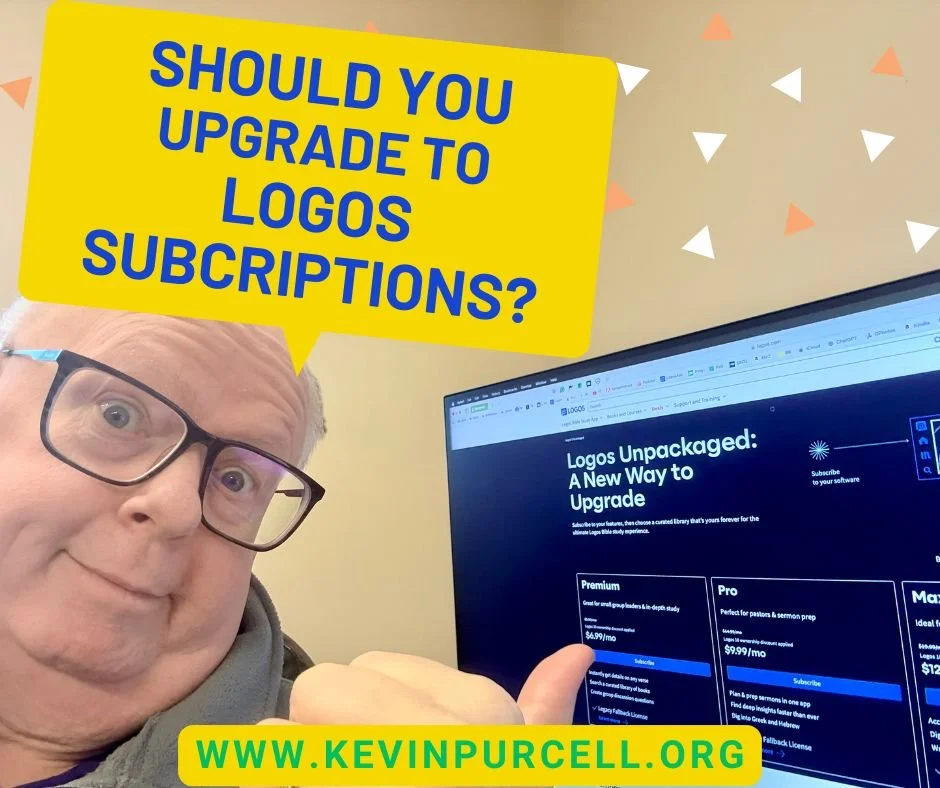
When Logos released the new Logos Subscriptions version of the Logos Bible Study Platform, it dropped the numbering nomenclature and added a subscription model. These moves upset some users and confused others, so we want to help alleviate the confusion. We can explain the name quickly, but the new Logos subscriptions model will take up more space here on KevinPurcell.org.
The most significant new features in the Logos Subscription options include AI tools, a redesigned user interface, Bible Study Builder, and a vastly improved Sermon Assistant with AI Outlines, Questions, and Sermon Illustrations.

What's the New Logos Called?
Just Logos! Previous versions all came with the number of that update - Logos 9 went to Logos 10. However, Logos 10 was something like Logos 10.11.34. Then they released Logos 10.12 or something like that. So, now they're getting rid of the first two digits that we expected to be Logos 11. Instead, they want to release more minor updates, which they call versions.
The company named the new subscription-based version of the program Logos Version 37. That's because the last version of Logos 10 came with version 36. Sometime soon, they will give us Logos 38 and so on. For a while, I'll call it the New Logos Version 37.
Get One Extra Month Free
Whether you're an owner of Logos 10 or trying it out for the first time, you can use this link add 30 days free. That means you'll get either 30 or 60 days for free..
Three Options for Logos Subscriptions
You can subscribe to one of three options for the new Logos Subscriptions (affiliate link). They focus on three groups of users as follows:
- Bible Study Leaders: Logos Premium starts at $9.99/month and will help people who lead Bible studies.
- Pastors: Logos Pro starts at $14.99/month and adds tools intended to help pastors dive deeper into the Bible and write sermons. You can start using Logos for slightly more advanced language study at this level.
- Academic Users: Logos Premium starts at $19.99/month and takes users to the level of a scholar studying the Bible in advanced ways for scholarly research, translation, and writing academic research projects for school.
Each of the above subscription levels comes in annual subscriptions, too. You can get Premium for $99.99/year. Pro costs $149.99/year, and Max costs $199.99/year. If you pay for two years, you'll get a 21% discount off the second year, so the three cost $189.900, $284.80, or $379.80.

If you already own Logos 10, you can save on a subscription. Check out the chart above to see your savings. Also, using my Logos Affiliate link will give you an extra 30 days in your free trial offer.
Subscribers get more tools per tier the more you pay. For example, the cheapest plan doesn't include the Counseling Guide or Lexham Counseling Ontology Dataset. Pro and Premium subscribers will also not get many of Max's language tools. And each tier bumps up the number of included books you get. Premium users won't get the High-Definition Commentaries that Lexham Press produced, nor will they enjoy the Holman Old and New Testament Commentaries.
Which of the Logos Subscriptions Should You Choose?
Most people should take a look at Logos Pro. That level gives you the best bang for your buck with Logos subscriptions. Otherwise, go with the tier Logos recommends for each level of the Logos subscriptions. Lay people who teach the Bible could go with Premium. Pastors could get Pro, and academics could subscribe to Max. However, some laypeople may want more books and language tools. They should jump up to Pro. Some pastors might now use language tools as much and don't need the Pro features and tools.
You could also approach your decision based on money. Buy the most you can afford. Try to save by going with an annual or a 2-year subscription.
2025 Logos Collections for Subscribers Only
First, remember that you have to subscribe to buy one of these new 2025 Logos Collections.
While the subscriptions include many new books, Logos also adds new 2025 Libraries. Their offerings look too complicated. I wish they'd simplify things, but people love the dizzying array of options. Let's try to understand the possibilities.
Think of the collection colors as levels. They offer Bronze, Silver, Gold, and Platinum. You can start lower with the Starter Library or higher with the Collector's Edition Library.
To see the new libraries and what they offer, look at the slideshow below.


They label the collections with the year and level for 2025. We assume that we'll also get 2026 and 2027 libraries.
Add to the year and color a user description. Logos offers a 2025 Starter Library, which costs the least and comes with less than any other collection. If you're a Leader (the target of the least expensive Logos Premium Subscription), then consider the Leader Starter Library, which has a different set of tools at the introductory price than that basic Starter Library.
Logos offers libraries not just for Starter and Leader categories but also for Preachers and Researchers. You can combine them for options like the 2025 Preacher Silver Library or the Leader Gold Library. If you have a lot of money, you could purchase the 2025 Researcher Portfolio Library for $3,324.99 or the 2025 Collector's Edition Library for a whopping $7,699.99.
Don't forget dynamic pricing for 2025 libraries. The above prices mainly target new buyers. However, if you already own Logos and a library of books, you can save money. Make sure to sign in to Logos.com and then check prices.
Logos Ownership Explained
If you choose to subscribe to Logos, then do you own Logos? The answer depends on when you first purchased or subscribed to Logos. First, if you owned Logos before the subscription update, then you will own what you owned before. However, you won't receive any new features that come with this Logos version 37 or higher.
Subscribers will earn the right to own the new features of their subscription after 24 months of subscribing. If you subscribed to Logos Pro today and then chose to stop subscribing in November 2026, you'd keep all the new features that came with the subscription. Logos calls this the "Legacy Fallback License." This only applies to features that don't rely on the cloud or any new Logos AI features. You have to have owned a Logos base package to receive this Logos Fallback License.
Should You Subscribe to the New Version of Logos?
That's a terribly complicated question without an easy answer. Here are some people I think will enjoy subscribing to Logos. Take a look at the screenshots in the gallery below.


- You love having the latest and greatest version of Logos and are willing to pay $7-$20 monthly or $70-$200 annually for the new features and books.
- You want the new features (see screenshots above) available only to subscribers, like...
- Dark mode without restarting Logos.
- Getting started wizard to new users.
- Smart search.
- Insights.
- Help Center improvements.
- Factbook improvements.
- Summarize tool.
- Bible Study Builder.
- Sermon Assistant with AI Outlines, questions, illustrations, and application.
- Sermon Builder/Manager on Android and iOS
- You want a 5% discount on everything you buy and enjoy free books and courses and a 5% rebate on everything you buy in a year.
Don't subscribe if you can't afford a monthly or annual fee and/or don't think the new features will benefit your Bible study. Some people hate subscriptions, so don't upgrade if that describes you.
I received a free upgrade but planned to pay for it before I knew Logos would give me a free subscription to write an article for them at ChurchTechToday.com.
The New Logos Subscription Model and How to Save Money
What's with all these new Logos subscription tiers and libraries. We'll explain what's going on and what you should get. We've also got a deal for 2 months free.
Logos released a new version of Logos Bible Study on October 21. It includes some interesting new features and a new user interface; however, they also introduced a new subscription model. So, what's new in the new Logos, and should you subscribe to one of the three new tiers of Logos version 37?
What Do You Call the New Logos?
For over 20 years, I've used Logos 3, 4, or some other version that ended in a small number. When Logos 10 came out, that became the last version that we'd described that way. What we called Logos 10 was called something like Logos 10.24.01. They just dropped the final numbers and called it Logos 10. We're dropping the 10 and getting Logos 37 as the first version of the new Logos (my Partner Link gets you 2 free months), which we thought they'd call Logos 11.
Logos Changed the Way You Buy the Logos Bible Study Platform
In the past, most people upgraded to Logos XX by paying for new features plus a library of new books. Now, you pay for a monthly, annual, or two-year subscription and add a library of books in a separate purchase.

Think of it like this. You decide to lease a home to own. YOu're paying monthly for the right to live there and over time you build up enough equity that you can buy it and own it outright. However, you decided you also want to make some improvements, so you add on a new bedroom and bathroom. You turn on of the rooms into a home theater and you build a nice gazebo out back.
Logos asks you to subscribe to get the new version and then asks you to add-on. You pay monthly for the new version of Logos like you pay monthly for the house. You add onto the house and make improvements like you buy a 2025 Library for the new Logos 37. If you quit paying for the home, the bank will kick you out. If you quit paying for the new Logos, then you lose the new features, unless you subscribe for a minium time. I'll explain that below when we discuss the "Legacy Fallback License".
To get new features, you will have to subscribe. Logos told me:
We will no longer sell a perpetual license to feature sets to consumers. For software, subscription will be the only way to get a premium Logos experience.
The subscription doesn't give you libraries of books. You will get the tools needed to use the new features. These will mostly come from Logos and not other publishers like Zondervan, Holman, or Baker, to name a few.
Three Tiers of Subscriptions
Logos reduced the number of different groups of features from nine to only three. They are as follows:
- Logos Premium - Focused on lay leaders who teach a small group in their church or community. The tools sit at the intermediate level of skill or knowledge and focus on English language study. Think of the old Bronze level of feature sets.
- Logos Pro - Focused on pastors and preachers who pastor a church or often preach and teach the Bible. They need advanced-level tools and will get access to intermediate-level language tools in Greek and Hebrew. People who study deuterocanonical books will need this level of subscription. Think of the old Preaching Suite or Silver packages.
- Logos Max - Bible students who need serious language study tools for advanced research will want to pay for this level. You get the whole feature set at this level to study Greek, Hebrew, Latin, Syriac, and more. Scholars or language nerds will want this subscription.
Most Logos users will want the Logos Pro level unless they need hardcore Bible study tools. However, lay people should get Premium, and then if they think they need more, they should jump up to Pro. Start lower and move up if you need it.
Logos Subscription Pricing and Benefits

How much does the new Logos subscription cost, and what do you enjoy besides the latest features? We'll share the full price. You can get discounts if you own Logos 10 or an older version.
- Logos Premium - $9.99/month, $99.99/year, or $189.80 for two years.
- Logos Pro - $ 14.99/month, $149.99/year, or $284.80 for two years.
- Logos Max - $19.99/month, $199.99/year, or $379.80 for two years.
If you own Logos 10 Bronze or higher, take $3, $5, or $7 off the monthly price of the three tiers. What if you own something lower than Logos 10 Bronze now? The discount gets smaller ($1, $2, $3).
Logos also offers discounts for Faculty and Students who subscribe annually. These users also get excellent deals on libraries—more on those below.
What else do you get besides the new features? Take 5% off every purchase from the store. Get another free book each month and up to eight Logos Mobile Ed courses each quarter. Pro and Max subscribers get access to the Logos Sermons service, which lets you host sermons online in a podcast or transcript format.
Pro and Max subscribers will earn an annual coupon worth 5% of all purchases the previous year. This coupon arrives in February each year and is only for current subscribers. So, if you plan to cancel your subscription, don't do it until after February, or you'll lose this perk.
Legacy Fallback License
What happens if you cancel your subscription? You will lose access to the features that you get by subscribing. However, there's something Logos calls a "Legacy Fallback License," which allows users to keep offline features when they end their subscription after 24 straight months of subscribing. You'll keep the features that don't need cloud or AI. If you have any questions about this, contact Logos to see what you'll lose before you cancel.
What Do You Get in the New Logos Subscription?
What's available in Logos after a user subscribes? We'll cover the new features in another fuller article, but here's a quick listing of new features taken from Logos PR documents:

- Dark mode without restart.
- Get Started Wizard - shows up on the new Logos Dashboard.
- Smart Search - use regular language to search your library.
- Insights - quick looks at your most essential library tools with one click.
- Dynamic toolbar - we covered this in a previous article.
- Help Center (see screenshot below).
- Factbook improvements - new sections and "lenses" to see what's in their passage.
- Smart Synopsis - AI-generated synopsis from search results with footnotes.
- Summarize tool - quick summaries of books, passages, or search results. More is coming.
- Bible Study Builder - the Wordsearch Lesson Maker, but reimagined for Logos and with better-resulting questions.
- Sermon Assistant - Only for Logos Pro and Max Subscribers...
- Outlines - AI-suggested sermon themes and outlines.
- Questions - AI-suggested questions for discussion based on your sermons built using Logos Sermon Builder
- Applications and illustrations - AI-generated sermon applications and illustrations from your sermons.
- Sermon Builder/Manager on Android - Android users can now use this tool, not just iOS users.

New 2025 Libraries to Add More Books to Logos

If the three subscription tiers didn't confuse you, the three tracks of libraries with eight different levels will. Each comes with books you own and can use if you subscribe to Logos. We'll offer a more in-depth recommendation in another article. But let's look at the three tracks and who they're meant for.
The tree tracks focus on who's using Logos. For example, the Standard Track Libraries help people who use Logos for personal use and to teach a Bible study or small group. If you buy a Logos Premium subscription, then you'll likely want to consider the Standard Track Libraries. Take a look at the price and what each includes, and you can buy what you can afford or need.
Next, we see the Leader Track, which focuses on church leaders. Again, if you teach a class or Bible study, you'll want to take a look at this track. You'll get more intermediate-level books.
The Preacher Track Libraries were designed for preachers and pastors. Logos Premium subscribers will likely want to look here.
Finally, the Research Track Libraries will help people who subscribe to Logos Premium or Max. These users write commentaries, translate for new Bibles or in missionary settings, or teach at a seminary or Bible college.
Look for more complexity with Denominational Libraries coming in January 2025.
Recommended Upgrade Path for Different Users
What should you do if you want to upgrade to Logos. First, consider using my Partner Link. Logos gives you one month free and using my link gets you a second month free if you upgrade to a subscription.

First, choose a subscription level. Most users will want Logos Pro, the mid-level tier. You get the most bank for your buck. Since the majority of my readers are pastors, teachers, and serious Bible students who need to do language study, but might not possess an advanced level of Hebrew and Greek skill, then get this tier for $14.99/month, unless you already own Logos 10 Bronze or above. Then it's just $9.99. You can save more with an annual subscription.
Second, you need to pick a library of books. You can get the subscription alone, but why not add some books to your library at a discount. Take a look at the Libraries for 2025 and choose what you an afford. Logos will let you split up payments into a couple of months up to a year to pay off your purchase.
As we said above, they offer several tiers of libraries too. For now, go with Standard and then add to it later. Or jump to the Preacher level if you're subscribing to Pro. They seem to fit together well.
Logos gave me the the Gold Library, but if they hadn't, that's what I would have bought. You add the Preacher's Outline and Semon Bible, the ESV Expository Commentary Collection, and Theologocial Wordbook of the Old Testament to name a few. It's only $600 and if I wanted, I could pay for it over several months to make it more affordable. Logos doesn't charge interest, but you do pay a small fee for processing.
New Logos Redesign - Where Is That Button in Logos 11
First, let's discuss one important element we'll all need to get used to—Logos will no longer be called Logos 11 or any other number. Instead, the new Logos redesign comes with a new designation. They will call it simply Logos and then use version numbers like version 37, the shipping version of the brand new Logos, which many will want to call Logos 11. Think of Logos 11.37, but they're dropping only the 11 part of it.
Second, the new Logos Redesign moved around many things thanks to a new Logos Resource Toolbar in Logos version 37. You might ask, "Where is that button I need?" We'll show you where that button went and the new user interface of Logos version 37 and beyond.

Get the New Logos Now
If you read this article and decide to invest in the new Logos subscription, visit their subscription page. You can also invest in a library to get extra non-subscription content. Let me recommend a few things.
First, the new Logos comes in 3 subscription levels targeted at 3 groups of users.
- Logos Premium—for the average user, it costs $9.99/month or $99.99/year unless you already own Logos 10 Bronze, in which case you'll only pay $6.99 or $69.99. Use my link above to get two months free.
- Logos Pro - for pastors or serious Bible students who don't need academic tools. It costs $14.99/month unless you own Logso 10 Silver and up, in which case it only costs $9.99/month. Yearly discounts cost $149.99 or $99.99, and using my link gets you two free months.
- Logos Max - the highest tier meant for academic users. It costs $19.99/month or $12.99/month for Logos 10 Full Set owners. Logos 10 owners pay $199.99/year or $129.99/year.
These subscription tiers come with discounts for people who subscribe for two years. You get five months free.
Watch the Logos announcement video below.
Subscriber Perks for the New Logos 11
Logos doesn't call it Logos 11 anymore, but they do still offer some great perks. They include the following:
- 5% off store-wide for all subscription levels.
- Extra free book each month for everyone who subscribes.
- 8 Logos Mobile Ed courses focused on the people Logos expects to subscribe to each tier.
- Logos Sermons adds some sermon prep tools for Pro and Max users.
- 5% Annual Reward for Pro and Max users gets you a discount of 5% of your annual spending in February each year for active subscribers as a reward for subscribing. So, if you spent $2,000 on Logos in the past year, you'll get a coupon for $100.
Libraries for the New Logos Subscription
Second, get one of the 2025 Logos Libraries, which are only available to subscribers. These libraries use the same names as previous versions. They range from Starter, which costs as little as $23.79 for Logos 10 owners or $33.99 for owners of older packages, to Collector's Library for $10,999.99. The best bang for the buck comes at the Silver or Gold levels, costing $250 or $850 for new users. Owners of previous versions will pay less.
The above are for Standard Track Libraries. They confusingly offer many other tracks for Leaders, Pastors, and Researchers, and they add to that their denominational Libraries. I suggest that you start with the Standard if you're an average user. Preachers and pastors should look at the Preacher Track Libraries, and academic types or language nerds should go with Researchers Libraries.
Since I'm a preacher, I'd go with the Preacher Track and look at the Silver or God Libraries. This would add to my library the ESV Expository Commentary Series or Biblical Greek Made Simple for Silver. In Gold, I'd get the Preaching the Word Commentary, The Concise Greek-English Lexicon of the New Testament, and The Preacher's Outline and Sermon Bible. Each of those links is a partner link.
Logos Redesign Changes the Home Page to the Dashboard
We'll start with a minor change. Logos used to boast a cluttered Home Page, including things like book information, layouts, reading plans, and ads. You could add them by clicking a plus button in the upper right corner.

The new Logos Redesign changed the Home Page to the Dashboard. It's not that different, but it has a new name. If you use the default toolbar location, look for it in the upper left corner. People who position their toolbar on the top edge of the program window will find the button to the right of the Logos logo. Hover over it, and you'll see the popup tooltip that shows the Dashboard label.
You'll find a few important features on the new Dashboard.
- Welcome to Logos Video - click this video in the upper left corner labeled Welcome to Logos Pro or whatever subscription level you use. You can watch the short intro video that explains many of these new changes.
- What would you like to do today? - The lighter blue square next to the Welcome video square shows five options, including...
- Personal study
- Group Bible study
- Write a sermon
- Original language
- Pick up where I left off
- Need some help? - gives help for using Logos with options to:
- Ask about Logos - ask natural language questions about how to use Logos.
- Get Started - opens a page for those new to Logos.
- Videos and Webinars - take users to the great Logos tutorial videos and helpful webinars page.
- Features - opens a page with training videos covering several features in Logos.
- Technical Support - helps you find various technical support options.
- Community - opens the great Logos community forums page. They've promised a new forum interface coming soon.
- Help Manual - opens the Help Manual built into Logos.
New Logos Resource Toolbar
Logos now offers a helpful new toolbar called the Resource Toolbar. This toolbar reorganizes the buttons to make the program more efficient; however, changes take time to get used to. Let's look at this new Resource Toolbar.

The new Resource Toolbar now has a set of tabs across the top of the Bible window. You can toggle it on or off by clicking on the names of each tab on the toolbar.
- The Back Button takes you back to your browsing history, like you'd find in a web browser.
- In the Book Dropdown Box, click the down arrow button with your book cover. You will see a list of your Bible translations, commentaries, dictionaries, or other books similar to the one currently displayed.
- An Entry Box lets you type in a Bible passage or other entry, which will take you to the passage or article you entered.
- Home - shows the primary tools in a toolbar below the Resource Toolbar as follows:
- Contents
- Favorites
- History
- Chapter with Up and Down Arrows
- Link set - this used to be in a different location, so note that you now connect books to the Bible translation you want to drive the others. For example, set your commentary to follow your Bible when you move from passage to passage.
- Insights - a new feature that shows your top related books and passages connected to the passage open in a Bible translation.

- Search - opens a search box. Notice the three links at the right end. YOu can click these to narrow your search results or change where Logos will look for results.
- Notes - includes options to show or hide notes in text, add notes or highlights, and filter your notes. It also has arrows to jump to previous or next notes.
- Formatting - change the formatting of the text in the open book.
- Factbook Tags - shows what words in your text have Factbook entries. Click the drop-down to change what tags show or don't show.
- Markers - Logos includes icons that show it has more information on things like Addresses, Speakers, Timeline Events, and Media
- Emphasize - emphasizes corresponding words when you hover over them or click on them by highlighting a word used multiple times.
- Reformat - change the look of text in a book.
- Reading Plans - shows markers for the beginning and ending points of any reading plans active for a passage or book.
- Passage Lists - shows passages found in any passage lists you've created.
- Visual Filters - shows any visual filters you created.

- View - change the look of the book display.
- Add parallel text—you can add columns of text as seen above or rows of texts, depending on which button you select in the pop-up window.
- Interlinear - turn on the Interlinear using this button. You can customize which information shows up in the Interlinear.

- View Continued...
- Paged view - shows you either a paged view with columns like you might find in a printed bible with multiple columns of text or show a single column that scrolls. YOu can also change how many columns of text show up.
- Location bar - turn on and off the Location bar that shows where you are in the current book or Bible, like "Hebrews > Chapter 4" seen in the above screenshot.

- Tools - shows tabs for tools used to interact with the text.
- Compare - opens text comparison.
- Translate - opens the AI Translation tool.
- Summarize - opens the AI Summarize tool, which summarizes the current article in the open book.
- Read aloud - reads the current text using the computer-generated voice of the OS.
- Start reading plan - opens a new reading plan for the current book or Bible.
- Printer/Export - opens the Print/Export Dialogue box.

- Share - offers various methods of sharing what you're reading.
- Copy - select some text and click this button to copy it, or use CTRL+C on Windows or CMD+C on Mac
- Copy special - shows some of the options you would find in the Copy Bible Verse tool.
- Copy link - creates a link you can use in notes or online which will open Logso to the present location of the book or Bible displayed.
- Create slides - opens the Media generation tool which lets you create visual copies of text for us in Proclaim, PowerPoint, Keynote, or other apps.
- Send to - sends the current selection to a Clipping, a Passage List, a Canvas, or Proclaim.
- Print/Export - opens the Print/Export dialog box.

You'll see a blue New button, which opens a Logos Community post. This will likely go away eventually. Also, at the far right end, you'll see a button that looks like an up or down arrow in a circle. This toggles the Resource Toolbar on or off. Finally, there's the menu button (it looks like three dots stacked vertically). Here, you'll see controls that work with the current book window.
- Find in this panel - type something, and you'll see corresponding highlights showing the text in the open book.
- Send hyperlinks here - when you click a Bible reference link in another open book window, the links are sent to this window.
- Open in a floating window and Open all in a floating window - opens the current book in a separate window or floating window or all the books in that tab in floating windows.
- Duplicate this tab - open another copy of the current book in the first tab in a second tab, just like it.
- Reopen the closed tab - if you recently closed a tab, it opens again.
- Close this tab, other tabs, or all tabs - self-explanatory.
5 Huge iOS 18 Weaknesses on iPad that Apple Doesn't Want You to Know
When Apple introduced the new iPad Pro with M4 processors, the iOS 18 weaknesses became more glaring because this new iPad sports so much power it's now faster than any Mac you can buy. However, Apple’s decisions about iOS and iPadOS limit these fantastic new iPads in 10 glaring ways. Here’s my list of 10 of the most glaring iOS weaknesses currently in iPadOS.
We hoped Apple might improve with iPadOS 18, which will be released this fall after Apple introduced it at WWDC 2024 on June 10. We did see significant improvements, like the better placement of home screen widgets and app icons and an incredible new Calculator App with Apple Pencil and Apple Intelligence built in. Yet, we still want to see more.
iOS 18 Weaknesses: We Need Preview App for iPad

I moved towards macOS about the 2nd generation MacBook Air introduced on October 20, 2010, by Steve Jobs. I remember calling it "drool-worthy" to one friend. It's funny how it feels like a tank today compared to modern MacBook Air models.
Now that Apple offers several iPads with processors that blow away the MacBook Air from just a few years ago, Apple should rethink iPadOS for those who use it as a laptop or MacBook Air replacement. After all, you can buy a 15-inch MacBook Air today with a fantastic screen, excellent keyboard, plenty of storage and memory, and fits where a light laptop used to fit thanks to the Smart Keyboard Cover.
We Need Preview in iOS 18

Preview comes preinstalled on every Mac and has become my constant companion. It handles...
- Screenshots
- Previews of PDF files
- Previews of image files
- Markup
- Signatures
- Basic photo editing
- Scanning
- File conversions
I'm indeed leaving out some features that you use. Comment below what I missed.
Why can't we have such a helpful app on the iPad? Other apps give users most of the features in Preview, but it's such a friendly, simple, and complete app that the omission of Preview on Apple iPadOS 18 seems baffling.
Bring Journal to iPad Soon Please
I don't use Journal on my iPhone much, but it's an excellent app. I'd love to journal using my iPad's keyboard or Apple Pencil. Why didn't Apple include this in Journal and put it on the iPad?

Including it on the iPhone makes perfect sense. The Journal App will keep track of photos or videos you've taken. It also watches your location and puts a map in a Journal entry. Gathering photos and a map and then typing on my iPad keyboard cover or drawing using the Apple Pencil would be very nice.
Finder and Files Should Merge - One of the Worst iOS 18 Weaknesses on iPad

I don't necessarily want all that macOS Finder offers on my iPad, but I'd love a lot of it.
Apple didn't want users to access the file system on their iOS devices. However, now that we can use the iPad as a computer replacement, we need a more robust Finder app in iPadOS 18. Give me the following, and I'll jump for joy.
- Make folders wherever I want a new folder. Not just in the places they say I can now. Using Finder to organize apps would be easier.
- Let me put a shortcut to a folder on my iPad home screen that opens to that folder in Files.
- Show me a Finder-style progress bar for copying.
What I'm asking for is greater control over the file system. I don't necessarily want full control like we get on macOS. Keep apps, the operating system, and
Mousing on iPad Not Quite There
I hate the little circle you get instead of a familiar arrow. Better yet, let me choose what my cursor looks like. An iPad with a Magic Keyboard has a trackpad, but mousing is not quite there yet. While we're talking about it, can I say that I hate the descriptor "Magic" that Apple uses?

We need a right click menu but can't do that in the OS. Press and hold doesn't work as efficiently and only works in some places. Imagine right-clicking the Home Screen to add a new folder or paste a file (see previous section).
5 Best Audio Bible Apps for iPhone or Android in 2024
We have the 5 best audio Bible Apps for iPhone, iPad, Android, and, in some cases, desktop and web. See if your favorite app shows up.
While I personally love reading my Bible, I know many people prefer listening to the Word. Most people consumed the original books of the Bible audibly instead of visually in a book or scroll. If you're looking for the best audio Bible app for your iPhone (or even Android!), this list is for you. We'll dive into the top 5 options, each with its unique features to enhance your Bible listening experience.
Dwell: Audio Bible - Best Audio Bible Apps for Dedicated Bible Listeners Willing to Pay for a Subscription
The Dwell: Audio Bible app runs on iPhone and iPad. Users can install it on a Mac thanks to Apple's M processors. Finally, it also works on Android.


When you open the app, you see a screen with four tabs across the bottom and the Settings icon in the upper right. This screen appears after you go through the first setup screen the first time you run the app.
Home shows you various listening options. There's an Explore tab to find something to listen to. The Bible tab lets you listen based on predefined listening plans or by book of the Bible split into two screens for the Old and New Testament. Finally, you can search the Bible, which will help you listen to a specific passage. You see the Me tab with Favorite verses, Downloads, Playlists, Plans, and your Listening Queue.
Try out Dwell app for free, but you'll need to buy a subscription to use the full feature set. It costs $39.99 a year or $7.99 a month. That's steep, but if you really love listening to the Bible, try it out and subscribe for a month. The $40/year will seem worth it if you find it useful. Otherwise, try one of the options below.
Bible from YouVersion - Best Free Audio Bible Apps
Most Bible listeners will enjoy free over $40 or $8. The most popular Bible app on mobile is YouVersion. The app does more than play audio of your favorite Bible. You can get it on iPhone, iPad, Android devices, and your computer through the browser.

The app includes audio Bibles, videos related to Scripture, and almost every translation you might want to read and download. You will also see many reading plans to choose from.
The Bible app includes social media components that let you follow the activities of other Bible readers and share yours.

Listen to a Bible by downloading one that includes audio. For example, I downloaded the NKJV, and it shows an audio icon next to the name in the translation chooser drop-down list. Open it, and the screen shows the text and a Play button. Go to your desired passage and click or tap the play icon.
You can't beat free; the other features make it a great option. The voices sound pretty good, but Dwell sounds better. The Store tab lets you buy books Bibles and books with audio.
Logos Bible Study - Best Audio Bible Apps for Cross Platform that Lets You Grow
Many people already own a Logos library, so don't overlook their listening features. We don't have time to explore everything the Logos Bible Study app can do, but the Audio features will help you enjoy an audio Bible inside your favorite Bible study app.
Some of the audio uses the built-in iOS voices, which sound pretty robotic. However, if you go to the Menu button in the lower right corner and choose Audio, you can find plenty of Audio Books, including some Bibles.

To listen to basic audio, open a Bible and tap on the Audio button in the Bible's toolbar (second from right). It opens the audio control screen at the bottom of the app.
If you want to listen to a better-quality Audio Bible, open one. Search the Library search box for "Audio," and you'll see many audiobooks. Everyone will own the Lexham English Bible Audio New Testament, but your library might include others.
The Logos Bible Study app doesn't cost anything. The most essential features and library also cost nothing. However, you'll want to buy a library to make the most out of it. As of this day, Logos has a great sale on Logos 10, which they call their Farewell Tour because Logos 11 will ship soon. Buy a library or upgrade package (affiliate link) now and save a lot of money. You can get the CSB Audio Bible if you buy one of the smaller packages. Everyone receives the LEB and ESV Audio Bibles.
Bible.IS for Free Apps Focused on Audio
Few people know about the excellent Bible.IS app. It's free and focuses on audio and text Bibles. There's an online version, the Android and iOS apps. You can listen to a few English translations like NKJV, NLT, ESV, and CEV. The app also offers 3 video versions (ESV, KJV, and NIV).

When we rounded up the 4 best Android Audio Bible Apps, Bible.IS won the award for our Winner: Best Audio Bible Apps for Android. After a few years, I think Dwell and YouVersion would win that award—Dwell for audio quality and YouVersion for the overall quality of the app's features and usefulness for more than audio.
Olive Tree Bible Study for High-Quality Audio Bibles
Olive Tree produced the best mobile Bible Study app for many years. Recently, others overcame their feature deficit and the quality of the user interface design. However, it's still a good tool for more than Audio Bibles.

The Audio Bible feature built into Olive Tree Bible Study works well. We included it in our roundup of Android apps a few years ago. You can read, study, and research your passage. However, to listen, open an Audiobook from the app's library, which appears on the main screen's toolbar next to the menu button on the left. There's a tab for Cloud and Device, which shows the books in your library that you downloaded (Device) or haven't yet downloaded (Cloud). The books with audio include a headphone icon on the bottom of the book cover in your library. Tap to open the book.
Many will have the KJV Complete Audio Bible Dramatized in their library. Click to open it and tap on the play button at the bottom of the screen. Navigate to your chosen passage by clicking the dark green button at the top of the window. A Book Chapter Verse chooser will pop up.
To get more books, tap on the Recommended tab in your library. It shows the Olive Tree Store where you can find more books, which may or may not include audio. It's easier to find them on their website.
6 Reasons to Switch from Accordance to Logos Bible Software
A lot of people who use Bible software want to know if there's a good reason to switch from Accordance to Logos Bible Software. we've got 6 reasons to switch.
With the upcoming release of a new version of Logos Bible Software, many Bible software users might want to switch from Accordance to Logos. Why would someone go through the hassle of making the switch from Accordance to Logos Bible Software even though it means buying much of the same content you already own in the other program? Switching also involves learning a new user interface and finding new sources of learning or support for the new Logos.

Here are 6 reasons to switch from Accordance to Logos Bible Software.
Get Logos 10 With Biggest Discounts Ever Offered
In August, Logos will offer the most significant discounts on Logos 10. They called it their "Farewell Tour 2024 because Logos 11 will hit their store soon.

Click the image above, which will take you to my affiliate link to get...
- Full Feature Upgrades at up to 65% Off if you own Logos 10.
- Get a new Logos 10 base package and save up to 50% off for those upgrading from an earlier version.
- For first time buyers of Logos 10, get 5 free books.
Learn about the new era of Logos that will come with Logos 11.
Robust Sync Elements in Logos Bible Software Way Ahead of Accordance
This might seem like a strange place to begin, but it's one of the features promised when Accordance 14 came out a long time ago, and they still don't have it.
Syncing does more than keep your content, settings, and user-created content in more places. Change settings on your desktop, and it will sync to your laptop. Add notes on a verse with your phone while listening to your pastor, and they'll end up on your desktop. If you're studying on a friend's or family's computer, you can hit the Logos Web App, and your work will sync to other devices.
Syncing makes Logos great, but it also helps back up your work. If your computer dies, you can work on an iPad or a Samsung Android tablet. Then, once you get a new computer, install Logos, and your work will be ready to use after it finishes downloading and indexing your library.
Great Features that Make Logos Easier to Use for Bible Study
I could write a post on this topic alone. We may discuss it later, but here's a bullet list of why these features make Logos Bible Software a superior option.

- Advanced Search Features—Logos struggled with basic search, so many of us searched Google instead. That's changed with versions 10 and 11, which promised to improve it with built-in AI features. You won't get these in Accordance. See the link to learn more about how Advanced Search in Logos simplifies your research.
- Use of Louw-Nida Numbers—Louw-Nida Numbers offers access to the lexicon that many students love. The book description on Logos.com says, "This lexicon differs from other lexicons in that it does not arrange words alphabetically and does not give one listing of a word with all of that word's meanings after it. Instead, it breaks words down by their various shades of meaning." (See Above)
- Unicode Fonts - Biblical languages work better when they use Unicode fonts. You can type in Greek or Hebrew; they will look more readable.
- Print Library ISBN Scanner—Logos will let you scan your physical library books and show you search results from those books in your library if they offer them as Logos books. You can see where the search hit shows up in your book. You can take it off the shelf and read it or buy it from Logos. We learned about this new feature in our article on what's new in Logos Mobile 10. (See Below)
- Search books you don't even own - When you search your library, Logos also offers links to books you don't own. Some might not like this, calling it spam. But, if you need some information in a book you don't own, you can quickly buy it, download it, and incorporate it into your research.

Switch from Accordance to Logos Because of the Logos Mobile App's Full Set of Features
For years, I complained about Accordance's weaknesses on Android and iOS. Sadly, it never got better. Now, you can't even download the Android app from the Google Play Store. You must get it from the Amazon App Store for Android or Accordance's website. Even that link tells you it's on the Google Play Store, but if you click their link, you'll get an error saying the link isn't available.

Many Accordance users report issues with syncing content directly via their terrible sync feature or Dropbox. To sync with your computer installation of Accordance, you have to set both the app and the desktop program to sync over local Wi-Fi.
You can also connect both apps to your Dropbox, requiring you to rely on a third party. People complain that Dropbox sync often corrupts notes files.
Compare that to the iOS and Android versions of Logos. They include a large percentage of the desktop features. Syncing works quickly and automatically in the background soon after you open any version of Logos while connected to the Internet.
Accordance includes less than a third of the desktop program's features. That's a generous percentage.
iOS includes a little more than Android, but not much. Both are essentially book reader apps with unreliable note-taking and highlighting features. You can do some Bible study.
Logos includes many great language study tools, commentary searching, and much more.
Quick and Useful Updates
Logos updates their app often and usually with more stability than less. Accordance updates slowly, and the mobile seldom gets updates. Logos mobile on iOS went from version 30 to version to version 35 (all minor updates) in 8 months. That's a massive benefit if you use a feature that doesn't work. Logos will take your bug report and create a ticket, and their developers will work on it quickly. If they can fix it easily, it often gets fixed in a week or a month. Occasionally, it takes a little longer.
Accordance received only four updates on iOS in the last two years. All of them were minor bug fixes. As we said, you can't even get it on Google Play Store. The latest version (2.2.3) came out in Summer 2021. Not even one minor bug fix has come out since.
Significant updates on Logos for Desktop come out about once every two years. Accordance went from 13 to 14 two years ago. However, Logos aggressively updates their Desktop app with minor releases that add new features. They come out often monthly. Accordance for desktop doesn't update nearly as quickly.
The update to version 14 promised many great features. Two years later, we still do not see many of these, like an online version and syncing over the internet without needing Dropbox.
Best Online Bible App Bar None

We've looked at online Bible study apps in the past. We posted that here in 2020, and it needs an update. However, the best still comes from Logos.
The Logos Web App includes many features available in the Logos Bible Study App for your desktop or laptop. It's as good as or better than the mobile version.
The user-interface looks different on the web, but once you open your books and get to work it behaves much like the desktop. You have word study tools like the Exegetical Guide, reverse interlinear features, great searching features, and other guides (Bible Word Study, Sermon Starter, Passage Guide).
The Factbook offers a lot of the features from the Desktop as well.
Sadly, Accordance users don't have an online version. There's a promise that it will come soon, but I doubt it will. When it does, it won't likely offer more than basic book reading and searching tools. I hope I'm wrong, but I don't think so.
New AI Features in Logos Bible Software
I'm working on an article for ChurchTechToday.com regarding their new AI tools, and I'll link to it here.

The new features include Insights. Open a book, and you'll see a button on the book's toolbar labeled Insights. This button gives you cards showing information from Related books, Related passages, and Cross References.
A nice addition to the Search tool lets users search with natural language. Open Search and set it to Smart using the drop-down list button at the top right. Then, enter a natural language search. I entered "Where did Jesus first talk about discipleship?" and it returned hits from several spots in multiple translations since I had it set to search my Top Bibles.
The Synopsis tool in the resulting search will give you an overview of your search results.
I then switched my search to Downloaded Books, which yielded results for many book types. Again, the Synopsis tools summarized the results. You will see a number referencing the sources of the synopsis summary.
Those are just a few of the new AI-empowered features in Logos. I don't think Accordance has AI tools on its radar since it's still working to release the promised features from version 14. The company has a tiny programming team, so I understand why it's taking a long time, but I fear it will get left behind.
How to Run the Logos Web App Like a Desktop Program
You can run the Logos Web App like a desktop program using a cool little known Safari feature or a simple Chrome Extenstion.
Would you like to open the Logos Web App for Logos Bible Software with a single action like you would with the desktop version of Logos? Instead of opening your browser and browsing the Logos Web App website for online Bible study, use a cool Safari feature you probably didn't know existed or an excellent Chrome Extension that works on both Mac and Windows. There's also a feature in the Windows Edge browser that installs a web page like an app. You can use them to install the Logos Web App to work like a Desktop Program instead of a bookmark or favorite.
Why Use the Logos Web App Instead of the Desktop Program?

Why do some people prefer the Logos Web App for great Bible study on a website instead of Logos Bible Software's desktop program?
- Logos Web App Runs Faster, Usually: If you use Logos while connected to a fast Internet connection, you can probably get things done faster on the web app than the desktop program.
- Logos Desktop App Can Consume a Lot of Space: If I install the desktop program, my Logos library consumes nearly 70 GB of space, while the Web App uses much less.
- Users Find the Web App's User Interface Simpler: Many people prefer the user interface on the website. It seems less complicated than the desktop program. It's also not as feature-filled.
- Run Logos on Linux or ChromeOS: Logos doesn't make native versions that run on Linux or ChromeOS. You can run the Android app on some ChromeOS computers, but you may want the Logos Web App version since it looks and works more like the desktop.

How to Create a Safari Web App That Behaves Like a Computer Program
This only works in Safari on a Mac, which I use 99% of the time. Below, we'll show you how to do it in Chrome so you can do this on your Windows computer.

Go to the Logos Web App page. You'll find it at app.logos.com. You can also try out the beta version by using the address beta.app.logos.com. Click on the File menu in Safari and choose Add to Dock towards the bottom of the menu. This adds the icon on the right below to your Dock.

You'll now see an icon in the Dock on your Mac that looks like the Logos logo with white trim around a slightly smaller logo instead of the larger logo with no white trim (see comparison image above).

Click on the Web App Icon to open the Logos Web App in Safari. It opens the page in a simplified Safari window. The Safari User Interface includes the Safari URL bar, bookmarks bar, and tabs. You won't see them in the Web App Mode created by adding the page to your dock. This makes the Web App look better than it does in Safari.
How to Add a Chrome Web App for Logos Using a Chrome Extension

After installing the Extension on Chrome, click the Extensions button on the toolbar. Click the Pin icon next to the extension to make it always visible on the toolbar unless you want to hide it and only access it when you need it.

Head over to the Logos Web App, either the stable release or beta version, and then click on the Install as App button you just placed on the toolbar. If you skipped that step because you don't want it visible on the toolbar, click the Extensions button to show the list of extensions installed in Chrome. Click Install as App to add the Logos Web App to your Chrome Web Apps folder. The app will also ask if you want to add it to your Windows Taskbar. I chose to add it.
Where to Find Chrome Web Apps on Windows or Mac
You'll find the Chrome Web Apps folder in Finder in your Home folder (the one with your login name for macOS). Open Finder and go to your Home folder. You'll see the Applications folder. Click on it, and you'll see a Chrome Apps folder. The Logos Web App icon sits in this folder. The link automatically placed in your Dock points to this folder. Here's the folder's location on Mac.
/Users/kevin/Applications/Chrome Apps
On Windows, the Chrome Web Apps folder will show up in your Windows User folder at the following location:
C:\Users[Username]\AppData\Local\Google\Chrome\User Data\Default\Web Applications
Open the folder that has a long name with random characters. There, you'll find your Web Apps on Windows.
On Mac, you can drag these to the Dock or Desktop or, if you prefer, into your Applications folder. On Windows, you can drag the icon to the Desktop or Taskbar.
Install a Web App Using Microsoft Edge

Microsoft Edge will also install a web page as an app. To do so, head to the Logos Web App (stable or beta version) and click on the three dots icon at the right end of your Edge toolbar. Find the Apps item in the menu that pops up. Then, choose Install Logos Bible Study to install the Logos Web App using Edge.

Notice there's also an option to View apps on that Apps menu flyout. You can find all web pages that you installed as Web Apps. A window opens that lets you customize the Web Apps. Click Open next to the Web App, and it will open. With the Web App open in a simplified Edge window, click the three horizontal dots icon, and you'll find the customization there, too.
You can pin the app to your taskbar, the Start menu, or the Desktop. You can also restart the Web App when you log into Windows.
4 Exciting Tools in Logos Bible Software to Find Great Sermon Illustrations
We teach you how to use 4 exciting tools in Logos 10 to discover great sermon illustrations. They will help you paint pictures with words.
Logos Bible Software includes many valuable tools to help preachers find sermon illustrations as they write sermon outlines. Good sermon development always includes sermon illustrations, which the preacher can use to explain the text, prove its truthfulness, and then apply the text to the lives of their audience. So, we'll look at 4 useful tools in Logos to help you find good sermon illustrations.
For those who don't already own Logos 10, head over to my affiliate link and order one of the great packages, which include the tools you read about below. I recommend getting Logos Gold or higher to get the most bang for your buck.
4 Tools in Logos Bible Software to Help Find Great Sermon Illustrations
Let's look at the list of XX tools you can use in Logos Bible Software to find great sermon illustrations, and then we'll examine each one more fully.
Click the list item above to jump directly to the section that focuses on that tool, or just read about them in order below.
1. Factbook Collects Many Tools in One
Users can open many of the tools in the list above directly, but the Factbook will put them in one window with links to open them to your topic, passage, idea, person, place, or thing. That's the benefit of Factbook; it puts everything in one place. So, let's look at what tools you'll find.

In our previous posts on the 4 Essential Tools for Sermon Development, we looked at the passage about faith. Jesus uses the illustration of a mustard seed to show the binary nature of faith. You either have faith, or you don't. That's the point of the tiny seed used in Jesus' illustration. Modern science can measure the volume of a mustard seed, but most in 1st-century Israel would conceive of measuring a mustard seed's volume.

We open the Factbook from the Logos 10 toolbar (see above). Then, type an idea you want to illustrate in the search box. Hit enter, and the Factbook shows all it can find in the Factbook search tools. Some of the things you'll find in the Factbook include...
- Key Article - Each Factbook idea comes with a Key Article, often from a Bible Dictionary. Faith's Key Article is the entry for Faith from the Lexham Bible Dictionary.
- Further Reading - You'll see articles about your topic from other books or resources. For example, "Faith" shows the Lexham Theological Wordbook article.
- Media - the Factbook finds media related to your search, like videos or graphics.
- Key Passages - think of a cross-reference tool finding all the instances of your topic in the Bible with Key Passages and then a See Also section with other passages. They all appear as links you can hover over or click to open.
- Biblical Senses - if you search for a word with an original language like faith and the Greek word pistils (transliteration of the Greek term sometimes translated faith) that is translated as your word, then the Factbook lists Biblical Senses, which show the kind of word and the basic usage in Scripture.
- Dictionaries - articles from your dictionaries covering your topic or word.
- Journals - a search of your journals related to the topic or word.
- Sermons - sermons about your topic that may include great Sermon Illustrations.
- Preaching Resources - mostly sermon illustration databases.
- Biblical Events - you can discover places related to your passage or subject. This might not help us with faith.
- Biblical Books - maybe you're studying a book and want information about the book, the author, and the book's audience.
- Theological Topic - find information in your library about a topic like faith.
- Greek and Hebrew Words - some original language terms come with "word pictures," which help us understand a topic or an idea because the word etymology illustrates the concept concretely.
- Other Books from Your Library - a broad search for your word in your library.
- Factbook Tags - other books with Factbook tags related to your topic.
- Logos Store Links - links to buy books related to your search.
- Other Tools and Links - links to run one of the Guides on your topic or word.
The results listed in a Factbook search differ depending on what you search for.
How to Make Use of the Factbook Results
Some of the above will offer more fruitful results when looking for Sermon Illustrations. For example, Preaching Resources seems like a great way to find illustrations. However, Sermon Illustration Databases often include stale or boring illustrations that modern listeners can't relate to.

I took an illustration from these collections and researched online to learn more. For example, a search for faith shows an entry in the book 1000 Illustrations for Preaching & Teaching. We read about a man named Stewart Alsop who had leukemia. If you search for him and his book mentioned in the illustration database, you can find and read it. You can also read the Wikipedia page about him. Search Google or select the title and author name in the article, right-click, and choose Selection on the left part of the menu and Wikipedia on the right. As a result, this might give you better context about him and help you craft a more effective illustration of the concept of faith.

Other tools in the list above contain great information that you can use to explain your idea and illustrate it to appeal to the mind and the imagination. You'll even find media to display if you use a multimedia system in your worship or teaching environment. Key Passages will take you to cross references where you can let the Bible illustrate your concept. Share an example of faith from the life of someone like Abraham, who, in Genesis 12, was called to leave his home and wasn't told where he was going.

You'll find more images and videos with different searches. Faith is more of a concept than a person, place, or thing. If I'm preaching from the story of Moses in the book of Exodus, I can find media showing plagues, maps of Egypt, or the Israelites' exit. Make sure you also look for Factbook icons in the text of your Bible passage. The above screenshot shows three icons related to Pharaoh and two for the Egyptians.
2. Use Logos Guides to find Great Sermon Illustrations
The Factbook shows a lot of cool content. However, the Logos Guides give us similar results. Find content related to a passage, a topic, a specific word, counseling issues, or theological topics. Logos includes the following Guides...
- Exegetical Guide - for language study of a passage.
- Passage Guide - seeks a wide range of content based on a passage.
- Topical Guide - search your library for a Topic.
- Sermon Starter Guide - takes the Guide concept and finds content to help you prepare a sermon.
- Bible Word Study Guide - like the Exegetical Guide, but focuses on one Biblical word.
- Counseling Guide - focuses on counseling issues.
The Passage Guide, Topical Guide, and Sermon Starter Guide offer the best hope for finding great sermon illustrations. You can open these Guides from the Guides button on the toolbar. The most recently used items will appear at the top, but all of them will appear in the menu's Guides section. Also, each guide will let you search for one part of that guide. Scroll down to the Guide name in the menu and click it to show the sections of the Guides. Click on one, like the

To find some of the Guides, open to your passage and right-click on it. Click on Reference in the left part of the menu and then click on the Guide in the right. You'll see Passage Guide near the top, but if you scroll down on the right, you'll also see things like Sermon Illustrations and a few more Guides further down the list.

Using the right-click method, you can also search for a word or phrase in a passage. Instead of clicking Reference in the right-click menu, choose Selection. You'll find Guides on the right side of the menu. If you search a word you'll find the Bible Word Study Guide at the top and other Guides as you scroll down.
You'll find a wealth of potential Sermon Illustrations in the resulting search.
3. Sermon Builder and New AI Sermon Assistant
The Sermon Builder came with Sermon Illustration tools for a while. Logos added a new feature that uses artificial intelligence to overcome sermon writer's block. This new AI-powered tool requires a subscription to Logos Pro, which costs $9.95 and gives early access to new features like this new Sermon Assistant. See their official description of the Sermon Assistant in the Logos Community Forums.

Open a sermon you're already editing. Click on the Sermon Assistant button in the box's toolbar on the right of your sermon text. Next, choose Illustrations under Sermon and type an idea into the Idea box. You can also copy from the sermon and paste it here. Click Generate, and you'll see the resulting Sermon Illustration ideas. (see screenshot above).

If you like the illustration shown in the search results, hit the Insert or the Copy button. Insert places where your insertion point sits in the sermon text. Copy places it on the clipboard, letting you move the insertion point and paste it manually.
Next to the Sermon Assistant button, you'll see a Quotation icon. Click it to open the Popular Quotes tool, which works like the Sermon Assistant. It finds quotes from your library related to what you type into the box on that screen.
4. Don't Overlook Your Interactive Media and Your Library of Books
The above tools will help you find sermon illustrations, but some people overlook their books and features in Logos. For example, I'm going to do a demonstration of the Passover Seder for two churches in my Association of churches. I own the Rose Guide to the Feasts, Festivals and Fasts of the Bible. Under the Passover section, an excellent graphic shows the Seder Plate with descriptions of each item. This visual illustration will help me teach this feast.

To find these illustrations, search in one of the Guides as described above or open one of your dictionaries, a lexicon, or study Bibles, which often include charts, graphs, maps, or images.
Here's a list of books or features that include images useful to illustrate ideas or sermon points:
- Dictionary
- Encyclopedia
- Study Bibles
- Sermon Collections
- Media Collections
- Handbooks
- Atlas
- Illustration Books
- Bible Backgrounds (IVP, Zondervan, etc)
How Do You Find Great Sermon Illustrations?
How do you use Logos to find Sermon Illustrations? Please comment below to help out the community. I'll edit this article and cite you. If you know of a good YouTube video covering this how-to, share the link, and I'll take a look and update the article with the best videos, too.
5 Amazing Desktop Gadgets to Improve Your Productivity
I recently bought a new desk for my home office, so I needed to improve my desktop setup. So, I found five amazing, cool desktop gadgets that made me more productive in my home office while doing digital Bible study or other ministry work. Here's my list below, with links to where I got them.
After you read about my favorite Desktop Gadgets, please comment below. What's your favorite Desktop Gadget? Either share an alternative to one of these or a new gadget I've not included.
HUANUO HNSS7 Monitor Mount Stand Desktop Gadget

I own a large 32-inch 4K monitor, and the stand that came with it takes up a lot of desk space. Mounting this monitor to the HUANUO HNSS7 Mount Stand freed up some desk space.
Below my monitor, I placed a stand for my iPad, which connects to my MacBook Pro for a third monitor. Thanks to Apple Continuity and Universal Control features, I can control the iPad with my desktop mouse and keyboard.

The stand connects to the back edge of my desk with a clamp. You can also put a hole through the desktop and mount it that way, but installing with the clamp takes less time and effort and works as well.
When I posted this roundup, the stand cost $90 with a 10% coupon, making it $81 with free Amazon Prime Shipping.
What I really like...
- Holds a large, heavy monitor up to 26 lbs.
- Easy installation with a strong clamp.
- It comes with a USB cable to connect to a monitor hub.
- The cable runs through the arm of the stand.
- With slight adjustments, the arm easily raises and lowers.
- The display can rotate 90 degrees.
Problems...
- Instructions are confusing.
- Adjustments aren't easy to make due to poor instructions causing many bad reviews on Amazon.
LG UltraGear QHD 32-inch Gaming Monitor
I love this monitor. It's designed with gamers in mind, but for under $500, it competes with high-end professional monitors with a 32-inch Nano IPS display, which offers superior color accuracy and a wider color gamut than conventional IPS monitors. This Nano IPS technology brings a more vivid and lifelike color representation to the screen, making it an excellent choice for writing with crisp text, color-accurate photo and video editing, and design work.

The refresh rate of 165Hz reduces the time it takes for the monitor to refresh new images, reducing eye strain while working for long editing sessions. A 1ms response time makes it adept at minimizing ghosting and providing a clearer, blur-free visual experience.
The stand's tilt/swivel/pivot/height adjustability provides maximum comfort for extended use. This makes it suitable for those long work sessions, allowing users to adjust the monitor to their most comfortable viewing angle.

What I really like...
- Excellent image quality and fast refresh rates.
- A large 32-inch screen makes it easy to read and see what you're working on.
- Adjustable tilt/swivel/pivot/height adjustments.
- Decent price for what you get.
- HDMI and DVI ports.
- Simple switching if you use more than one device with the monitor.
- Picture-in-picture and 2-in-1 feature with included software.
Problems...
- No built-in speakers.
- No USB-C in the USB hub.
- The on-screen control menu is annoying.
- Included control software is not good on a Mac.
You can get the LG UntraGear QHD 32-inch Gaming Monitor at Amazon for under $500.
ADEELIA 2-in-1 Foldable Magnetic Wireless Charging Stand

I wanted a cheaper charging dock for the road and found this gem for $36 as of May 2023. It charges an iPhone and AirPods at the same time wirelessly. However, it also claims to work with Samsung, LG, Google, Sony, and ONEPLUS phones. I only tested it with my iPhone 14 Pro Max, and it works great on the road and at home.

The will fold up for travel. I put it in my computer bag and folded it up. It takes up very little space. It charges with a USB cable. I have a ton of those and didn't use the included USB A to C cable.
When you fold it up, lay the charger flat or set it up so that it holds your phone up at multiple angles in both portrait and landscape.
You can get the Adeelia 2-in-1 Foldable Magnetic Wireless Charging Stand at Amazon for $35.99. There's a $5 coupon right now, so hit the link above and pick one up for your desktop or mobile kit bag.
What I really like...
- Works with MagSafe and other magnetic charging devices like Android phones.
- Charge in portrait or landscape mode.
- Versatile charging modes with foldable design.
Problems...
- Moving from mode to mode by rotating the two charging pads is stiff.
Focusrite Scarlett Solo 3rd Gen USB Audio Interface Desktop Gadget for Sound
Most people use their computer's audio interface to play music, video, or edit. You may also have a mic built into the computer. However, you can get better-sounding audio with the Focusrite Scarlett Solo 3rd Gen USB Audio Interface.

They advertise it as "professional audio" but I wouldn't go that far. However, for only $100, it sounds really good if you pair them with great speakers and a quality mic.
The company makes a bunch of these USB Audio Interfaces, but for one person, the Solo works best. It connects to my Mac via USB-C. On the back, you get two quarter-inch jacks to plug into a left and a right speaker. On the front, it has an XLR mic input, a quarter-inch input (for an instrument typically), and a quarter-inch output for headphones. The large volume knob controls the audio, not your computer.
The 48V button lets users switch between a 48-volt phantom power mic interface or non-phantom power. Check your mic to see if it needs the power. Another button labeled INST turns the front quarter-inch jack into an instrument interface. Otherwise, you can use a line-level input like a keyboard or external audio mixer via the quarter-inch jack.
Each front input has its own gain knob to get the right sound levels.
The device also comes with some excellent software bundled. Ableton Live, a 3-month subscription to Avid Pro Tools, a 3-month subscription to Splice Sounds library, and more.
Amazon sells the Focusrite Scarlett 3rd Gen USB Audio Interface for $99.99 as of the date of this post.
What I really like...
- The simple interface.
- A physical volume control ready to turn it up or all the way down without fumbling in software.
- Excellent sound outputs for two monitor speakers.
- USB-C.
- Small.
- The clipping indicator on each front input with colors indicates that you're getting close to clipping (orange).
Problems...
- The sound going to the computer can be low.
- If you need to control the audio input from software, you can't on a Mac.
Desktop Gadgets I Use With the Scarlett
I use the following accessories with my Scarlett Solo:
- WORLDS BEST CABLES Quad Balanced XLR - $27
- Hosa HSS-001.5 REAN Balanced Quarter-inch Cables - $7
- PreSonus Eris E3.5-3.5-inch Near Field Studio Monitor Pair - $99
- Shure SM58 Cardioid Dynamic Mic - $99

The Shure SM58 mics and the PreSonus speakers are excellent! They sound professional and don't break the bank. I have had no problems whatsoever.
Bose QuietComfort 45 Bluetooth Headphones
The Bose QuietComfort 45 Bluetooth Headphones sound great and feel comfortable. You can probably find better headphones on Amazon, but not for the under $300 price point.

Do you hate Bluetooth headphones? Great! You can use the Bose QC45s with a wired connection too. In fact, I've connected mine to the Focusrite Solo 3rd Gen USB Audio Interface above with a 3.5mm to quarter-inch conversion cable, and they sound better than over Bluetooth.

I like the convenience of Bluetooth. When I'm listening to music, watching a movie, or editing audio/video, I prefer connecting these headphones. They fit well on my big ears, and I can wear them for a long time before taking a break.
The headphones offer noise-canceling sound. You can switch from canceling to aware mode to hear your environment if needed.
Connect to more than one source and listen over Bluetooth for hours. Bose advertises 22 hours, and I can't dispute that because I've never worn out the battery before charging them.
Get them right now for $279 on Amazon.
What I really like...
- Great sound quality.
- Versatile with Bluetooth connection to 2 devices or a wired connection.
- Long battery life.
- Nice carrying case with all the cables you need.
Problems...
- I can't think of any.
Note all links above to the product purchase pages are affiliate links.

How to Use ChatGPT to Make Sermons More Interesting But Not More Biblical
You shouldn't use ChatGPT to study your passage but you can use it to make it more interesting. We look at how AI can help in sermon prep.

Everyone's amazed at the usefulness of ChatGPT while also concerned about it replacing so much in our culture. This includes good sermon preparation. Should pastors and preachers use ChatGPT to prepare their sermons? We will examine how to use ChatGPT to make sermons more interesting but not more Biblical.
Will the artificial intelligence tool make your sermons more interesting? How about more biblical? Can you even trust it?
I started using ChatGPT in my sermon preparation, but not how most people might think.

The Ethical Concerns Over ChatGPT for Sermon Preparation
Ethical preachers do their best to let the hearer know they didn't come up with the content on their own unless they did it on their own.
I once preached a narrative sermon telling a third-person story about a marathon running in the Corinthian games. It was an in-depth story that made my key points based on a passage from 1 Corinthians. I wrote it. It was original to me. So, I never cited anyone.
After the message, a church member told me she loved that story and couldn't remember where she first read it, but was glad I told it. I didn't have the heart to contradict her, so I said, "Thank you!" I left it there. But I wrote it.
At the same time, I heard a preacher quote an entire chapter from a Max Lucado book verbatim while he preached a revival at my church. After that service, I approached him and said, "I enjoyed listening to that. I, too like to read Max Lucado's books." I wanted him to know without being too confrontational that I knew he just passed off non-original work as his own.
Do You Always Cite Sources?

That brings us to the question of citing sources. Do you always cite every source you glean information from? Do you say, "The New American Commentary says..." about a passage? I don't always do that. If the material is unique and especially creative, I will clarify that I found this somewhere else. If it's ordinary and you can find the same content in five different Lexicons or Bible dictionaries, then it's not that revolutionary. You don't need to cite it.
That leads us to ChatGPT. Too much of the content we discover doesn't come with good citations. You can ask for references, but sometimes the information is wrong. So, ethical preachers should carefully use content from ChatGPT.
I don't use the tool for learning about language study, historical information, or other content I can find using something like Logos Bible Software. It's not good for that. Don't do it!
If you ask ChatGPT to write a full outline, you must cite it. It could be interesting, especially if you can find a way to connect that to the message. You might say, "I used ChatGPT to develop this outline." Some won't care, while your "lazy" sermon prep will scandalize others. However, in the end, you could make a point about life that ChatGPT illustrates. I can't imagine such an illustration, but you might.
I say that because...
ChatGPT Won't Replace Good Exposition of Scripture
Use your Bible Software or your seminary language study skills to learn what the author of Hebrews means by "Faith is the substance of things hoped for, the evidence of things unseen."
- You don't know whether you can trust the sources for studying Greek or Hebrew languages.
- You don't know whether you can trust the sources for church history, hermeneutics, or English-based dictionaries.
Fill in the blanks with any source. ChatGPT doesn't provide good sources, so you'll need to cite ChatGPT, and the tool often gets things wrong. A site called Analytics India Magazine posted a list of problems with ChatGPT. This ranged from bias to factually false info to bad math.
Don't use ChatGPT to study your passage. It's not good at it. If you have any experience preaching or training in exposition, then you're better at studying scripture than ChatGPT.
Use ChatGPT to Make Sermons More Interesting by Finding Illustrations
ChatGPT does a decent job of finding good sermon illustrations. Everyone knows a good sermon illustration will help you create interest. So you can use ChatGPT to make sermons more interesting by asking for great sermon illustrations.

Ask for historical or news-based examples of your topic. For example, ask ChatGPT, "What's a good example of a news story that took place since 2010 that shows what it is like to forgive?"
You'll notice a clipboard icon right of the answer when you get your answer. Click it to copy the content and then paste it into your sermon. Here's what the site offered when I wrote the above question.
One notable news story that demonstrates the power of forgiveness is the case of Rachel Denhollander, a former gymnast and lawyer, who in 2018 became the first woman to publicly accuse Larry Nassar, the former USA Gymnastics national team doctor, of sexual abuse. Denhollander's brave decision to come forward eventually led to Nassar being convicted and sentenced to up to 175 years in prison.
During Nassar's sentencing hearing, over 150 women shared their stories of abuse, and some even expressed forgiveness towards their abuser. In her victim impact statement, Denhollander said, "I pray you experience the soul-crushing weight of guilt, so you may someday experience true repentance and true forgiveness from God, which you need far more than forgiveness from me."
Denhollander's statement not only showcases her own strength and resilience, but also highlights the power of forgiveness. The courage and empathy displayed by her and the other survivors in offering forgiveness, despite the immense pain and suffering they endured, is a testament to the healing potential of forgiveness. This case gained widespread attention, opening up conversations about the importance of acknowledging and addressing sexual abuse in sports and other institutions.
ChatGPT
Other examples could include things like...
- What's a good quote from one of our founding fathers on the value of learning?
- Give me a literary example of mercy.
- Are there any movies from the last five years that show the value of family?
Remember that when ChatGPT gives you a result, you can narrow the results. When I typed the third prompt, I asked it not to give me any Disney movies. It included the movies Coco and Onward, both Disney films.
Use ChatGPT to Make Sermons More Interesting by Finding Just the Right Words
I don't make a big deal out of sermon titles. We don't publish them in our bulletin or post them on the church sign. However, I sometimes state them if they're interesting and grab attention. If you want to do that, ChatGPT can reword your sermon title or the Big Idea sentence (main idea of the sermon) in a more memorable way.
I asked ChatGPT, "what's a catchy way to say Approved by Faith" since that's my subject for an upcoming Bible study on Hebrews 11:4-6. Here's the response I received:
A catchy way to say "Approved by Faith" could be "Faith-Certified" or "Blessed by Belief." These phrases maintain the essence of the original statement while adding a touch of flair and memorability.
ChatGPT response.
I like Faith-Certified because it not only sounds interesting but sparked an idea for an opening illustration about getting certified. Some authority says you're qualified in a particular area when you receive certification. You could pick programming, something from a job some congregation members hold, the certification to do CPR and save lives, or maybe to use a powerful tool safely.
What's new in Accordance 14?
What's new in Accordance 14 Bible software. We go over what those new features are and how to use them with video.
The Accordance 14 update came out with interesting new features and a troubling lack of quality control. Even though Accordance 14 came to users' computers last fall, I held off writing this until it became stable. While it's still not great, it's better on Mac, so let's look at what's new in Accordance 14 Bible software. Check out the sections below for each major new feature and the video demonstrating the Accordance 14 update on macOS. It looks and works the same on Windows with minor exceptions.
Below you can watch the demo video made by Accordance.
Open Accordance 14 Dynamic Word Study
Accordance 14 adds a new word study tool that you can use to study English, Greek, or Hebrew words. Bible students can understand the word and learn how to teach, preach, or apply it personally.
The most used way of opening these word studies comes from the context menu. Select a word in your Bible and right-click on it. Then look for the Research section of the right-click menu. Under that, you'll see Word Study. Select it to show the fly-out menu. You'll see options for Word or Key Number.

Each option shows content about the Word you're studying. Choose Word, and it will search the English term. Choose Key Number, and it will search using Hebrew or Greek Key Numbers as the foundation. A Word-based Word Study shows details about that word, like...
- Word Count - how many times it shows up in the Bible.
- Definition - shows the word in your highest-ranked dictionary.
- Text Compare - shows the difference between translations in English.
- Visual Details - pie or bar graphs on what Hebrew or Greek words were translated into English words.
- Dictionaries - shows your top five Bible dictionaries for that word.
The choice opens a new window with a Word Study tab open

Users open an Accordance 14 Word Study using the File menu. Click on File and New Tab. Then look for the Research section. Under it, you'll see Word Study with a fly-out menu offering three options for English, Greek, or Hebrew word studies. Choose one by clicking it. This opens a new tab ready to perform word studies based on the open Bible.

If you haven't opened a Bible yet, Accordance 14 will connect the new tab to your top-ranked Bible with language study tagging. You can also open the new tab using the New Tab button on your toolbar. Find the Research section, and click Word Study just below the section title. Choose one of the three language options to open a new Word Study tab.
How to Use Accordance 14 Dynamic Word Study
With the Word Study tab open, type in a word. You can type English words, and the results showing up after you hit enter come from that word in the translation selected in the drop-down menu in the upper left of the Word Study Tab.
Change your translation by clicking on the drop-down and selecting a new translation. This changes the results in the tab.
You'll see a few sections in this tab based on what kind of word you searched for. For example, an English search gives you...
- Word Info - content from your top English Bible dictionary.
- Text Compare - shows a list of the instances of your English word in the top translation. Click the plus icon to add other translations based on your text ranking in the Library.
- Word Graphs - includes Pie, Bar, and Frequency Graphs based on usage in your top Text. Add texts to see more graphs.
- Dictionaries - a list of your Bible dictionaries with that word in them.
Custom Phrasing
With the new Custom Phrasing feature, users can create diagrams of the text to show the text in a visual way. This shows the relationship between parts of the text to other parts.

Go into a Bible text in any language and use the setting drop-down box in the upper right corner of the pane.

Select Phrasing, and a new menu flies out to the right. The options include...
- Phrasing Break [Shift + Enter] adds a new line to a verse so you can show a phrase below another in a single verse.
- Phrasing Indent [Shift+Tab]moves the margin on the left of English texts over one tab at a time to place that phrase below a specific word above it.
- Phrasing Delete [Shift+Backspace] removes the tabs created with Phrasing Indent or Break.
- Hide Phrasing [No KB Shortcut] temporarily returns the look to the prior state. After doing this, go to the menu and click on Show Phrasing to bring it back.
- Lock Phrasing [No KB Shortcut] keeps the changes in place.
Why would a user want to create Custom Phrasing? This shows how various parts of the text relate to other parts of an idea. I use them to show things like major ideas and subpoints. You can also create visual lists in a text, like Galatians 5:22-23 which tells us about the "fruit of the Spirit."
Learn the keyboard shortcuts listed above to create these diagrams. It will speed up creating these Custom Phrasing outlines.
Easy Answers

Some books include things like questions with space to answer. In paper form, users could write in the space provided. Think about a workbook for your Hebrew class in Bible college or seminary class.
Digital versions of these books may still show discussion questions at the end of a section or in a workbook, but they're not easy to work with. You can add notes. But now Easy Answers helps for books that take advantage of the feature.

Easy Answers promises to make this possible in Accordance 14. You'll have to own a book that supports the feature. So look for this in future updates to books. I don't own any I know of, so I can't recommend or show you this feature. You'll have to search your library or the Accordance store for books with Easy Answers support. I know that Christian Worker's Commentary has this feature. See the screenshot above.
I will warn you that this feature is buggy on Mac. I experienced a few crashes while using it. It seems that when you open a Bible by clicking a link in the commentary, that it crashes once you click in the text box to add your answer.
Accordance 14 Offers New Citation Formats
Accordance added a few new official citation formats. You could always use Turabian, SBL, and Simple citations. But now you can use APA, Chicago Manual of Style, and MLA.

To change the default format, go into your preferences or settings. On a Mac, use the Accordance menu in the upper left of the menu bar. Then choose Preferences. You can also use the keyboard shortcut COMMAND + , (the Command key and the comma).

The above sets the default form of citation. Select something you want to copy with your preferred citation format. Right-click the selection and choose Copy As in the pop-up menu. Then choose Citation in the new flout menu. You could also use the keyboard shortcut COMMAND + CONTROL + C on a Mac.

Unicode Text in User-Created Tools
Tools created by the user can now use Unicode Text. Why is this important? Users creating tools in languages like Asian or other non-Latin languages.
Quick-Click Verse Picker - AKA Book/Chapter/Verse Chooser

Click on the new Quick-Click Verse Picker tool in the upper left corner of the Bible window in Accordance 14. Then a drop-down shows up with abbreviated Bible book names. Pick your book, then the chapter, and the verse. It opens the Bible to that reference. See the above animated GIF.
User Created Dictionaries & Commentaries

Accordance 14 offers new options for user-created tools. As a result, you can now create custom dictionaries, lexicons, and commentaries.

To create these, open the File menu, choose User Files, and then New User Tool.... Creating these tools is similar to creating General tools in previous versions.
Recommendations on Buying and Using Accordance 14
Should you go and upgrade to Accordance 14? Because it's not that expensive, I'd recommend you do so. At this point, version 14 has a lot of bugs that the company needs to fix. The Windows version has many more than the Mac version. Also, the iOS and Android verses are woefully behind the competition. If you buy the upgrade, you might want to keep 13 around by entering your Applications folder in macOS and renaming Accordance to Accordance 13. Then you can install Accordance 14. Look at our post on downgrading from 14 if you already installed it.
What's New in Logos 10 Web App with Video
Now that Logos 10 is here, check out this demo of the Logos 10 Web App. We go over the major new features in the Logos online Bible study site.
When Faithlife released Logos 10, they also updated the Logos 10 Mobile app and the Logos 10 Web app. We've got the major new features of the Logos 10 Web App, with screenshots and a video showing how to use each feature.
If you want to upgrade to Logos 10, consider using my affiliate link to get a discount and help me pay for this site and the video I made about the update.

Why would you want to use a web app instead of software?
- Chromebook users can install the Android app, but it's not as good as the iOS app and not even close to the desktop app. The web app does a good job of presenting users with some good Bible study tools.
- People sometimes use a computer they don't own and can't install the software. Travel to a friend's house or borrow your spouse's system and log onto the Web App and you can access all your books and many of the advanced Bible study tools of the mobile and desktop apps.
- Small SSDs in systems like the Microsoft Surface Go or other older systems can run the Web App and still use your huge Logos library.
- A web browser and the Logos 10 Web App run faster than Logos 10 on the desktop. You might want to read some text or quickly run a simple search.
The new Logos 10 Web App offers a slightly changed user interface. You also get a few other features that we'll demonstrate in the video below and in each section after that below.
Video Demonstrating the Logos 10 Web App New Features
Logos 10 Web App Simpler Search
Logos 10 simplified search and ported that feature to the Logos 10 Web App. The new Simpler Search cuts down on some of the arcane syntax users needed in previous versions. The example they give is as follows:
For example, <Person Moses> WITHIN {Speaker <Person Jesus>} becomes person:Moses IN speaker:Jesus, to find all the times Jesus talks about Moses.
You no longer need brackets or curly braces to search in Logos. They say it’s more like a Google search. That’s a good thing because searching in Logos made things too complicated. Many of us just opened a browser and searched Google for simple searches trying to find a specific passage.
For the Logos 10 Web App, you can use their auto-complete to add search terms for special syntax. You can still use the old terms if you struggle to remember the changed syntax. Logos will translate it into a new way of searching.

To use the feature, click the Search button and then type in your search into the search box, as seen above.
Logos 10 Web App Sermon Import
The Logos Web App now lets users add their sermons thanks to the Sermon Importing feature. Add sermons you wrote in other software like Word or Google Docs. Then automatically create slides to export to Proclaim, PowerPoint, or Keynote. The Web App offers other options as well.
You can import existing sermons into Logos to take advantage of Preaching Mode, automatic slide creation, Sermon Manager planning, and wider integration into Logos.

Open the Sermon Manager from the tools menu. Then click on the three vertical dots in the upper right corner of the Sermon Manager and click on Import to add your sermon files. A dialog box opens up. Click on Choose files. Select one or more documents to import.

Logos 10 Web App processes the files adding tags for things like Bible passages. You can edit each file with the information you might find in the Sermon manager's Sermon Info sidebar on the right after selecting a file.
Popular Quotes in Logos 10 Web App
Using Sermon Builder, you can search for quotations to help illustrate ideas in your message. Open the Web App, go to the Tools menu (the 9 dots in 3 rows), and open Sermon Builder.

You'll see a single quotation mark in the upper right corner of the Sermon Builder. Click on it to open the Popular Quotes feature. You'll now see an entry box that you can use to search for passages, text, or topics. The tool searches the quotations dataset and finds applicable quotes.

Find your quote and drag it to the sermon editor. The Web App will create a slide to export to Proclaim, Keynote, PowerPoint, or other useful destinations. If I used it, I could export it to the worship presentation tool made by Faithlife called Proclaim.

Only customers who bought the Silver package or above of Logos 10 will see this feature in the Logos Web App.
Advanced Timeline in Logos 10 Web App

Logos updated the Timeline feature in the Logos 10 Web App and gave it a new name: Advanced Timeline. Open it from the Tools button on the toolbar (9 dots in three rows next to the search box on the main toolbar). You'll see Advanced Timeline in the drop-down box.
You'll need the Bronze package of Logos 10 or higher to access the new Advanced Timeline.
Church History Themes
The new Church History Themes feature brings a "combination of a new dataset and resource" to the Logos 10 Web App, which will help users better understand theology in the historical setting.
Logos added many pages to the Church History Themes section of the Factbook. These themes show the historical movements inside the history of the church. The entry in the Logos communities says...
Every Theme begins with a summary and lists Key Developments. It goes on to identify key People, Events, Places, Concepts, and Documents, which link out to other Factbook pages for further detail.

Here's how to use it. Open the Web App and then click on the Factbook icon, which looks like a book with a checkmark next to the search icon on the toolbar. In the Factbook, click on the drop-down list and choose Church History Themes.

You'll see a list of items in the left column of the Factbook. Choose one to study that item. The main window to the right shows content from the Factbook and your library regarding the item you selected.
How to Open Church History Themes from Advanced Timeline
Users can also open the Church History Themes feature from the Logos Web App Advanced Timeline. Click the Tools button on the toolbar. Then choose Advanced Timeline to open it.

Now click on the Facets button in the upper left of the Advanced Timeline Window. You may need to open the Subject Area section. Click on Church History to see the Church History Themes in the timeline.
How to Open Church History Themes from Library

You can also open the Church History Themes content from your Library of Resources. Click on the Library button on the main toolbar. Then search for either...
- Essential Lexham Dictionary of Church History
- Church History Themes
You can open one or both of these books to read and find content.
Auto Translation in Logos 10 Web App
Users can open a resource or book, and on the right side of the window, there's a new feature to translate the book or resource from the currently published language to another language.

See the screenshot above. Click the button second from the right in the resource's window. This opens the Auto Translation Tool. Choose the language you want to translate from the drop-down box that lists the languages. The Web App instantly translates the open book into the new language.

How to Downgrade from Accordance 14 to Accordance 13
People don't like Accordance 14 because it's buggy and many new features don't work. So here's how to downgrade to Accordance 13 from 14.

Accordance 14 came out a few weeks ago, but many report significant problems with the update. That's why people want to downgrade from Accordance 14 to Accordance 13.
Fortunately, downgrading safely is easy. Here's how to downgrade from Accordance 14 to Accordance 13.
How to Downgrade to Accordance 13 from Version 14

- Right-click the file in the Applications folder on your Mac. Sorry, this only works on a Mac.
- Choose Rename. If you have Accordance 14 installed, then rename it to Accordance 14. It will, by default, be named Accordance.
- Now hit Enter on your keyboard or click anywhere outside the pop-up menu. You've now renamed the app to Accordance 14.
- Install Accordance 13 by downloading it from the Accordance website. Double-click the downloaded file, which is most likely saved in your Downloads folder.
- Drag the file to the Applications folder. This will appear in a window that opens when you double-click the downloaded file. See below.

If you want to clarify that this newly installed copy is version 13, you may want to follow the above steps to rename the new app Accordance 13. Then double-click it or open it from Launchpad.
This should keep all of your customizations and settings in place. You won't need to download the library files again.
How to Backup Accordance Settings
Some people in the Accordance user forums report that this method messed up their library organization and settings. To ensure you can get yours back, backup the right files to quickly restore them if installing Accordance 13 alongside 14 messes up your installation.
Open Finder and go to your Home folder. It will probably have your name on it. Then click on the Go button on the Menu bar while you hold down the OPTION key on your keyboard. This shows Library as a destination. Click on Library and then release the OPTION key.
Click on Application Support and then Accordance in your Library folder. You could just copy all the folders in this Accordance folder to a temporary place, like your Desktop.

After downloading Accordance 13 from the Accordance website, open the file, and the DMG will pop up with two icons. One for Accordance 13 and one for your Applications folder. Drag the Accordance file into the Applications folder. I'd suggest renaming Accordance to Accordance 13, so you can differentiate between versions 14 and 13. Now open it.

Everything should be as it was when you finished customizing things like your library and display theme. If your Library is not in the custom order, you place it in, then restore your files from the backup. You don't really need to restore all of them. Only the Text Library.apref file and the Tool Library.apref file need to be copied back to the proper spot.
Close Accordance, open two Finder windows with the backup folder in one, and open the other to Library, Application Support, Accordance, and Accordance Preferences. Drag the Text Library.apref and the Tool Library.apref from the backup folder to the Library folder.
Google Chrome for Mac Users Update Now
Update Google Chrome for Mac right away thanks to a zero day bug that can let malicious hackers do damage to your system.
Do you use a Mac and run Google Chrome for Mac as your browser of choice? Then update it right away.
The update fixes a security hole in Google Chrome for Mac that would let a malicious attacker harm your computer if you went to a specifically coded website meant to take advantage of the vulnerability.
Google rates the vulnerability with its HIGH designation, meaning it is severe and needs updating quickly. Here's how to fix the problem.
Please see our best Bible apps on ChromeOS and More
How to Update Google Chrome for Mac
Open Chrome and click on Chrome in the menu bar at the top left of the screen. Then choose Preferences. You could also use the keyboard shortcut COMMAND+, (that's a comma).

Now click on the About Chrome link in the lower left corner of the Settings page (#1 above) and then look at the status of the updater (#2 above). If you turned on Automatically update Chrome for all users, then it will automatically download this update. Click on Relaunch (#3 above) when it finishes downloading the update.

On other computers, users can find the Google Chrome settings in the menu found at the right end of the toolbar with the URL bar, as seen above. Click the Menu button (three vertical dots) and then click on Settings.
Should You Use Google Chrome or Safari as Your Mac Browser?
Security problems like this seem frequent in Google Chrome on the Mac. That leads many to wonder if they should use Safari instead.
Prefernce dictates which browser you should use. The options include...
Safari - it's built into macOS and seems a little more security pulse you can blog ads and use a user-friendly reading view more easily. There aren't as many plugins, which means it may come with more security but less functionality. Also, pages sometimes don't load as well.
Google Chrome - users can customize it with a larger collection of plugins and features, making it more vulnerable. The browser software itself seems to come with more security issues lately. It works better with a larger percentage of websites than Safari. I've seen more problems with Safari lately.
Firefox - also comes with a lot of plugins and greater speed, but sometimes suffers because websites don't test for Firefox compatibility due to how unpopular it is.
Others to consider - Brave, Opera, Edge Chromium (yes that Edge).
Logos 10 Mobile App: What's New?
Here are the top new features of the Logos 10 Mobile app with a demo video and instructions on how to use them.
Faithlife, the makers of Logos Bible Software, updated their suite of Bible study apps and desktop/laptop programs, releasing Logos 10 Mobile for iPad, iPhone, and Android. Most new features work best on the iPad, but many also work on iPhone and Android. We've got a demo of all the most significant upgrades with instructions on how to use these new features.
Logos 10 Mobile App Adds New Selection Menu
When you want to select a verse or some text to highlight it, add a note, or look up information, the Logos 10 Mobile App improves the selection menu.


If you tap on a verse, a popup menu shows up with a few things in it. Depending on your selection, you'll see highlighters, buttons to interact with the verse, some information from your user notes, the Factbook, or other content. This works in non Bibles too.
The highlights come from the most recent first and then the top highlights in your highlighters tool.
The buttons that you can use to interact with a Bible verse include the following:
- Copy the verse
- Share the passage
- Add a Note
- Search
- Compare in multiple translations
- Perform a Passage Guide on the passage
- Perform an Exegetical Guide on the passage
- Mark the passage as a Favorite
- Translate the text using the new Logos 10 Translation tool
- Clip the selected content
- Create a Visual Copy, which makes the selection into an image to share on social media, save, or use in your presentation.
Below the buttons, you will see cards for items found in the selected text. These take you to the Factbook or Bible dictionaries. It might show an entry from a Lexicon. What it shows depends on what it finds in the selected text.

Slide left or right on the cards to see more of them. Use the menu button in the upper right corner of each card (it looks like three vertical dots) to do more with the content in the cards.

Press and hold on a single word and bring up a different kind of menu that shows info about that one word. You'll see Word Info that comes from tags on the word. For example, it will show an entry from your top Greek or Hebrew lexicon. You can open it by tapping on the More button.
You'll also see an entry from an English dictionary or Bible dictionary.
Print Library Tool
Now in Logos 10 you can search your Print Library. However, you'll have to first add books to the Print Library using the Logos 10 Mobile App.

Tap on the More button, which looks like three horizontal lines in the lower right corner of the screen. If it's not showing up, tap on the book's title that's open on the screen. In the top Library section of the menu, tap on the Print Library ISBN Scanner entry. This opens the camera. You might have to give the app permission first.

You can only add books to the Print Library if Logos also has the book in its digital library store. That's because they have to have the text of the book in their library to search for text in the book. Any book that you have with an ISBN bar code or QR code will work.
Now, when you search for words or phrases, they will return entries in the Print Library. You can't read the whole book in Logos, but the Logos 10 Mobile App will tell you where you can find it in your print copy of the book.
Read Aloud in Logos 10 Mobile App

If you like audiobooks, then you'll love the improvements to the Read Aloud feature in the Logos 10 Mobile app. It's easy to find in the open book's top toolbar. It looks like a sound icon. Tap it, and it brings up the reading feature at the bottom of the screen.
In the Read Aloud feature, listeners can pause and play the audio. They can also skip back a verse or a whole book of the Bible. Skip forward a verse or a book too. There's a speed option to read the book or Bible faster. I like to listen at 1.5 times to many books.
If the book comes with an audiobook version, a download button appears next to the X in the Read Aloud feature box.

Most phones let users add different voices to read books that don't come with an audiobook version. Open your phone's Settings app. In iOS, go to Accessibility and then tap on Spoken Content. That opens the screen where you can choose Voices to select your voice.
iOS lists voices by language first and then name. I tapped on English at the top and chose Samantha. The phone gives the user two options. One is regular Samantha and the other reads "enhanced". I picked the enhanced version and downloaded her voice.
Go back to Logos, choose a book that doesn't already have an audiobook associated with it, and follow the instructions at the beginning of this section to listen to the book using the iOS voice we chose in settings.

The Android version of the Logos 10 Mobile App plays audio almost identically, except for changing the voices.
Sermon Manager Update
The update to the Sermon Manager in the Logos 10 Mobile App allows users to edit and read sermons created, either in the app or on the desktop. Open the Sermon Manager from the More button, which looks like three horizontal lines stacked on top of each other in the lower right corner of the toolbar.

You'll find the Sermon Manager in the Tools section of the menu. Tap on it to open it.
You will see all the important features of the Sermon Manager on your iPad. This only works on iPad.
You can also open the Sermon Manager from the tabs button. Hit a plus button to open from the Tools section of the new tab feature.
Canvas Tool on iPad

A canvas shows information in a visual way. The iPad and desktop app tools include many drawing tools, diagramming tools, and text formatting. Add images, icons, and shapes. Do this all to show information in a visual way for presentations or documents. You could create them for your own benefit.


To open or create a Canvas, go to the More button (three horizontal lines in the lower right) and tap on it. Head to the Documents section. Tap on the Canvas item, and you'll see a list of any Canvases already in your library. Tap one to open it. Work with the canvas, and then you can work with the Canvas.
You can also create a new one from the Tabs screen. Tap the plus icon and go to the Documents tab (right button on the Tabs toolbar). Now tap on the plus icon at the top of the box, which shows a list of the kinds of documents you can add. Tap on Canvas to make a new one.
The Canvas feature is available only on iPad, and only in Bronze packages, and above.
Draw On Screen Feature on iPad
Teaching using Logos as a visual aid got easier with the update to Logos 10 Mobile thanks to my favorite new feature, the Draw On Screen feature on the iPad only. You can now draw on your screen and save that as a screenshot in notes or share it elsewhere.


Open the More button (three horizontal lines in the lower right) and choose Draw On Screen from the Tools section. This brings up the Apple annotation feature, which lets you draw using your Apple Pencil, a third-party stylus, or your fingers.
Drawings can use a pen, highlighter, pencil, eraser, selection tool, and ruler to make straight lines.
When you're finished drawing on the screen, share the drawing or exit without saving it. You can share the image in a few ways.
- Copy Image - copy it for pasting in a document or note.
- Save to Photos - save it in the iOS Photos app.
- Save as Note - saves the drawing as an unattached note, which you can then manually attach to a verse or paragraph.
- Share - use the iOS Share Sheet feature to send it to a Facebook post, a file on the iPad, Instagram, or other services you use.
Enhanced Panel Linking
You've been able to link books before so that your commentary would move along with your Bible as you swiped to advance to the next passage. Now, you can tweak these settings a little so that the Bible drives the link relationship.

Open a book and then slip the screen into at least two books. When you do, a new book will fill the second half. Then, if you like, then add other books. You'll see a box with the word None in it and a pair of linked chain links. Tap it to bring up the Enhanced Panel Linking feature. Tap the A to link to the other book. Then tap on Follow Only so that this book won't make the other book move, but the other book will move this one.
For example, I have the NASB and Faithlife Study Bible open above. If I choose Follow Only, then as I swipe up and down on the NASB or left and right in widescreen mode, the FSB will follow it so that the verse in the Bible matches the verse in the study Bible. However, if I choose Set all panels to match, then any book will force the others to follow it. Moving to a new chapter in the FSB will move to that channel in all linked Bibles.
You can also set this from the main book menu in the upper right corner of each book panel, which looks like three vertically stacked dots.
New Logos 10 Mobile App User Interface with More Tiles
The user interface on Logos 10 Mobile gets a much-needed feature update. You can now open as many as six books on your iPad. However, this doesn't work on the phone since it would be impractical to open that many on a small screen.


To open a layout with more tiles, tap on the Layouts icon in the bottom toolbar on the right. You'll see a little popup with options for...
- 1 book
- 2 books side-by-side
- 2 books, top and bottom
- 3 books with one on the left and two splitting the right side column
- 3 books with one on the right and two splitting the left side column
- 3 books arranged in verbal columns
- 4 books splitting the screen into four equal quadrants
- 4 books with 2 each in the vertical columns on the left and middle and two splitting the third column
To add two more books, open the layout in the top right of the popup. Then, from the toolbar at the top, tap on the 3 dots which opens the options menu. Choose Split this tile.
Deal on New Logos Books
If you want to get the new Logos 10 upgrade, then head over to my affiliate page to get a nice discount on Logos and some free books. This way you can use the Logos 10 Mobile app
6 Fun Cameras to Take Your Church Media Up a Notch
These 6 fun cameras will take your church media to the next level. Check out the cameras and have fun shooting creative images.
I love cameras, which help me promote my church and communicate with people. Most church media people or pastors take photos and videos with a phone like the new Apple iPhone 14 or the new Samsung Z Fold 4. Others have a DSLR or a mirrorless camera. Many people use a point-and-shoot they bought for $100-$200. But you can create more creative and fun images with these 6 fun cameras that can take your church media up a notch.
6 Fun Cameras and Their Uses in Church Media
What can you do with these cameras?
- Create social media posts that grab attention for your Facebook, Instagram, Twitter, TikTok or more.
- Add fun images of your church activities to the above sites or post them to your own website to drive people there more regularly.
- Share what groups and ministries in your church do to serve others and fellowship together, like Youth outings, Senior adult events, special programs by the children, or others.
- Create art for your church building walls.
- Add attractive images to your worship presentations for backgrounds, lyrics, Bible verses, announcements, or attention-grabbing loops before and after services.
- Illustrate ideas in your worship service, especially the sermon.
- Don't forget videos, like welcome videos or announcements.
However you use your camera, consider moving beyond the smartphone to something that makes more creative images.
GoPro Hero 11 or Earlier

The GoPro created the "action camera" or at least popularized it. Most people think of them as tools for extreme sports. You can use it for that. If your youth or young adults go skiing, bring a GoPro to take some fantastic shots to show off the following week at church. You can also put them on the youth page of your website or social media. Save the shots or videos to promote the trip next year.

GoPro just released the GoPro Hero 11, and I upgraded my Hero 10. I probably shouldn't have, but I love having the latest and greatest. It costs $349.99 with a one-year subscription to their cloud backup service. If you buy from other stores, it will cost $100 more. The best deal costs $50 more with 2 extra batteries, a charger that charges up 3 batteries, a nice selfie stick that floats in water, plus a 32GB micro-SD card.
You absolutely should get one accessory for your GoPro. It's the GoPro Volta, a battery and tripod in one. It costs $129.99. Put the GoPro on the tripod and then plug in the cable to extend your GoPro battery. GoPros are notorious for short battery life, so an external battery like this will help.

DJI Osmo Action 3
I love DJI cameras. The DJI Osmo Action 3 is the competitor to the GoPro above. I post it here because it doesn't cost as much and has a few cool features you don't get on the GoPro. First, the price makes it worth a look. For the same price as a GoPro Hero 11, you'll get the DJI Osmo Action 3 plus some great accessories, like a magnetic connector that you can then snap to an excellent mount for your helmet, to a mount for your car, on a selfie stick, and more. It starts at $329, but the great combo packages run up to $439.


I did a nice slow-motion video of the leaves falling from a treat in my front yard. You could create a looping background out of a video like this for lyrics, or other fall uses in worship. It could also illustrate a sermon idea like a dying spirit that looks healthy but eventually becomes cold and worthless in the kingdom due to no connection with the tree, which is the church.
Which camera would I buy? I'd probably go with the GoPro Hero 11. The Osmo Action 3 produces slightly soft video; some even say their camera shoots blurry videos. Mine is not as bad, but it's not as sharp as I'd like.
Drone Cameras Like the DJI Mini 3 Pro

Did I say I love DJI? The DJI Mini 3 Pro drone can help you get some fantastic shots of your church property, activities, or general scenery. Use the images or video as slide backgrounds or foreground images to illustrate ideas. I shot the above photo using the bracketing feature on the Mini 3 Pro. It takes 3 or 5 images that are exposed differently so that they are...
- 2 stops darker
- 1 stop darker
- the main exposure
- 1 stop brighter
- 2 stops brighter
If you chose 3 images, you get the primary exposure plus one brighter and one darker.


I took the five shots and put them in a program called Luminar Neo which automatically combines them so that areas where you might see no detail because it's too bright or too dark, now shows plenty of detail. Tweak the photo to get better overall exposure, detail, and color. Then export it and add the words in a program like Photoshop, Affinity Photo, or Canva.

You can do a lot with a drone. Take photos of activities from above. Don't forget you can use it for close-up shots too. It makes an excellent tripod for large groups.
I recommend the DJI Mini 3 Pro because it's a fantastic starter drone. It's small, which makes it easy to take with you. It also weighs less than 250 grams, which makes it easier to use because larger drones come with additional FAA regulations.
DJI Osmo Pocket 2
Another DJI camera? Yes, because they are crushing it with creativity. The DJI Osmo Pocket 2 is a tiny gimbal camera that fits in your pocket and stays with you all the time. You can also mount it on a tripod or use other cool connections, but it shines as a handheld camera.
I had the first version, and it was pretty good. The 2 improves image quality and stability for $349. You can get it in white or black. There's a bundle with some great accessories for $499.
The video and images look good. For such a small camera, you'll get great quality.
Having the camera with you always means you don't have to worry about carrying around a big camera, and you'll get more stable shots than most phones.
You can connect it to your phone, giving you a larger image of what the camera's shooting. Or you can use it standalone, which is how I used the previous version most of the time.
Insta360 Go 2
The Insta360 Go 2 gives users a unique way of shooting 1st-person photos and videos by placing the camera on their chest, a hat, or on their head. You can put it in other places depending on your creativity.
The camera comes with some excellent stabilization, so it looks stable while you're running or walking around as you wear the camera. The case charges the camera and holds it to give you an instant tripod. It's so tiny, and you can carry it everywhere.


You'll get some decent-quality images that you can frame using the app on your phone. Also, the images look pretty good.
The camera costs $300 for a 32GB model, but I'd get the 64GB version at $329.
Insta360 One RS 1-Inch Edition or Insta360 X3
360-degree cameras shoot two photos or videos with two lenses on opposite sides of the camera. The software in the camera stitches the two images together to create a 360-degree photo or video.

I love 360-degree tiny planet photos. They're fun and show the scene in a unique way that you can't get with a traditional or phone camera. These images get attention on social media.
The two cameras I recommend come from the same company. Inste360 makes both of these cameras and the Go 2 mentioned above. They started making consumer-grade 360-degree cameras a decade ago. They weren't great, but today the Insta360 One RS 1-inch Edition shoots professional-quality images. You can do the fun photos above or shoot videos of events.
Our church held its Trunk-or-Treat event on Halloween night to give families an alternative to worldly events. There were people everywhere. Shooting with a traditional camera means you might miss what's behind you or beside you. With a 360-degree camera, you can shoot it all at once time and then choose later what to focus on by editing in the app on a phone or tablet or on a piece of software on your computer. The video above was shot using the Insta360 One RS 1-inch Edition.
What's the difference between the Insta360 One X3 and the Insta360 One RS 1-inch Edition? The X3 costs half as much at $450. It has a larger display, so you can better see the settings and the image. The One RS 1-inch has a modular design and better quality lenses for $800. I own the more expensive version and love it. But I do wish mine had a larger display.
Both cameras connect to an app on your phone. The app lets you set the shooting settings, edit the video or photos, and updates the camera. You can also live stream on Facebook or YouTube.
Which of These 6 Fun Cameras Should You Buy?
So which camera should you get? First, if you don't have anything but a phone, then grab the GoPro Hero 11. The DJI Osmo Action 3 will cost less, so it's an excellent second choice.
People looking for the most unique and attention-grabbing shots or videos look at a 360 camera. I'd start with the Insta360 E3. It's cheaper than the RS 1-inch Edition and works great. However, people who want higher-quality images should pay extra for the RS.
A drone is also a fantastic tool. The DJI Mini 3 Pro is the best first drone you can buy right now. However, I also own the DJI Air 2S. It's bigger and holds up better in the wind. If you plan to shoot near the ocean or up in higher altitude, you might want to consider it instead.
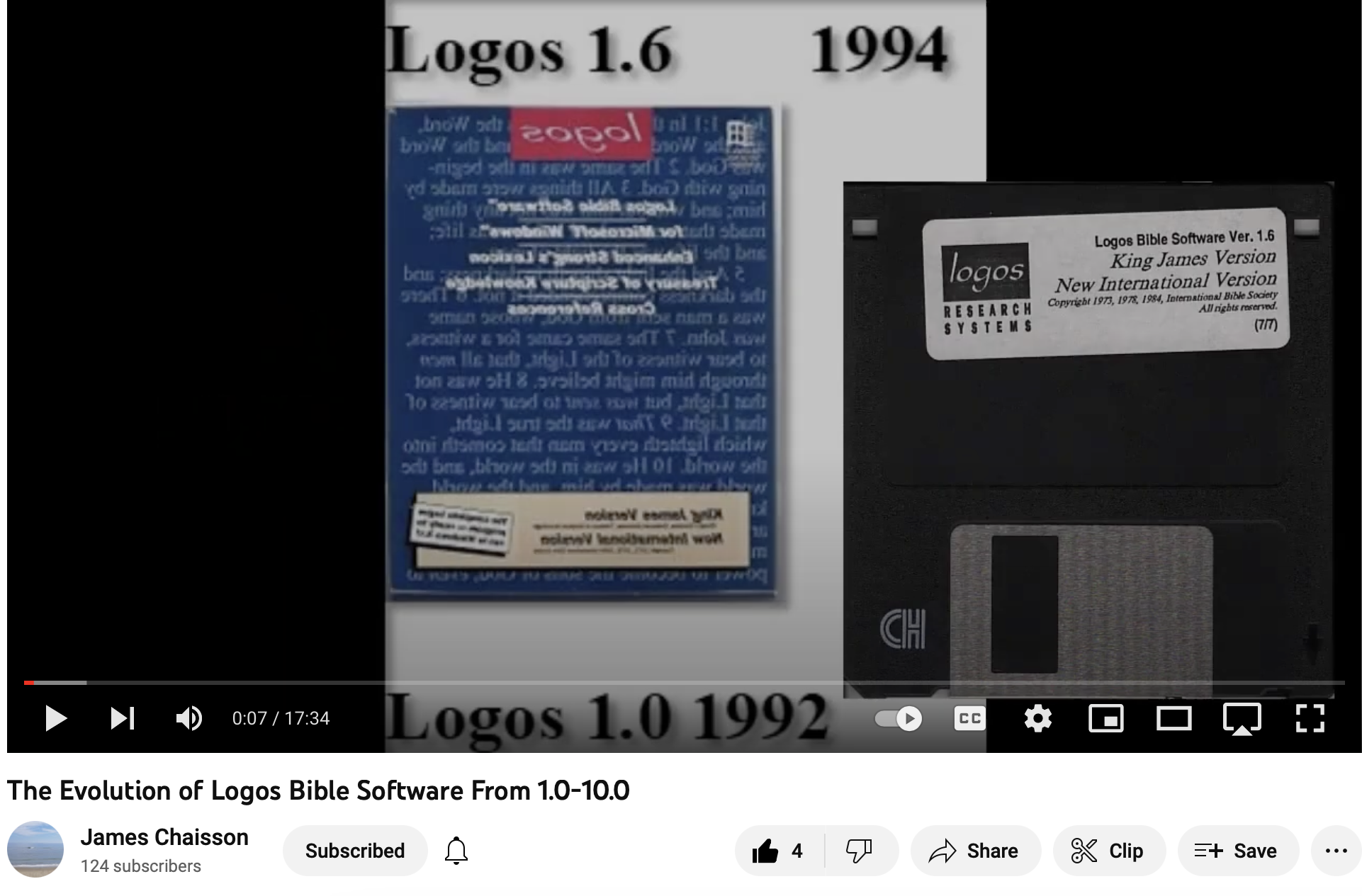
Logos Bible Software Through the Years Video
Logos user James Chaisson made a great video that shows off Logos Bible Software through the years. I share it here for your enjoyment.
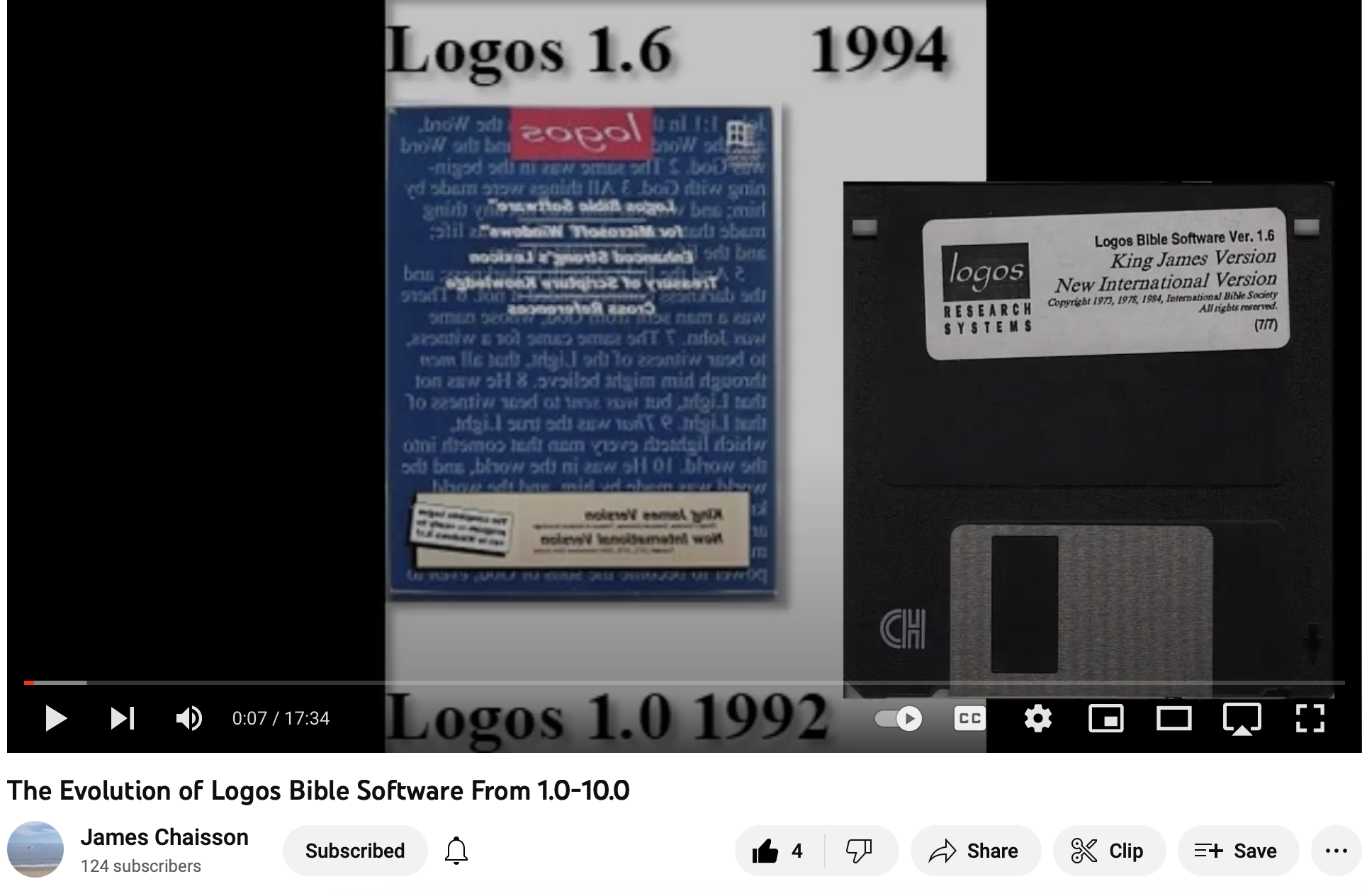
I didn't make this video of the evolution of Logos Bible Software through the years, but I wish I had. James Chaisson made it and he did a greet job. It's fun to see the way a complex and powerful program like Logos evolved from the first version all the way up to Logos 10, which just launched last month.
My History with Logos Bible Software Through the Years
As you'll see in this video the software advanced beyond the primitive origins. It was the third version that I first bought at a Sam's Club in Wilmington, NC a long time ago. The ability to enter a passage and find all the books in the library amazed me. I quickly started added books with an academic discount for seminary students while I worked on my Doctorate at Gordon Conwell Theological Seminary in the early 2000s. This add a huge library for $500. I felt like I was mortgaging my future, but I've since added a tone of other great content.
Make sure to go to James' YouTube channel and subscribe. He has some great Logos content.
Jumping on the Logos 10 Bandwagon

Also, if you want to join the Logos family, consider using my affiliate link to buy a package for Logos 10. You can also get 5 free books and the same 15 or 30 percent discount on packages depending on whether you're a current or new customers.
What makes Logos worth your time? First, it's the powerful feature set including som anew features that we outline in our last post along with a video which you can see below.
Another reason to go with Logos is the huge library of content available. They make sure to present books in a high quality format and their book formatters respond to your error reports.
Logos 10: What's New and How to Get a Discount?
What's new in Logos 10 Bible software? Read about each new feature and watch my video demo.
That's right; Logos 10 shipped on 10-10-2022. Despite the marketing department at Logos taking advantage of the date and version number, this was a big upgrade. It marks the 30th anniversary of Logos first hitting the Bible software world. They weren't the first, but they indeed have outlasted most.
Users get some interesting new features with the latest version of Logos 10. I want to highlight what's new in Logos 10 on the desktop or laptop version, the mobile version, and the web app.
Many of the features listed below only come in advanced packages, like the Gold or Bronze. You can buy a package using my affiliate link. This gets you either 15% or 30% off the price plus five free books. I'll get a cut of the sale as well.
Logos 10 User Interface Changes

Users of Logos 10 will notice the new user interface immediately. The software displays the toolbar on the left instead of the top of the window. Users can change this, but it might conserve screen space if you use the program on a wide 16:9 screen aspect ratio.
I won't keep the toolbar on the left because I like to display the button label text to remind me of what each one does. You can show the labels on the left, but that takes up too much screen space. Without labels, people who can remember what each button does can collapse the toolbar. Here's how to change the position and collapse or expand the toolbar.
How to Move the New Logos 10 Toolbar Between Top or Left

Open your Program Settings. You can do that from the menu. On a Mac, click on Logos in the upper left corner and then choose Program Settings. The Logos menu in the upper left doesn't appear on Windows, only on Mac. The second item in the settings list will change position. Click the drop-down arrow to choose Top or Left.

Optionally, in the lower left, there's a menu button with three vertical dots. Click it, choose Program Settings, and then choose the drop-down arrow to select Top of Left.

Millions of New Factbook Tags
A new visual filter in Logos 10 shows users millions of new tags from the Factbook. The Logos 10 Factbook, like the one in previous versions, serves as an information treasure trove to help Bible students understand what their reading and studying in God's word.

With Logos 10, these tags appear as an underlined word with information about that term in the Factbook. You might find things like...
- Greek and Hebrew Lemmas - open them to study the original languages for that word in English or another language.
- Information about People, Places, and Things.
- Terms with theological significance like Propitiation or the word Conform from Romans 12.
Logos described these underlined terms like the Kindle X-Ray feature that shows definitions of words in your Kindle digital books.
How to Turn On or Off Factbook Tags in Logos 10
See my post about How to Get the Most Out of the Factbook in Logos

Factbook tags are like Visual Filters, but you don't turn them on or off from the Visual Filters menu. Instead, the Factbook gets its own button in a Bible or book window. It looks like a book with a checkmark and a drop-down arrow next to it. Click the arrow to open the menu and select which tags you want to turn off or on.

Not everyone will get these new Factbook tags. First, if you upgrade and buy a Started collection, you'll get the People tags. The bronze level will add Theological terms and Greek words. You'll need to buy Silver to add Hebrew and Aramaic.
Everyone must have their computer connected to the Internet to use the new Factbook tags. If you're not connected, then they won't work. Logos 10 still works, but the tag underlines don't show up.
Church History Themes
Another Factbook improvement comes from a dataset and resource that shows Church History Themes.

To find them open the Factbook from the toolbar. You'll see the three horizontal lines often called the Hamburger menu button. Click on the Dropdown box and find Church History Theme from the list.

You can also find it in the Advanced Timeline (see more below about the Advanced Timeline). Open the Timeline and click on the Hamburger menu (three horizontal lines). Find the Event Type section and then click on Church History Theme.
The information comes from two resources - the Essential Lexham Dictionary of Church History and the Church History Themes dataset. Open them from the Library and read or search for them from there.
Simpler Search Terms
To search in older versions of Logos, users had to know some complex boolean search terms to get advanced searches. With Logos 10, you get simpler search terms.


Logos gave the following example of one more straightforward search you can now perform in Logos 10 but could not in version 9 or earlier. If you wanted to find out where in the Bible Jesus mentioned Moses, you'd type in a search box the following:
<Person Moses> WITHING (Speaker <Person Jesus>) and hit enter.
Now, just type:
person:Moses IN speaker:Jesus
That's much easier to remember and to type.
Logos will auto-complete suggested search terms to help you. You may not even need to remember the search terms to search your Bible.
Another simpler search lets you do a Search All, and Logos 10 will find results in all your datasets without you even knowing the dataset exists.
Bring Your Print Library Into Logos 10
You can add your print books to Logos 10 without buying digital copies. This also works with Kindle books too. When you add such books to Logos using the camera on your iPhone and the ISBN code on a print book, the book shows up in the Logos 10 Library. When you search for something and find it in the books added, it shows them in your list of returned search results. You can find it by page number, open that book from your bookshelf, and turn to that page.
To import a print book into your Logos 10 Library, open the app and then tap on the menu button in the lower right corner. Next, tap on Print Library ISBN Scanner. Finally, scan the ISBN code on the back of the book.

2. Tap on Print Library ISBN Scanner.
3. Scan the ISBN code on the back of the book.
The feature comes with a few caveats.
- This only works with books in the Logos catalog of books. If they don't already have the digital text of a book, it won't work.
- You must spend time and effort adding your books one at a time.
- The search results only show a snippet of the content from the book. You'll have to read the book in the print edition.
- Only people who buy the Gold package will get access to the feature.
Searching the Print Library
The new books in your print library will appear in general searches, but you can't open those books. Instead, Logos tells you where to find the content in your print book by page number. You'll open the physical copy of the book and find the content.

However, if you want to search your print library books, you can use the Library window. Open a Library window and look for the Print Library item on the left-hand side of the Library window. Find the book you want to search, right-click, and choose Search this resource.

If you want to search the entire library, follow the above steps, but instead of right-clicking first, select all the books in the Print Library. Do this using the keyboard shortcut CTR+A on Windows or CMD+A on Mac.
After selecting all the books, you can right-click one of the selected books and choose Search these resources. This opens the Search panel. Type in your search phrase or word to find items in the book.

You will see results in the Search window. Find the Print Books section as seen above. Look at the results and find the entry in the book. Grab your book and open it to the page listed or the section listed. Not all books will show page numbers.
Import Multiple Sermons into the Sermon Manager in Logos 10
Logos 10 now supports importing a collection of sermons into the sermon manager. After you add them, you will get tags added for Scripture references in the text of the Word document.
The Sermon Manager import only supports Microsoft Word's DOCX format. Only buyers of the Gold package or higher in Logos 10 will get access to the tool. If you want to upgrade, use this link to get 5 free books and a discount.

Access the import tool by opening the Tools button from the toolbar (9 dots on it) and either click on Sermon Manager or type it in the search box to find it quickly. The Sermon Manager will open. Click on the menu button (three vertical dots) in the upper right corner of the Sermon Manager. Choose Import and then click on the Choose Files button in the lower part of the Import dialog box. Navigate to the folder that holds the sermons you want to import. You can select multiple files with the CTRL+A or CMD+A.

How to Find Imported Sermons
To find your sermons open the Sermon Manager in a separate full-screen window and choose the Date you preached the sermon. This makes working with the Sermon Manager easier, especially if you're using a small screen.
I had to open the Grid view and select All from the top of the window. I opened one of my sermons, and it the formatting I used didn't work with the Import very well. If you use the built-in Microsoft Word Headings, then it will work better for you.
Now you will want to clean up your imported sermons. Edit them to use things like Headings, the information pane that opens on the right side, and the slides. If you make slides from your sermon, then you can export them to programs like PowerPoint, Keynote, Faithlife Proclaim, or PDF documents.
Popular Quotes in Sermon Builder
The Sermon Builder gets an added feature called Popular Quotes. Preachers search for quotes to add to their sermons inside the Sermon Builder.

Open a new Sermon using the Sermon Builder from the Tools button (grid with 9 dots on the toolbar). Create a sermon and then choose the Popular Quotes button on the right when you want to add a quote. The button looks like a quotation mark.

A list of quotes will appear. Drag and drop any quote you want to add to your sermon from the right-hand column to the Sermon Builder. The Sermon Builder will add the default slide. Change it by clicking on the slide thumbnail. You'll see a menu appear. The list of options includes...
- Edit - change the look of the slide.
- Apply this style to quote slides - change all quotation slides to match this.
- Apply this style to all slides - change all slides in general to match this slide.
- Delete - delete this slide.
Advanced Timeline
The new Advanced Timeline shows historical events in the context of the era in which that event occurred. The timeline offers this in a visual way. Users can filter events to focus on what they're most interested in seeing.

To open the Advanced Timeline, click on the Tools button on the toolbar. It looks like a grid of 9 dots. Either type Advanced Timeline or scroll down to the Reference section on the Tools menu and click Advanced Timeline.
This feature only works on Bronze packages or above. You can buy the Bronze package at this link and get a discount plus 5 free books.

Interact with the Advanced Timeline using the sidebar or the toolbar. The toolbar at the top has the following...
- Button to open the sidebar, which lets you select the kinds of content you want to hide or show.
- A time range box where you enter years like 20-100 AD.
- Search box where you type what you're looking for.
- Zoom in, fit, and zoom out buttons.
- View the dropdown menu to limit by things like Bible & Church Eras or Western History Eras
- Info button
- Menu (three vertical dots)
Speed Improvements
Logos 10 boasts faster performance, especially for users of Silicon Macs that use M1 or M2 branding. These are modern processors that run more efficiently than Intel chips. They claim a 35% speed boost, especially while indexing your library. I can attest to this improvement. It used to take hours to index my library with 8,000+ resources. It now does it in around an hour.

The computer still chugs along while the program indexes the library. However, Logos 10 takes far less time to index on my M1 MacBook Pro, M1 Mac mini, and M2 MacBook Air.
For Windows users, you'll see a small speed boost. It comes thanks to something called .NET 6.
Auto Translation

In almost any book, open a side panel on the right that shows a translation of the book's text. To use it, open a book. Click on the Sidebar button in the upper right corner. A new window opens with the default language. You can use the language dropdown list to pick from dozens of languages. The above image shows a French translation of the open book.
If you want to copy the contents in the Sidebar, choose the copy button to the right of the language dropdown list.
Your computer needs an Internet connection to use the Auto Translation feature. You also have to own the Gold Package, which you can buy here and get a discount plus 5 free books.
Questions and Answers
Think of Dear Abbey only for Bible study. The Questions and Answers feature answers common questions you might have about the Bible. It also includes some obscure answers too. This all comes from a new dataset.

Use the feature by typing a question in the search box (magnifying glass icon on the toolbar). The program notices you worded it as a question and tries to find your answer in the dataset. The results come from your library. It also includes other kinds of results, so scroll down to the Questions & Answers card.