

6 Reasons to Switch from Accordance to Logos Bible Software
A lot of people who use Bible software want to know if there's a good reason to switch from Accordance to Logos Bible Software. we've got 6 reasons to switch.
With the upcoming release of a new version of Logos Bible Software, many Bible software users might want to switch from Accordance to Logos. Why would someone go through the hassle of making the switch from Accordance to Logos Bible Software even though it means buying much of the same content you already own in the other program? Switching also involves learning a new user interface and finding new sources of learning or support for the new Logos.

Here are 6 reasons to switch from Accordance to Logos Bible Software.
Get Logos 10 With Biggest Discounts Ever Offered
In August, Logos will offer the most significant discounts on Logos 10. They called it their "Farewell Tour 2024 because Logos 11 will hit their store soon.

Click the image above, which will take you to my affiliate link to get...
- Full Feature Upgrades at up to 65% Off if you own Logos 10.
- Get a new Logos 10 base package and save up to 50% off for those upgrading from an earlier version.
- For first time buyers of Logos 10, get 5 free books.
Learn about the new era of Logos that will come with Logos 11.
Robust Sync Elements in Logos Bible Software Way Ahead of Accordance
This might seem like a strange place to begin, but it's one of the features promised when Accordance 14 came out a long time ago, and they still don't have it.
Syncing does more than keep your content, settings, and user-created content in more places. Change settings on your desktop, and it will sync to your laptop. Add notes on a verse with your phone while listening to your pastor, and they'll end up on your desktop. If you're studying on a friend's or family's computer, you can hit the Logos Web App, and your work will sync to other devices.
Syncing makes Logos great, but it also helps back up your work. If your computer dies, you can work on an iPad or a Samsung Android tablet. Then, once you get a new computer, install Logos, and your work will be ready to use after it finishes downloading and indexing your library.
Great Features that Make Logos Easier to Use for Bible Study
I could write a post on this topic alone. We may discuss it later, but here's a bullet list of why these features make Logos Bible Software a superior option.

- Advanced Search Features—Logos struggled with basic search, so many of us searched Google instead. That's changed with versions 10 and 11, which promised to improve it with built-in AI features. You won't get these in Accordance. See the link to learn more about how Advanced Search in Logos simplifies your research.
- Use of Louw-Nida Numbers—Louw-Nida Numbers offers access to the lexicon that many students love. The book description on Logos.com says, "This lexicon differs from other lexicons in that it does not arrange words alphabetically and does not give one listing of a word with all of that word's meanings after it. Instead, it breaks words down by their various shades of meaning." (See Above)
- Unicode Fonts - Biblical languages work better when they use Unicode fonts. You can type in Greek or Hebrew; they will look more readable.
- Print Library ISBN Scanner—Logos will let you scan your physical library books and show you search results from those books in your library if they offer them as Logos books. You can see where the search hit shows up in your book. You can take it off the shelf and read it or buy it from Logos. We learned about this new feature in our article on what's new in Logos Mobile 10. (See Below)
- Search books you don't even own - When you search your library, Logos also offers links to books you don't own. Some might not like this, calling it spam. But, if you need some information in a book you don't own, you can quickly buy it, download it, and incorporate it into your research.

Switch from Accordance to Logos Because of the Logos Mobile App's Full Set of Features
For years, I complained about Accordance's weaknesses on Android and iOS. Sadly, it never got better. Now, you can't even download the Android app from the Google Play Store. You must get it from the Amazon App Store for Android or Accordance's website. Even that link tells you it's on the Google Play Store, but if you click their link, you'll get an error saying the link isn't available.

Many Accordance users report issues with syncing content directly via their terrible sync feature or Dropbox. To sync with your computer installation of Accordance, you have to set both the app and the desktop program to sync over local Wi-Fi.
You can also connect both apps to your Dropbox, requiring you to rely on a third party. People complain that Dropbox sync often corrupts notes files.
Compare that to the iOS and Android versions of Logos. They include a large percentage of the desktop features. Syncing works quickly and automatically in the background soon after you open any version of Logos while connected to the Internet.
Accordance includes less than a third of the desktop program's features. That's a generous percentage.
iOS includes a little more than Android, but not much. Both are essentially book reader apps with unreliable note-taking and highlighting features. You can do some Bible study.
Logos includes many great language study tools, commentary searching, and much more.
Quick and Useful Updates
Logos updates their app often and usually with more stability than less. Accordance updates slowly, and the mobile seldom gets updates. Logos mobile on iOS went from version 30 to version to version 35 (all minor updates) in 8 months. That's a massive benefit if you use a feature that doesn't work. Logos will take your bug report and create a ticket, and their developers will work on it quickly. If they can fix it easily, it often gets fixed in a week or a month. Occasionally, it takes a little longer.
Accordance received only four updates on iOS in the last two years. All of them were minor bug fixes. As we said, you can't even get it on Google Play Store. The latest version (2.2.3) came out in Summer 2021. Not even one minor bug fix has come out since.
Significant updates on Logos for Desktop come out about once every two years. Accordance went from 13 to 14 two years ago. However, Logos aggressively updates their Desktop app with minor releases that add new features. They come out often monthly. Accordance for desktop doesn't update nearly as quickly.
The update to version 14 promised many great features. Two years later, we still do not see many of these, like an online version and syncing over the internet without needing Dropbox.
Best Online Bible App Bar None

We've looked at online Bible study apps in the past. We posted that here in 2020, and it needs an update. However, the best still comes from Logos.
The Logos Web App includes many features available in the Logos Bible Study App for your desktop or laptop. It's as good as or better than the mobile version.
The user-interface looks different on the web, but once you open your books and get to work it behaves much like the desktop. You have word study tools like the Exegetical Guide, reverse interlinear features, great searching features, and other guides (Bible Word Study, Sermon Starter, Passage Guide).
The Factbook offers a lot of the features from the Desktop as well.
Sadly, Accordance users don't have an online version. There's a promise that it will come soon, but I doubt it will. When it does, it won't likely offer more than basic book reading and searching tools. I hope I'm wrong, but I don't think so.
New AI Features in Logos Bible Software
I'm working on an article for ChurchTechToday.com regarding their new AI tools, and I'll link to it here.

The new features include Insights. Open a book, and you'll see a button on the book's toolbar labeled Insights. This button gives you cards showing information from Related books, Related passages, and Cross References.
A nice addition to the Search tool lets users search with natural language. Open Search and set it to Smart using the drop-down list button at the top right. Then, enter a natural language search. I entered "Where did Jesus first talk about discipleship?" and it returned hits from several spots in multiple translations since I had it set to search my Top Bibles.
The Synopsis tool in the resulting search will give you an overview of your search results.
I then switched my search to Downloaded Books, which yielded results for many book types. Again, the Synopsis tools summarized the results. You will see a number referencing the sources of the synopsis summary.
Those are just a few of the new AI-empowered features in Logos. I don't think Accordance has AI tools on its radar since it's still working to release the promised features from version 14. The company has a tiny programming team, so I understand why it's taking a long time, but I fear it will get left behind.

Proving Your Point with Argumentation in Sermon Development - Part 3
In our series on sermon development we come to proving your points using good argumentation. What does that mean and how do you do it. Plus we've got more Logos deals.

In your sermon development, you should include 4 essential elements: explanation, illustration, application, and a fourth one that too many preachers leave out. We call it either argumentation or proof.
Each kind of sermon development answers a question:
- Explanation: What does that mean?
- Application: Why does it matter to me?
- Argumentation or Proof: Is that true?
- Illustration: What does that look like?
Why Do We Need to Prove a Biblical Truth with Argumentation?
Have you heard this popular statement among Bible-believing Christians? "The Bible says, I believe it, and that settles it." I've also heard people shorten it to, "The Bible says it so that settles it."
The Bible says, I believe it, and that settles it.
Well-known evangelical quote.
Unfortunately, we preach to people who don't believe things just because the Bible says it. Some guests at your church don't believe the Bible is infallible. Even church members might choose only parts of the Bible to believe and apply. A recent Barna study defined a Biblical worldview and found that most Christians disagreed with that definition. So, we must consider these people as we prepare to preach our message.
Many Christians believe something until it forces them to change their assumptions or behavior; then, they willingly give up their Biblical convictions and choose to live like they want. We must prove to them that applying the Bible in their lives brings them into proper obedience and makes it in their best interest to obey.
My seminary preaching professor, Wayne McDill, wrote:
Sermons are designed to persuade. But if you are to be persuasive, you will have to make a case for your ideas. You will have to demonstrate that your point is reasonable and worthy of belief, that what you are saying makes sense. Argument is that part of your support material in which you give reasons for accepting the principles you are presenting.
McDill, Wayne. 12 Essential Skills for Great Preaching.

Click here to get it in Logos Bible Software.
Tying Your Sermon Argumentation to the Context
Advanced preachers use multiple sermon types or outline styles to carry the text's message, and we want to describe where we should place argumentation or proof in our sermon development.
You might call yourself an expository preacher because you work through books of the Bible and take a verse-by-verse approach. It's like a commentary that covers each verse separately. That's a form of preaching, but it's not Expository Preaching.
Truly Expository Preaching follows the Big Idea of the text, as well as the tone and form of the passage. For example, if you preach poetic language and imagery from a Psalm, you won't preach a didactic sermon with few mental images. Use the mental images the Psalmist offers and share them to make your points. Explain the imagery and how it relates to the theological concepts your message presents, following the author's approach in both content and tone. Your sermon development might contain a modern-day version of the psalmist image to explain your idea.
Once you've explained the idea and tied it to the text, you will argue the truth of the concept for your audience. Don't assume they will believe it because David wrote it. This is where we fit proof or argumentation in our sermon development.
An Example of Where Argumentation Fits from Psalm 1
Look at Psalm 1, which includes several metaphors to describe the godly man. We learn that he's like a person taking a walk. He won't walk by ungodly influences and get distracted by them. We get a mental image of someone stopping to look at what the ungodly are doing. Then he sits down with them. The progression of walking by, stopping, and taking a seat is the mental image of being drawn into the sins of the ungodly.
Blessed is the man
Who walks not in the counsel of the ungodly,
Nor stands in the path of sinners,
Nor sits in the seat of the scornful;Psalm 1:1, NKJV (italics mine)

You will first need to show the hearer what you mean by describing the scene or telling a story about a time when you were distracted by something while taking a walk or driving along the road. You've used an illustration or natural analogy to explain what you mean by the concept of distractions from a spiritual relationship with God.
As the Deer Panteth for My Attention

I once drove home at night along Yellow Banks Road near my home in the rural area of Wilkes County, NC. A home along that road has a huge field in front and to the left. There's a row of trees about an acre off the road. We recently moved here and, at dusk, saw some deer. It grabbed my attention, and my wife counted. The number grew while my speed decreased. Finally, I nearly came to a stop to see for myself. We counted more than a dozen deer in that field.
Those deer grabbed my attention to the point where I nearly stopped. Sometimes, as we walk along God's path, we get distracted and slow down to see something. We stop and might take a seat to examine it for a while.
After explaining the concept using an illustration, you must prove it to your modern hearers who don't assume the Bible's truth. This leads us to the next step in proving your point with Biblical argumentation.
Consider Arguments People Might Make Against the Big Idea and Answer Them

You've shown the audience what you mean and explained how it relates to the text. Next, brainstorm possible arguments against the Big Idea. How might someone object to the text and your statement of the idea?
You could write the idea at the top of a page or type it into your sermon notes. Then, use bullet points to list arguments against it.
You're not writing or typing what you believe are valid arguments against the idea; you're brainstorming what a listener might say in response to the Biblical truth. Imagine a teenager or a young mother who might struggle with the issue. Picture people who might sit in the congregation listening.
Using our example above, consider the following possible arguments against the truth. Sinful influences won't easily distract a godly man living for God.
Sinful influences won't easily distract a godly man living for God.
We'll clean up the above statement in a future part of our sermon design to make it pithy and memorable. At this point, it's a good idea to write it out in detail to give you a complete idea of your concept, which will help you brainstorm. List the possible objections. Consider these two.
- I won't get distracted because I've been a strong Christian for many years.
- Didn't Jesus tell us not to neglect lost people?
- I get easily distracted by sins. I can't stop ... (fill in the blank with any sins people might habitually commit).
Answering Arguments Against a Truth
You might think of other arguments against the truth. Let's consider an answer to one of the arguments listed above.
You're at a coffee shop with a friend. You discuss the concept found in verse one of Psalm 1. He looks at you thoughtfully, looks away, and then says, "I get distracted by sin all the time. I find it really hard to resist certain temptations."
We need to convince the person that they can walk with the Lord, and this helps us overcome temptations as we continue in the faith. Where would you find a convincing argument to help your friend trust that they can overcome sin if they do something new?
Is the Bible a Valuable Source for Argumentation?
We're tempted to rush to other passages that will prove our point. I immediately thought of a passage in 2 Peter 1 that says...
5- But also for this very reason, giving all diligence, add to your faith virtue, to virtue knowledge, 6- to knowledge self-control, to self-control perseverance, to perseverance godliness, 7- to godliness brotherly kindness, and to brotherly kindness love. 8- For if these things are yours and abound, you will be neither barren nor unfruitful in the knowledge of our Lord Jesus Christ. 9-For he who lacks these things is shortsighted, even to blindness, and has forgotten that he was cleansed from his old sins.
2 Peter 1:5-9, NKJV
That passage might help someone who trusts God's word. When you first believe God can answer your problems, this kind of faith adds virtue. We progress from virtue to knowledge. You find great self-control when you learn about God's love, grace, and support through His Holy Spirit. That brings perseverance and less failure. The more perseverance you find, the more godliness you gain in your behavior, and you can better resist temptation. That leads to an abundance of fruit-bearing behavior.
However, this alone won't help the skeptic. Scripture is powerful, so use passages like this to support your argument. However, you will usually need more for an unbelieving person and even for Christians who don't yet submit willingly to the Word just because "God said it."
Other Sources for Argumentation in Sermon Development
You can find many sources for proof or argumentation in your sermon development. Statistics, examples, stories that show the truth applied effectively, and quotations from trusted people all help the preacher prove the truth.
For example, I used a Barna Research stat to prove that believers might not trust Scripture alone for proof in a sermon. I could strengthen my argument with an example of someone I knew who claimed to serve Christ but didn't believe some clear Biblical idea.
Returning to Psalm 1:1, we see that our friend at the coffee shop didn't agree that living for God can help them fight off the distractions of temptation. What if we used 1 Peter 1, an example or testimony from our own lives, and a quote from someone the person trusts? Together, with the conviction of the. Holy Spirit, might convince our friend.
Find Argumentation or Proof for Sermon Development in Bible Software

I use Logos Bible Software to study passages and topics found in those passages. You could open Logos Bible Software and run a Topic Guide from the Guides menu. Type the topic in the search box and wait while Logos returns content from your library. Look through the results to find some possible support material.
Logos Sale on Lexham Press Collections

You can now save 40% on the Logos Lexham Press Collections, which include their Master Collection, the NT or OT Collections, and their language suite of tools.
These can get pricey. However, you can also get something free..

Check out the free book of the month. It's Warfare in the Old Testament and John Chrysostom by Boyd Seevers.
These sales are good until the end of May 2024. You can find the latest deals on my affiliate page if you're reading this after that date.

6 Logos Word Study Tools to Explain Your Sermon Ideas
An experienced preacher highlights the importance of 6 Logos Word Study Tools for crafting sermons. These tools prevent the misinterpretation of biblical words by ensuring contextual analysis and multiple translations. The word study culminates in recording findings, reinforcing accurate biblical interpretation and engaging sermons.

In the early days of my preaching, I wish I knew the power of these 6 Logos Word Study Tools. They will captivate your congregation, injecting each sermon with a mixture of fascination, delight, and clarity to simplify the message of the Bible. Embrace these 6 word study tools, and your preaching will surpass my early efforts.
Here's the problem with inexperienced preachers studying key theological words in a text. The preacher often takes the words out of context by looking them up in a concordance. A word used one way in John might not fit the meaning of the context in 1 Corinthians or 2 Peter.
Search the word love in a concordance, and you'll find it everywhere in the Bible. However, the Hebrew and Greek understanding of the word differs. Greek has a few words for love that mean somewhat different things. You can't assume it means the same thing in all the verses that contain the word.
We have to protect against careless word studies, and the Logos word study tools below will help you avoid making mistakes as you use these 6 Word Study tools so you can explain the ideas in your sermon.
See at the end the latest deal from Logos Bible Software which can give you up to 25% off a new package, plus more.
Read and Reread Your Text in Context
As an expository preacher, I usually use one passage for my sermon. Other passages may help me explain, illustrate, or apply the primary text. Occasionally, a quoted verse might introduce proof that argues the point.
If you use one primary text, read that text in context. At the very least, read the entire chapter and probably the chapters before and after. If you're preaching from a narrative covering many chapters, read the entire story.
Next, read the passage again by itself. Note any ways the context affects the understanding of the text. Then, read the passage again in multiple translations. Avoid paraphrases at this point.
1. Rereading a Text Using Logos Text Comparison Tool
The first of the 6 Logos word study tools will present your text in a few to all of your Bible translations in one window. Open the Text Comparison tool and set with your favorite translations or all of your Bibles.

Click the Tools button on in your toolbar at the top or left (depending on your settings). Find the Text Comparison Tool in the Passage section of the Tools menu and click to open it.

You'll see the tab with the verse at the top of the Text Comparison Tool. Right of that notice some blue text underlined with abbreviations for your Bibles. It shows the Bibles displayed in the window. Click the listing of Bible translations to modify the chosen Bible translations.
The menu that pops up includes three sections. The top section shows your displayed texts, which you can check or uncheck to show or hide that Bible in the Text Comparison tool. The second section shows your saved collections of Bible texts. Click one to replace what's showing in the window. The third section lets you choose what to show in the window from different collections of books. To show all of your Bibles, click the Bibles Collection.

Shown in column formation instead of interlinear.
Customizing the Text Comparison Tool in Logos Word Study Tools
Logos offers three other customizations as follows:
-
- Show or Hide Differences between the Bible Translations.
-
- Show or Hide the Base Text in the text of the other Bible Translations with a strikethrough line through the base text.

Logos also lets users show the verses in interlinear mode. You can still see the differences between the words in strikethrough format and without.

2. Comparing Multiple Texts Using the Logos Passage Analysis Tool

Open the Passage Analysis Tool from the Tools menu. This includes a few visual Logos word study tools. You'll find it under the Passage section. In it you'll see the differences between various translations. This doesn't help you read a passage repeatedly, but it shows you how they differ so you can pay careful attention to those differences.
At the bottom of the window you find buttons showing the differences in various visual formats. Click each to try it out.
Take Note of Key Theological Terms and Look Them Up 4 Key Logos Word Study Tools - Concordance, Bible Dictionary, and Lexicon.
By now, you've read through the passage multiple times and know it pretty well. You might even have memorized it. Next, take note of the key terms in a verse. For example, let's look at Matthew 28:18 in the NKJV.
And Jesus came and spoke to them, saying, “All authority has been given to Me in heaven and on earth.
Matthew 28:18, NKJV
The words that stand out to me include...
-
- came
-
- spoke
-
- saying
-
- authority
-
- given
-
- heaven
-
- earth
Looking at the list, the words authority and given carry the primary meaning, while the others might offer less interpretive importance. It doesn't matter. Still, look them up the 4 Logos word study tools listed below, just in case.
A good word study includes looking them up in three different tools and possibly more.
-
- Concordance - search a concordance for an important term and see how the author of this book you're reading used it and how others used it. Be careful about jumping between the Old and New Testament.
-
- Lexicons - without using Bible software, you'll need some language skill to look up words in a lexicon. You'll need a Hebrew Old Testament and/or a Greek New Testament. Find the word in a Hebrew or Greek Lexicon. We'll show you how to do this in Logos below under number three.
-
- Bible Dictionary - look up the English term in a Bible dictionary and note what might apply to your verse.
-
- Atlas - geographical terms should show up in a good Bible atlas.
Remember that not all you find in the reference tools above will apply to your passage. English speakers use the word cool in a number of different ways. The Fonz was cool, but so is today's temperature, and a pitcher in the baseball game who doesn't get rattled. You wouldn't make a point about how The Fonz was cool so he wore a jacket to keep warm. Be careful about doing the same thing with Bible reference books.
3. Bible Word Studies in Logos Word Study Tools: Letting Logos Look Things Up
The Exegetical Guide in Logos runs a specialized search for hits in books in your library for content related to words in Greek or Hebrew. Open your Bible to your passage and select a verse. Right-click it and select Reference on the left of the pop up list. Then scroll down to the Exegetical Guide in the list onto the right of the pop up menu and click it.

The Exegetical Guide on your text shows a list of language tools including the WORD BY WORD section. Open it and you'll see your favorite translation name. Click it to open the Bible to the verse. Next, you'll see the verse in Greek or Hebrew on the left near the top. The English verse shows up on the right next to it. Then, each main word shows up below with some important information, including...
-
- The word in the original language and an English transliteration.
-
- The word in the verse's context is on the same line as the word in Hebrew/Greek and Transliterated.
-
- A circle that you can click to run a Bible Word Study on that word.
-
- The Greek or Hebrew word again with an audio icon which you can click to hear the word pronounced.
-
- A simple English translation of the word.
-
- The morphological information which you can click to open a definition of that info or hover over it to see a pop up.
-
- List of your top lexicons and the option to see more by clicking More.
-
- You can add notes to each word too.

Any text in blue is a hyperlink that you an click to open or hover over. Read about words, tenses, etc. Open these to read more and learn about the various words in your passage. Keep records in the notes you can add to each word or the current Guide. However, I prefer to add a note to the verse itself instead of the Guides. You can easily find this study info each time you open that verse.
Other Logos Word Study Tools in the Exegetical Guide

You can find other tools in the default Exegetical Guide as follows:
-
- Your Content - shows things like notebooks you've created about this passage.
-
- Textual Variants - shows info from your library related to textual criticism.
-
- Word By Word - described above.
-
- Grammatical Constructions - shows grammar items that affect this passage's meaning
-
- Important Word - lists keywords from your text and shows links to run a Bible Word Study.
-
- Lemma in Passage - like the Important Word list, but shows the lemma instead of the exact word in the text.
-
- Important Passages - runs a report of cross-references related to your passage.
-
- Ancient Literature - shows entries about the passage in ancient literature, like Church Fathers, the Works of Josephus, Apocrypha, and more.
-
- Commentaries - show your passage in all of your commentaries.
-
- Journals - shows your passage in all of your Journals.
-
- Grammars - shows morphology in grammar books for words in your passage to help you understand things like tenses, moods, and more.
-
- Visualizations - shows links to your passage in different Visualizations like Diagrams or Outlines.
4. Find Words in the Factbook
The Factbook finds your keywords and searches for key information to help you understand the definition, sense, and meaning of English, Greek, and Hebrew words.

To find the word in your Factbook, open the Factbook and type in the word. Find it more easily through the right-click menu. Right-click on a word, and you'll see the menu with two columns. Along the left, click on the word in Greek or Hebrew. You can click the word as it appears in the text or the lemma. Look down to find the English word with Factbook icons next to it. Click on that word as seen in the screenshot above. Then, on the right side of the right-click menu, click on Factbook. Logos opens the Factbook to that word and gives you many search results tagged for the Factbook.
5. Open the Logos Explorer

The Logos Explorer window shows important content based on the passage currently shown in your open Bible. Open Explorer from the Tools menu along the top or left of the Logos windows. You'll find it under the Passage section.

The Bible Explorer window shows you a lot of context based on the text in your Bible window. Turn on the Link Set by clicking on the three vertical dot icon in the upper right corner of the Explorer window. Choose a letter and then do the same in the Bible window's three vertical dot icon. Choose the same letter in the Link Set.
The Explorer includes information from the Factbook, Media, Cross References, and Commentaries. At this point, avoid the commentaries, since those will come with interpretation biases from the author. You want to let the Bible speak for itself as you ask the Holy Spirit to interpret the text through your own reading and research.
6. Add a Verse Note to Record Findings From the Logos Word Study Tools

Here's a great tip for keeping your info for current and future study. Add a note to your passage. I prefer to do this through the right-click menu as well. After you right-click in your passage, you can add a verse by selecting the verse reference in the left column of the menu. Select Add note from the right column. If you prefer you can instead add the note to a specific notebook. You'll see the most recently opened books listed under the Add note section.

Users can also record their findings by adding a new note using the New note button in the Notes window. The button will add a new anchored to the reference that's currently the focus in the main Bible window. If you would prefer to add a note that's not tied to the current verse, then click the down arrow and choose New note, the first item in the drop down list.

The other two items on the list let you add a new note to a reference, which the New note button itself also does, as shown above. You can also add a highlight to the verse.
The Latest Logos Bible Software Deals
First, you can save up to 25% on a new Logos 10 Package. Buy the Logos 10 Diamond, you'll get 25% off.

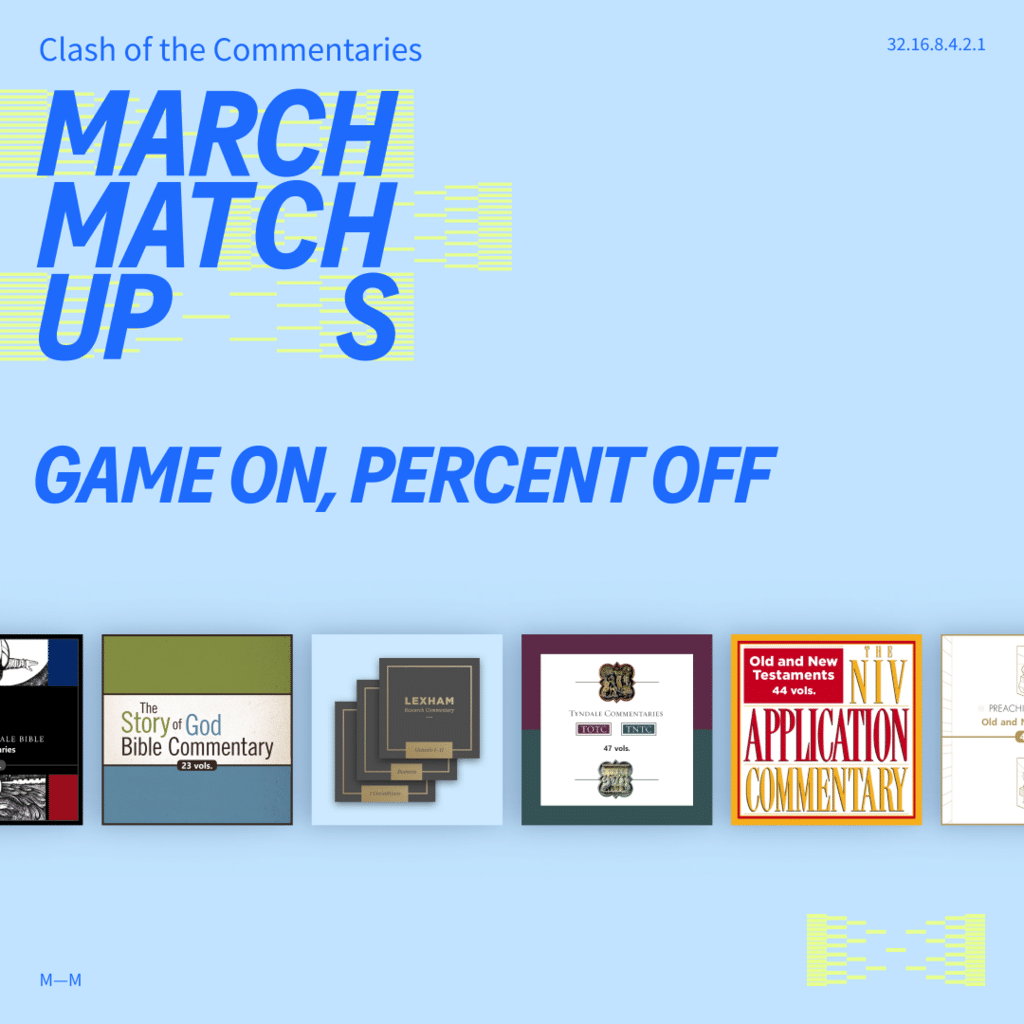
Top 5 Logos March Matchups Deals Worth Buying Now
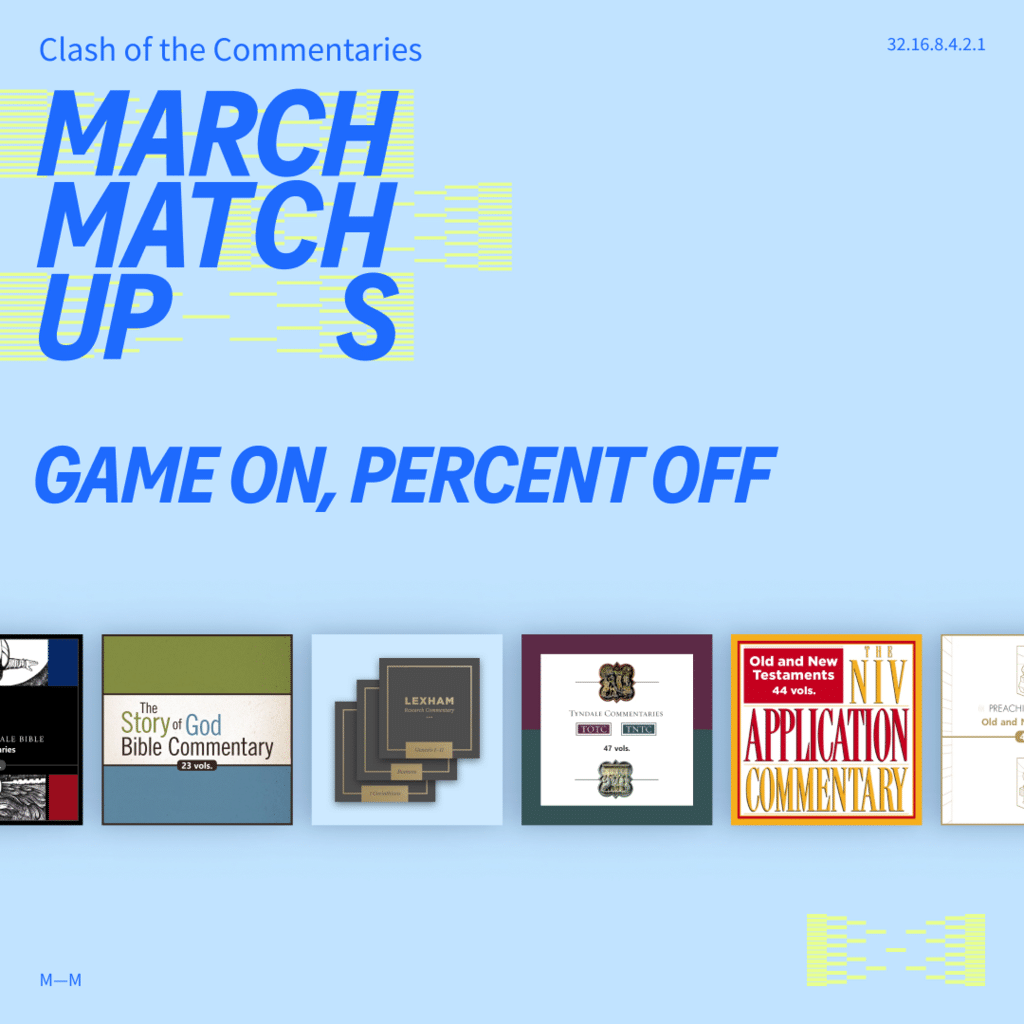
In basketball, March Madness will kick off soon, but in Logos Bible Software, the Logos March Matchups 2024 deals are live now—all of them! Logos users picked their favorites from dozens of options, and it came down to two options. The user crowned one of them the champ, and you get the winnings in big discounts.
I've got all the available deals, but I recommend these top 5 Logos March Matchups Deals for 2024. Check them out. Some of them are what Logos calls Hall of Fame titles. That means they were not part of the March Matchups, but you still get steep discounts because users picked them in previous years. Comment below to tell me which deal you buy and which you'd like to get. Now for the Top 5, in my opinion.
Take a look at the bottom of this post for other steep discounts on the Logos version of March Madness.
New International Commentary on the Old and New Testament

Logos currently charges $1,824.99 for NICOT and NICNT at their regular price. However, you can get them for $1,094.99. That's a great deal for the complete set covering the Old and New Testaments. Take a look at Best Commentaries, a site that ranks commentaries for users, and you'll see that this series boasts more volumes ranked first or second for each book of the Bible. I counted almost 30 volumes listed first or second. Many others rank third or fourth.
This commentary series offers scholarly discussion of each text and book in the Bible. It also adheres to Scripture as the infallible Word of God so you can trust it.
NIV Application Commentary Series

Get the NIVAC for $600 off the regular price of $1,199.99 during this sale. You'll love the way it's laid out. You get scholarly discussions of the text and some wonderful applications to modern life, hence the series title.
Like NICOT and NICNT, the NIV Application Commentary series put many books in the top two for each book of the Bible. Best Commentaries ranks 28 volumes in the top 5, mostly in the Old Testament.
New American Commentary Series

The New American Commentary, or NAC, strikes a wonderful balance between academic discussion of the text and accessible understanding for most people who teach or preach the Bible. I rank this commentary first in my list of Logos Bible Software commentaries and in other programs, too.
Lovers of this series feel frustrated that we still can't get Ephesians or the Psalm 1-72 volume. Ephesians supposedly ships on November 1, 2024, and the Psalm 1-72 volume hopefully comes out before Christ's return. Or should I say that I hope Christ returns before it comes out?
According to a person on the Logos Bible Forums, the author said he'd get it to the publisher by December 1, 2023, and it would come out in "late 2024."
Logos will sell you the NAC for only $439.99, a nice discount off their regular price of $1,117.57. That's a good deal!
Best Commentaries doesn't rank as many NAC titles in the top 5 in the New Testament, but most OT books come near the top of their list. Some of the NT books should rank higher because they're excellent.
Anchor Yale Bible Commentary

The Anchor Yale Bible Commentary costs a whopping $4,257.12 at regular price, but you can save a lot with this great discount and get it for $1,437.76. Because of the huge discount alone, I've included it.
It's always a good idea to have a commentary that challenges thinking in your library. If you're an evangelical conservative like me, then this set will do that. It's very good, so long as you know you must spot the non-conservative thinking. The publisher relied on Protestant, Catholic, and Jewish scholars to write this collection.
Christ Centered Exposition Commentary Series Collection

While Anchor might challenge you theologically and with its technical scholarly approach, the Christ Centered Exposition Commentary Series Collection reads like a collection of sermons on each book in the set. You could read it devotionally for your own benefit or use it to prepare sermons. Either way, it's worth the $195.59 price, which saves you over $200 off the regular price.
Other Great Deals on Logos March Matchups
Now that March Madness will heat up, Logos March Matchups just crowned its 2024 champion. Here's the rest of the top deals available this year.
- Baker Commentary on the OT - The Big Winner!
- Pillar New Testament Commentary - Runner-Up in the Final March Matchups Tournament!
- Evangelical Exegetical Commentary.
- Lexham Geographic Commentaries.
- Tyndale Commentaries Old and New Testament.
- Lexham Research Commentaries.
- The Story of God Bible Commentary
Find all the other deals by using my affiliate link. This will help me with the costs of keeping my site ad-free.
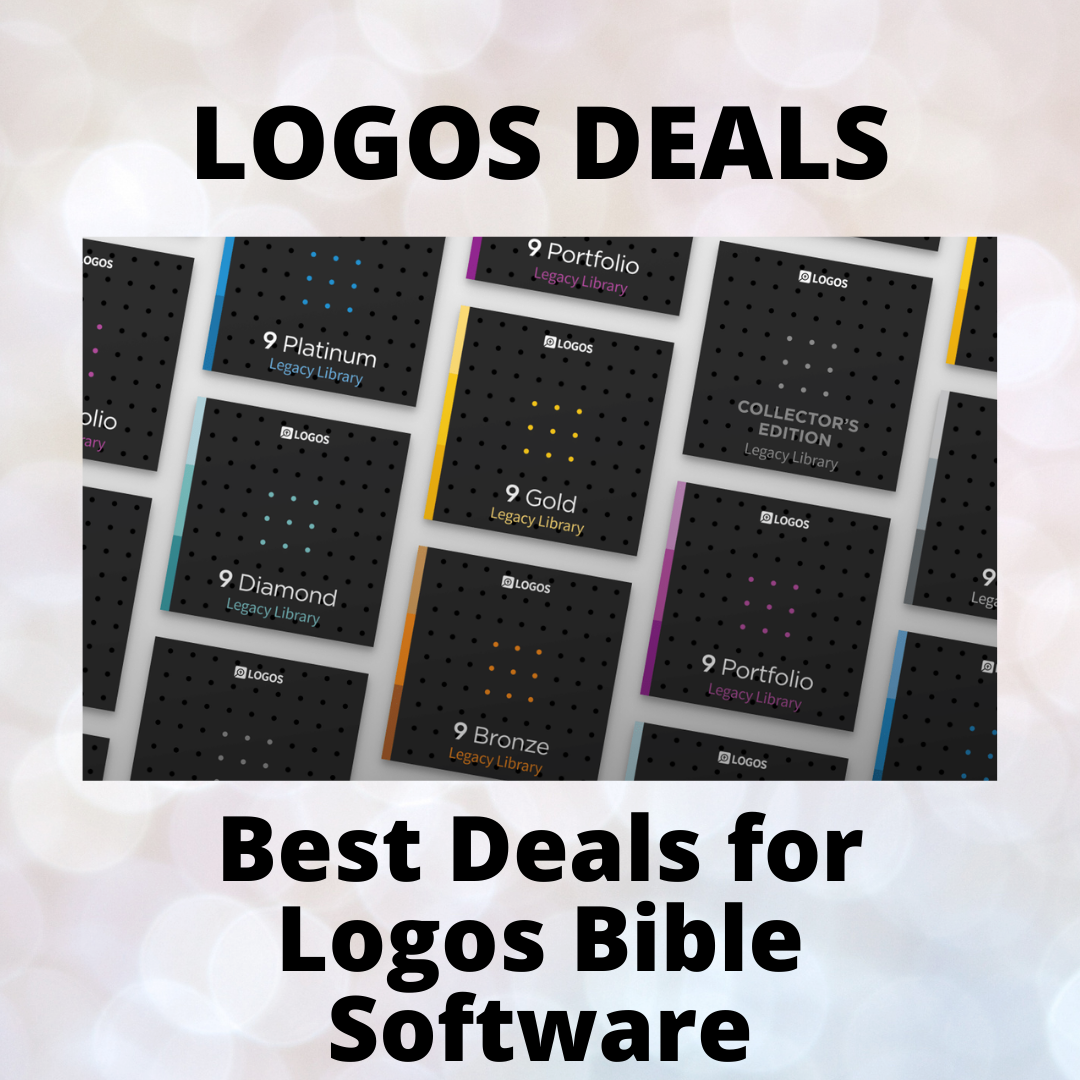
3 Great Logos Bible Software Deals You Should Buy
Here are 3 great Logos Bible Software deals that you can get now and save a lot of money. Find out how to gets free books and deeply discounted books, commentaries, and collections for Logos.
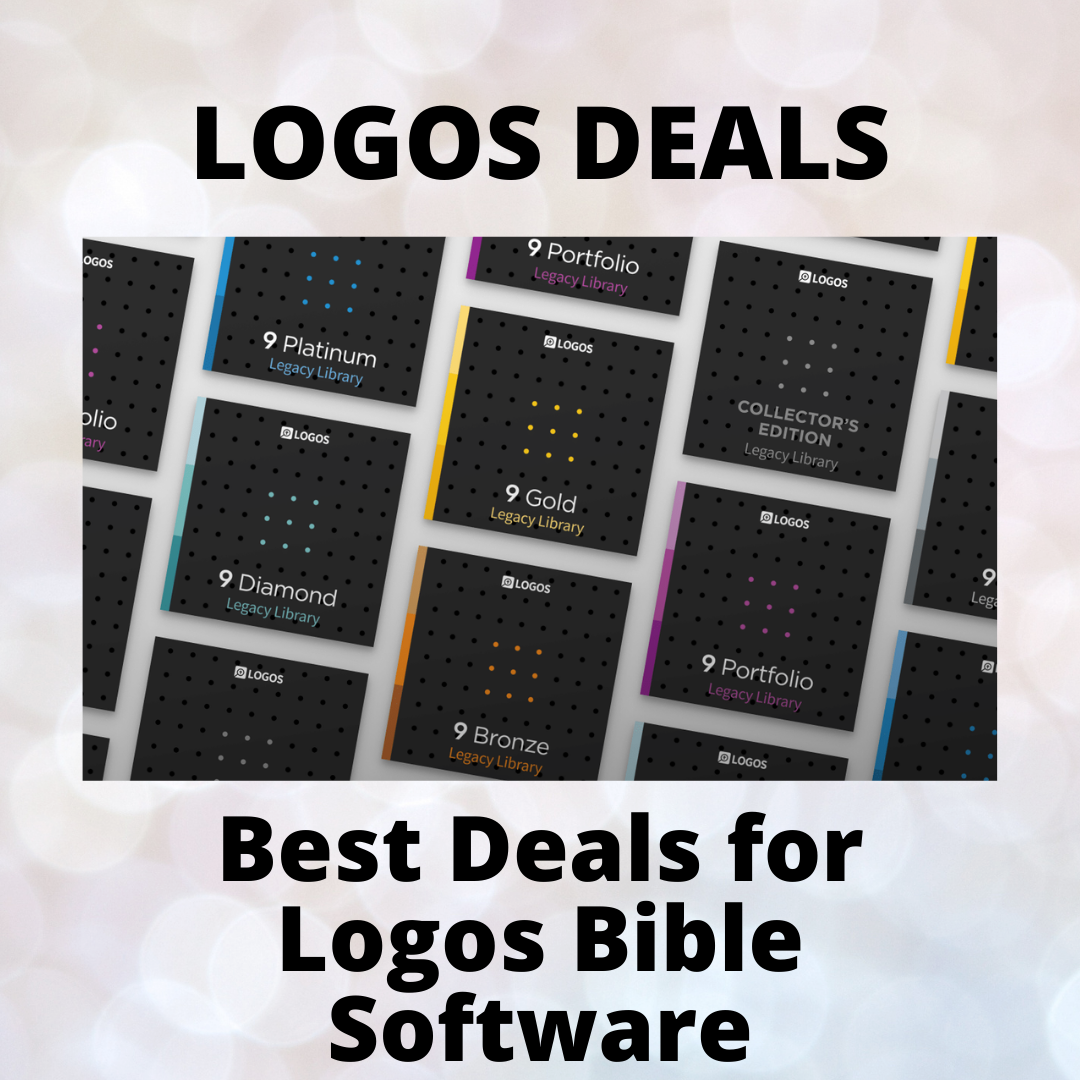
You know that I use Logos Bible Software for most of my Bible study needs. As a result, I'm happy to recommend these 3 great Logos Bible Software deals on some excellent books, collections, and upgrades to Logos 10 or even Logos 9 if you haven't updated to the new Logos 10 version.
Logos Bible Software Deals on Logos 9 Legacy Libraries

The first of our Logos Bible Software deals lets you update your collection of resources with Logos 9 Legacy Libraries. A legacy library includes books like the CSB Study Bible, Tyndale New Testament Commentaries, the Anchor Yale Bible Dictionary, and Theological Diction of the New Testament. Not only will the Logos 9 Legacy Libraries cost as little as $35, but also you can get a huge collection for thousands of dollars. Here's a recommendation:
- Get the Logos 9 Gold Legacy Library which includes excellent resources like...
- Pillar NT Commentary
- Baker Sermon Outlines Collection
- Anchor Yale Bible Dictionary
- Cornerstone Biblical Commentary
- John Piper's Sermon Archive
- Take a look at your denomination's library
- Baptist
- Lutheran
- Messianic
- Anglican
- Methodist/Wesleyan
- Pentecostal
- Orthodox
- Reformed
- Verbum (Catholic)
Free Book of the Month and Other Sharply Discounted Books

The free book for June comes from R. C. Sproul. Get The Consequences of Ideas: Understanding the Concepts that Shaped Our World for free. This book covers the "influential philosophies" from impactful minds in theology, education, arts, and more. Each of the 14 chapters covers a different philosopher or group of philosophers.
Sproul explained why we need to study Philosophy with the following quote:
Philosophy forces us to think foundationally. By foundational I mean first principles or basic truths. Most ideas that shape our lives are accepted (at least initially) somewhat uncritically. We do not create a world or environment from scratch and then live in it. Rather we step into a world and culture that already exists, and we learn to interact with it.
R. C. Sproul, The Consequences of Ideas: Understanding the Concepts that Shaped Our World
Likewise, the other books available for steep discounts include:
- Kingdom Race Theology: God's Answer to Our Racial Crisis by Tony Evans
- The Sabbath as Rest and Hope for the People of God (Short Studies in Biblical Theology) by Guy Prentiss Waters
- The Psalms: Language for All Seasons of the Soul by Andrew J. Schmutzer and David M. Howard Jr.
- Understanding and Applying the Bible by Robertson McQuilkin
- A Merciful and Faithful High Priest: Studies in the Book of Hebrews by Martin Lloyd-Jones
- The Heart in Pilgrimage: A Treasury of Classic Devotionals on the Christian Life by Leland Ryken et. al.
- Creative Bible Teaching by Lawrence Richards and Gary Bredfeldt
- A Biblical-Theological Introduction to the Old Testament: The Gospel Promised by Miles Van Pelt
- The New Moody Atlas of the Bible by Barry J. Beitzel
- Theistic Evolution: A Scientific, Philosophical, and Theological Critique by J. P. Moreland, Stephen C. Meyer, Christopher Shaw, Ann Gauger, Wayne Grudem
- Covenant Theology: Biblical, Theological, and Historical Perspectives by Guy Waters, J. Nicholas Reid, John R. Muether
- Unlocking the Bible Story (4 vols.) by Colin Smith
- The Holy Spirit: The Helper (The Complete Works of John Owen, vol. 7) by John Owen, Andrew S. Ballitch (PREORDER)
Publisher Spotlight: Eerdmans Collections

You can get deals on Eerdmans books. Specifically, the publisher offers 40% off the New International Commentary of the Old and New Testament, a great series with many volumes listed in Best Commentaries. More than 20 of the OT volumes are ranked in the top 5 while all but 4 of the NT volumes show up in the top 5. Amazingly, this collection retails from Logos for nearly $1,800 but will cost you only $1,061.99 with this sale offering 40% off. If you own any single volumes dynamic pricing will reduce the price.
You can also get several collections in the Old Testament, Soren Kierkegaard, Theological Dictionary of the Old and New Testament, the Pauline Collection of commentaries, and dated collections from the last several years.
What's New in Logos 10 Web App with Video
Now that Logos 10 is here, check out this demo of the Logos 10 Web App. We go over the major new features in the Logos online Bible study site.
When Faithlife released Logos 10, they also updated the Logos 10 Mobile app and the Logos 10 Web app. We've got the major new features of the Logos 10 Web App, with screenshots and a video showing how to use each feature.
If you want to upgrade to Logos 10, consider using my affiliate link to get a discount and help me pay for this site and the video I made about the update.

Why would you want to use a web app instead of software?
- Chromebook users can install the Android app, but it's not as good as the iOS app and not even close to the desktop app. The web app does a good job of presenting users with some good Bible study tools.
- People sometimes use a computer they don't own and can't install the software. Travel to a friend's house or borrow your spouse's system and log onto the Web App and you can access all your books and many of the advanced Bible study tools of the mobile and desktop apps.
- Small SSDs in systems like the Microsoft Surface Go or other older systems can run the Web App and still use your huge Logos library.
- A web browser and the Logos 10 Web App run faster than Logos 10 on the desktop. You might want to read some text or quickly run a simple search.
The new Logos 10 Web App offers a slightly changed user interface. You also get a few other features that we'll demonstrate in the video below and in each section after that below.
Video Demonstrating the Logos 10 Web App New Features
Logos 10 Web App Simpler Search
Logos 10 simplified search and ported that feature to the Logos 10 Web App. The new Simpler Search cuts down on some of the arcane syntax users needed in previous versions. The example they give is as follows:
For example, <Person Moses> WITHIN {Speaker <Person Jesus>} becomes person:Moses IN speaker:Jesus, to find all the times Jesus talks about Moses.
You no longer need brackets or curly braces to search in Logos. They say it’s more like a Google search. That’s a good thing because searching in Logos made things too complicated. Many of us just opened a browser and searched Google for simple searches trying to find a specific passage.
For the Logos 10 Web App, you can use their auto-complete to add search terms for special syntax. You can still use the old terms if you struggle to remember the changed syntax. Logos will translate it into a new way of searching.

To use the feature, click the Search button and then type in your search into the search box, as seen above.
Logos 10 Web App Sermon Import
The Logos Web App now lets users add their sermons thanks to the Sermon Importing feature. Add sermons you wrote in other software like Word or Google Docs. Then automatically create slides to export to Proclaim, PowerPoint, or Keynote. The Web App offers other options as well.
You can import existing sermons into Logos to take advantage of Preaching Mode, automatic slide creation, Sermon Manager planning, and wider integration into Logos.

Open the Sermon Manager from the tools menu. Then click on the three vertical dots in the upper right corner of the Sermon Manager and click on Import to add your sermon files. A dialog box opens up. Click on Choose files. Select one or more documents to import.

Logos 10 Web App processes the files adding tags for things like Bible passages. You can edit each file with the information you might find in the Sermon manager's Sermon Info sidebar on the right after selecting a file.
Popular Quotes in Logos 10 Web App
Using Sermon Builder, you can search for quotations to help illustrate ideas in your message. Open the Web App, go to the Tools menu (the 9 dots in 3 rows), and open Sermon Builder.

You'll see a single quotation mark in the upper right corner of the Sermon Builder. Click on it to open the Popular Quotes feature. You'll now see an entry box that you can use to search for passages, text, or topics. The tool searches the quotations dataset and finds applicable quotes.

Find your quote and drag it to the sermon editor. The Web App will create a slide to export to Proclaim, Keynote, PowerPoint, or other useful destinations. If I used it, I could export it to the worship presentation tool made by Faithlife called Proclaim.

Only customers who bought the Silver package or above of Logos 10 will see this feature in the Logos Web App.
Advanced Timeline in Logos 10 Web App

Logos updated the Timeline feature in the Logos 10 Web App and gave it a new name: Advanced Timeline. Open it from the Tools button on the toolbar (9 dots in three rows next to the search box on the main toolbar). You'll see Advanced Timeline in the drop-down box.
You'll need the Bronze package of Logos 10 or higher to access the new Advanced Timeline.
Church History Themes
The new Church History Themes feature brings a "combination of a new dataset and resource" to the Logos 10 Web App, which will help users better understand theology in the historical setting.
Logos added many pages to the Church History Themes section of the Factbook. These themes show the historical movements inside the history of the church. The entry in the Logos communities says...
Every Theme begins with a summary and lists Key Developments. It goes on to identify key People, Events, Places, Concepts, and Documents, which link out to other Factbook pages for further detail.

Here's how to use it. Open the Web App and then click on the Factbook icon, which looks like a book with a checkmark next to the search icon on the toolbar. In the Factbook, click on the drop-down list and choose Church History Themes.

You'll see a list of items in the left column of the Factbook. Choose one to study that item. The main window to the right shows content from the Factbook and your library regarding the item you selected.
How to Open Church History Themes from Advanced Timeline
Users can also open the Church History Themes feature from the Logos Web App Advanced Timeline. Click the Tools button on the toolbar. Then choose Advanced Timeline to open it.

Now click on the Facets button in the upper left of the Advanced Timeline Window. You may need to open the Subject Area section. Click on Church History to see the Church History Themes in the timeline.
How to Open Church History Themes from Library

You can also open the Church History Themes content from your Library of Resources. Click on the Library button on the main toolbar. Then search for either...
- Essential Lexham Dictionary of Church History
- Church History Themes
You can open one or both of these books to read and find content.
Auto Translation in Logos 10 Web App
Users can open a resource or book, and on the right side of the window, there's a new feature to translate the book or resource from the currently published language to another language.

See the screenshot above. Click the button second from the right in the resource's window. This opens the Auto Translation Tool. Choose the language you want to translate from the drop-down box that lists the languages. The Web App instantly translates the open book into the new language.

12 Days of Logos Christmas Deals Available Now
The annual 12 Days of Logos Christmas sale is now live with some Logos deals on great packages. Here's what they're offering and how to get them now.

The annual 12 Days of Logos Christmas sale is live with some Logos 10 deals on great packages. Here's what they're offering and how to get them now. They aren't exclusive to Logos 10. Many of these 12 Days of Logos will work if you're still on older versions of Logos.

These deals are available from December 12 at 10:00 a.m. PST/1:00 p.m. EST until 12 days later, which brings us to Christmas Eve. You might be able to get them after Christmas, but don't count on it.
12 Days of Logos Christmas Deals
Head over to the Logos store website to find these deals. Full disclosure: the link is an affiliate link which gives me a small commission. I'd appreciate you helping me out by clicking the link. It helps me pay for this site and my YouTube channel.
- Logos 9 Master Library Expansion, XL - 73.2% off, $1,499.99 sale price
- Lexham Press 2022 Collection (54 vols.) - 40% off, $599.99 sale price
- B&H Academic Biblical and Theological Studies Collection (162 vols.) - 70% off, $756.89 sale price
- New Testament Technical Commentary Collection (53 vols.) - 65% off, $629.99 sale price
- Bible Speaks Today: Commentaries and Themes (76 vols.) - 60% off, $331.19 sale price
- Crossway Studies in Biblical, Doctrinal, and Systematic Theology (76 vols.) - 65% off, $482.99 sale price
- Reformed New Testament Expository and Homiletical Commentaries (71 vols.) - 60% off, $399.99 sale price
- Pillar New Testament Commentary | PNTC (15 vols.) - 52.7% off, $199.99 sale price
- Zondervan Academic Research Library (52 vols.) - 63.6% off, $349.99 sale price
- Paideia: Commentaries on the New Testament | PAI (18 vols.) - 50.1% off, $268.99 sale price
- The Oxford Handbooks Religion Collection (26 vols.) - 65.7% off, $599.99 sale price
- Lexham Press Church Fathers Bundle (11 vols.) - 40% off, $104.99 sale price
Days of Logos Deals Logos 9 Master Library Expansion XL

The first deal for the Logos 9 Master Library Expansion XL gives you a ton of books that normally cost around $5,600. You'll pay only $1,500. You'll get a little of everything like...
- Classic Commentaries series
- High Definition Commentaries, which have great information and visual explanations
- Lexham Geographic Commentary, which addresses geographic considerations in interpretations
- Lexham Research Commentary, which collects some scholarship on the book of the Bible to save you time finding it yourself
- Pocket Dictionary series
- Extensive collection of Old and New Testament studies books
- Bible Surveys and Intros of books of the Bible to help you with a book study or sermon series
Some of the other great resources you'll find in the Logos 9 Master Library Expansion XL sale include four great courses, which would cost you $2,200 alone. You'll get a course on each of the following:
- Mobile Ed: NT101 Introducing New Testament: Its Structure and Story (6-hour course)
- Mobile Ed: NT305 New Testament Theology (12-hour course)
- Mobile Ed: OT101 Introducing Old Testament: Its Structure and Story (6-hour course)
- Mobile Ed: OT300 Old Testament Theology (16-hour course)
As a pastor, I appreciate the preaching tools in this Expansion pack. You'll get some preaching and sermon resources, like Stott's The Preacher's Notebook, my friend Alan Carr's The Sermon Notebook, and sermon collections from Spurgeon.
This gives us only a few of the huge collection of resources. They'd cost you over $26,000 if you bought them from Logos individually.
Lexham Press 2022 Collection with 54 Volumes

You could pay $1,000 for the Lexham Press 2022 Collection, or you could buy it in the 12 Days of Logos sale and pay only $600, saving 40%. If you do, you'll get...
- Commentaries on the NT from the Talmud and Midrash vol 1&2
- Reading the Book of the Twelve Minor Prophets
- Faith in the New Testament: A Study in Biblical Theology
- The Word from the Beginning: The Person and Work of Jesus in the Gospel of John
- Endure: Building Faith for the Long Run
- Faith in the Wilderness: Words of Exhortation from the Chinese Church
- Finding Hope in a Dark Place: Facing Loneliness, Depression, and Anxiety with the Power of Grace
- Finding Hope in a Dark Place: Facing Loneliness, Depression, and Anxiety with the Power of Grace
- Fount of Heaven: Prayers of the Early Church
- Unexpected Jesus: How the Resurrected Christ Finds Us, Meets Us, Heals Us
- What Grace Is: Meditations on the Mercy of Our God
- Christ and Calamity: Grace and Gratitude in the Darkest Valley (audio)
- Faith in the Wilderness: Words of Exhortation from the Chinese Church (audio)
- Jesus and Gender: Living as Sisters and Brothers in Christ (audio)
- Illustrating Well: Preaching Sermons that Connect
- All Thy Lights Combine: Figural Reading in the Anglican Tradition
- Ruth: A Guide to Reading Biblical Hebrew
- A Bond between Souls: Friendship in the Letters of Augustine
- Christ, the Way: Augustine’s Theology of Wisdom
- How the Church Fathers Read the Bible: A Short Introduction
- Reformed Dogmatics in Dialogue: The Theology of Karl Barth and Jonathan Edwards
- Suffering, Not Power: Atonement in the Middle Ages
- The Quest to Save the Old Testament: Mathematics, Hieroglyphics, and Providence in Enlightenment England
- The Theological Correspondence of John Frame: Volume 2
- Formation for Mission: Discipleship and Identity for Emerging Adults
- Great Is Thy Faithfulness: The Trinity Story *
- On Earth as in Heaven: Theopolis Fundamentals
- Pastoral Ethics: Moral Formation as Life in the Trinity
- Uncommon Unity: Wisdom for the Church in an Age of Division
- 50 Ethical Questions: Biblical Wisdom for Confusing Times
- The Gates of Hell: An Untold Story of Faith and Perseverance in the Early Soviet Union
- After the Revolution: Sex and the Single Evangelical
- Amidst Us Our Belovèd Stands: Recovering Sacrament in the Baptist Tradition
- Jesus and Gender: Living as Sisters and Brothers in Christ
- Justification by the Word: Restoring Sola Fide
- Theology of Mission: A Concise Biblical Theology
- Virtuous Persuasion: A Theology of Christian Mission
- Abraham Kuyper Collected Works in Public Theology
- Stewards of the Earth: Christianity and Creation Care
- The Klaas Schilder Reader: The Essential Theological Writing
- Tolkien Dogmatics: Theology through Mythology in Middle-Earth
This collection gives you a lot of resources for less than the Expansion pack above. Check out the books included, and you may find them worth the price.
Other Awesome Tools
You see the list at the beginning of this post. The books or collections I'm most interested in picking up or have and use are the B&H Academic Biblical and Theological Studies Collection, Crossway Studies in Biblical, Doctrinal, and Systematic Theology, and the Zondervan Academic Research Library. With these, you'd save 70%, 65%, and 63%, respectively.
Take a look and be sure to comment below...
- Tell us which one you want most and why.
- Share your experience if you already own any of the above resources.
See More In-Depth Over on Theotek Facebook Page
If you want to see a more in-depth overview of what's in the sale, head over to my Theotek Facebook Page. There I did a live video showing what's in the sale.
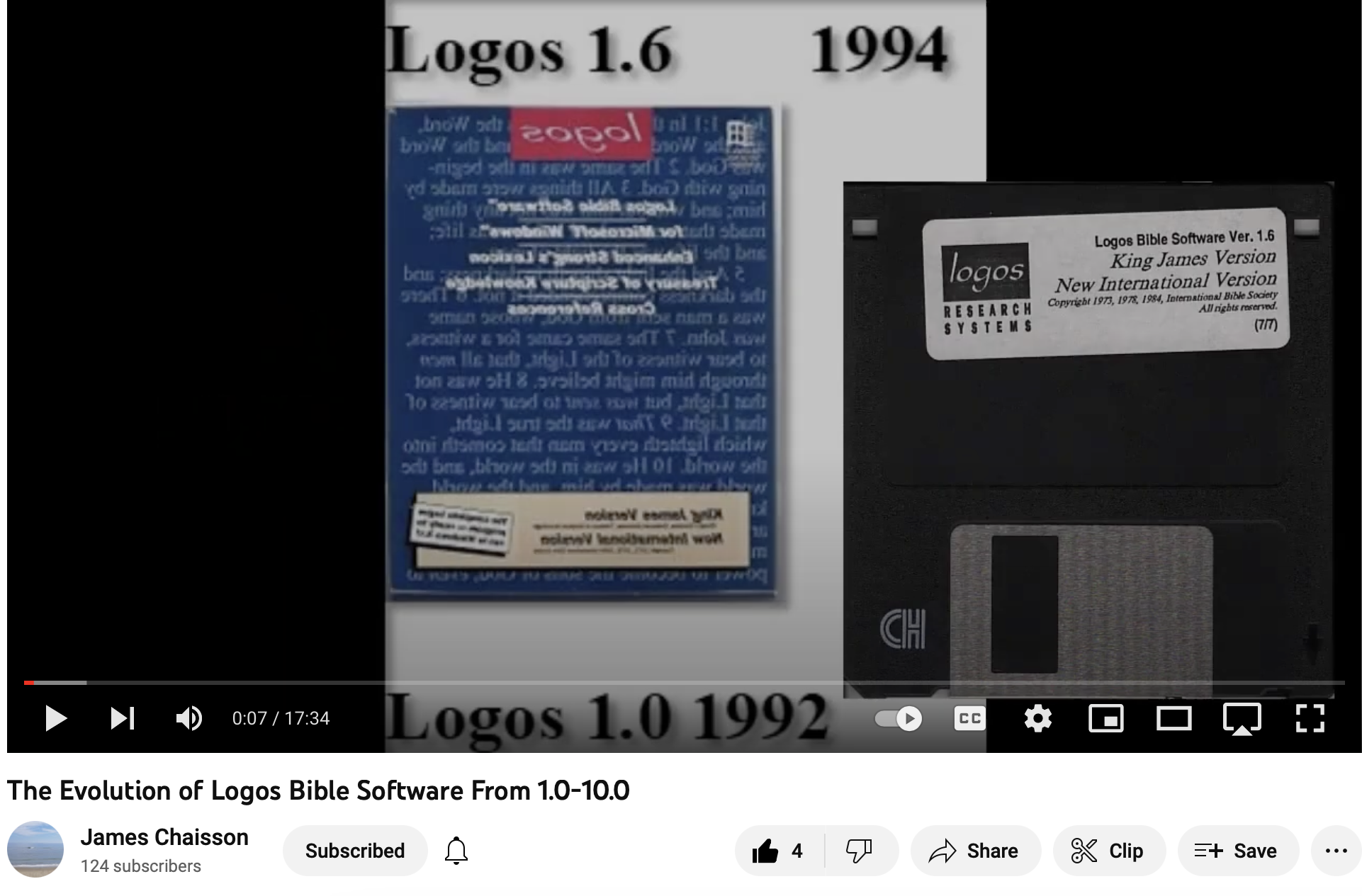
Logos Bible Software Through the Years Video
Logos user James Chaisson made a great video that shows off Logos Bible Software through the years. I share it here for your enjoyment.
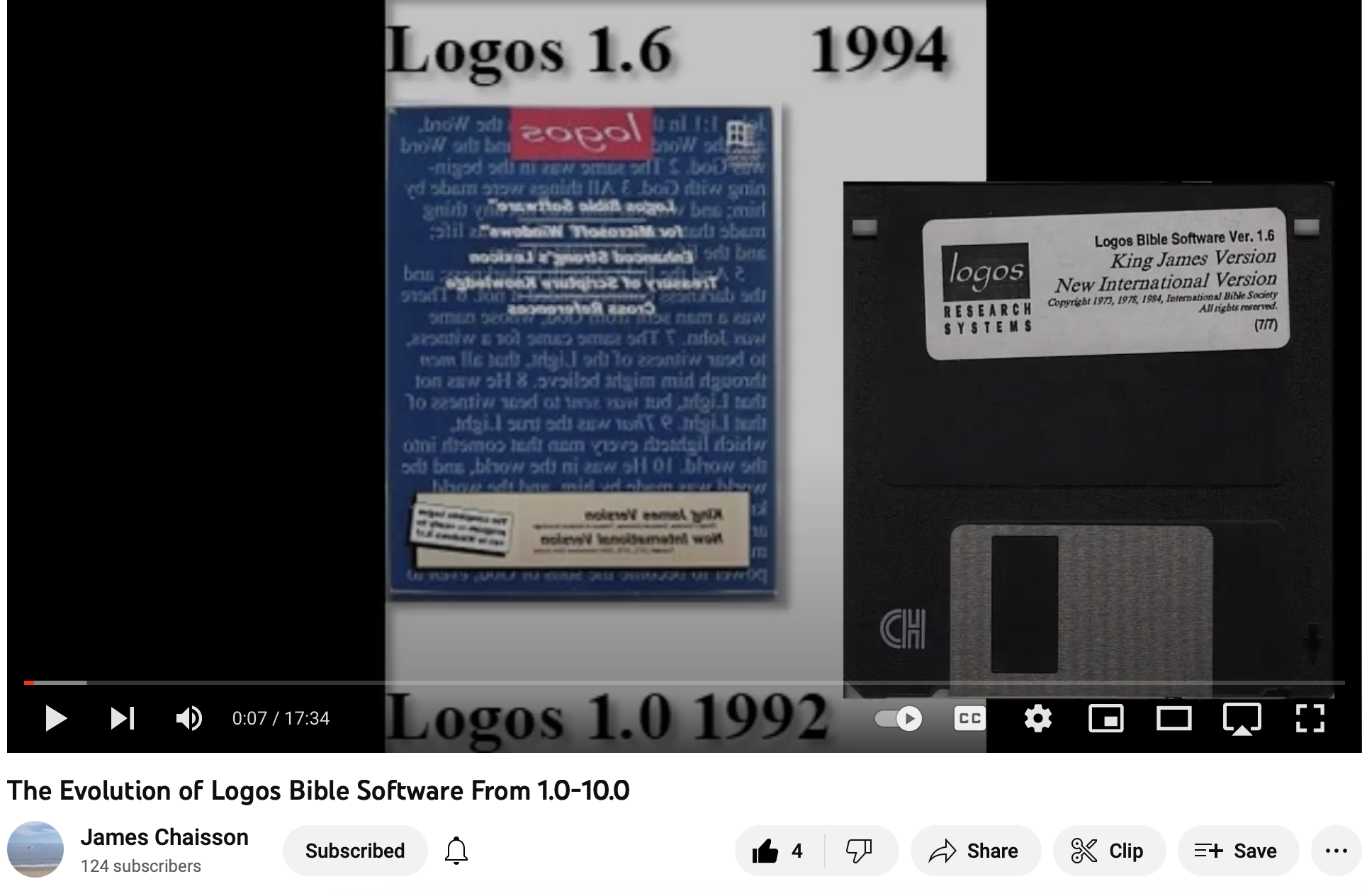
I didn't make this video of the evolution of Logos Bible Software through the years, but I wish I had. James Chaisson made it and he did a greet job. It's fun to see the way a complex and powerful program like Logos evolved from the first version all the way up to Logos 10, which just launched last month.
My History with Logos Bible Software Through the Years
As you'll see in this video the software advanced beyond the primitive origins. It was the third version that I first bought at a Sam's Club in Wilmington, NC a long time ago. The ability to enter a passage and find all the books in the library amazed me. I quickly started added books with an academic discount for seminary students while I worked on my Doctorate at Gordon Conwell Theological Seminary in the early 2000s. This add a huge library for $500. I felt like I was mortgaging my future, but I've since added a tone of other great content.
Make sure to go to James' YouTube channel and subscribe. He has some great Logos content.
Jumping on the Logos 10 Bandwagon

Also, if you want to join the Logos family, consider using my affiliate link to buy a package for Logos 10. You can also get 5 free books and the same 15 or 30 percent discount on packages depending on whether you're a current or new customers.
What makes Logos worth your time? First, it's the powerful feature set including som anew features that we outline in our last post along with a video which you can see below.
Another reason to go with Logos is the huge library of content available. They make sure to present books in a high quality format and their book formatters respond to your error reports.
Logos 10: What's New and How to Get a Discount?
What's new in Logos 10 Bible software? Read about each new feature and watch my video demo.
That's right; Logos 10 shipped on 10-10-2022. Despite the marketing department at Logos taking advantage of the date and version number, this was a big upgrade. It marks the 30th anniversary of Logos first hitting the Bible software world. They weren't the first, but they indeed have outlasted most.
Users get some interesting new features with the latest version of Logos 10. I want to highlight what's new in Logos 10 on the desktop or laptop version, the mobile version, and the web app.
Many of the features listed below only come in advanced packages, like the Gold or Bronze. You can buy a package using my affiliate link. This gets you either 15% or 30% off the price plus five free books. I'll get a cut of the sale as well.
Logos 10 User Interface Changes

Users of Logos 10 will notice the new user interface immediately. The software displays the toolbar on the left instead of the top of the window. Users can change this, but it might conserve screen space if you use the program on a wide 16:9 screen aspect ratio.
I won't keep the toolbar on the left because I like to display the button label text to remind me of what each one does. You can show the labels on the left, but that takes up too much screen space. Without labels, people who can remember what each button does can collapse the toolbar. Here's how to change the position and collapse or expand the toolbar.
How to Move the New Logos 10 Toolbar Between Top or Left

Open your Program Settings. You can do that from the menu. On a Mac, click on Logos in the upper left corner and then choose Program Settings. The Logos menu in the upper left doesn't appear on Windows, only on Mac. The second item in the settings list will change position. Click the drop-down arrow to choose Top or Left.

Optionally, in the lower left, there's a menu button with three vertical dots. Click it, choose Program Settings, and then choose the drop-down arrow to select Top of Left.

Millions of New Factbook Tags
A new visual filter in Logos 10 shows users millions of new tags from the Factbook. The Logos 10 Factbook, like the one in previous versions, serves as an information treasure trove to help Bible students understand what their reading and studying in God's word.

With Logos 10, these tags appear as an underlined word with information about that term in the Factbook. You might find things like...
- Greek and Hebrew Lemmas - open them to study the original languages for that word in English or another language.
- Information about People, Places, and Things.
- Terms with theological significance like Propitiation or the word Conform from Romans 12.
Logos described these underlined terms like the Kindle X-Ray feature that shows definitions of words in your Kindle digital books.
How to Turn On or Off Factbook Tags in Logos 10
See my post about How to Get the Most Out of the Factbook in Logos

Factbook tags are like Visual Filters, but you don't turn them on or off from the Visual Filters menu. Instead, the Factbook gets its own button in a Bible or book window. It looks like a book with a checkmark and a drop-down arrow next to it. Click the arrow to open the menu and select which tags you want to turn off or on.

Not everyone will get these new Factbook tags. First, if you upgrade and buy a Started collection, you'll get the People tags. The bronze level will add Theological terms and Greek words. You'll need to buy Silver to add Hebrew and Aramaic.
Everyone must have their computer connected to the Internet to use the new Factbook tags. If you're not connected, then they won't work. Logos 10 still works, but the tag underlines don't show up.
Church History Themes
Another Factbook improvement comes from a dataset and resource that shows Church History Themes.

To find them open the Factbook from the toolbar. You'll see the three horizontal lines often called the Hamburger menu button. Click on the Dropdown box and find Church History Theme from the list.

You can also find it in the Advanced Timeline (see more below about the Advanced Timeline). Open the Timeline and click on the Hamburger menu (three horizontal lines). Find the Event Type section and then click on Church History Theme.
The information comes from two resources - the Essential Lexham Dictionary of Church History and the Church History Themes dataset. Open them from the Library and read or search for them from there.
Simpler Search Terms
To search in older versions of Logos, users had to know some complex boolean search terms to get advanced searches. With Logos 10, you get simpler search terms.

Logos gave the following example of one more straightforward search you can now perform in Logos 10 but could not in version 9 or earlier. If you wanted to find out where in the Bible Jesus mentioned Moses, you'd type in a search box the following:
<Person Moses> WITHING (Speaker <Person Jesus>) and hit enter.
Now, just type:
person:Moses IN speaker:Jesus
That's much easier to remember and to type.
Logos will auto-complete suggested search terms to help you. You may not even need to remember the search terms to search your Bible.
Another simpler search lets you do a Search All, and Logos 10 will find results in all your datasets without you even knowing the dataset exists.
Bring Your Print Library Into Logos 10
You can add your print books to Logos 10 without buying digital copies. This also works with Kindle books too. When you add such books to Logos using the camera on your iPhone and the ISBN code on a print book, the book shows up in the Logos 10 Library. When you search for something and find it in the books added, it shows them in your list of returned search results. You can find it by page number, open that book from your bookshelf, and turn to that page.
To import a print book into your Logos 10 Library, open the app and then tap on the menu button in the lower right corner. Next, tap on Print Library ISBN Scanner. Finally, scan the ISBN code on the back of the book.

2. Tap on Print Library ISBN Scanner.
3. Scan the ISBN code on the back of the book.
The feature comes with a few caveats.
- This only works with books in the Logos catalog of books. If they don't already have the digital text of a book, it won't work.
- You must spend time and effort adding your books one at a time.
- The search results only show a snippet of the content from the book. You'll have to read the book in the print edition.
- Only people who buy the Gold package will get access to the feature.
Searching the Print Library
The new books in your print library will appear in general searches, but you can't open those books. Instead, Logos tells you where to find the content in your print book by page number. You'll open the physical copy of the book and find the content.

However, if you want to search your print library books, you can use the Library window. Open a Library window and look for the Print Library item on the left-hand side of the Library window. Find the book you want to search, right-click, and choose Search this resource.

If you want to search the entire library, follow the above steps, but instead of right-clicking first, select all the books in the Print Library. Do this using the keyboard shortcut CTR+A on Windows or CMD+A on Mac.
After selecting all the books, you can right-click one of the selected books and choose Search these resources. This opens the Search panel. Type in your search phrase or word to find items in the book.

You will see results in the Search window. Find the Print Books section as seen above. Look at the results and find the entry in the book. Grab your book and open it to the page listed or the section listed. Not all books will show page numbers.
Import Multiple Sermons into the Sermon Manager in Logos 10
Logos 10 now supports importing a collection of sermons into the sermon manager. After you add them, you will get tags added for Scripture references in the text of the Word document.
The Sermon Manager import only supports Microsoft Word's DOCX format. Only buyers of the Gold package or higher in Logos 10 will get access to the tool. If you want to upgrade, use this link to get 5 free books and a discount.

Access the import tool by opening the Tools button from the toolbar (9 dots on it) and either click on Sermon Manager or type it in the search box to find it quickly. The Sermon Manager will open. Click on the menu button (three vertical dots) in the upper right corner of the Sermon Manager. Choose Import and then click on the Choose Files button in the lower part of the Import dialog box. Navigate to the folder that holds the sermons you want to import. You can select multiple files with the CTRL+A or CMD+A.

How to Find Imported Sermons
To find your sermons open the Sermon Manager in a separate full-screen window and choose the Date you preached the sermon. This makes working with the Sermon Manager easier, especially if you're using a small screen.
I had to open the Grid view and select All from the top of the window. I opened one of my sermons, and it the formatting I used didn't work with the Import very well. If you use the built-in Microsoft Word Headings, then it will work better for you.
Now you will want to clean up your imported sermons. Edit them to use things like Headings, the information pane that opens on the right side, and the slides. If you make slides from your sermon, then you can export them to programs like PowerPoint, Keynote, Faithlife Proclaim, or PDF documents.
Popular Quotes in Sermon Builder
The Sermon Builder gets an added feature called Popular Quotes. Preachers search for quotes to add to their sermons inside the Sermon Builder.

Open a new Sermon using the Sermon Builder from the Tools button (grid with 9 dots on the toolbar). Create a sermon and then choose the Popular Quotes button on the right when you want to add a quote. The button looks like a quotation mark.

A list of quotes will appear. Drag and drop any quote you want to add to your sermon from the right-hand column to the Sermon Builder. The Sermon Builder will add the default slide. Change it by clicking on the slide thumbnail. You'll see a menu appear. The list of options includes...
- Edit - change the look of the slide.
- Apply this style to quote slides - change all quotation slides to match this.
- Apply this style to all slides - change all slides in general to match this slide.
- Delete - delete this slide.
Advanced Timeline
The new Advanced Timeline shows historical events in the context of the era in which that event occurred. The timeline offers this in a visual way. Users can filter events to focus on what they're most interested in seeing.

To open the Advanced Timeline, click on the Tools button on the toolbar. It looks like a grid of 9 dots. Either type Advanced Timeline or scroll down to the Reference section on the Tools menu and click Advanced Timeline.
This feature only works on Bronze packages or above. You can buy the Bronze package at this link and get a discount plus 5 free books.

Interact with the Advanced Timeline using the sidebar or the toolbar. The toolbar at the top has the following...
- Button to open the sidebar, which lets you select the kinds of content you want to hide or show.
- A time range box where you enter years like 20-100 AD.
- Search box where you type what you're looking for.
- Zoom in, fit, and zoom out buttons.
- View the dropdown menu to limit by things like Bible & Church Eras or Western History Eras
- Info button
- Menu (three vertical dots)
Speed Improvements
Logos 10 boasts faster performance, especially for users of Silicon Macs that use M1 or M2 branding. These are modern processors that run more efficiently than Intel chips. They claim a 35% speed boost, especially while indexing your library. I can attest to this improvement. It used to take hours to index my library with 8,000+ resources. It now does it in around an hour.

The computer still chugs along while the program indexes the library. However, Logos 10 takes far less time to index on my M1 MacBook Pro, M1 Mac mini, and M2 MacBook Air.
For Windows users, you'll see a small speed boost. It comes thanks to something called .NET 6.
Auto Translation

In almost any book, open a side panel on the right that shows a translation of the book's text. To use it, open a book. Click on the Sidebar button in the upper right corner. A new window opens with the default language. You can use the language dropdown list to pick from dozens of languages. The above image shows a French translation of the open book.
If you want to copy the contents in the Sidebar, choose the copy button to the right of the language dropdown list.
Your computer needs an Internet connection to use the Auto Translation feature. You also have to own the Gold Package, which you can buy here and get a discount plus 5 free books.
Questions and Answers
Think of Dear Abbey only for Bible study. The Questions and Answers feature answers common questions you might have about the Bible. It also includes some obscure answers too. This all comes from a new dataset.

Use the feature by typing a question in the search box (magnifying glass icon on the toolbar). The program notices you worded it as a question and tries to find your answer in the dataset. The results come from your library. It also includes other kinds of results, so scroll down to the Questions & Answers card.
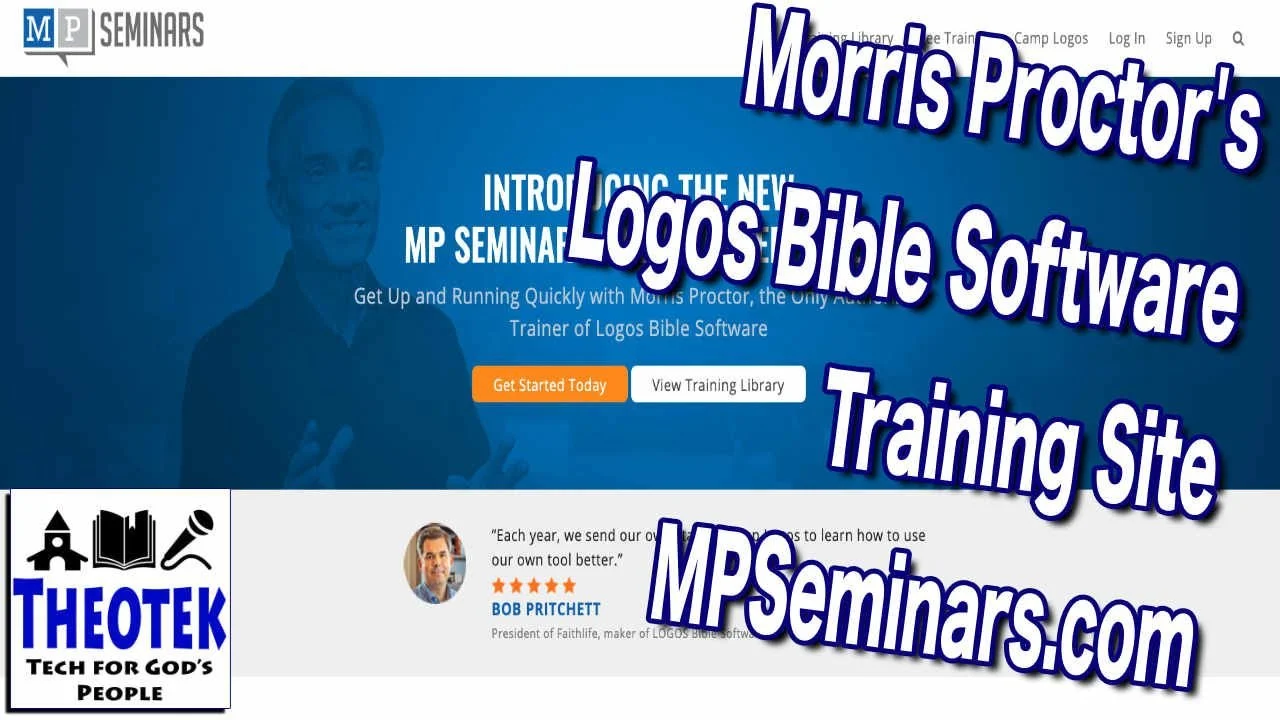
Morris Proctor MPSeminars.com Logos Bible Software Training Review
If you use Logos Bible Software, you should consider Morris Proctors MPSeminars.com. I review this training subscription service here and on YouTube. See my video and read the review here.
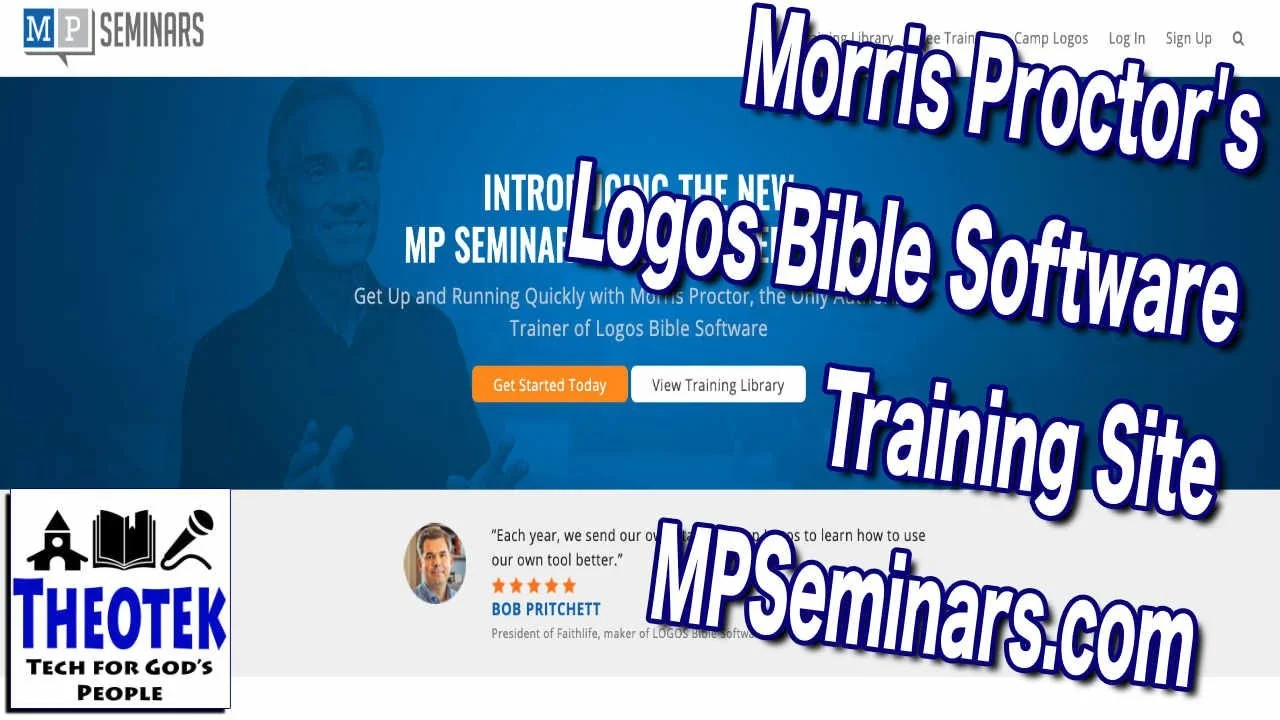
Thanks to MPSeminars.com from Morris Proctor, you can comprehensively learn how to use Logos Bible Software. This service offers a slew of videos and courses on how to use the powerful computer (desktop and laptop) software for studying the Bible.
Note that I've republished this review from two years ago because of a nice update to the training site. Look below for the bold and italicized paragraph under the "User-Interface" section.
In this review, we'll look at the courses and how well the service works. Let's judge MPSeminars.com on three criteria...
- Quality of Training
- User Interface
- Value for Money

Morris Proctor MPSeminars.com Quality of Training
I subscribed to the Morris Proctor's MPseminars.com Logos Bible Software training library for a few months now. In that time, I went through a few courses and watched maybe 100 videos so far. Morris Proctor knows not only how Logos works, but he also knows how to effectively teach users to use this complex and powerful Bible study tool.

Each video has excellent sound and Morris Proctor speaks clearly. His voice is easy to listen to and I enjoyed taking the courses.
Back in 2005 I bought my first package of Logos 3.0 and have been using Logos off and on for the last 14 plus years. I'd call myself an intermediate user. Plenty of people have a better understanding of the more arcane tools built into Logos Bible Software, but I'm no beginner.
In spite of nearly 15 years of use, I still learned some things from Morris Proctor and MPSeminars.com.
Morris Proctor MPSeminars.com User Interface
I like the user interface generally but have a few gripes. The site follows the blue and white branding of Logos and has a modern look and arrangement. When you open the site, you can clearly see where to go for different parts of the subscription service.
The first page, after a user logs into their account, mimics the look of the Home Page in Logos 8 with cards in a 3 column grid similar to the columns of cards in Logos 8's home page.
At the top you will see a set of tabs for the following:
- Training Library - the bulk of the training courses show up here and they offer courses for both Logos 7 and Logos 8.
- Free Training - you don't have to pay to use MPSeminars.com. They offer some free courses on this section, which they organized like a blog with articles for each topic of training.
- Camp Logos - if you want to get live training in person, the go here to sign up for the scheduled Camp Logos. As of this writing we see only one Camp Logos course in Murfreesboro, TN for Dec. 9-11, 2019 and it costs $129-$329 depending on whether you want to attend the live webinar (online with no travel to TN necessary) or in-person. You can also rent a computer so you don't need to bring yours. I'd recommend you bring your own.
- Account - shows your specific account interface and lets you manage your subscriptions.
- Logout - log out of the site.
- Search - a button to search the site.
Users will spend most of their time in the Training Library. It has training for both Logos 7 and Logos 8. I'm a Logos 8 users, so we'll focus on that part of the library.
You find courses like "What's new in Logos 8" and "Quickstart for Logos Bible Software Version 8". A more comprehensive list of courses shows up under the Logos 8 A to Z: A Video Reference Guide, which includes courses for most of the features, if not all of them, found in Logos 8. Use this as a reference guide. If you have a question on one specific tool, head here to find a video to learn how to use it.
Strangely, even though I'm a subscriber, I get this message that pops up when I first clicked this part of the Training Library instructing me to click on the Take this Course button to add it to my list of "My Courses". That seems silly. I'd rather just click and let it open the list of courses.
MPSeminars.com Video Interface
Once you begin taking a course, the website falls down a little. When I watch the videos, I like to watch them in a faster speed. It sounds funny, but you get through the course quicker. People who don't like this don't have to do it. You won't even notice this unless you change it. However, I do like to speed up the videos.

To watch the videos in their fastest speed and highest quality, 1080p and at 1.5x times speed, I have to change this setting every time. I like that I can change it, but the videos default to lower quality and 1x speed. For most people, it should default to lower quality and 1x speed. But once I change it, I wish I didn't have to keep changing it. I suspect this is a limitation of the software they use to present the videos. It looks a lot like Vimeo, a service like YouTube. And they probably don't offer the option. I just wish MPSeminars.com could find a way to add this feature.

After you start watching the videos in a course, the site shows your progress with a visual progress bar and a list of the course outline to the right of the video. The completed sections show an orange checkmark next to the section. Incomplete sections show up as a gray empty circle where the checkmark will go once the user completes that course.
At the end of each video, you can mark that video as complete. It would be ideal if the website would automatically mark it or give the learner an option for the site to mark it complete automatically. When you click on the Mark Complete button, it will automatically take you to the next video without any interaction from the learner.
UPDATE: The folks at MP Seminars found a way to fix one of the above complaints. Users can now watch a video and the site automatically advance to the next video marking the previously watched video as complete.
A few courses look like they have videos that are slightly out of date. It doesn't happen often. The user can still learn from the course, but you get little differences between the current version and the way the software looks in the video. For example, in a course entitled "Bible Study with God and Guides - Passage Study" you see a problem. In the video, it says enter Luke 4:1-4 and you'll see Open Passage in the command box. That's not the way the program behaves in the current version. Instead, it says Open Passage Study Guide to Luke 4:1-4. It's a minor annoyance, but can confuse beginning users getting started with the most recent version of Logos 8.
Value for Money
Morris Proctor does a great job on MPSeminars.com of training users. The cost of the service is not cheap and you can get a lot of what you get for free on the Logos Training website. There's a reason Morris is the official trainer of the company. He does a great job. But he also charges a pretty penny for his courses.
The monthly subscription costs $19.99. There's an annual subscription for $199.99 too. You can buy courses without paying, but I like that I get all updated courses, even when Logos 9 comes out, which I assume will happen by the end of 2019.
To buy the courses instead of subscribing you'll have to pay. The Logos A to Z course, their most comprehensive training on Logos 8, costs $500. The What's New in Logos 8 course costs $100. They offer a Time-Saving Tips and Tricks course for $50. And a few courses are only available to subscribers.
The service even taught me, a long-time user some new things. Plus it reminds you of the features that you might have stopped using, thinking they are too basic but have improved since you quit using them. For example, I tried the Canvas tool early on, but never really liked it. The training on the What's New course on Logos 8 inspired me to try it out again and I like it.
5 Best Linux Bible Apps You Can Use Today
If you're a Bible student and a Linux user then consider these 5 Best Linux Bible apps. We have some good ones.
Linux doesn't get as much attention as Apple macOS, Microsoft Windows, or even Chromecast. However, Linux users love their operating system of choice and Christians can run a group of Linux Bible apps that will help you study God's word. Take a look at these 5 Best Linux Bible apps that you can use today to study the Bible digitally on the lesser-known operating system of choice.
Before we go any further, I have to admit that I'm an inexperienced Linux user. So, you will need to get help with these from other sources. To install them or get them running if you face a glitch, you'll need to find help from Linux power users. I'm not your guy. I'm recommending these Linux Bible apps based on trusted sources and not personal experience.
Sword Project from Crosswire Bible Society

First, I want to share the standard, The Sword Project. The other apps in this roundup all use The Sword Project's book server to download and install Bibles and tools.
The Sword Project offers the books and lets you search the text, including commentaries, Lexicons, and dictionaries in addition to Bible texts.
Crosswire curates a list of Sword Project Linux Bible Apps and apps for other operating systems, like Windows or Mac.
Xiphos Bible Study Tool for Linux

Learn more about Xiphos at their website. The program, formerly called GnomeSword, has a substantial online user manual and a community of users who will also help you get the program running.

Xiphos runs on Gnome desktop. It's based on the Sword Project, which gives users access to a large library of tools for Bible study.

You'll enjoy a tabbed display, quick searching features, an audio reading out loud feature, a parallel mode for comparing translations, and plenty of user-created tools.
Above you'll see a demo on installing Xiphos Linux Bible app on Gnome.
BibleTime Runs on Linux, Windows, and macOS
Next, we have one of the few Linux Bible apps that will run on Linux and the more popular Windows and macOS operating systems. Find it on Github.
With BibleTime, users will have to install the app, and then they will need to add books because the basic installer doesn't come with any. The Settings menu shows the Bookshelf Manager where you can add books.
Like Xiphos, BibleTime uses Sword Project books. That gives you access to a large library of books to use in your study.
Bible Desktop

The Bible Desktop Linux Bible app also runs on The Sword Project engine and gives us a simple user interface to study the Bible.

There's a Bible comparison tool in Bible Desktop that shows you the differences between translations. Pick the base translation like the ESV chosen in the screenshot above. Then choose another translation and it will show the two translations in the first and third column with differences in the center second column.
Users can choose between a window mode or a tabbed mode.
Run Bible Desktop on your Mac, Windows PC, and of course it's also one of our favorite Linux Bible apps.
Logos Bible Software on Linux Through WINE
WINE lets users install Windows software on Linux. Getting these up and running can present a challenge, especially to novice users. However, if you can use Linux, you can likely get WINE working to run Bible software on Linux.
Logos Bible Software works on Linux using WINE, sort of. You can find a long thread in the Logos Forums that cover getting the program to work on Linux.
Go Online and Run a Web-based Linux Bible App
I know. This feels like a cop-out, but the best way to do great Bible study on Linux probably requires nothing more than your web browser.
I created a series of the best online Bible study websites and that still holds up despite one site that's now gone. Wordsearch's Bible site is on the way out.
Wordsearch Support by Logos Ended, Now What?
People who used and loved Wordsearch were likely disappointed when Logos and Faithlife bought the company and announced they would eventually shut it down. That time has come so what should a Wordsearch user do now? Here's the best way to continue studying the Bible digitally now that Faithlife and Logos ended support for Wordsearch Bible Software.
Logos Stops Wordsearch Support: What Does It Mean to Me?
Logos announced they planned to stop supporting Wordsearch, but that doesn't mean you can't use the software. You can. Just don't uninstall it or buy a new computer unless you have the installer and your books backed up.
Logos sent out an email to Wordsearch owners that said:
- You will not be able to download the desktop and mobile apps in the future
- You will not be able to download your books to the desktop/laptop or mobile Wordsearch apps.
That's frustrating if you want to keep using Wordsearch after buying a new computer, phone, or tablet. You'll need to find a new different way to get access to the program or start using Logos or some other app or program.
On your desktop or laptop computer, you can do a backup of your computer that includes your installation of Wordsearch and find a way to port it over to your new computer or a computer that you had to reformat or erase. That's more complicated than we have time to discuss in this post. A Google search will likely find dozens of options for Windows or Mac users.
Wordsearch users can also keep using the program on their current computer, phone, or tablet. The company won't cripple Wordsearch apps for software already installed. So keep using it knowing you won't get app or book updates. You also can't add new content, so if that commentary series you love gets a new volume, you'll have to find it in another format to enjoy it digitally.
Start Using Logos Instead of Wordsearch
Logos would love for you to start using their software. That's the whole reason they bought out Wordsearch, to get their users and their library of books.
If you want to start using Logos, then go over to the Logos website and see what version of Logos they gave you when they bought out Wordsearch.
In addition to a version of Logos, you will also get most of your books from your Wordsearch library in Logos. They will download after you install Logos on your computer or mobile device. A small percentage of books won't make the trip over to Logos.
See our post on using Logos and setting it up like Wordsearch.
Switch to Accordance
The best alternative comes from the folks at Accordance Bible Software. They offer a complex and powerful software program that brings you every feature you need to study the Bible at a scholarly level but also works well for pastors, teachers, and lay Bible students.
Switching from Wordsearch will cost more than going to Logos since Logos offers free software and gives you most of the books you own in Wordsearch format. However, you may not want to use Logos. You can get the $200 Crossgrade for Accordance. Crossgrades take the term "upgrade" and marry it with cross-over to form a crossgrade.
In addition to the Wordsearch crossgrade, you can crossgrade many of your books. Just contact Accordance to learn what it will cost. In both cases, you'll need to fill out a form proving you already own either Wordsearch or the books you want to buy via crossgrade.
Other Bible Software Options

Logos and Accordance aren't the only games in town. You can also find great options from the following:
- n Olive Tree Bible - Olive Tree provides a decent desktop or laptop computer program, but also has the best mobile app you can get on iOS or Android. They sell a lot of books too.
- Laridian PocketBible - You won't get as many books with Laridian as you will with Olive Tree, Accordance, or Logos. However, the developer does a nice job of creating a stable platform with some unique features, like showing 4 or more window pains on mobile, something can't get from any other app that I know of. With Book Builder you can make your own books for PocketBible on Android, Windows, iOS and Mac.
- e-Sword - The long time free Bible study program from Rick Meyers will seem simplistic compared to the other programs in this article. However, if a user doesn't like Logos and can't afford the others, then free books from e-Sword will help you with your study needs until you can afford something a little more advanced. Some Wordsearch users will find that it's all they need. If you want some modern Bibles and books you can buy them from eStudySource.

Recommendation
What should you do if you were a Wordsearch user who wished they were still in business?
- Keep using Wordsearch. You can still use it as long as you don't change computers and even then might be able to jump through some technical hoops to get it to work on a new computer.
- Go ahead and get Logos installed, if you have space on your computer's hard drive. You can also install it on your mobile devices. If you used the minimalist Wordsearch mobile apps, you will find that Logos does so much more. This will confuse some users who were Wordsearch's simple book reader app. But most will view it as a huge upgrade on mobile. Spend time about Logos until you feel comfortable using it for your digital Bible study.
- Get free versions of Accordance, Olive Tree, e-Sword, or Laridian's PocketBible. Try them out and see which one you like best. Then start looking into getting the books you need for your study.
Mobile users should look at Logos, Olive Tree, or Laridian first. They are the best mobile apps for serious Bible study. Accordance gets honorable mention if you are using iOS, but Android users should look elsewhere because Accordance on Android is too limited right now. They plan to upgrade making it more useful, but Logos, Olive Tree, and Laridian are so much better on Android.
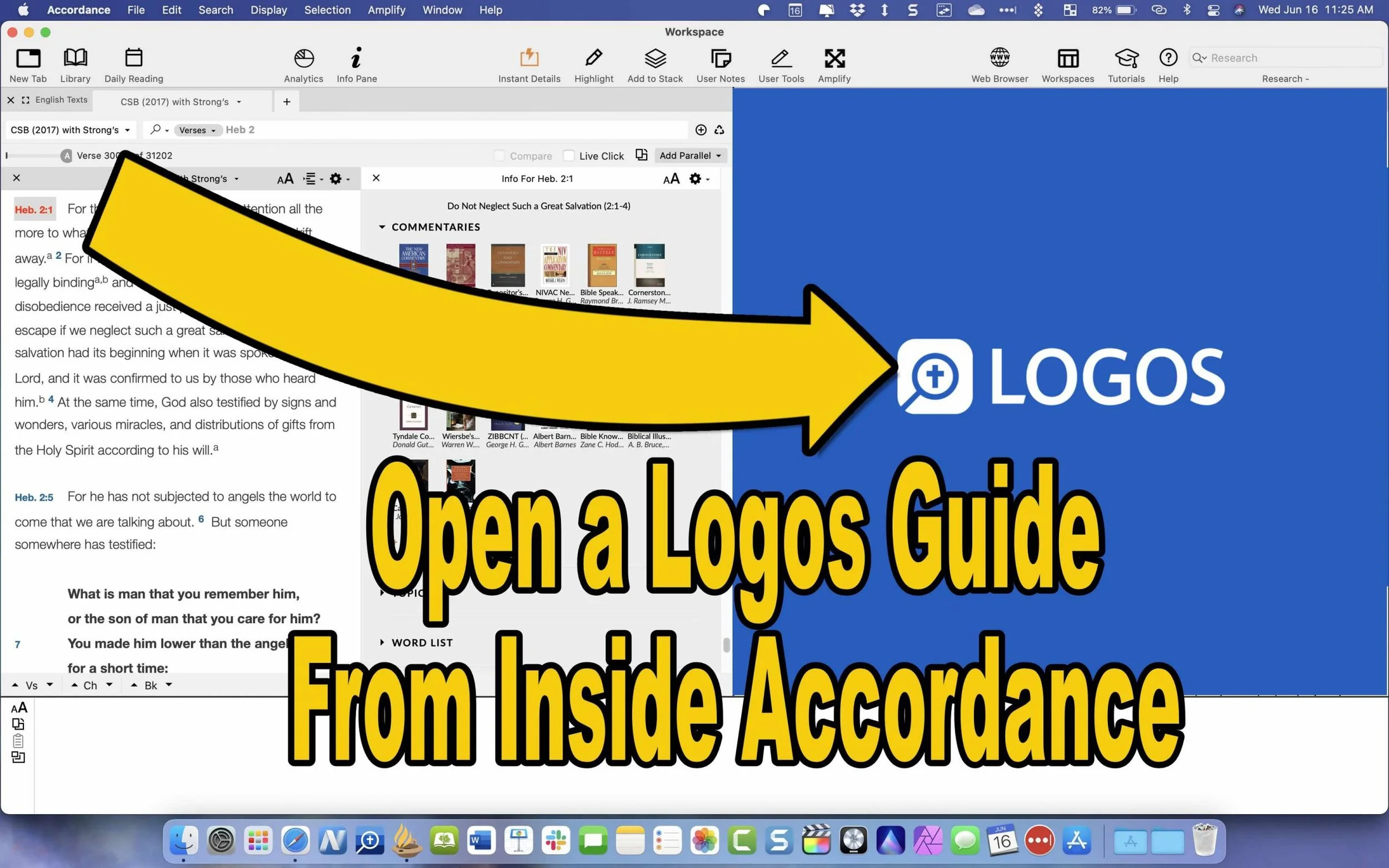
How to Use Accordance Amplify to Website to Open Your Logos Library
Did you know you can open a Logos Passage Guide inside Accordance using the Accordance Amplify to Website? We'll show you how.
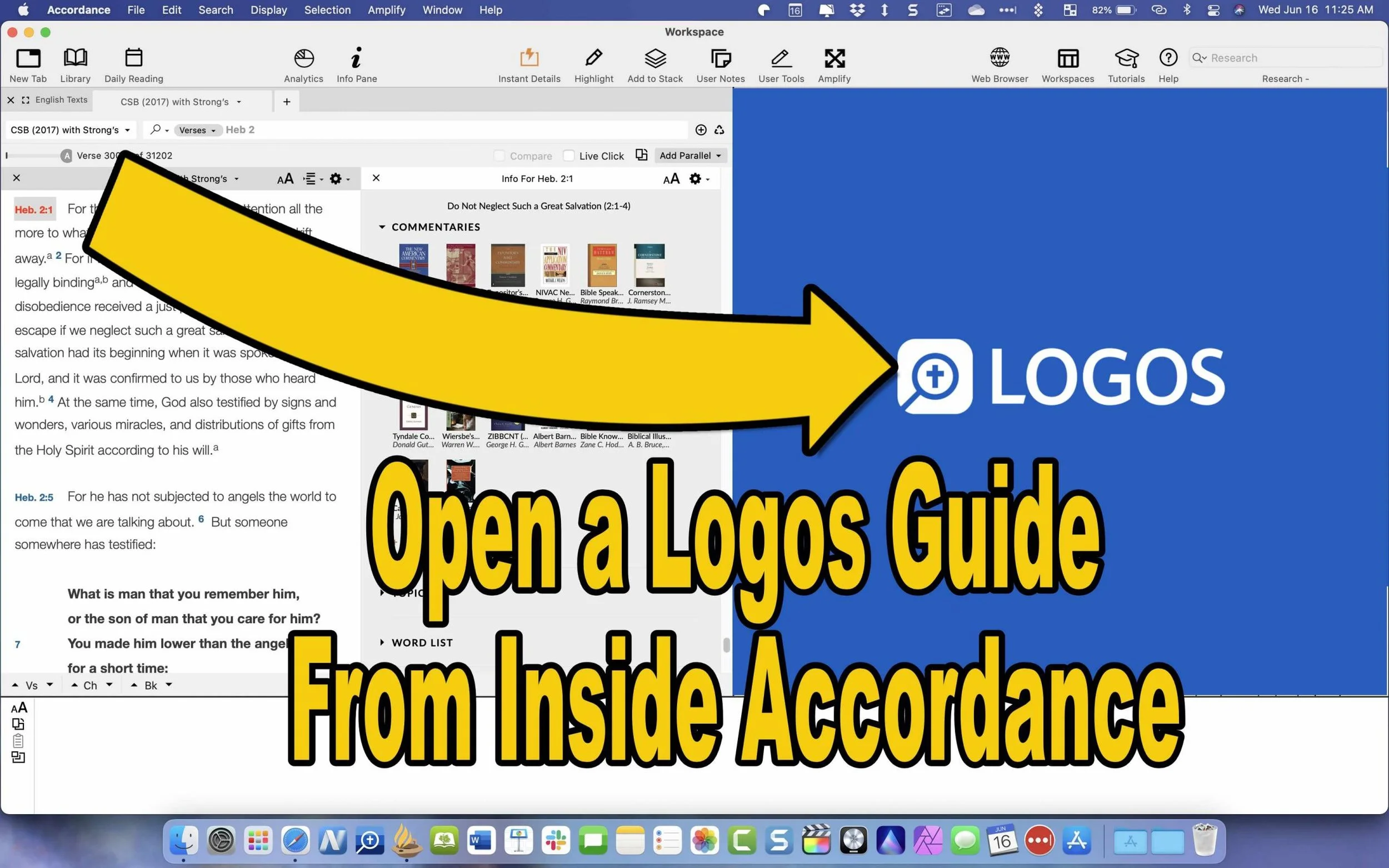
Accordance Bible Software will let you use their Accordance Amplify to Website feature to open other websites while using Accordance to research Bible studies. With these features, people with books in Logos Bible Software who have access to their Web App will let you access your library inside Accordance. First, we'll show you how to set this up and then how to use it.
Use 'Accordance Amplify to Website' to Open Logos Guides
Accordance includes two awesome features that make it possible to open a Logos Passage Guide from inside Accordance. The Accordance Amplify to Website feature will help you. Here's how to add Logos to the menu in Accordance.
To add Logos, you'll have to add a few things to Accordance. I found out about this in the Accordance forums, which are a great option for learning how to use Accordance features and asking for help in using the software.

Open Accordance Preferences from the Accordance menu item in the upper left or by using the keystroke CMD+,. Next, click on the External Websites item on the left side of the Preferences window. Thanks to Accordance user Paul Meiklejohn for these steps.

Then choose the New button to add a new link.
Click on New at the bottom of that box. A new box pops up where you can add your website links so you can use the Accordance Amplify to Website feature to open the Logos Web App.

Now use the links you'll find from the Accordance Forums. Here are a few that I added for Logos.
- Passage Guide: https://app.logos.com/guides/passage?layout=reading&reference=***
- Word Study Guide: https://app.logos.com/guides/word?layout=reading&reference=***
- Exegetical Guide: https://app.logos.com/guides/exegetical?layout=reading&reference=***
- Search Logos: https://app.logos.com/search?layout=reading&q=***&resources=yourBible&tile=right
The above came from Accordance user jarcher who posted them in the forums.
Some other links you'll find there include:
- Blue Letter Bible: https://www.blueletterbible.org/search/preSearch.cfm?criteria=*** (from user dandennison)
- Bible Gateway: https://www.biblegateway.com/quicksearch/?quicksearch=***&qs_version=NET.(from user Drewster; change the last three letters to your chosen translation, like NIV or CSB)
Use Accordance Web Browser to Open Logos Webapp
Now that we've added the sites to Logos and other sites, how do we use these? Open a Bible in Accordance and select the verse along the left. Then right-click the verse, and a large pop-up menu appears. Next, click on the Website in that menu. Choose your new item added in the step above.

For example, in the animate GIF above, I selected Hebrews 2:1 and then opened a Passage Guide in the Logos Web App.
Have you created any Accordance Amplify to Website links that aren't listed above? Then, comment below with your chosen link and let us know how to use it in Accordance.
18 New Features in Logos 9.5 Update
Faithlife recently released a Logos 9.5 Update to their popular Logos Bible Software. It comes with 18 new features and updates.
Logos 9.5 Update came out recently, and it brought some interesting new features and fixes. Here's a list of the X new features in Logos 9.5 that you can enjoy right now by updating your copy of Logos. If you're not yet running Logos 9, now's a good time to update. See my 6-month later review to get a 15% discount until June 15, 2021.

Download and update inside Logos 9 using the Update Now command in the Command Box. It sits on the toolbar on the left side with the big green GO button as seen in the screen shot above.
Counseling Guide Improvements

- New Journals Guide Section
- New Lectures Guide Section
- New Web Resources Guide Section
- New Bookstore Guide Section
- More Link takes you to Monographs and Dictionaries Sections.
Factbook Improvements
See our post about how to use the new Factbook
- Added the ability to see your results in the autocomplete drop-down when there are no results in your localized language.
- Added a keyboard switcher to the Factbook auto-completer.
- Improved the transliterations in Factbook autocomplete

My Library

There's now a new facet in the My Library for Factbook in the tabs for Yours and Store, which refers to books the user owns or books from the Logos store. So first, open the Library, and you'll find these tabs in the upper right part of the window on the toolbar. Next, open the Facets list by clicking on the Facets button, which looks like three horizontal lines next to the search box in the Library window.
When a user clicks on the "more:" link in the Facets list, it adds up to 100 new items instead of just 50 as it previously did.
Other New Features in the Library
From the Logos 9.5 Update wiki...
- Added support to persist Library settings in Favorites, Shortcuts, History, and Bookmarks.
- Added support to retain the selected tab and filter state when copying the panel URL.
- The update moved the Language facet to the top in the Store tab.
Resource Info Panel Improvement

If you use the reading plans in Logos 9, you'll love the new feature they added to the Resource Info Panel in the Logos 9.5 Update. First, open a book and click on the resource panel by clicking on the three vertical dots button at the right end of the book's toolbar. Then, click on the Start reading plan button in the list.
Sermon Builder Improvements
In this version, you can now edit passage blocks in the Sermon Builder. This also works with quote blocks. When you hit Enter, the cursor will leave the blockquote box. Also, Logos will now auto-publish the date changes on a sermon's occasion.
Two other minor updates include a new Store button on the toolbar. This is a little annoying because it takes up space that may be precious to users on smaller screens.
Before the Logos 9.5 update, when you created a customized guide using one of the default guides as your starting point, Logos never added new sections in later updates. Now, if you add sections or remove sections from the default guides, then Logos will not only keep your changes, but add anything they added to the default guides. New things added in future updates would not be added to your customized version, but Logos fixed that in this update.

3 Great Logos Deals You Can Get Right Now
Logos Bible software users can get 3 great Logos deals right now.

Logos Bible software users can get 3 great Logos deals right now. The first one is an older deal that remains in place until June 15. The other three just started this June.
Do you use Logos Bible Software for your study? Logos 9 is a great package to study the Bible personally, for sermons, Bible studies, teaching, preaching, and for your scholarly study.

Save 15% on Logos Deal on Logos 9 Base Package Sales
We shared last month during our 6-month later review. You can get 5 free books from a select collection of titles plus get 15% off Logos 9 Base Packages. Here's the link to get the deal.
The base packages will let you upgrade to Logos 9 if you haven't already. If you did, you can jump up to a higher level or get the next level for your denominational base package.
50% Off Eerdmen Publishing Resources for Logos

Check out these great deals and add to your research or study library books like...
- NICOT and NICNT - a great in-depth commentary series on the Bible with "thorough and modern scholarship" on the books of the Bible covered by the New International Commentary series. You save over $600 off the $1599.99 regular price.
- Eerdman's Biblical Reference Collection - resources on language study, additions to the Factbook, and the Theological Dictionary of the OT and NT. The collection retails for $1,138.99, but you can buy it in this sale for $569.99.

- Theological Dictionary of the OT and NT - a great set for theological linguistic research and study. It normally costs $849.99, but with this Logos deal, save 40% and pay $509.99.
- International Standard Bible Encyclopedia Revised - ISBE was a standard reference for almost any important word or topic in the Bible with a huge collection of 1,500 photos and 342 maps. Instead of paying $129.99, you only pay $77.99.
- Two Horizons Commentary Series - get 23 volumes with excellent biblical exegesis and theological study. It covers the Bible paragraph by paragraph rather than verse by verse. Pay just $249.99, saving 28% off the $349.99.
Logos Deal on Free Book of the Month
Every month Logos offers a free book of the month, where users can save and get a free book. Sign up for the email to get the book. You can also get other books drastically discounted. For example, this month get...
- Hard Sayings of the Bible - explains over 500 passages difficult to understand. Free
- The Spirit of Grace - part of the Christian Belief for Everyone Series, which gives readers an accessible explanation of the doctrines of the faith. This is the 4th volume covering "the Holy Spirit, the holy Catholic Church, the communion of the Saints, and the forgiveness of sins." $.99
- Psalms: An Introduction and Commentary - part of the Tyndale Commentaries series. $1.99
- The Person of Christ - focuses on the person of Christ in the history of church doctrine. $2.99
- 2 Corinthians The IVP NT Commentary - part of this commentary series and covers the book in a practical and theological way covering passage by passage comments. $3.99
- The Temple and the Church's Mission: A Biblical Theology of the Dwelling Place of God - G.K. Beale discusses the OT tabernacle and temple as symbols of the indwelling of Christ and talks about how this applies to NT understanding thanks to Christ. $4.99
- The Bible for Everyone - a new version of the Bible written to make it more accessible for everyone. $5.99
- Exodus Apollos OT Commentary - discusses the book focusing on the Exodus event and how we learn of God's love for his people as he changes the lives of people who were similarly victimized. $6.99
- Foundations of the Christian Faith: A Comprehensive & Readable Theology Revised and Expanded - a readable theology for the average believer. $7.99
- The Revelation to John: A Commentary on the Greek Text of the Apocalypse - Dr. Stephen Smalley offers a commentary on the Greek text of the book of Revelation. $8.99
- Pre-order Changed into His Likeness: A Biblical Theology of Personal Transformation - Gary Miller covers the issue of the Gospel where many promise too much and others expect too little of converts. $7.99
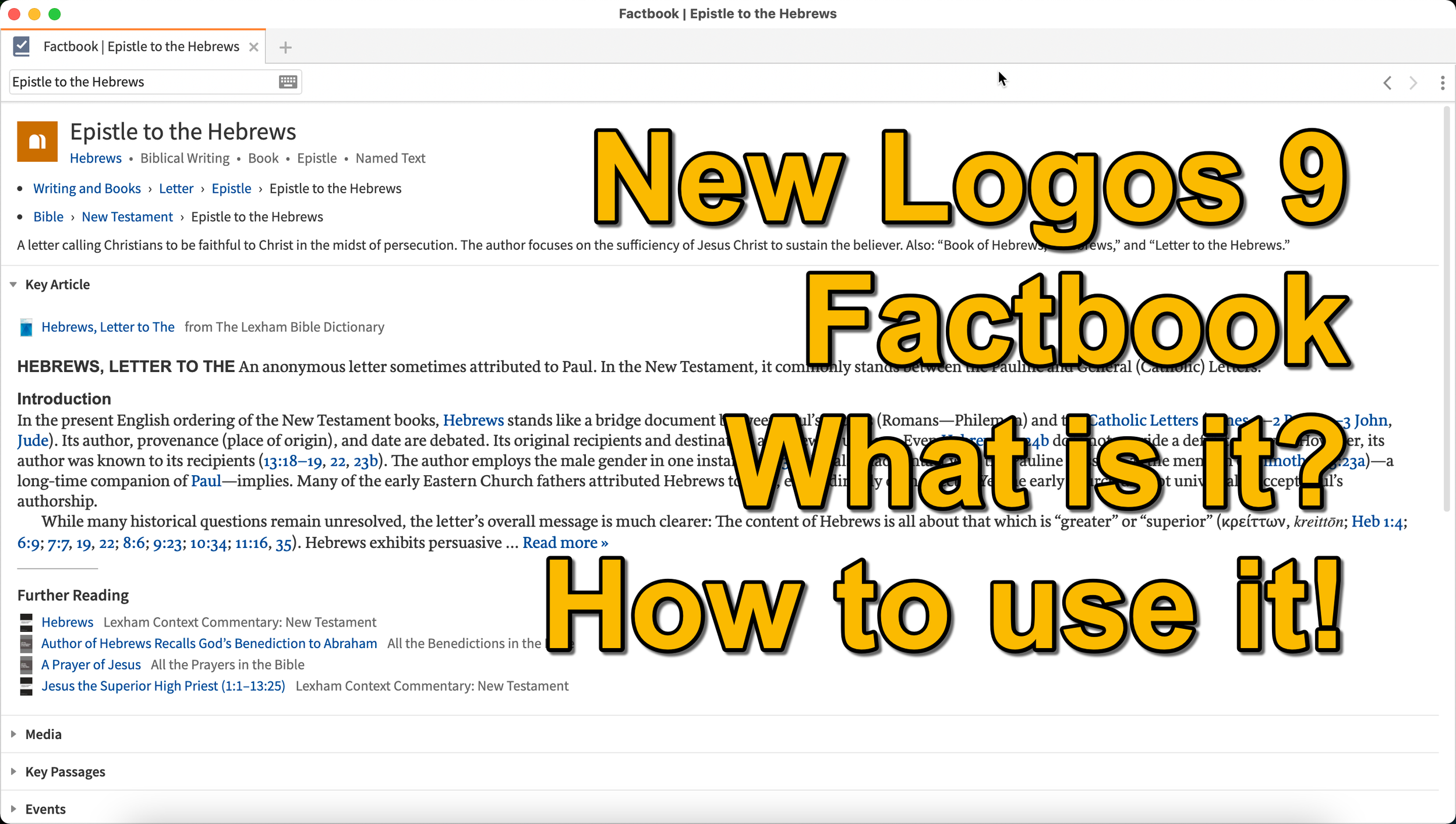
Logos 9 Factbook: How To Get the Most Out of the New Features in Logos 9
What is the new Logos 9 Factbook and how can it help you study the Bible more efficiently. We'll look at it in this series on new Logos 9 features.
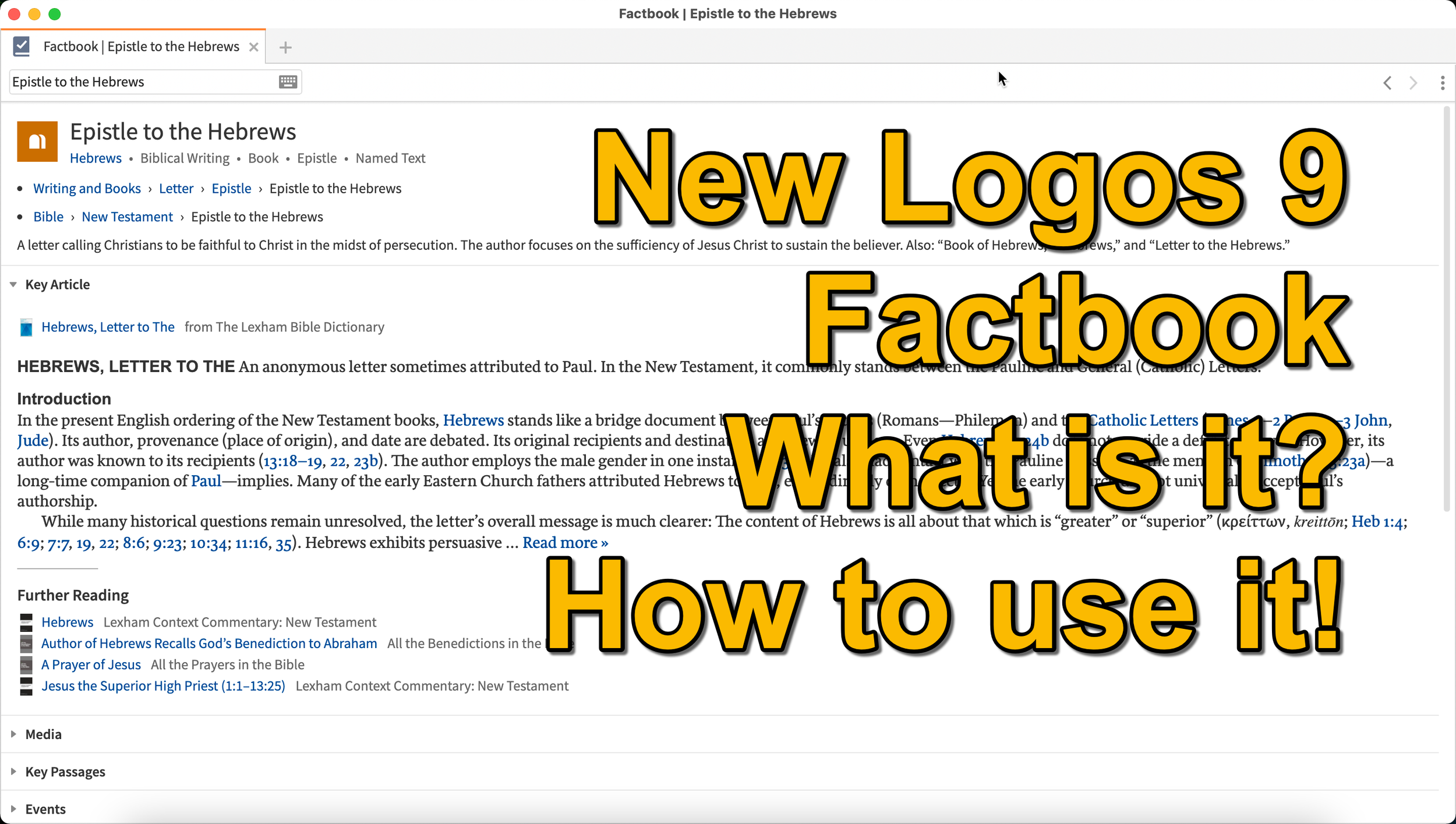
What is the Logos 9 Factbook, and how can you get the most out of this new feature if you upgraded to Logos 9? We'll take a look at each of the new features in Logos 9 now that we've had plenty of time to use them.
It's now been six months+ since Logos 9 came out. Since we've had it in hand that long I wrote a 6-months-later review. In addition to reading that, you can see my original post about the release of Logos 9. In this post, we will do a deep dive into all the new features starting with the one Logos made the most of in their advertising of Logos 9, the Logos 9 Factbook.

If you'd like to get a discount on Logos 9, you can use my affiliate link to give you 15% off, some free books, and my appreciation. I get a kickback to help me with expenses related to my website, podcast, and YouTube channels. Use the code PARTNEROFFER9 when you follow that link to get the discount and free books.
What is the Logos 9 Factbook?
Logos says, "The Factbook is one of the most powerful features of Logos, and it makes almost any biblical or theological term easily searchable." I compare it to a Bible encyclopedia on steroids. Just about anything you want to learn about in a Bible text will show up in the Factbook.
Past versions of Logos included the Factbook. However, it received a lot of attention in the update to version 9. A minor update comes in the form of the new icon. It now looks like a book with a checkmark on it.

New Sections in the Factbook
Second, Logos added a bunch of new topics to search for in Factbook. The new things include...
- Biblical Senses - these are translations of the Greek or Hebrew word. Biblical Senses give you an understanding of different ways the original language terms were translated in various places.
- Hebrew & Greek lemmas - you can now start a Greek or Hebrew word study from the Factbook report.
- Counseling Guide - start a study of the counseling guide on topics related to counseling, like marriage or addiction.
- Theological Guide - start a study of theological words or concepts from Factbook.
- Denominational Content - find all content on the topic from a denominational library, like Baptist or Lutheran.
- Lists as Topics - when you search for a topic, like a person's name. You'll see entries in the Factbook with lists related to that person's name or book of the Bible. For example, if I search for Matthew, it will find people named Matthew, topics or preaching themes from the book of Matthew, and more.
- Show All Topics - when you type a search term in the box in the Factbook, it will show a drop-down list of some searches you might be wanting as you type. At the bottom of the list, you'll see Show All Topics, which gives you a new list with all the Factbook topics containing your search term.
- Pericopes as Topics - search for a reference like John 3:16, and you'll get a list of pericopes (passages) with links to open the passage in the Lexham Context Commentary plus Media, Events, Sermons, and a See Also section.
These make up the list of the major new parts found in the updated Factbook.
Other Parts of the Logos 9 Factbook Still Available
Below, you'll see a list of other topics still included (from Logos support). The sections that show up in it are listed below:
- Info - basic information about the item search. This shows up in every search.
- Key Article - a section at the top from one of the common books in your library. Logos says the Lexham Bible Dictionary is an example of the book this Key Article will show. You get part of that article shown there in the list. Faithlife picked what Key Articles will show up for each kind of search item. The company focuses on its own tools, like Lexham Theological Library for original language terms.
- Media - images from any of your media resources.
- Letters - Personal Letter resources by an author if that's what you searched.
- Works - works created by the author showing links either to books in your library or store pages on Logos.com.
- Passages - shows a list of passages, like concordance of the word, topic, or thing. A link lets you instantly create a Passage List from the resulting list in the Passages section.
- Events - links to the Timeline and Biblical Event Navigator if a user owns that book.
- Dictionaries - articles in your dictionaries.
- Preaching Resources - topics from your preaching-themed resources.
- Referred To As - Bible verses organized by the way the search item is referred to with a list of the verses and a graph showing where that shows up in the Bible.
- Cultural Concepts - shows links to the Lexham Cultural Ontology Glossary, "which shows a hierarchy of the concept’s type, and search results for the concept within your Library" (from Logos Support site).
- Library - books in your library with content related to the search item.
- Journals - links to journals in your library with content related to the search.
- Sermons - links to sermons found in your library with content related to the search.
- Community Tags - these are tags that Logos users added to a section related to the search item. If I tagged a part of a book as "grace," then it would show up in other users' searches for grace.
- Bookstore - shows books for sale related to the search item.
- See Also - shows other things in your library that don't fit in the above section.
How to Open the Logos 9 Factbook
To open the Factbook you can do one of the following...
- Toolbar - Click the Factbook icon on the main window's toolbar. Enter what you want to search for in the search box.
- Go Box - start typing in the Go Box, and Logos 9 shows links to Open the Factbook to that topic, word, passage, etc. It also shows up as one of the taps that opens when you enter a search term and hit enter or click on the Go button.
- Tools Menu - You can also open it from the Tools menu. Either look for Factbook or type that in the search box at the top of the menu. Or it usually shows up in the shortcuts area at the top of the Tools menu.
- Context or Right-click Menu - Select a word in the text of your book or Bible and right-click, bringing up the context menu. You'll see the Factbook links in many places usuually in the right when you highlight a subject on the left.
- Visual Filters Button - There's now a toolbar icon in the Bible window for the Factbook. Click to turn it on and from now on you'll see blue dotted lines under words with Factbook entries. Don't confuse those with other solid blue lines that may show up if you've created other visual filters, like I did for parts of speech. Click those words to open a Factbook window for that word.
- Search Panels - When you search for things in a search box, the Factbook sits near the top somewhere in your search results. It moves around depending on what you searched for, but it will show up near the top of the results.

If you use the last method to turn on the Factbook, you can turn on or off what Factbook features will show when you click using Visual filters (see image above). Turn on or off different parts of the Factbook by clicking the down arrow next to the Factbook button. A list with checkboxes shows up, ready to turn off and on.
Bible Book Guides

The Bible Book Guides in the new Logos 9 Factbook shows up when looking at a book of the Bible in the Factbook. For example, if you search for the book of Hebrews, it will show you a section about the book. This section will help if you're going to do a study of a book of the Bible. You'll see the following sections:
- Content - Introduction, outlines, and contents mostly from commentaries on the book that you search for in Factbook
- Origin - Links to the books in your library with information about the book's author, date, and purpose.
- Background - Shows books with content about historical context, recipients of a book, and the author's location when writing the book.
- Objects - Books with geographical, date, location, and key people in the book.
- Canon - Discussions about the canonization of the book.
- Form - Discussions of the book's composition, text, title, style, and structure.
- Meaning - Books with info on the book's themes, emphases, interpretation, theology, significance, and spiritual content.
- Additional Information - Links to Bible dictionaries and commentaries with additional info about the book.


Logos March Matchups Starts Today with Big Savings
Logos March matchups starts today with 40% off New International Commentary on the Old and New Testament. Find out what it is and how you can save money.

I love March Madness. I used to find a set of NCAA basketball brackets and fill them out. Then I'd watch as many NCAA college basketball games as I could find time to watch. The Logos March Matchups comes along at the same time to promote Logos Bible Software.

Logos March Matchups promotes the software to customers with some deals on commentaries during the March Madness season. Logos started the promotion today, and you can start voting on which books you want to be discounted. By the way, the above link is an affiliate link. That means if you use it to buy books, then you'll help me out since Logos gives me a kickback.
How Logos March Matchups Works
You can participate and vote on what books they offer at the best prices. The College Basketball March Madness works like this: they rank teams in four sections from 1 to 16. The best teams are ranked 1 with the weaker teams ranked 16. Take four groups of 16 and you get 64.
Each group of sixteen plays a single-elimination tournament. The winner gets to compete in the Final Four. That's the four winners of the four 16-team tournaments.
Logos does the same, putting 64 commentary sets in a bracket. Instead of playing a game, they let people vote on which commentary sets they want to receive the steepest discount. Since they start with 64 sets, they pair them up in 32 polls in the first round. The sets that voters choose move on to the second round. In that round, Logos pairs 32 sets and 16 can win based on the votes of users. This continues to the third round with 16 teams, the fourth round with 8 teams, the final four, and the final pair. By the end, voters pick one commentary set to get the steepest discount.
Buyers get smaller discounts in the earlier rounds. The final winning commentary set will cost 60% less after March 22, the end of the tournament.
What Can Users Vote On?
Buyers can get the "Hall of Fame" commentary set, the New International Commentary on the Old and New Testament, for 40% off today. You don't have to wait for the end of the Logos March Matchups tournament. Here's how Logos describes this work:
This massive collection combines the available New International Commentary (NIC) volumes covering the books of the Old Testament and the New Testament to provide an exposition of Scripture that is thorough and abreast of modern scholarship, yet at the same time loyal to Scripture as the infallible Word of God. This conviction, shared by all contributors to New International Commentary (NIC), defines the goal of this ambitious series of commentaries.
The brackets for the Logos March Matchups tournament show the following commentary sets...

Here's my list of recommendations from each division of the brackets.
Division 1 - This section includes the New American Commentary series, my favorite set of commentaries. However, a lot of people like Word Biblical Commentary, so I think it may win the division. However, consider the Lexham Geographic Commentaries. Logos says, "The Lexham Geographic Commentaries deliver fresh insight by drawing attention to an often overlooked component of biblical stories—their geographical setting."
Division 2 - I expect that Evangelical Exegetical Commentary will win this division. It's a critical commentary written by and for Evangelicals. They focused on creating a digital tool. The other set that should challenge for the win is the Pillar New Testament Commentary. It's slightly less technical that some commentary sets making it a nice choice for preachers or teachers not doing scholarly work.
Division 3 - The New International Greek Testament Commentary Series should take this division. In fact I'll call it now.
Division 4 - Either the Zondervan Exegetical Commentary Collection or Anchor Yale Bible Commentary will take this part of the bracket. However, I'd prefer The IVP New Testament Commentary Series.
The final round should result in either Word or EEC winning it all. What do you think? Answer below to tell me what your favorite commentary is and which one you think will win it all.
Fans of Mobile Education and Verbum will also enjoy their own bracket.
Logos Bible Software Bought Wordsearch. What does it mean for me?
Now that Faithlife bought Wordsearch, what does it mean for users of both programs and where will Bible software go in the future?
In case you didn't know, the publishers of Logos Bible Software and Proclaim Worship Software, Faithlife, bought Wordsearch Bible Software from LifeWay, the publishing arm of the Southern Baptist Convention. I shared a little about it here and at ChurchTechToday.com, where I sometimes write.
When we face significant changes, we feel afraid and wonder what will happen and how will it affect us. Those feelings will affect Wordsearch customers more than Logos customers. However, it will also offer some positive changes. We'll look at both the negatives and the positives and then consider the future of Bible software.
Simplicity and Comfort with Wordsearch for Users
People who used Wordsearch for a long time liked that they could collect a large library of excellent Bible study tools and ministry books from excellent publishers. Wordsearch produced a lot of great digital content for their software users. Wordsearch also presented those excellent tools in a simple, familiar format. The program added features and changed the way it looked over time, but it always had a look that reminded us of Windows Explorer or macOS Finder. The list of content showed up in easy to recognize folders along the left, while the content showed up on the right. You could display a Bible in one window, a commentary in another, and notes in a third. It all made sense.

Moving from Wordsearch to another program felt more jarring than most moves because the other high-powered windows software looked very different. At least Accordance had the library list on the left. Logos hid their library in a drop-down list that you could open as a window and put on the left, but it took some work to set up a familiar layout that Wordsearch users would consider familiar.

Disappearing ZipScript; Gone But Not Forgotten
ZipScript appealed to Wordsearch users and many of those trying to jump to Logos, the new Wordsearch overlords, experience consternation at seeing it go away when the program stops working. Understand that the deadline won't come anytime soon. But one day it will quit.

ZipScript ran in the background and grabbed scripture from a chosen Bible from the Wordsearch library. Users could quickly paste it into a Word document or some other text editor or even a website. It worked simply and elegantly.

Logos has something similar in the Copy Bible Verse tool, but you have to open Logos to get at it. We'll show you how to use Copy Bible Verses in Logos below.

And that leads me to some hope for Wordsearch users. You can do most of what you really love in Logos or some other third-party application. It will take some time and training to get the most out of it. So let's look at the hopeful side of the buyout of Wordsearch by Faithlife.
Reasons for Hope for Both Logos and Wordsearch Bible Software Users
Logos users will experience the most hopefulness with the purchase of Wordsearch. Users now can access a large library of books and tools not available before in Logos.
The Complete Biblical Library includes a commentary and some language study tools to name a few resources. Logos didn't offer this package until now. Wordsearch and Accordance did. That's just one of the hundreds of books Logos users can now buy and use. More will become available as they finish converting the digital files into Logos book formats.
Wordsearch users will also get access to a lot of resources that weren't available to them before. Both customer bases could buy thousands of Bibles, commentaries, reference books, and other titles. Now they can get even more.
In addition to more books, Wordsearch users willing to take the time to learn how to use the powerful and complex features in Logos 9 will discover that their new program is more like owning an aircraft carrier than a 400-foot luxury yacht. Both float in the water and both will get you across the Pacific Ocean, but one can do it in a simple familiar way while the other feels more like a highly technical piece of machinery ready to attack any task with skill and advanced expertise like nothing else in existence. I think Accordance would disagree with that last bit. It's similarly powerful, but I hope you get the meaning of my flawed analogy.
I recommend that Wordsearch users patiently take the time to learn to use Logos. Here are a few ways to help...
- Logos Support Page has plenty of training
- Logos community forums is full of helpful users
- Check out one of the advanced training schools online like Morris Proctor and LearnLogos
- Visit Theotek here and on YouTube
- Take time to look around the software
- Open Wordsearch and Logos at the same time and take a look at what you love about Wordsearch and try to mimic that capability inside Logos
- Take a look at other Bible software like Accordance, Olive Tree, e-Sword, PocketBible and more.
- Keep using Wordsearch until you can't
The last recommendation above is important. Just because you won't likely get any software updates in the future from Logos, the program will probably keep running fine until Microsoft updates Windows and breaks it. If that happens, then don't upgrade windows. I'm guessing you can keep using Wordsearch for at least another year or more. That might extend for years, especially if you don't mind staying on current versions of Windows. Eventually, however, it will shut down and you'll have to move on.
The Future of Bible Software
Where will the Bible software community end up in a couple of years or longer? That's a hard question to answer and I've never been a good prognosticator. I thought Covid would last a few weeks at most. But let's give it a try.
Bible software is both expanding and contracting at the same time. Over at ChurchTechToday.com my editor, Lauren Hunter, wrote about the future of Bible software quoting Rick Meyers, the generous creator of e-Sword. He said...
“This same decade has seen new Bible software companies emerge who are embracing these new hardware/platform changes. So, in the decade which saw WORDsearch first sold to LifeWay, and now to Faithlife, we have seen the rise of YouVersion. One generation of programmers hands off the baton to the next generation of programmers; meanwhile, God’s Word remains as popular as ever.”
I agree. We see more options for quality Bible software. At the same time, we now have fewer options for the advanced Bible study needed for academic Bible study or translating the Bible into more languages on the mission field.
With that, I think that Bible software companies that offer a strong online presence will win in the long run. And that means Logos. They are the only advanced Bible study option that works on all platforms including...
- Windows
- Mac
- iPhone
- iPad
- Android
- Online
- Chromebooks
- Kindle
Others work on many of those like Olive Tree, but they don't offer a website for Bible study. Accordance is in the same boat.
Some of the best online sites work great in a desktop browser, but not as well on mobile. Some of those show up as apps in the app store, but not all.
With the contraction of the number of powerful programs, it may seem like Bible software is in trouble. However, the big names are strong and not going anywhere soon. So, I'm hopeful.
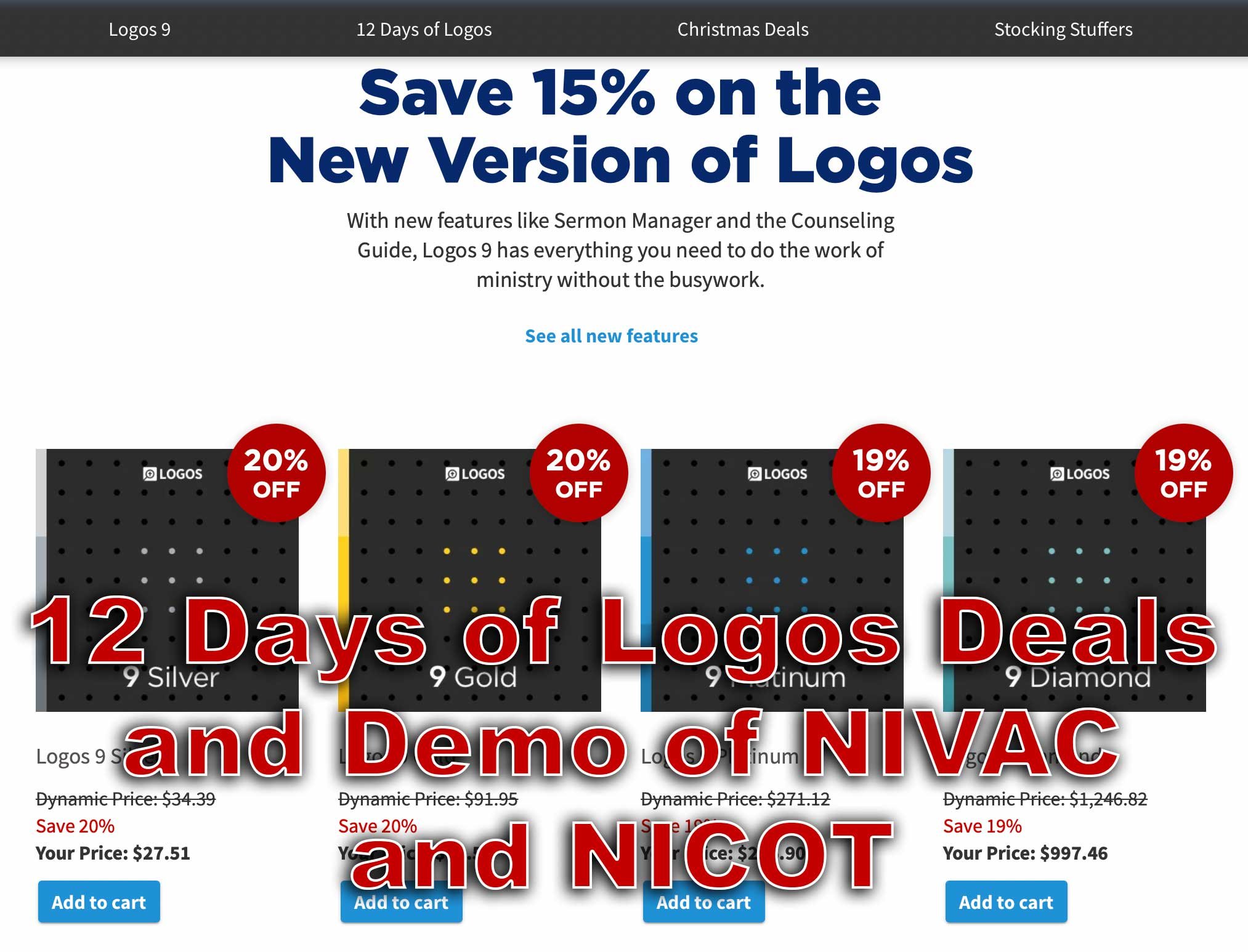
12 Days of Logos Deals and Demo in Logos 9
The 12 Days of Logos brings steep discounts on Logos Bible Software books and tools as well as packages. Use the link in this article to save up to 60%.
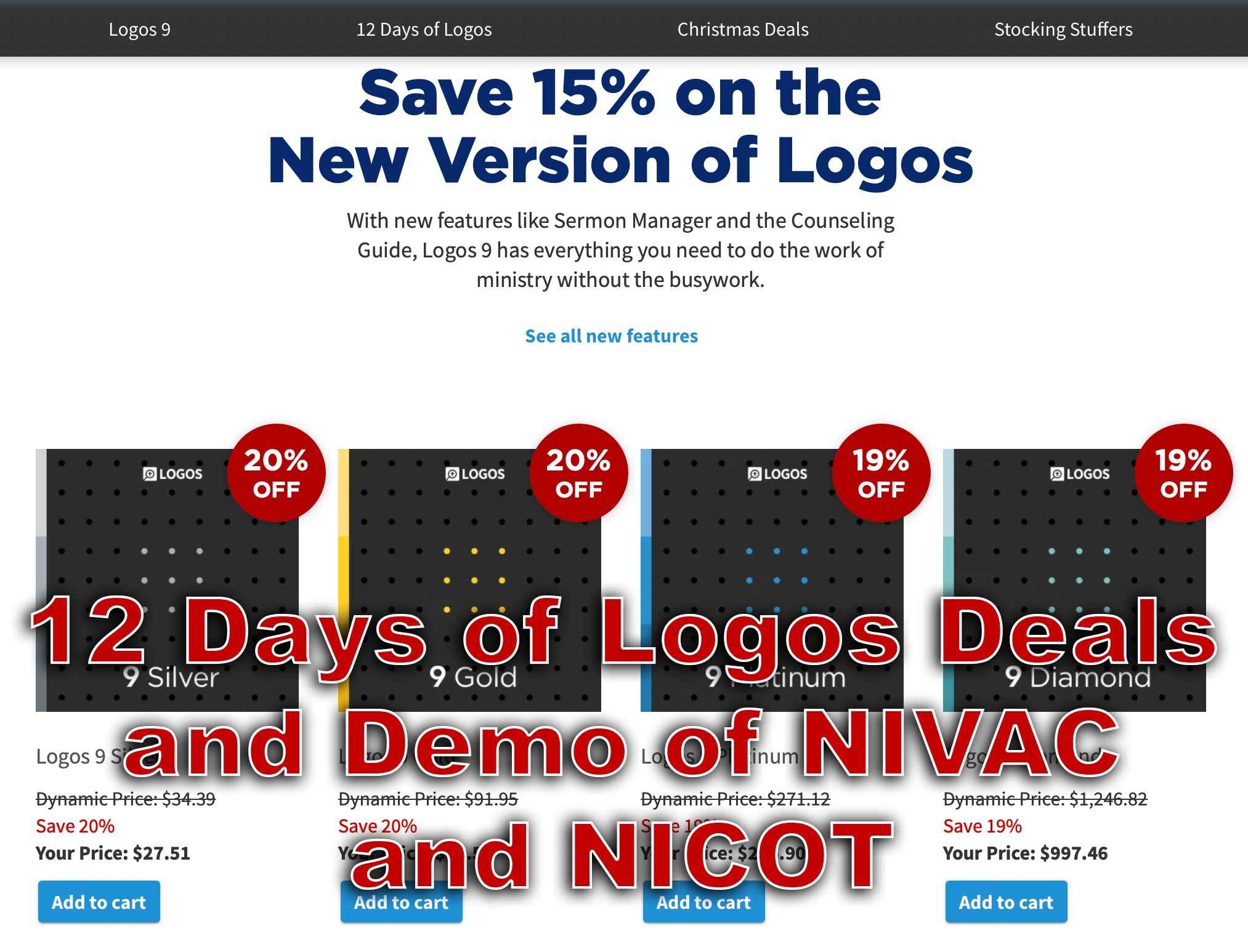
Every year Faithlife offers what they call the 12 Days of Logos, where they offer 12 different products for steep discounts. That benefits you if you want to buy any of these 12 products for Logos 9. We'll take a look at them and give you some tips as to which ones you should consider and maybe avoid.
What are the 12 Products Available This Year?
On our list this year, we get some really great books and tools for Logos 9 and Logos Bible Software, which you can use with their latest desktop version of Logos 9 or you can get it on their mobile Logos 9 Mobile app. They also work on the web app.

Here's the list of the 12 products and how much they cost. If you want to buy one of these, I ask you to consider using my affiliate link because it helps me continue my work of writing reviews and how-to articles about Bible software and ministry-related tech topics.
- Bible for Everyone Commentary Collection (35 vols.) 62% off, $119.99 sale price
- Challies Recommends: Best Old Testament Commentaries (55 vols.) 50% off, $442.99 sale price
- Romans-Philemon, 21 vols. (New Testament Technical Commentary Collection) 65% off, $232.99 sale price
- New Studies in Biblical Theology Series Collection | NSBT (50 vols.) 52% off, $299.99 sale price
- NIV Application Commentary: New Testament | NIVAC (20 vols) 55% off, $199.99 sale price
- New International Commentary: Old Testament | NIC (28 vols.) 51% off, $499.99 sale price
- Popular Patristics Series Collection (53 vols) 54% off, $229.99 sale price
- Ancient Christian Reference Collection (55 vols.) 50% off, $549.99 sale price
- Smyth & Helwys Bible Commentary | SHBC (36 vols.) 55% off, $499.99 sale price
- Welwyn Commentary Series | WCS (56 vols.) 60% off, $199.99 sale price
- New Covenant Commentary Series | NCCS (16 vols.) 54% off, $99.99 sale price
- The Life Application Bible Commentary (17 vols.) 60% off, $49.99 sale price
Let me highlight a couple of the above books. I use the New International Commentary: Old and New Testament sets regularly. Faithlife is offering the Old Testament package for only $500, a 51% discount. That's steep. It's both an easy to understand commentary, but has a technical level of information for advanced Bible students and people who teach and preach the Bible.
The NIV Application Commentary: New Testament comments on the text and then offers some practical application to the commentary. This helps the average Bible student or the teacher/preacher alike. You'll pay only $200, a great price for this product.
The Life Application Bible Commentary focuses on real-world use of the teachings of scripture to help Christians in their growth. It comes in at 60% off.
Deals on Logos 9 Packages

In addition to the above tools, you can also get one of the Logos 9 packages available from Faithlife with some deals. Logos identifies them by colorful names like Silver, Gold, and Platinum. You can follow my affiliate link, which gives me a 5% commission to help me continue writing helpful reviews and how-to articles about Bible software and ministry tech.
How Use Logos Important Passages Guide to Create Sermon Series
How can preachers us the Important Passages Guide in Logos 8 to help them craft exciting sermon series on a given topic in the Bible? We'll show you how.

Would you like to preach a sermon series on a topic in the Bible but also want to preach expositorially? You can use Logos Bible Software and the Important Passages Guide to select passages to study and preach for a sermon series on a topic. Each sermon will cover one passage, but the series serves as a topical sermon series instead of preaching through a book of the Bible as many Expository preachers prefer.

I was going over the new features in Logos 8 recently and forgot about the Important Passages Guide. As I looked over this new tool in Logos 8, it hit me - this would work great for picking passages to study and preach while crafting a sermon series on a particular topic.
Most expository preachers like to preach through books of the Bible. I am one of those. But I also like to choose passages that cover a topic and then study the passage covering that topic to preach expository messages on them. We'll show you how to put together a sermon series on passages found using the Important Passages Guide in Logos 8.
What is the Important Passages Guide in Logos?

Logos added the Important Passages Guide when it released Logos 8 back in 2018. Users will see it from the Guides Menu on the Logos toolbar. Find it quickly by typing in the Guides search box the first part of the guide's name "Important" and it will show up as the first item in the Bible Reference Guides section. You can also scroll down to the Bible Reference Guides section.

When it opens, it looks totally blank. Type a passage into the box at the top of the new window like John 3:16. It will search the index and find passages related to the topics in that verse.

After searching for a passage, you'll see the results that will like the image above. You see a few things.
- The top line says "References of All Types To all passage" - these help you choose what will show up in the list of passages. Click on All Types to change the types of passages. Click on To to change whether the passages will go out from the selections below or to the selections below. More on these options below.
- The Add menu lets users add types of datasets. Click it to see what you can add.
- Under each passage you see hyperlinks to various kinds of content found in Logos. These links will open the Factbook. For example, the above image shows the Factbook entry for God: Love. You'll see other kinds of links.
- The links at the bottom of the window will...
- Show more passages found
- Save the list as a Passage List
- Open all of the found passages in your top Bible translation
The To and From links in part 1 above will change the list of passages as follows:
- To - To finds cross references from other passages that link to your passage. So if a passage links to John 3:16 it will show up in this list.
- From - All cross references in your various translations that go out from John 3:16 will show up when you select From.
How to Use The Important Passages Guide to Choose Sermon Topics
I often read a passage in my quite time or while I'm listening to another Bible teacher or preacher and think, "That passage make a great sermon." Then as I look at the passage it leads me to look up others and inspires me to preach a series of 3-6 sermons or more on that topic.
You can quickly find a lot of passages from the Important Passages Guide by entering the verse that inspired you into the search box of the guide. Then read through the resulting searches.
Take this a step further by adding various kinds of datasets. Click on the Add button and choose something like Topics. This gives you more passages from that dataset. A dataset refers to sets of information that Logos organized around that kind of info. In this case, they collected the Topics together into the Topics dataset.