

Accordance Bible Software 25 Day Switch Part Two - Accordance Mobile
While switching to Accordance Bible Software for the next 25 days, I will use Accordance Mobile alone as my iPad Bible study app. How does it handle sermon prep?
If you read the first post about why I'm testing out Accordance for 25 days, then you'll know I vowed not to open my primary Bible software until it's over. That means I'll use the Accordance Mobile apps instead of the Logos Bible app. My previous entry covered using the Notes feature in Accordance.
Awhile ago I wrote a review of Accordance Mobile for ChurchTechToda.com and gave it a high rating. That review happened while I was also using my other Bible apps. This is the the first time I've used no other Bible app. Accordance Mobile alone! If you want a full review, go to the ChurchTechToday article. Instead this will serve as a comparison. See this as my strengths versus weaknesses of Accordance Mobile.

Please see my review of the NAC Studies in Bible & Theology in Accordance.
Accordance Mobile User Interface
Accordance Mobile looks so simple it will surprise you how many features they pack into the mobile app. It deceptively looks like a simple Bible reader app that also happens to let you open other books. Yet, I recently wrote a sermon primarily using Accordance Mobile to read follow my sermon prep steps which include:
- Reading the text in multiple translations.
- Studying the passage inductively by recording observations in my app's notes.
- Asking key interpretive questions about the text and finding answers in references books, other than commentaries.
- Checking commentaries to make sure my interpretive decisions up to this point are not way out in left field.
- Copying the passage and other supporting verses to my chosen word processor.
- Writing the sermon in my word processor.
- While I probably won't choose a mobile app for 100% of my sermon prep, I enjoyed using Accordance Mobile on my iPad. It works great. Let's start with the ways it excels.
Strengths of Accordance Mobile

All of my books reside on the iPad which makes the app fast. I navigate to a text to study it and the apps jumps to the new spot in my Bible instantly. I keep two window panes open with my favorite commentary in the right side and the Bible in the left. Both books jump to the new passage faster than I can tap the book, chapter and then verse in the navigation tool.

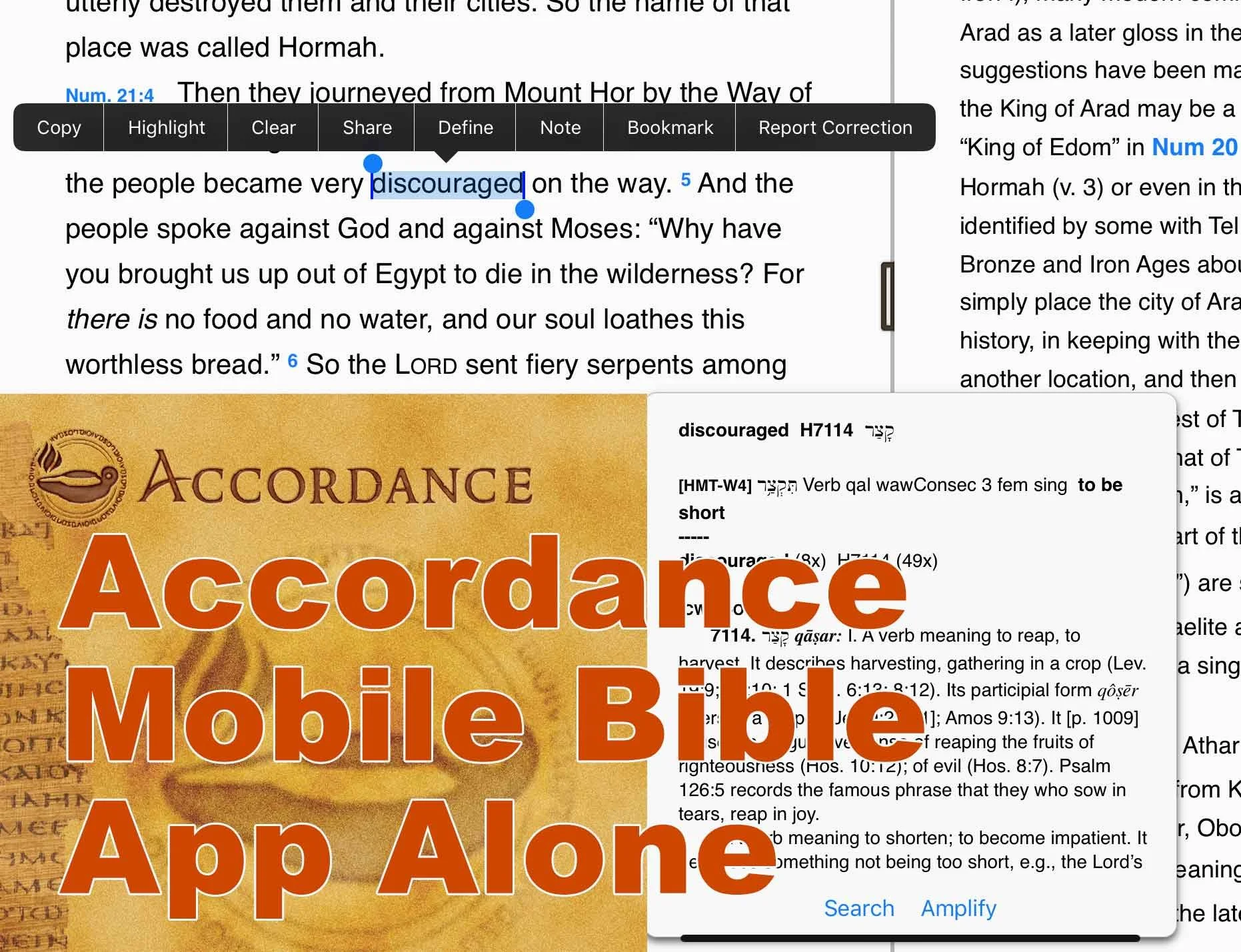
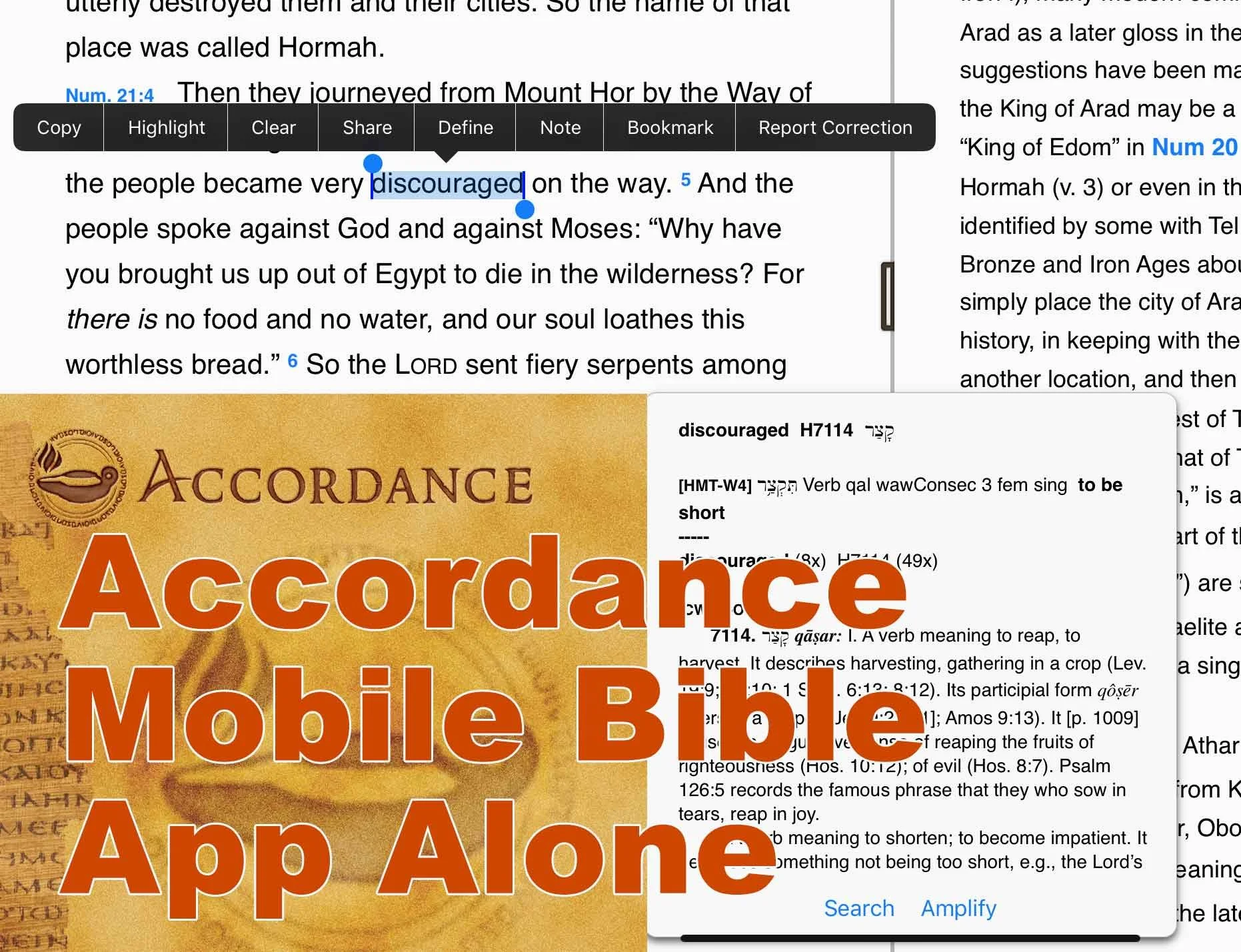
Doing word studies happens with a long press on a word. Above you'll notice I selected the word discouraged in Numbers 21:4 in the CSB. You'll see a popup box with the word study info from your top books. There's also a menu above the word. This menu doesn't help with word studies, but you'll see that you can do other things like "Define" the word in English.
You can also open a Hebrew or Greek text and do the same with Hebrew and Greek words. On those words, tap the Amplify button to see more details. Here you can study the Lexeme, Inflected word or the Root. The first pop up box also lets you choose to search for the word. It will search the English term in hour English text. If you have a Greek or Hebrew text open it will let you search by Lexeme, Inflected form, Root or the Tag.

The will let you share verses. Tap and hold on a verse number to do this. The top of the pop up menu let you add verses to the beginning or end of the chosen verse. That way you can copy a range of verses.
Finally, the Accordance system publishes an excellent collection of digital Bible study tools from every Bible text you probably want to a more commentaries than you can use. They have excellent reference tools and every tool I want to use works in my Accordance Mobile app.
People who want to also make a switch can jump from their chosen Bible software to Accordance by taking advantage of some crossgrade discounts. a crossgrade is like an upgrade, but instead it's buying a book you own in another company's library for a discounted price for use in Accordance. I saved hundreds of dollars over the years by taking advantage of this. I purchased the New American Commentary, Bible Speaks Today and more.
Compared to the Logos Mobile app, Accordance feels simpler and yet has some of the same powerful features. It's also not as cluttered. That said, I suggest the developers consider a few improvements.
Accordance Mobile Bible App Problems
As we noted in the post on Notes, you can't open your User Notes in the right hand window pane and edit it within the pane. Accordance has a real problem with this. You also can't do this on their desktop app.
At least on the desktop app you can open open it, click at an insertion point and start typing and the note's editor window pops up. On the mobile app you have to long press on the verse number and choose User Notes from the menu. Then you have to tap on the name of your User Notes document and it will open a pop up window that covers most of the window.
UPDATE: Please see the user comments below where Rick Mansfield from Accordance tells how to see your text. This makes what I wrote next less of an issue.
The Accordance Mobile notes user interface is a terrible design choice because I can't see the text of my Bible or a commentary while I'm typing in the note. It's the least usable notes user interface of any advanced Bible study app out there.
Since writing my last post on Accordance Notes, I've decided to stop using the notes function built into Bible software. Instead, I've started using Scrivener to record my sermon notes. I'm following a system that my friend a member of the Theotek Podcast team Wes Allen uses. See the video above for how he does that.
Accordance Mobile lacks one feature that I miss from Logos. On the Logos mobile app you can open their Text Comparison tool and read your passage in multiple translations seeing them all on screen at the same time. The desktop version has the new Text Browser tool. Select a verse and choose Text Browser from the Amplify drop down menu to open it.

Accordance added the Text Browser to appeal to Bibleworks users after that company announced they'd stop selling the program.
Logos offers a few other features that we don't find in Accordance.
- New tabbed user interface which lets you open more than two books at one time.
- Guides to help you study a passage or topic more quickly.
- User edited reading plans for Bibles and books.
I don't mind losing these features, but I mention it in case Logos users would feel limited in their study without them.
Olive Tree Bible searches your entire library and presents them in a easily accessible way thanks to the Resource Guide. We don't get anything like that in Accordance Mobile.
Conclusion
The desktop Accordance program goes toe-to-toe with the other Bible programs quite nicely. The Accordance Mobile app still lags behind a little. In spite of that, you can study the Bible using nothing but their iPad app. I wouldn't try doing it all on an iPhone or Android phone due to screen size, but I enjoyed doing my sermon prep last week with nothing but the Accordance Mobile app on my iPad.
Accordance Bible Software 25-Day Switch Part Two - Notes
During my Accordance Bible Software 25-Day Switch I'm trying to use the Accordance User Notes. How does it compare to my old go-to application, Logos?
Many Bible software users make use of the built-in notes feature in addition to reading Bible passages and commentaries, including me. To make the Accordance Bible Software 25-Day Switch, the notes feature will need to record my observations, questions and findings.
Since I work on both a desktop, laptop and my iPad, it will also need to sync between the three devices easily, I'd rather they synced automatically. Finally, I want some formatting options, including bullet or number lists, automatic hyperlinks to Bible passages and basic text and paragraph formatting.
How well does Accordance work? We'll take a look in part two of the Accordance Bible Software 25-Day Switch from Logos Bible Software and the companion mobile apps from Faithlife.
Accordance Bible Software 25-Day Switch: User Notes

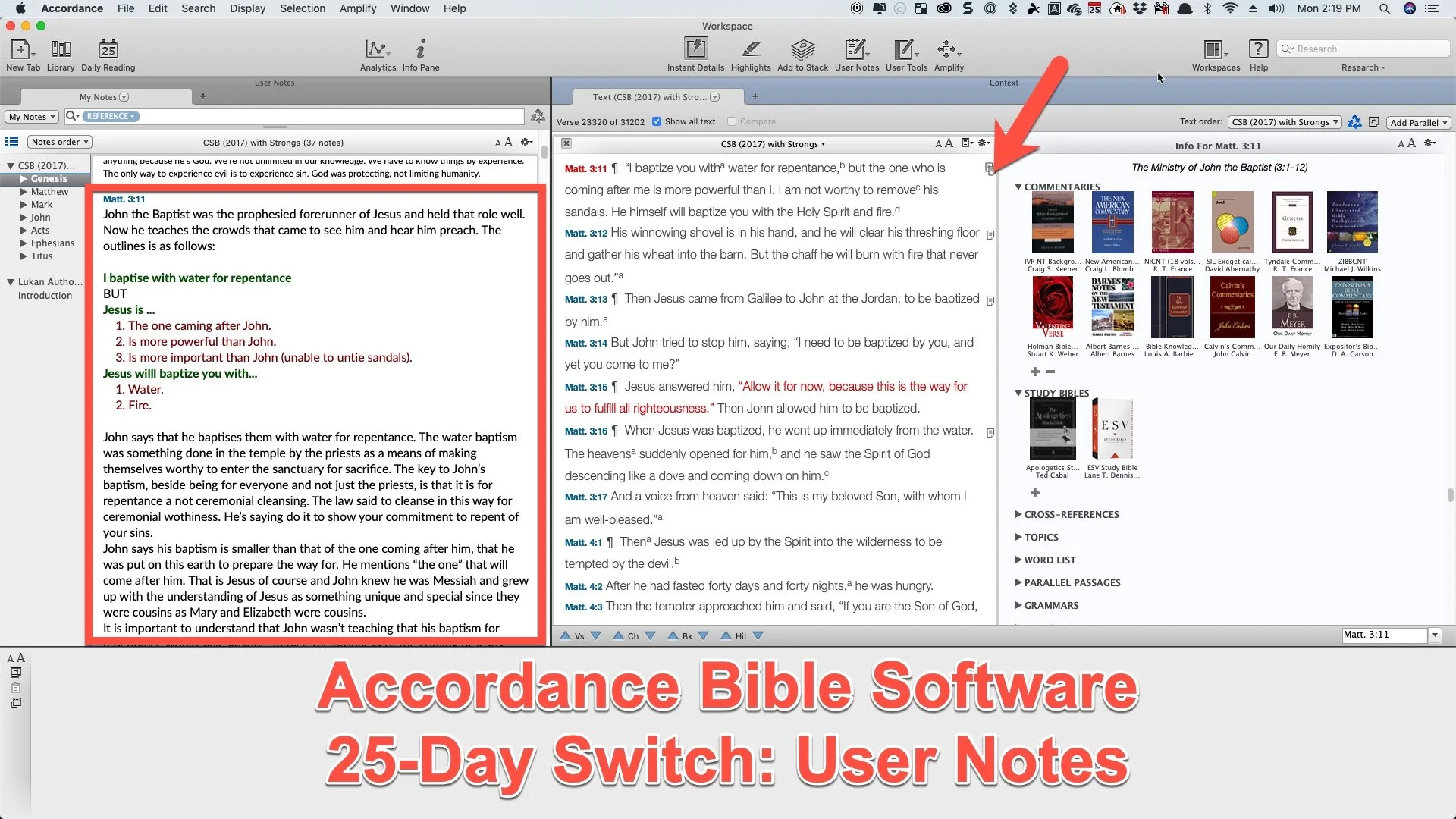
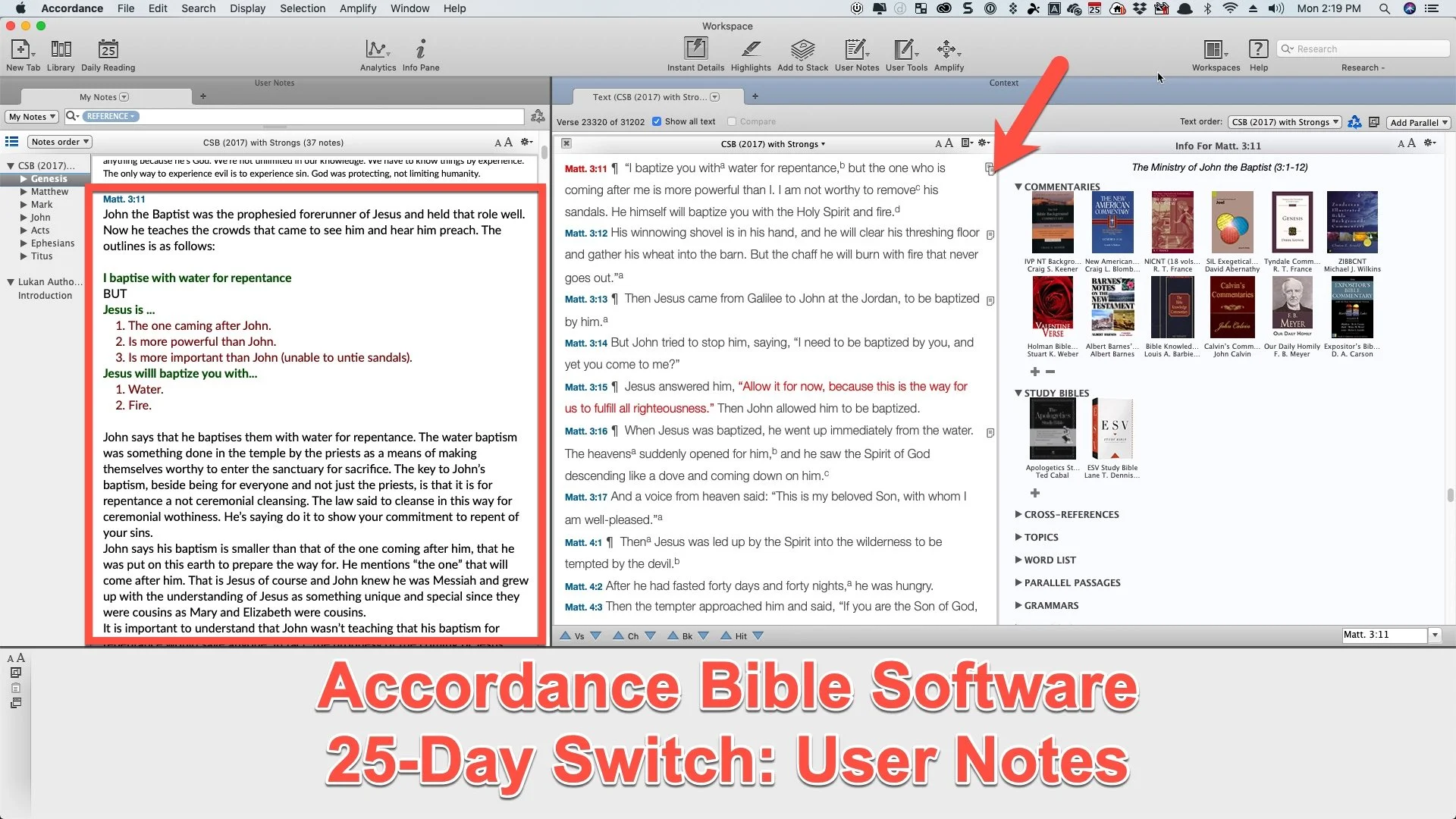
First, let's take a look at the user notes in Accordance. Any verse with a note will show it with an icon in the right margin next to the verse. See the arrow in the image above. It shows the note on Matthew 3:11. The red box shows the content of the note opened in a separate window.

To add a new note, click on the blank spot next to the verse along the right edge of the Bible window. A dialog box will pop up asking which User Note file to add the note to. A window will pop up over the main Accordance screen to edit the User Note. After you create the note you can save it by clicking on the Update button in the lower right corner of the pop up window.
The Update button highlights my first big annoyance with Accordance Bible Software User Notes. You have to click Update! I'm used to Logos which automatically saves your notes while typing them. And it does this seamlessly and quickly for most users. The few people who struggle with this issue includes people with underpowered computers. That's merely an annoyance, however. I can get over it.
However, another significant annoyances comes from the fact that the User Notes tool pops up in a box on top of the Accordance Bible Software program. Why can't I open the note in a window pane and edit it right in that window pane? If you open your User Notes file in a new window pane and click in the note and start typing to edit it, the note opens in a User Note pop up window.

The User Notes window toolbar includes the following functions (from left to right):
- Keyboard chooser - drop down lets you pick...
- Default - COMMAND+OPTION+SHIFT+D
- Greek - COMMAND+OPTION+SHIFT+G
- Hebrew - COMMAND+OPTION+SHIFT+H
- Font face
- Font style (like bold, italics, etc)
- Font size
- Font color
- Bold
- Italics
- Underline
- Superscript
- Subscript
- Link - select text and click here or use link dialog box or select text formatted as a URL and OPTION+Click on this button to quickly add a simple link.
- Auto-link - click to create automatic. links out of Bible passages.
- Insert picture
For the Auto-link button to work, the passage will need to use typical passage formatting like John 3:16. URLs with HTTP:// work but not just www.kevinpurcell.org by itself.
At the bottom of the User Notes editing box we get arrow buttons. Two sets up of UP/DOWN buttons will jump to the previous or next note in your file or will add a new note on the previous or next verse. When you click these buttons they automatically update and save the note file. To delete a note, just clear the box and hit Update. If you close the Note editor, it will ask you to Update. That keeps you from entering a long string of notes and then fail to save the note.
After you save a note, the Notes box will open to show your notes. You can't edit them in this box, but they will be displayed here. That dialog box has a few buttons as well. You can close it using the little X in the upper left. The center to area has a drop down menu that shows all of your User Notes found by the program. The upper right has a font size Up and Down to make the notes look bigger or smaller in the display box. The last button in the upper right looks like a Settings icon. It has the following items...

- Move Up - moves the whole box to the right end of the current window.
- Move Down - moves the note box to the bottom part of the window.
- Show Interlinear - grayed out in a notes box, but there for when you're displaying a Bible.
- Enter Reading Mode - opens window in full screen without any window controls or toolbar (Keyboard shortcut CONTROL+R)
- Auto-scroll - starts to scroll the window automatically.
- Untie Scrolling - breaks the link between the Bible window and this window.
Accordance Notes Pluses
Here's what I really like about using the Notes Tool so far during my Accordance Bible Software 25-Day Switch. First, it's fast! Logos notes can get a little slow. The auto-update and sync feature on Logos probably slows it down since it's phoning home to the Logos servers every time it saves. Accordance doesn't do that until you sync them on exit or manually.
Second, the Notes Tool has all the basic features you need. We can format text and add images. It supports Unicode which means you can enter Greek and Hebrew text. Plus, it adds links to Bible passages and you can also add links to websites.
Third, users can link their notes to Bible passages, websites and even other books in your Accordance library. If you have a file on your computer, you can link to it too.

Select the text you want to add the link to and then click on the link icon (third from the right on the top toolbar of the User Notes Edit window). Choose the kind of note you want. If you are linking to a file on your computer, then choose File and click on the Choose File... button. Pick your file and then click on OK to create the link.
Resource links will let you add them to any book in your downloaded library. A drop down box opens so you can select the book. Play around with it to see all that this powerful linking tool can do.
Finally, Accordance gave us a better way to sync notes between the Mac, Windows, and mobile versions of Accordance. Instead of doing it manually over Wi-Fi as the used to require, users can connect their Dropbox account to Accordance and sync that way.
Syncing with Dropbox
See the video above to learn how to do this and how to use the sync feature. Unfortunately, it forces you to manually sync from the mobile app to Dropbox. You can set the desktop version to sync each time you exit the program. It's a shame the mobile app won't do this automatically. Since they require it, they should put the sync button in the main window of the app instead of nested in the library window, which forces you to tape a few times. I added a button to my toolbar on my Mac version of Accordance even though it syncs automatiaclly upon exit.
The Accordance video tutorial collection includes some great help on using their software. They offer an awesome one on using notes in Accordance Mobile. There’s another one covering the desktop version’s Notes tool.
BibleWorks users can import their notes into Accordance thanks to a recent update from Accordance.
Accordance Mobile Notes
In Accordance Mobile, add notes by long pressing on the Bible verse. A new window pops up with many options. Select User Note to add a note or edit one aloready in place. Now choose Notes file you want to use to add this note. I use the same file for all my tasks.

A verse with a note already attached will show a tiny note icon in the right margin (see the left image above). Tap on it to see a popup displaying the note. Tap on Edit to change the note or Open to read it in the lower half of the app.
Notice the Note editor has font formatting. You can't add links like you can in the Mac or Windows version. UPDATE: To add links to your mobile notes press and hold on text and then choose Link from the pop up menu. The Plus icon on the top toolbar will let you add images from your mobile device. The up/down arrow moves to the previous or next note.
Lessons Learned from Accordance Notes Use
Here's what I've decided after making this switch for the first few days. First, I will see if I can get used to using the Accordance User Notes tool in both mobile and on my Mac. I think I can adapt.
Second, I'm seriously thinking about dumping Bible software notes tools entirely. For years I used PC Study Bible and lost all of those notes because I didn't know how to get them out. e-Sword lets you move your notes out and so did QuickVerse. I used both of those for years. When I used BibleWorks for a few years before jumping to Logos, I loved that they saved their fils as RTF files. Logos makes it really hard to get notes out of the program.
I should probably use a third-party solution to record m notes. I may do that with a simple Word document for each book of the Bible. Some like Evernote, but I've stopped using the service due to the subscription fees. I already pay for Word. We'll see after this 25 days.
Accordance Bible Software 25 Day Switch Part One
To celebrate the 25th anniversary of Accordance, I'm trying to switch from Logos to Accordance. My Accordance Bible Software 25 Day Switch begins.
For the last 13+ years I've used Logos Bible Software plus others as I reviewed them. Today I am going through an Accordance Bible Software 25-day Switch experiment to jump from using Logos first to prioritizing Accordance Bible Software. What inspired this choice? How do I expect this change to affect my Bible study experience? Should you make a similar switch?

This post won't answer all of the question posed above, but it will answer the first and share my early experience. The Accordance Bible Software 25-Day Switch may be temporary. We'll see after it's over. However, it will be complete during that 25 days.
Why am I making this possibly temporary switch? There's a number of reasons.
- Of all the Bible software I use regularly, I'm least familiar with Accordance and want to become more adept with it.
- Logos works great, but it's a hardware resource hog and Accordance runs faster and takes up less space and power to run on both Windows and Mac.
- This experience, I hope, will inform readers what it takes to switch from one major Bible software platform to another.
- I like a challenge.
- The length will honor the history of Accordance, as they celebrate 25 years of publishing a world class Bible software program first on Mac and now on Mac, Windows, iPhone, iPad and Android.
Accordance Bible Software 25-Day Switch Rules
First, I won't use my old go to program or the apps related to the program. In other words, I can't launch Logos on my Mac or on my phone/tablet during the 25 days. There's one exception. If I'm studying a passage and need to open Logos to access a resource that I know will help me produce a better sermon or Bible study, then I will. My preaching and teaching ministry at High Peak Baptist Church matters more than an article written on this site.
Second, like most weeks, I can use other programs or apps. While I launch Logos first, unless I'm reviewing another program or app, I always use more than one Bible program or app to research my sermons. So this "switch" means that Accordance will dominate my study, but I'll continue to occasionally use other programs and app besides Logos when I need to.
Third, I reserve the right to cancel the switch at any time but not for any reason. If this switch means I'm so unproductive that the switch harms the affectiveness as I study the Bible. I'll write about it here.
Fourth, if I need to open Logos to get a screen shot or shoot video to explain differences between Logos and Accordance for articles in this series, I will. But I will only set things up to get the shot and then close it.
Accordance Bible Software 25 Day Switch Copying Passages to Other Programs
Logos helped me finish most of the in depth study for this weeks' sermon already. The first day of the switch came after that on purpose. I didn't want to dive head first into the Accordance deep end. Instead, I'm wading in the shallow end this week.
This week I began to prepare my preaching notes for this week's message. That means I'm copying passages from my Bible software to a Microsoft Word document. I take that Word document into the pulpit with me on my 12.9-inch iPad Pro. It's an extensive outline with the Bible passages copied to the document.
In Logos, copying a passage to Word is simple after some setup. The Logos Copy Bible Verse tool will let you select a passage and then choose the translation, a copy format and whether you want to simply copy the passage to the clipboard or copy it and paste it in one click. If you want to copy it, hit the copy button. Or you can hit the Copy-Paste button and it automatically inserts it into the Word document with the formatting chosen.
With Accordance you insert passages into Word or other programs on macOS by using the built-in macOS Services feature. You can download a Accordance Services Set and install them. To insert the passage, type out the reference in Word and select it. Then right-click it and choose Services and then Insert Verses.

I love the Logos Copy Bible Verses tool, but the Accordance use of services works. Also, you can do a little more. They offer services for ...
- View Verses - shows the reference in Accordance.
- Search with Options - searches the selected text using an options dialog box.
- Search for Words - opens a search in Accordance and looks for the selected text.
- Insert Verses from any Text - lets you choose which Bible translation to paste the passage from.
- Insert Verses - inserts the selected passage from your top Bible.
Users have created other services, which you can find in the Accordance Bible exchange site, which holds files related to Accordance, including this collection of user created services.
This process took some configuration to make the inserted verses look how I want. Go to Preferences and then look in the Citations screen to experiment with the options there to make things look the way you want them too. Here's my screenshot to make things look how I wasn't.

Here's the way the verses look when I paste them into Word. After pasting them into Word, I apply my Bible Quote Style. Logos does this with one click and in Accordance it takes several steps.

Here's how to insert text using Accordance and services.
- Type the reference in Word or another program.
- Right-click (or click on menu for Word, Services, Insert Verses) and choose Services and then Insert Verses (or one of the other services).
- The passage gets pasted using basic formatting so I have to select the passage and click on the Ribbon to apply my Style.
Logos handles this better, but if Accordance handles more of my Bible study process better than Logos, this minor weakness will not keep me from continuing my Accordance Bible Software 25-Day Switch.
5 Best Kindle Fire Bible Apps
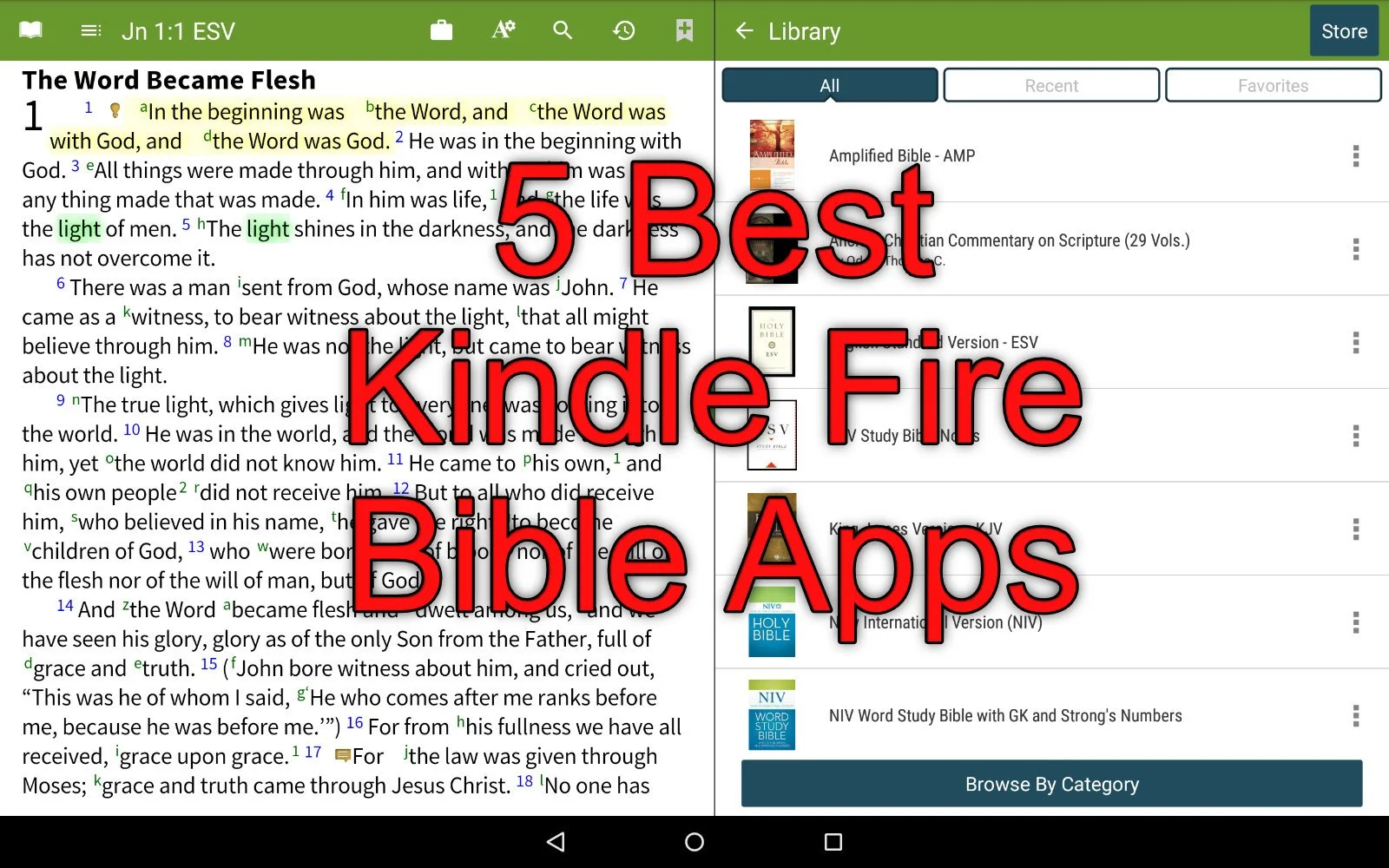
Would you like to find a great Kindle Fire Bible app? We've got the five best Kindle Fire Bible apps for you plus one app you should avoid for awhile.
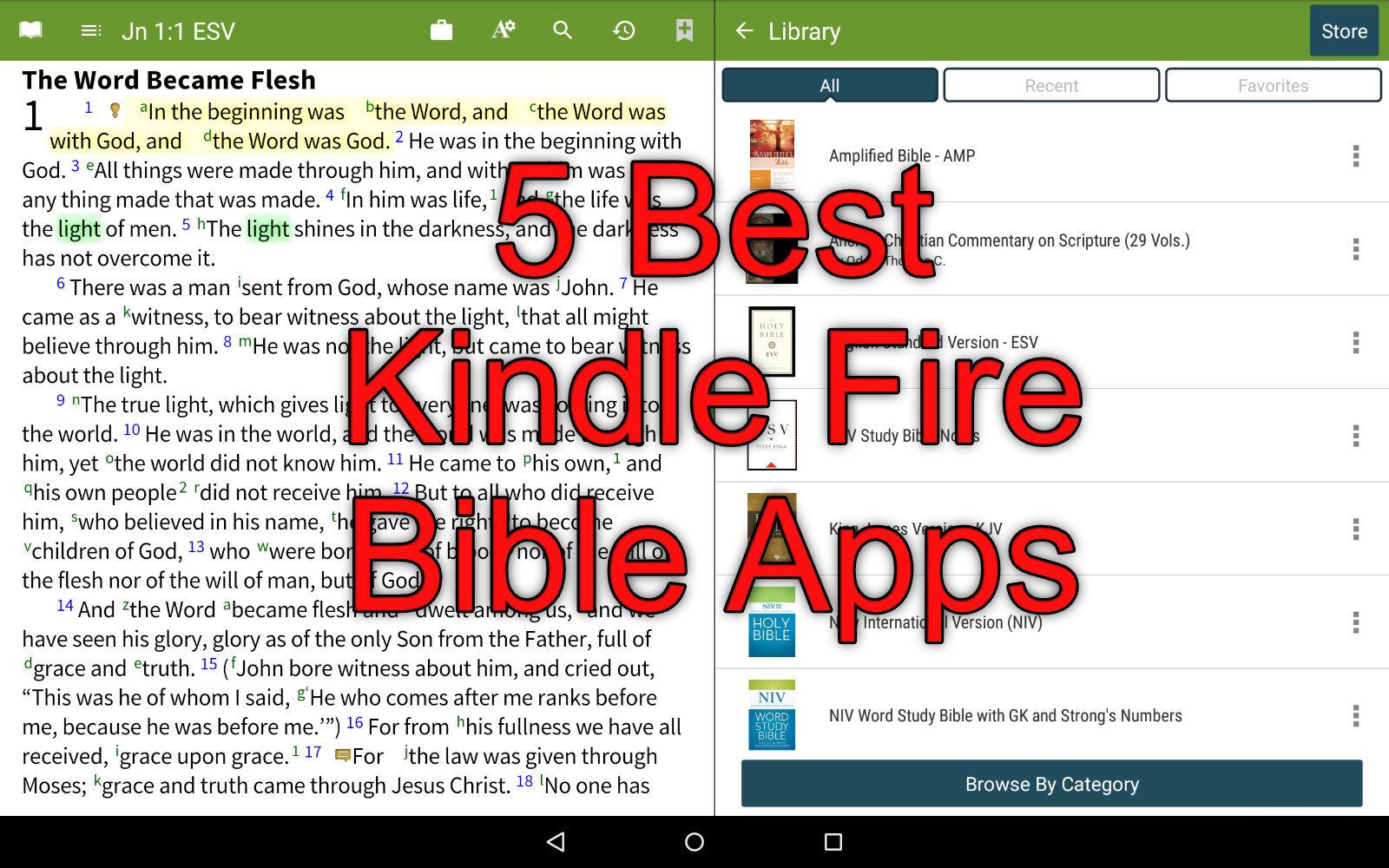
The Amazon Kindle Fire appeals to people who like the idea of a tablet to read books, watch movies and do some simple things like surfing the web and checking their email. You can also play games. But how good does the Kindle Fire do for Bible Study apps. We've got the 5 best Kindle Bible Study apps that run on the Kindle Fire.
A Kindle runs a heavily skinned version of Android. The Fire OS runs Android 7.1 Nougat, which lags a few generations behind. Google released Android Pi in 2018 and will release unnamed Android O this year.
The fact that Fire OS uses Android means many Android Bible apps will run just fine on the Kindle Fire. However, the app creator must choose to send their app to the Amazon Kindle App Store, which has some of the most stringent evaluation processes of any App Store. This leads many app developers to ignore Amazon.
The following apps come in no particular order. I chose them based on…
- Price of the app plus add-on books
- Size of library
- Quality of the app and its features
- Stability and speed of the app
- Olive Tree Bible Reader
- Accordance Mobile
Bible by Olive Tree
The best Kindle Fire Bible app comes from Olive Tree. Bible by Olive Tree includes a simple user interface but also includes powerful enough features to let Bible students study the original languages and use most of the best commentaries available on mobile devices today.

The modern translations and better commentaries or other reference books will cost extra. They offer free books and even some language study tools for nothing extra. However, the Olive Tree library carries more resources than the other apps here.
Open your favorite Bible and then look at the Resource Guide, available along the right or bottom (depending on whether you hold the Fire in landscape or portrait mode). The resource guide will find all of the books in your library that include info about that passage.

The user can do the basics, like highlighting, searching, take notes, sharing verses and bookmarking. Add to that the excellent user of the tap and hold to work with the text and the resource guide, and you get an awesome Bible reading and study experience on the Amazong Kindle Fire.
Accordance Mobile

The Accordance Mobile Bible app gives users access to their Accordance books for free. Even Kindle owners who don't own any books on Accordance can download it for free and get some free books. Sign up for an account for free, also, and you'll get a few more books. However, it works best if users invest in the Accordance ecosystem on Mac or Windows.
When you see all it can do, you'll likely agree it's the best app for advanced Bible students while remaining simple enough for the average Bible reader. I prever the user interface of Bible by Olive Tree above, but Accordance comes in at a close second. The app's description lists the free resources. I quote it here:
The following free resources are included in your initial download of Accordance Mobile for Android:
• ESV Bible with Strong’s numbers (ESVi)
• World English Bible (WEB)
• Samples of the Greek New Testament and Hebrew Bible
• Easton’s Bible Dictionary
• Outlines of each book of the Bible
• Margin notes and cross-references
• Bible Lands PhotoGuide Sampler
• Kohlenberger/Mounce Concise Hebrew–Aramaic Dictionary
• Mounce Concise Greek-English Dictionary
• BiblicalTraining.org
If you register an Accordance account, you will also be able to download a free Android Starter collection including:
• The 1901 American Standard Version (ASV)
• French: Louis Segond Bible
• German Elberfelder 1905
• German Lutherbibel 1912
• Greek and Hebrew Strong's Dictionaries
• Hitchcock's Dictionary of Bible Names
• Nave's Topical Bible
• Portuguese Bible: João Ferreira De Almeida Atualizada (ALMEIDA)
• Spanish 1909 Reina Valera with Strong's numbers
• Dr. J's Bible Study Methods
• Maps Sampler
• Timeline Sampler
• Chronological Readings
• Devotional Readings
• Classic Passages
• Parables & MiraclesFrom Accordance Mobile page in Amazon App Store
You can read the Bible and search for words, topics and even more powerfully search for tags, lemmas and more.
The app lets you open two books at a single time and set it up so the app will scroll the two books together as you move through a passage. The Bible will cause the other book, like a second text, a commentary or study Bible, showing the information about the same verses displayed in the Bible.
Tap and hold on the word and you'll get a toolbar open up. Tagged English Bibles will let you look up the word based on the Strong's number. Greek and Hebrew words will let you see morphological details.
There's also a simple way to share text outside the app.
YouVersion from Life Church
The YouVersion Bible app from Life Church is the most popular Bible app available. It's not a powerful Bible study app, but it does a great job for people with simple needs.

The app is totally free and lets you download modern translations like the NIV, ESV, CSB, NKJV or NLT. You can also get the public domain books like the KJV. They don't offer Greek or Hebrew texts for original language research.
Life Church's apps excels at giving users a good Bible reading experience with a plethora of devotional reading plans. It also will share the app in beautiful mean-style images with text.
People who like to highlight and take notes in their Bible can do so with the Bible app. These will sync with the ministry's Bible website.
Do you want to keep up with another person's Bible reading? This helps with keeping one another accountable and YouVersion makes this simple. Follow one another and share your reading progress.
Because the Bible app's totally free, it also doesn't include things like language study, commentaries or other books to help you study beyond basic reading. You can listen to the Bible in the app.
Tecarta Bible
I use this app the least, but it always shows up as one of the most popular apps. It's a step above the Bible app from YouVersion, but below Accordance Mobile, Olive Tree and other more advanced Bible study apps.

Tecarta Bible costs nothing to download the basic app on the Kindle Fire. However, the more modern translations will cost the user. If you want to read the NIV, ESV, NLT, CSB or other modern translations you'll pay through either in-app purchases or on their website.
The user interace looks attractive and simple enough to learn quickly. Users can read, search, bookmar, take notes, highlight and study using commentaries and Strong's tagged Bibles (KJV and NASB).
Tecarta offers a subscription service that costs $5/month or $40/year. The first month is free. That's an interesting deal, but might get costly if you don't need a lot of books. Head over to their store to judge for yourself whether buying a few books or subscribing the premium offering works best for you.
Bible Gateway
Like Tecarta, Bible Gateway offers a subscription model for accessing books other than the ones that come free with the app.

The app focuses on Bible reading with a verse of the day feature on the main screen. Listen to the Bible or read following one of their many reading plans. You can also share verses through the app to social media.
When you subscribe you'll get access to more modern translations and some nice commentaries.
Like all the other apps, users can read, search, notate and highlight the Bible. Run the app with two books open on screen at a time. They will follow one another as you scroll through the book. Share verses with socila networks or family using your phone's sharing feature.
Where's Logos Bible?
A lot of people who read this site will ask, "Where's Logos?" I put it on my list best apps in more than one place. On iOS and more traditional Android phones and tablets, it runs well and would easily make this list. The app does not work well on a Kindle Fire.
I own the latest version of the Kindle Fire - the 2018 Kindle Fire 8. I bought it because I no longer own a Chromebook or Android phone. Instead of paying $150 for a cheap Android tablet or $550 for the Samsung Galaxy S4, the best Android Tablet for sale now, I chose to get a cheap Kindle Fire.
The Fire showed up in my mailbox so I opened it up and loaded the Logos Bible app on the tablet and fired it up. It takes a few minutes to set up in the background. So, I put down the table and let it do its thing. Then I downloaded a few books and opened up my favorite Bibles and Study Bibles the way I like.
Later, I came back to my newly setup Kindle Fire 8 and fired up the Logos Bible app and it took forever to load. Then it immediately crashed. A few attempts at restarting the app failed so I restarted the Kindle Fire and it loaded this time. But the app takes forever to do anything.
Some will tell you that the Logos Bible app needs to "phone home" meaning it connects to the Logos servers to a lot of what you want to do with the app. I downloaded books to the tablet and tried to run using only those books. The app still chugged along like a school bus loaded with 8 year-olds who are my size climbing the Appalachian Mountains along I-40 near my house. It can get there, but it won't be fast. It also seems to just stop for long periods of time.
You may not have any of these problems. I'd like to see a video of the Bible app from Logos running fine on your Kindle Fire. Post a link in the comments below and if I get a few I re-evaluate my situation and my chose to leave it off this list.

Bible Software Choice: Power House or Simple Software

People with simple Bible study needs often pick the simple Bible programs and apps. They are easy to learn and cost less if anything. But will the app or program grow with the user? Can a powerhouse program help people with simple needs study the Bible as well as a the simple apps? We'll take a look and answer those questions.
Three Kinds of Bible Software Users
Bible software or Bible app users fall into one of three categories usually.
- Bible Reader - average believer who plans to read the Bible on their phone or tablet and maybe a computer.
- Pastor or Scholar - these users will need a good app or program that can do advanced searches, study the Bible in Greek or Hebrew and study the word at a deeper level to teach, preach or write scholarly books or articles.
- Growing Student - some people start as a #1 but over time grow into the #2 or they just really like to study the Bible at an interim or advanced level for personal edification or to prepare for a family or small group Bible study.
A program like Accordance, Logos, Wordsearch or even Olive Tree will handle the #2 kind of user easily. Some people will never graduate above the #1 type of Bible student and that’s fine. I often recommend the Bible app from Life.Church, also called the YouVersion Bible app. In the past I've recommended Bible Gateway, Laridian's Pocket Bible, e-Sword and Tecarta's great Bible apps. Those all fall in the simple group even though Laridian also does some of the Power House tasks. So what should you use even if you're not a power user? What do we do with the third group of Bible students? Should these users consider using a more powerful Bible program and the companion mobile app? Since few people who move from the first group into the second group know they will, shouldn’t all believers start out with the more advanced tools knowing it might happen? I’m going to argue for that approach below.
Reasons Both Groups Should Use the Power House Bible Software
A seminary professor or a Sunday school teacher leading the youth class can enjoy a quality Bible app or Bible software. Here’s why the youth class teacher should consider the power house Bible software.
Room to Grow
I know of a young couple that recently built a new house. They put in only one large bathroom. They said that didn't need more. However, what if they have another child or two? A second bathroom will seem like a necessity and not a luxury. Similarly, more powerful Bible software gives Bible students of any level room to grow. They can go from a person who just wants to read and do simple Bible searches to a Greek or Hebrew scholar. You can’t do that if you invest in an app.Many pastors, missionaries and Bible scholars share testimonies of teaching a youth Sunday school class when God called them to vocational ministry. If such a person invested a hundred or two hundred dollars in books to use with their simple Bible study tool, they would later need to buy another program to get the more powerful features these programs include. God doesn’t call everyone to become a pastor or scholar. If this was the only reason our simple users have to buy power house software, then I’d recommend they save their money and go with the Bible app. However, we’ve got a few other reasons.
Powerful Apps Also Do Simple Tasks
 While you wouldn't use a sledge-hammer to pound in a finishing nail sticking out of a chair rail in the dining room, you could. Buying a sledge-hammer and a small hammer won't break most carpenter's bank accounts. However, Bible users won't likely buy a $10 program for simple tasks and a $200-$3,000 program for Bible study. A lot of us use a free app and then buy the more powerful app, but some pay for an app that includes a few Bibles and commentaries to help them understand their daily Bible reading or teach their Sunday school class. Why not buy the books in a more powerful app since it does the complex and simple tasks?Remember that you spend more than just money. It takes time and effort to learn the program and get to a point where you're thinking about the Bible passage or theological topic more than the steps to get your study done. Take it from someone withe experience with a dozen Bible programs and apps over they years. Just knowing how to do what you want without thinking is a huge time saver.Accordance handles deep searching for every instance of a certain Greek verb in one tense or Hebrew word with a particular grammatical form. It will also let you read a Bible passage in multiple translations and share them online. You can use Logos to do create complex diagrams of a Hebrew text or instantly compare a passage in multiple translations with a visual report. Students can also buy the latest popular Christian books and read them on a computer, phone or tablet tracking your reading process. They can highlight every future passage verb and highlight your favorite verses in these programs. The more advanced programs all offer a way to share Bible memes online too, something that characterizes the best simple apps too.
See my round up of Simple Bible apps at ChurchTechToday.
Support for Multiple Devices
McDonald's sells billions of hamburgers even though they're universally criticized for lack of nutrition and taste. (Don't tell anyone, but I really like Quarter Pounders, but I'm in the minority). They sell so many burgers because you can find one in almost every town bigger than 500 people in America. You can also find the same quality at a store in New York City and Bangkok, Thailand. Consistency is key. It's the same with the best Bible software. Some apps work fine on a phone or on a tablet or on a computer. Few of these apps work great on all three and some app makers don't publish apps for all three. Sometimes the simple app makers offer a great desktop program, but a pretty weak iPhone version. Other developers sell great Android apps, but offer an iOS app that's pretty weak in comparison. Throw in the Kindle Fire tablet, and you get fewer options that work on all platforms.While your chosen simple Bible app might work great on your iPhone and iPad, maybe the app developer doesn't create a decent alternative for the Mac. And what if you need to switch to a Windows PC or an Android phone or tablet? That's why the big power house programs make the best choice for some people who need cross-platform support.Get the more powerful apps from companies like Faithlife Logos and Accordance Bible Software.
Contrarian View
I support the above arguments without reservation. However, some people will never become a student of the Bible who needs more advanced features of Logos or Accordance. The simple Bible app, Laridian’s PocketBible or even better Olive Tree Bible Reader does the job. In fact, most Christians should probably use Olive Tree as their simple program that can grow since that app does the basics and offers some advanced features. If such a person ever becomes a seminary professor, he or she will need more. But save money and time learning the intermediate app that works almost the same on all the major platforms.
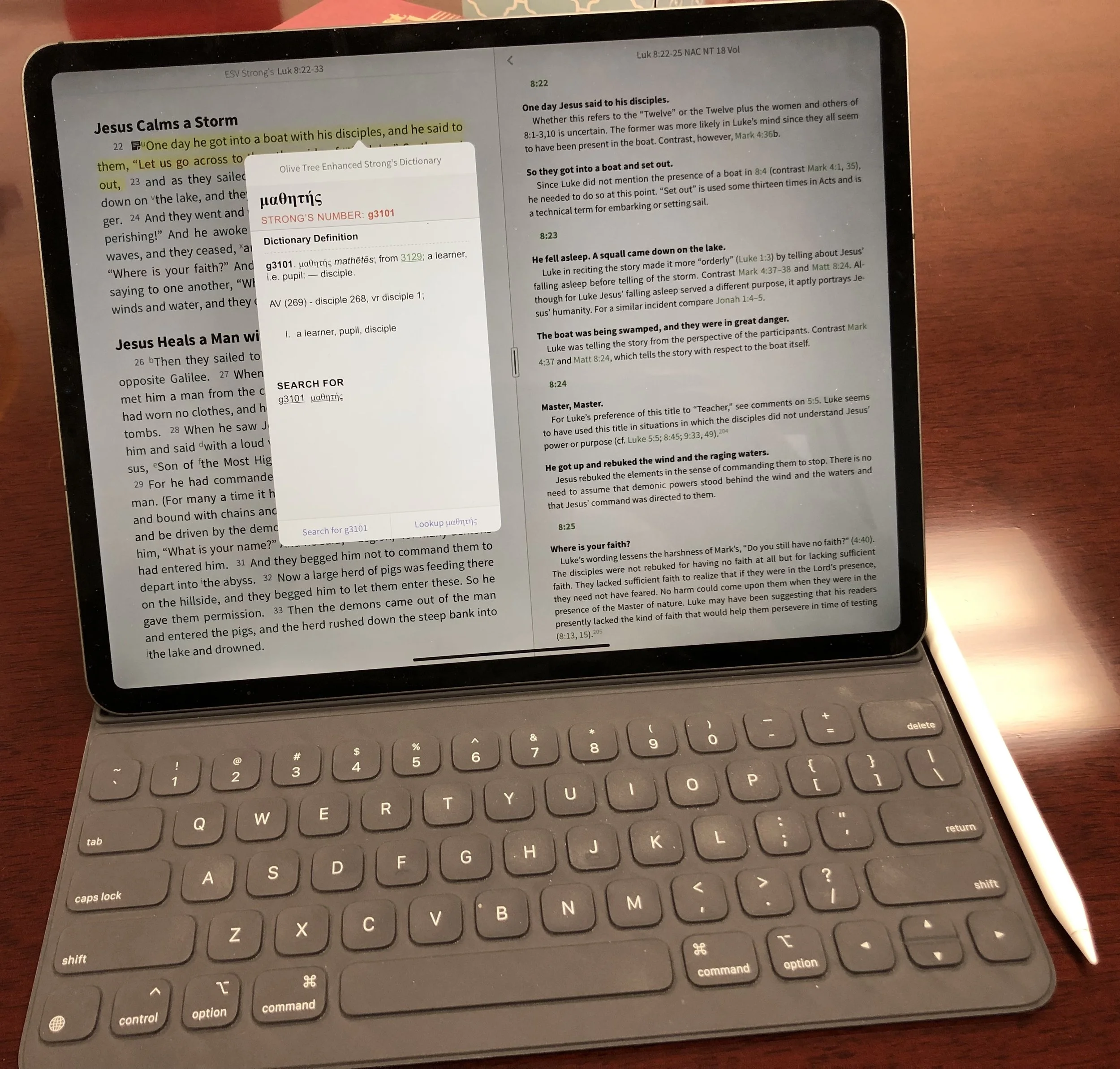
New 2018 Apple iPad Pro for Bible Study
The new 2018 Apple iPad Pro is getting a lot of love from reviewers. How well does it handle Bible study? We’ll look at it from a pastor’s perspective.
The new 2018 Apple iPad Pro is a beautiful piece of hardware and works great for Bible study, sermon prep and general use for pastors and ministers. In fact, I'm really tempted to make it my primary computer for 90% of what I do.
Is the New iPad Pro Better for Bible Study?
Not really! The major difference between the older iPad Pro and the new 2018 Apple iPad Pro comes from the speed and size and the new Pencil. Apple gave it a little facelift to modernize the look.https://youtu.be/HoLs0V8T5AAAn Apple A12X Bionic CPU powers the new 2018 iPad Pro, or as some say it over powers it. That's sounds really cool and gives me memories of Steve Austin, the Bionic Man (see video above) running really slowly as that wonderful music plays behind him. However, there's nothing slow about this chip. I did a review of Olive Tree Bible Study for all the platforms they support. I edited the video on my new 2018 Apple iPad Pro with Luma Fusion, a great video editing app. The video ran about ten minutes and took about a minute to render on the iPad. That's half the time it used to take. It's also faster than Premiere Pro can render a ten minute 1080p video on my 2017 MacBook Pro.In spite of the great speed, the Bible app makers don't exactly require that much power. Few digital Bible students own the new iPad so they can't make their apps to take advantage of the power. However, the faster CPU will help with the initial start-up of apps like Faithlife's Logos Bible app, which does some data crunching in the background after you first start it up.In addition to speed we get a nice looking design with a new keyboard and Apple Pencil. The physical redesign means two things. First, the screen covers more of the front with smaller bezels. That means you'll need to hold it more carefully, however, the accidental touch detection keeps you from accidentally tapping as you hold it and your thumb or fingers accidentally touch the screen. The iPad weighs a little less and takes up less space in your computer bag, if you use one. However, you wont notice that unless you hold them side-by-side. I like that the new Apple Smart Keyboard now covers the back as well as the screen. The screen's beautiful, which makes it a great tool for Bible study. Reading text on a screen for long periods of time requires a high quality screen with great resolution and excellent contrast.
Apple Pencil and Bible Study
 Why won't Bible study creators integrate the Apple Pencil or any stylus in their apps? It would feel so natural to add a handwritten note or highlight with the Pencil. I would love it if the Bible apps would recognize the Apple Pencil and put the app in a special mode where anything the Pencil writes would get saved as a vector drawing attached to the verse or the paragraph with an indicator icon, like they do with text notes now.Developers working at some of the Bible app makers tell me that adding drawing is not a simple thing. Do they spend limited development time on something that a small fraction of the population can take advantage of or on features in great demand that a large percentage of users want? However, I think that the first Bible app maker who figures this out will really stand out and could easily demand a nice premium for this.Until some app maker puts my inking dream into reality, we'll have to use the Pencil as a glorified finger, pointing and selecting. The tip is finer than my man paw fingers. So, I can get more fine pointing with it than I can with my massive digits.
 I love that the Pencil snaps into place on the edge of the iPad Pro when not in use. it also charges wirelessly so that it's always ready to go. The old Pencil would use battery power even while not in use. You had to charge it by plugging into the Lightning port on the bottom/side fo the iPad. This was awkward.I use my iPad for presentations during Bible studies. The Pencil lets me ink on the slides of Bible verses. Sometimes I would plug in my cable to send the video signal over a Lightning to HDMI adapter to our projector. The old Pencil would lose it's connection and if I forgot to plug it in before each Bible study I often had to do without or unplug the video cable, something not ideal while a room of 20-30 people are staring at the screen.The new 2018 iPad Pro and Apple Pencil solves most of these problems. However, carrying it around with the Pencil along the edge makes me nervous. I hit the iPad in just the right way with a hand or my side while carrying it and the iPad goes flying off. Today it landed in a puddle and scared me to death. I can share that a puddle won't destroy the Pencil immediately. We'll see if it has an effects over time.
Writing on the Apple Smart Keyboard
 The new Apple Smart Keyboard is both smaller and heavier at the same time. The old keyboard felt like folding origami at time, especially if you tried to use it as a stand with the keyboard on the back. The new Smart Keyboard's simpler. The special connector sits on the back of the iPad. The new keyboard has two grooves that the long edge of the iPad sit in. This gives the user two angles.
 Since the new 2018 iPad Pro measures less width than the old one, the keyboard does too. However, the keys go edge-to-edge so you still get a comfortably sized keyboard for touch-typing. I can work on it for a long time without problem. The keys give you enough travel to feel nice while typing. I actually type more accurately on my iPad than on my MacBook with its terrible butterfly keyboard.
Conclusion
Using the new 2018 iPad Pro for my work as a pastor is an improvement for a few reasons.
- Smaller size
- Better Apple Pencil
- Nice keyboard
- Excellent display
- Super fast processor
If you own the most recent iPad Pro, then I don't think this thing's enough of an upgrade to make the jump. It is a big change, but can you justify the expense when your "old" iPad will last you for many years to come. I upgraded, but I'm crazy about having the latest greatest.People who own an older iPad or who don't have one now and want and iPad for doing a lot of their work can with this iPad. Here's a few things I enjoy more on my iPad Pro than on another device:
- Editing video
- Typing
- Playing games
- Casual web surfing
- Short stints of reading
- Checking email and social media
However, I'll still prefer my MacBook Pro over my iPad for the following:
- Serious Bible study with desktop class Bible software instead of mobile apps
- Creating slides for my sermons/Bible study presentations
I don't use it for long stints reading. The Kindle Paperwhite works best for reading for extended periods of time. The TV is my choice for watching movies and videos; call me old-fashioned.What would it take to use the iPad Pro 100% of the day? The Bible apps have to get better. Mobile apps do a better job today than they did when I bought my first iPad back in April 2010. I'm not very good at creating my slides on the iPad, but I hope to get there. I could if I was better with using Affinity Photo, which is good enough. But using Adobe Photoshop on my desktop is easy because I have a decade of muscle memory that helps me do things quickly.

Print or Digital Bible App: Which One Is Best?
What kind of Bible should you use? Some believe the traditional print Bible has special value over digital Bibles. While others prefer to use a digital Bible a lot, most or even all the time. I have to admit I fall in the second group and only use my print Bibles on occasion.
Strengths of Print over Digital Bible Apps
Recently Trevin Wax wrote a post for The Gospel Coalition entitled When the Bible Becomes an App. In it he argued for a number of reasons why people should still use a traditional physical print Bible, like the ones Wax’s organization publishes, because of the special value. He says the following strengths means most people should go with this kind of Bible...
- The beautiful format of a high-quality leather Bible shows the value of the words included.
- A small pocket-sized New Testament gives us quick and easy access saying something about the value of the word leading the owner to keep it always on hand.
- A book containing all the books of the Bible tells us that the canon of Scripture and the story’s wholeness in a single book.
- The print edition of the Bible lends itself better to "deep reading" instead of quick, skimming, "surface reading”.
- You lose the “Bible’s geography” meaning the feel for where the books are in the print edition or where the verse is in a book.
- The print edition opens us to the will of God on the page better than the print version.
This is a quick summary of the arguments. You should really read Trevin Wax’s article for your self.
A Rebuttal from a Digital Bible App Maker
Craig Rairdin from Laridian, a Bible app publisher, took exception with Trevin’s articles in a post on the company's blog. He offered a useful point-by-point argument for Digital Bible Apps, like PocketBible from Laridian. Please read it and consider his great points.To summarize, Rairdin says that most of the points above are not strong arguments against digital Bibles, but against certain forms and functions in Bible apps. For example, the argument that the reader can go deaper i print comes from studies saying that using digital print means readers retain less. However, Rairdin points out that other studies say this is so only when the user scrolls the book and not when they use a paginated Bible app. I’m not sure why that would make a difference, but a study said it did.
My Opinion
Both arguments seem convincing. I prefer using a digital Bible app on my phone or sometimes on my tablet for a few reasons.
- Convenience - I always have my phone and it’s small enough to fit in my pocket. Since I can carry my Bible on my phone, I always have access to multiple translations. When one preacher reads from the KJV, I can follow in that version. Another reads from the NIV and I can follow in that translation.
- Weight - Like convenience, I can carry a seminary calibre library in my pocket on my iPhone X. I can’t even conveniently carry two Bibles and a full commentary set plus a Bible dictionary, atlas and Greek or Hebrew lexicons.
- Complexity and Speed - Rairdin pionts out that he can do some advanced Bible study while he’s listening to another speaker teach a lesson or preach a sermon on a passage. I can’t do that on the spot.
The above three arguments are all versions of the same argument. It’s more convenient to follow various translations, do advanced Bible study, and always have my Bible and library with me using a Bible app.I still keep a Bible in the pulpit with me when I teach or preach. It’s a kind of prop, to show the value of the word of God. It also reassures people who do not like the idea of giving up the physical Bible. Plus, if something ever goes wrong, I can always open the Bible to my passage and muddle through my message from memory.What do you prefer? Let me know below and why.
Which Logos Bible App Should I Use on My Phone or Tablet
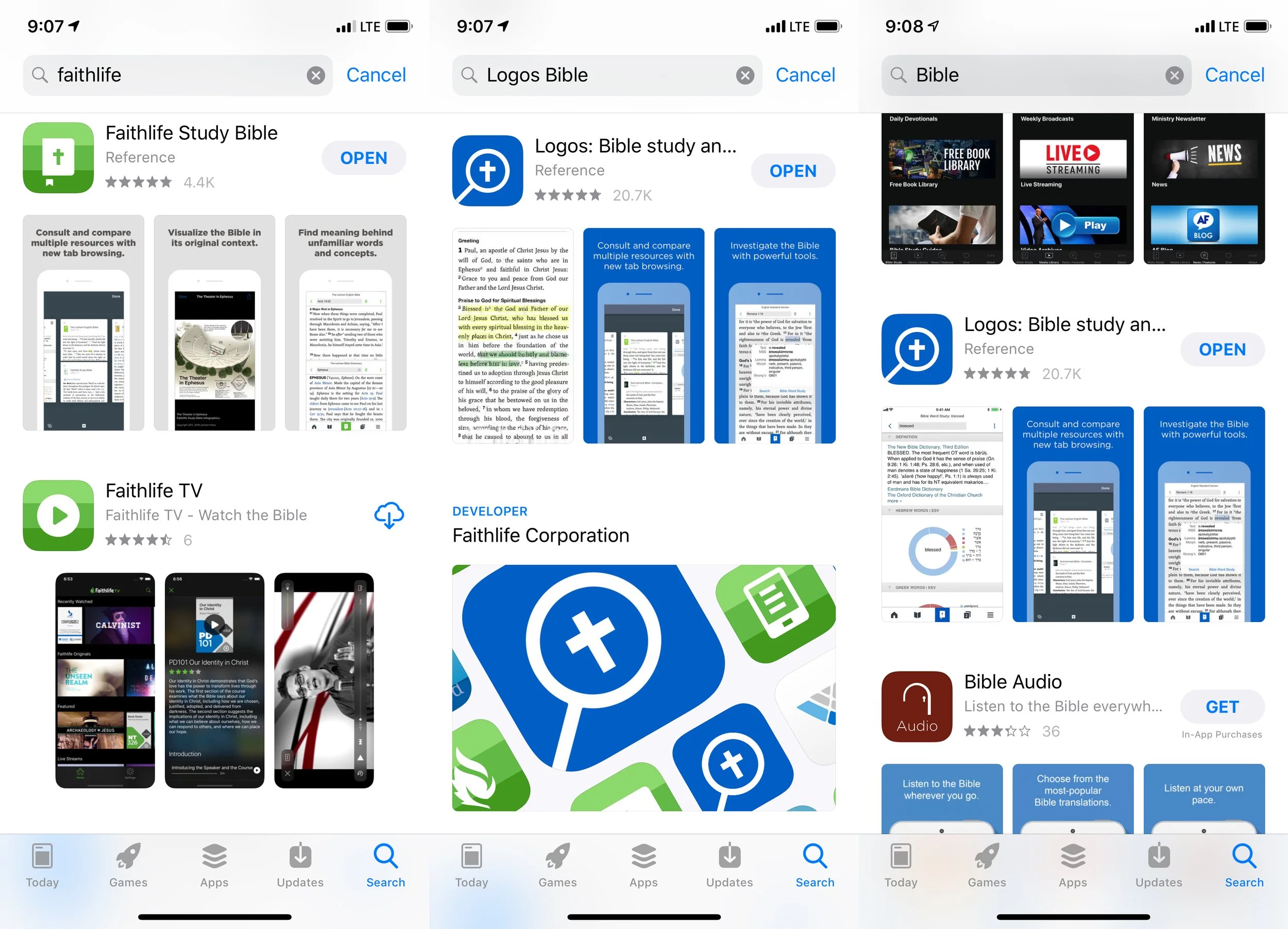
What Logos Bible App should I install on my device? When a new user enters the Apple App Store on their iPhone or iPad or the Google Play Store on their Android phone, tablet or Chromebook, they might search for Logos or Bible or Faithlife, if they know the name of the company that makes Logos. They will discover a handful of apps. Which one should a new user install?

Let's take a look at the various apps and see what each one does for the user. This will help you decide which one to install on your phone, tablet or Chromebook.
Logos Bible Study Apps
First, let's consider that Logos offers more than just Logos Bible Study apps. They also have an app for their Faithlife TV service, their Faithlife social network, and to control their Proclaim worship software presentation. If you're looking for a Bible study app then you don't need to bother with these.
In the screenshot above the heading, notice in the center screenshot there's a section labelled Faithlife Corporation. You'll find this in the Apple App Store on your iPhone or iPad. Tap on it to see all of the company's apps. You'll see on the next screen the list of all their apps. A section of this next screen reads Apps. You'll see the following listed:
- Proclaim Remote - controls the Proclaim worship software by connecting the phone to your computer running the software.
- Faithlife TV - shows videos that Faithlife distributes including training videos that fit in their Mobile Education tools. Think of Mobile Education as online seminary without the accreditation.
- Faithlife Ebooks - this shows books that a user might own. Faithlife sees this as a kind of Kindle for Christian books. You can see all of your commentaries, Bibles, dictionaries and more if you want. Or you can set it up only to show you Christian Ebooks, like the latest from Max Lucado or Charles Stanley or Christian fiction. It's not a serious Bible study app, but useful for reading books.
- Biblia! - Spanish language Bible study app. Serious Bible study for Spanish speakers.
- Verbum Catholic Bible Study - a scholarly approach to Bible study from the Catholic perspective. If you're Catholic and want to do serious Bible study, then this is your app.
- Note Classics Research App - a scholars app focused on classic works for serious scholarly study in original languages and English.
- Bible Screen - seems like it was made primarily for the Apple TV but works on a phone or tablet tool and shows artwork with inspiring Bible quotes. Save them as Wallpapers or share them to social networks. One nice feature: Fits My Device, which lets you choose your phone's screen size or device model.
- Logos Bible Study - the first and primary app for studying the Bible in preparation for sermons, Bible studies or for scholarly and personal study.
- Faithlife Study Bible - think of a study Bible only on your phone. It's the best app for people who just want a good free app for reading and doing personal study on their phone or tablet.
- Faithlife - social network for the mobile device. Take a look at the Faithlife groups you subscribe to on their Faithlife.com website or create a group for your church.
- Flashcards for Greek and Hebrew - does what it sounds like. Great for students learning one or both of the languages.

You'll find the same list of apps in the Google Play Store.
Which App To Use?
Assuming your looking for a Bible study app and can't figure it out from the list and descriptions above, here's my recommendation. This list doesn't include anything buy apps for studying the Bible or book reading.
- Logos Bible Study - most people will want to use this app. However, there are some exceptions to that.
- Faithlife Ebooks - if you just want to read books and not study the Bible, then get the Faithlife Ebooks app. You might want to get both of these first two apps. Use the first for Bible study and the second for reading fiction or Ebooks.
- Faithlife Study Bible - if you don't need to study the Bible for sermon prep, scholarly papers or your just a hardcore Bible nerd, then get the Faithlife Study Bible app. It's also the best app for people who don't want to buy anything. You just want a study Bible on your phone for church and reading.
- Noet or Verbum - get these if you want to study the classics or you're Catholic.
MyWSB Brings Wordsearch Bible Software to the Internet
Wordsearch has a new online Bible study website called MyWSB.com. How good is it and can you use it instead of their mobile apps?
Lifeway updated the MyWSB website for a better online experience for Wordsearch Bible Software customers.
If you use an iPad or another tablet or you own a Chromebook then using Wordsearch Bible Software wasn't possible. They offer a simple book reader for iOS and Android, but it's not enough for most students of the Bible. The MyWSB web app doesn't give us everything found in the Wordsearch 12 program for desktops and laptops. However, it's better than what you get with the iOS or Android mobile apps. They're pretty horrible for anything other than simple book reading.

What's New in MyWSB Wordsearch Online?
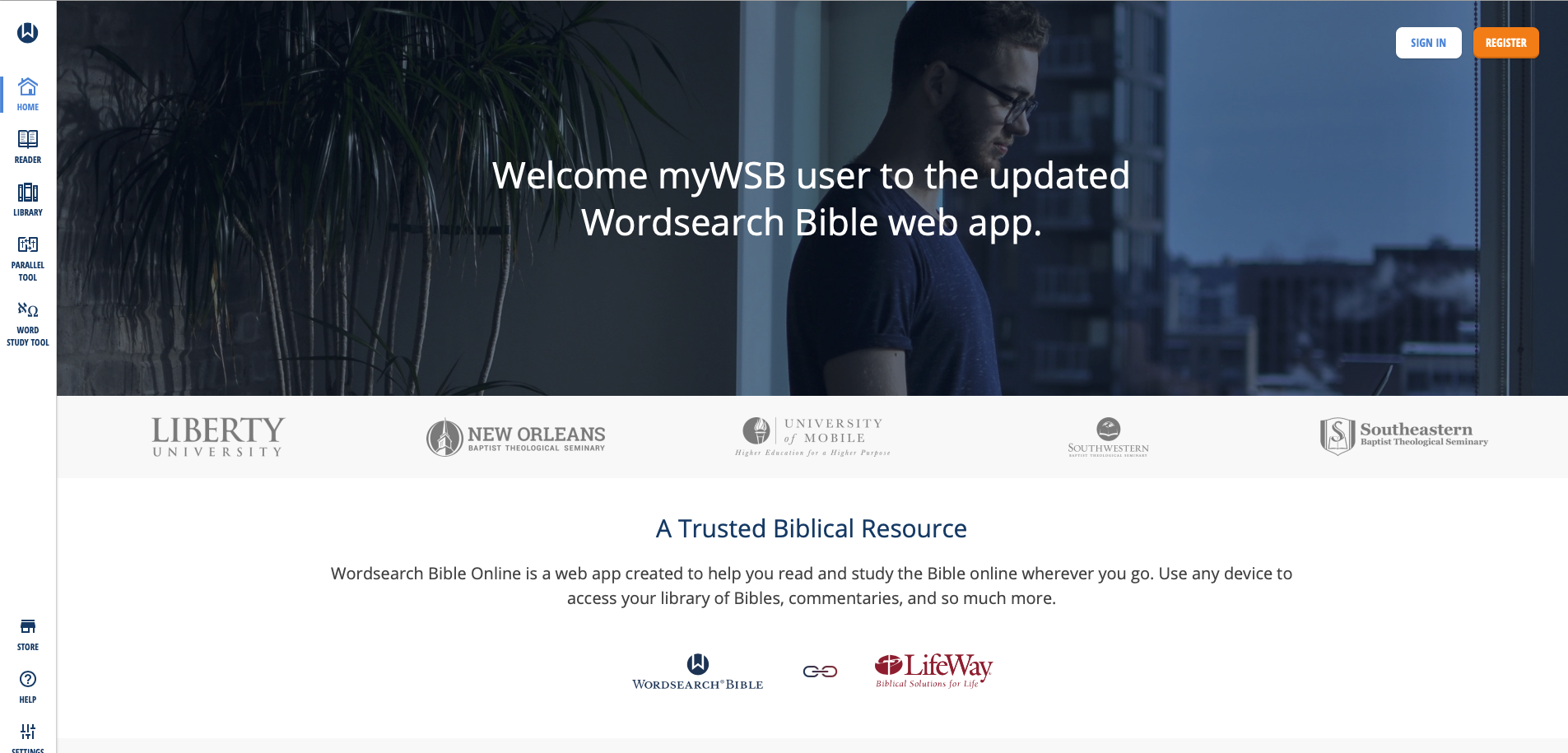
What's new in the online app? Most important, Wordsearch updated the user interface. Take a look at the screen shot above and you'll see the modern look. Sign in and see the home page that offers news about the website. Along the left there's a sidebar of links represented by icons. That's where you access your tools for Bible study.
Here's what each icon does...
- Home - shows the main page seen above.
- Reader - the reader lets users open books and read them with window panes (see more below).
- Library - see all the books in your library with categories of books along the left and cover icons in the main section.
- Parallel Tool - opens a window pane with parallel bibles in the Reader.
- Word Study Tool - opens a Word Study Tool pane in the Reader.
- Store - towards the bottom fo the sidebar we see the Store link where you can find new books to add to your library.
- Help - learn how to use MyWSB.
- Settings - change how the app works.
- Profile - manage the Lifeway account profile details.
The MyWSB Reader

The Reader will display your books in window panes with a toolbar. The toolbar has navigation buttons with back and forward buttons represented by large left and right pointing block arrows. These go back and forward one chapter in the Bible or section in a book. They sit at extreme ends of the toolbar. There's also a thin back arrow button that takes you back to the previous passage displayed. There's a table of contents that shows a list view of the contents of the book. Bibles or books tied to passages also have a menu that shows a grid-based book/chapter/verse chooser menu.

There's also a button to search the book or Bible. The small AA button decreases or increases the size of the book's font. And the full screen button sits to the right of that.
On the top you see name of the book open in that window pane. Left of the name is the book's info button. On the right end of the title bar you'll find a bookmark button, which opens the bookmarks toolbar. The next button returns to the regular toolbar described above. Then there's an X that closes the book.
The user can resize the window panes using the handle seen in the center of the screen in the screen shot seen under the section heading.
If you highlight some text in a Bible or book, a new toolbar appears at the bottom. It gives options to highlight the text, bookmark it, add a user note or copy a link to that verse. The link will take the person who clicks it back to this spot on MyWSB.com.

Regular readers of this page will know I am a Bible study notes afianado. The notes tool in MyWSB are pretty basic. You can type in basic text, add tags and that's it.
Word Study Tool

Some Bibles support Strong's Numbers. These books also have a button to show or hide them inline. Also, some books support displaying the Bible in paragraph or one verse per line. Those books have a button which toggles that method of display. See the NASB95 above with the Bible in verse-per-line mode and with Strong's numbers showing.
The Word Study tool is open on the right. It shows the Strong's concordance entry first. Then we see a section named Dictionary Reference. It has the dictionary entry showing a transliteration of the Hebrew or Greek word, a phonetic pronunciation, and the dictionary definition. You can choose which translation with Strong's tagging you want to use. The drop down is in the toolbar at the top of the Window.
The final section shows the Usage Study section. This lists all the entries of that word in your chosen Bible. Expand each book of the Bible to see the references for that book. The Word Study Tool will show the text of the verses in your chosen translation.
Combining Lifeway and Wordsearch Accounts
The other major change in MyWSB comes in the account backend. Ever since Lifeway bought Wordseach, they've wanted to combine accounts so that users have one single sign-on email and password. Finally, they've achieved that with this update.
In the past users had to link their two accounts. Now, after they link them one time, they will use their Lifeway user account to log into MyWSB.
Better Mobile Browser Support
The website works much better on a mobile browser. I use an iPad Pro for sermon prep and the iOS app doesn't work that well. From now on I'll use the MyWSB app. In fact, I created a website app icon on my iPad home screen.

Add a bookmark to the Home Screen on your iPad by tapping the share button on the Safari toolbar. Find the Add to Home Screen (black box with plus icon in center of the second row above). The Home Screen icon's not very attractive. Lifeway needs to fix that with a better site icon.
My Evaluation & Recommendation
I really like MyWSB.com for online Bible study. Logos really stepped up their game and they offer an excellent tool, but Wordsearch users will find a lot to like about this site. They site is simple to use and has enough features to make it useful. You can do nice Word Studies and general reading. Make sure to check it out.
I'd rank MyWSB second on my list of favorite online Bible study tools ahead of Bible Gateway and below Logos. That's only because I have a large Logos library and it has more advanced Bible study tools. It also syncs with their mobile and desktop programs.
Alternatives to BibleWorks - Shutting Down June 15
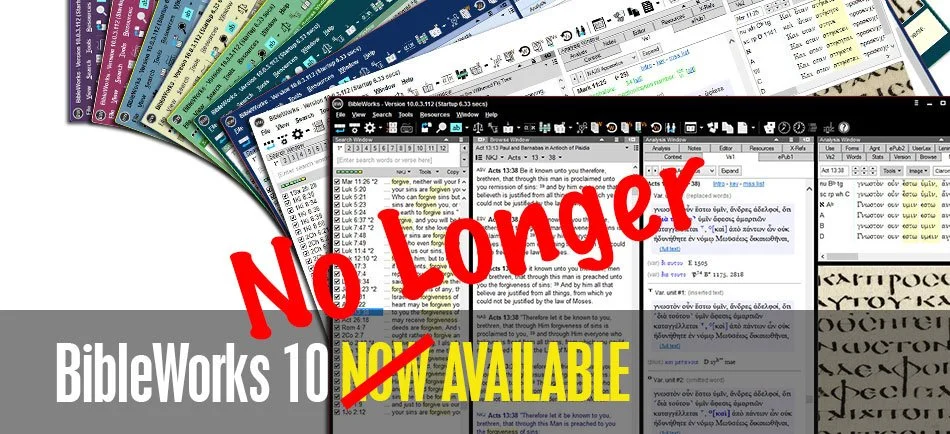
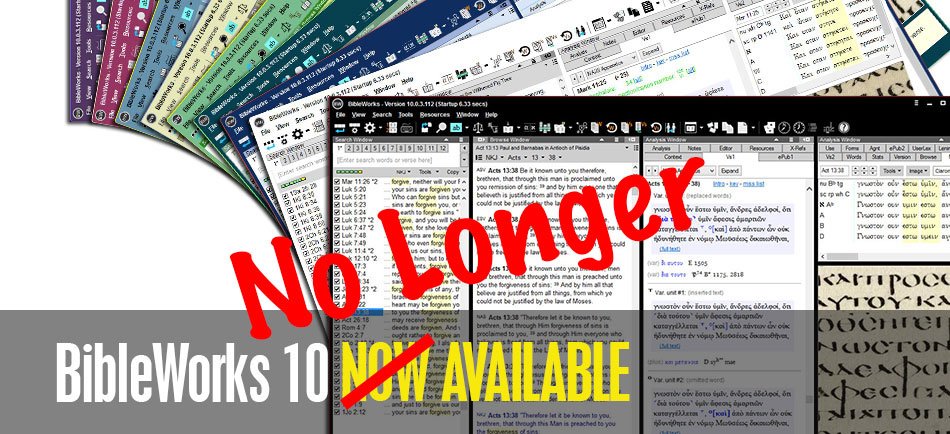
Many BibleWorks users got a shocking email on June 1 from the maker of one of the best original language Digital Bible Study tools on the market today. The email, which you can read on the BibleWorks website, included the following statement from owner Michael Bushell:
A special note to our friendsBibleWorks has been serving the church for 26 years by providing a suite of professional tools aimed at enabling students of the Word to "rightly divide the word of truth". But it has become increasingly apparent over the last few years that the need for our services has diminished to the point where we believe the Lord would have us use our gifts in other ways. Accordingly as of June 15, 2018 BibleWorks will cease operation as a provider of Bible software tools. We make this announcement with sadness, but also with gratitude to God and thankfulness to a multitude of faithful users who have stayed with us for a large part of their adult lives. We know that you will have many questions going forward and we will do our best to answer some of them here.
 We covered the release of Bibleworks 10 with a lot of excitement a few years ago. BibleWorks power user Dan Phillips joined us to demo the new features. He tweeted the morning of the announcement:
This is horrible news: https://t.co/2hWKy2Rw3C
Don't ask me what to do. I have no idea. I've written them. This hits hard. I cannot exaggerate, and you can't imagine, the investment of research and work I have in @BibleWorks.— Dan Phillips (@BibChr) June 1, 2018
I'm sure other long time users of the software feel or will feel the same way when they learn the news. It's a painful reminder that your Bible software may feel like yours, but it's really not. You buy permission to use THEIR software, regardless of what they say. QuickVerse and Pradis and other Bible software owners probably felt as shocked when their chosen company's operations ceased or sold out to another company which then shut down development.So what now? Who knows?BibleWorks said that you can continue to use the software. They hope to "continue to provide compatibility fixes for BibleWorks 10 well into the future." Make sure you get a working copy installed now and download all of your content if you don't already have it. After June 15 you can't get any support for the program. Then plan to keep the forums and their Knowledge Base up after that date, but I wouldn't count on this.If you don't own version 10 already, you will not even get compatibility updates. They say you can update to version 10 for $200, but don't. That's like buying the 2018 model of a car after the manufacturer says their closing down the company.
Alternatives to BibleWorks
So what should you do if you want a program that's functional and comes from a company that should support the software for a long time into the future. Here's my list of recommended alternatives to BibleWorks. The first list includes programs that will do most if not all of what you can do with BibleWorks 10.
- Accordance Bible Software - many used to call Accordance the Mac BibleWorks because of it's power. The company makes a great Windows and iOS version and is working to improve their Android app as well. BibleWorks users who don't want digital commentaries or other books can stick with the basics of language study like they had with BibleWorks. However, you'll now have access to a nice library of other digital books. Get the free version to try it out.
- Logos Bible Software - going from BibleWorks to Logos will feel like an Italian learning to speak Spanish. It's similar but also incredibly different. However, Logos has a huge library of content and BibleWorks users will suddenly have access to large collection of resources. They also will have to pay since Logos often costs more than the competition. Logos sells a subscription model called Faithlife Connect with a large library starting at $108/year. See my series on using Logos for Sermon Prep on YouTube or the Theotek Facebook Page.
https://www.youtube.com/watch?list=PL1-Xf_HZquDGvCiJtyisBrEULSH3McCSO&v=GZTrMB0PnuQ
Lower Price Means Fewer Features
The rest of these offer less expensive alternatives even if they don't match BibleWorks in language study prowess.
- Olive Tree Bible - many BibleWorks users who wanted a good mobile Bible app probably already invested in Olive Tree one of the best mobile Bible apps available on all platforms. They have a nice library of books to buy. They also are better at language study than they used to, but BibleWorks users may feel constrained on the desktop with this option.
- Laridian PocketBible - like Olive Tree, PocketBible has a long history of supporting mobile platforms. It predates the iPhone and Android, but has great apps for both. It also runs on Windows and Mac. They have a smaller library, but the programmer is a pioneer in Bible software and does a great job of updating and making the app run smoothly on every platform. Plus it's one of the cheapest options. However, like Olive Tree users might find the program limited in language study.
- e-Sword - if you don't have any money and just want to start getting into an alternative slowly, then grab e-Sword as a good free interim option.
- WORDsearch - the company just updated to version 12 and I'll have more to say about the program over at ChurchTechToday and on the Theotek Podcast. It's a good simple library reader with a better tool for language study in version 12 than it used to have, but like Olive Tree BibleWorks may feel a little constrained in language study with WORDsearch.
Hold Off and Wait
Another option might be to patiently wait. You can still use BibleWorks 10 for the foreseeable future. Get the free versions of the above tools to try them out. Then wait for sales. I know that a few of the companies are thinking about special deals for BibleWorks users to take advantage of the news.
What Happened?
I don't have any inside information, but I have some opinions.
- Mobile - they company didn't embrace iPhone or Android and this failure to embrace mobile meant Bible software users with limited funds didn't want to buy their books twice, once for BibleWorks and once for a mobile app, like OliveTree.
- Shrinking Bible Software Market - like the church in America, I think interest in Bible software is shrinking. Biblical literacy is at an all time low. Pastors who want Bible software is a niche market and fewer of those pastors will buy a program like BibleWorks due to their failure to offer a mobile app and because of the following reasons...
- No Native Mac App - the company's Mac app is a WINE port. That's not acceptable to a lot of Mac users. I see more and more of my colleagues in ministry using Macs instead of Windows.
- No Library to Speak Of - BibleWorks offers some of the best tools for original language study and searching. However, they offer relatively few resources like commentaries and Christian Living titles. So buyers don't want to buy BibleWorks even if it is superior in original language study if they can get something nearly as good like Accordance or Logos that also offers a these other digital resources all in one package.
- Updates Drive Business - as a consumer I don't really like the business model of putting out a big new update every year since it makes me change the way I work to learn new features, it makes me shell out anywhere from $20 to $200 for an update annually, and it turns the program into bloatware, something Logos and others seem to do. However, like it or not, that makes money for Bible programs. What would you rather get? Annual updates that you can buy or skip or an email about a shutdown from your software company after you invested hundreds or thousands of dollars in over the years?
Logos Sermon Prep Part Five: Taking Notes for Observations and Questions
Logos Bible Software helps preachers and teachers prepare their messages thanks to some useful Logos sermon prep tools, but the Notes feature gets more use than any other feature besides offering a library of Bibles, books and reference books. I use Notes extensively for the following:
- Recording my thoughts about a text.
- Keeping rack of ideas for how to preach a passage.
- Record things learned in research of a text.
- Write down questions I need to research.
I use a process called Inductive Bible Study in my Logos sermon prep, where the student reads the text and thinks about the context of the passage before every consulting third-party tools like lexicons, Bible dictionaries, atlases, concordances and commentaries. Those tools help me check my conclusions, find information I couldn't get from my simple observations and learn about things like cultural backgrounds, geography, and language studies.https://www.youtube.com/watch?v=MzyYMcxTIzc&feature=youtu.be
Taking Notes in Logos Sermon Prep
Bible software notes attach text and more to a specific word, phrase, verse or passage. Some programs will also let you record them as topics unattached to anything in a book. In Logos, you can also add notes to other kinds of books and even to tools, like a Passage Guide generated for a passage of Scripture.I attach notes to the passage I'm studying, a range of verses or a single verse. I almost never attach them to a single word in a verse, but you can if you like.Logos lets users create a new Note document for each message or keep on document for all notes attached to a book or the Bible. If I were starting over today, I'd attach one note to each book of the Bible. Instead I have a large notes document called Bible Notes and record all of my notes in that document. I create other documents for other books I read.
Creating and Using the Notes Document in Logos
 To get started, create a new note document, if you don't already have one you want to use. Open Logos and then click on Documents from the toolbar. Then in the window that pops open click on Notes. A new window opens with the new notes document in it. It has the title "Untitled Notes". Click that name in the new document and it turns into an editable text box. Give it a name like Sermon Notes or Ezekiel Notes. I call mine Bible Notes.The ensuing Notes Document will look like a simple word processor. It has the same control box in the upper left corner that all Logos windows show. Click it to see the menu that pops up. Users can sort their notes using different things like name, reference, and date to name a few. This also lets users print their notes or export the note as a passage list or sermon document.
Purpose of Making Observations
After I read and re-read my passage, I take notes on the passage using nothing but the English text at first. I do my language study at a later date. This has a few benefits.
- My first thoughts are not clouded by the views of another researcher.
- This lets me think through the text for myself with the Holy Spirit's inspiration only at first.
- I am going through my passage again, which helps me to internalize the message of the text.
What kinds of observations do I make? I record thoughts and ideas about almost every word in a verse. Let's take John 3:16 as an example.
John 3:16, CSBFor God loved the world in this way: He gave his one and only Son, so that everyone who believes in him will not perish but have eternal life."For" connects this verse with the previous passage. This tells us why Jesus was "lifted up" (John 3:15).God is the one who actively showed us his love in the work he did in giving us his son.The term "loves" shows this is an ongoing, active love. Is this present tense and from agape?God's love is directed not just at his people or Christians, but the entire world. The world refers to all of humanity making his love universal even if salvation isn't universal.How does he show that love? "In this way" denotes the means of his demonstration is presented in the ensuing phrases.
The above observations only cover the first part of the verse. I will go over the entire verse putting a note for nearly every word and definitely every phrase.The underlined part of the observations shows a question that I will need to find an answer by doing a word study of the word "loved". It's a good idea to mark the questions so you can easily find them in your research phase. When I do the research, I will add the answer either replacing the question with the answer or putting the answer right after the question and then removing the marking (underlining in this case).Finish this step by going through every word or phrase in your passage. I also add a note to the entire passage by selecting the range of verses and choosing adding a single note to all the verses using the steps below. In that passage note I will write about the context of the passage showing how it fits in the chapter, the book and the entirety of the Bible. I'll also give a brief outline fo the passage showing the flow of thought. Later I'll come back to this note and record my passage Big Idea.
Working with Notes Documents in Logos
 When you discover something you want to record in a note, create a new note for that verse, word or passage. You can do this by selecting it and right-clicking it. Then choose either the "selection" or the passage in the right-hand column of the pop-up. Use selection (the top item in the list), which shows the text of the words you selected, if you want to add notes to those words or a word and not to a passage. The note will attach to that translation of the Bible only. For example, I've got the Christian Standard Bible open above. If I open the same passage in the KJV, that note won't show up because it's attached the note to the words I selected in the CSB and note the verse reference.To add the note to a verse reference that will show up in any translation that includes that verse, choose the reference. It will attach the note to say John 3:16 instead of that translation of John 3:16. That way when I close CSB or open KJV the note will still show up.After you pick between selection or the passage, click on Add note, Add note to "Bible Notes" or Add community note.
- Add note - this is a new feature that relates to the new Notes features that Faithlife is adding to Logos. These notes will show up in the desktop, the mobile apps and the Logos Web app. Logos is in transition and the new notes feature will become the default soon. Some users might not see this yet in their installation of Logos. You can convert your old notes to the new version when it ships in the final form. For now, I'd avoid this I you don't use the web app.
- Add note to "Bible Notes" - you will add your note to the Notes Document you created above. Its title will show up instead of "Bible Notes". If your preferred Notes Document doesn't show up in the pop-up, then open the Notes Document first from the Document's menu.
- Add community note - Community Notes are public to all people who use them. You can turn these off or on from the Visual Filters toolbar button in the Bible's window. It looks like three dots arranged in a triangular shape (see below).
 I add all my notes to my "Bible Notes" document and will convert them later when the new notes feature gets launched. I'll write a full review and how to article about the new notes feature when it ships, so keep an eye out here.
Other Ways to Record Thoughts and Research
In addition to a Notes Document, users can record research or thoughts using other kinds of documents in Logos. I don't use these features as much, but other users swear by them and use them more than notes. They include...
- Clippings - select text from a commentary, dictionary or other reference tool while studying your passage and shave it to a Clippings Document. Think of this like note cards that you used to use while researching a paper in college or seminary. Clippings helps copy a bunch of snippets of information from other books. At this phase we're focused on the Bible text only, so it's not the best tool for the Observations phase of inductive Bible study.
- Passage List - keep a list of key passages. You might use this to keep cross references from a search performed on a word in your passage.
- Sermon - write your sermon within Logos and then export it or preach from the document in the mobile version of Logos. You can also convert a Notes Document into a Sermon Document.
- Word List - Like a Passage List, but for Greek or Hebrew words instead of passages. Make a list of every theological term in a passage to help you know what word studies you need to do after you've finished taking notes on the English text.
Logos Sermon Prep Part Four: Text Comparison Tool in Inductive Bible Study
The next step on Logos Bible Software Sermon Prep helps us actually learn what the passage we've selected means by reading it repeatedly using the Text Comparison Tool. We're talking about Inductive Bible Study.
What is Inductive Bible Study?
 The phrase Inductive Bible Study refers to studying the Bible hoping to discover the meaning of the text without any prejudices or preconceived notions brought to the task. Seminary students will remember studying the terms eisogesis and exegesis. We call Inductive Bible study exegesis in scholarly circles. It means studying the text and discovering the meaning based on the words, concepts, setting, writer's intent, audience and context. Eisogesis is the opposite. If a student fails to let the word speak for itself, then they might read into the text what's not really there.A lot of heresy comes from eisogesis or reading into the text what's not there. We take verses out of context or don't study them based on the original author's intent, context, setting or the meanings of terms used that we might misunderstand in our time.Inductive Bible Study leads me to discover what God's saying to me and my audience. That's why it's the best approach to Bible study for Logos Bible Software sermon prep.
Theotek Podcast
https://youtu.be/Jx-PYaR_y0o
Steps of Inductive Bible Study in Logos Sermon Prep
You can do Inductive Bible Study using physical books and a notepad or you can use any competent Bible software. Logos Bible Software helps us study the bible inductively thanks to a number of tools. This part focuses on the Text Comparison Tool. The full list of Inductive Bible Study steps include the following:
- Reading the text repeatedly
- Observing what's in the text without any other tools at first
- Ask good interpretive questions
- Diagram the sentence in Greek, Hebrew or English to see the structure of the author's thoughts
- Find answers to questions and check the accuracy of our observations using the tools in Logos Bible Software
- Discover the Big Idea of the text
We started the process with selecting a text covered in three steps (first, second and third steps). Now, it's time to read it repeatedly and we'll show you how using Logos.
Read the Text Repeatedly
We're going to work with Ephesians 1:3-14 as our text. I'm teaching through the passage during my Wednesday night Bible study at church. We already talked about multiple tools and ways to choose the text, so for this step, we'll assume that's a good text to choose, especially since it's one long sentence in Greek.Start by opening your favorite translation and prayerfully read though it in your favorite translation. I say "prayerfully" because you should begin by asking the Holy Spirit to guide your study.You should probably also read the text in context.
- Read the entire chapter.
- Read the whole book if it's not too long - Paul's letters, the Pastoral Epistles, shorter prophetic books.
- Read sections in longer books like the chapters before and after at least.
Use Multiple Translations
 Read the passage itself in a few translations. I always use ...
- Christian Standard Bible - This is my favorite translation. Below I'll explain the value of various translations. I like the CSB because translators targeted a readable translations that's as close to word-for-word without sounding too wooden.
- English Standard Version - A slightly more literal translation that is also very readable.
- King James Version - The standard that most people grew up with in my church and is often the most recognizable translation for popular passages. It's more literal.
- New American Standard Bible - A very literal and highly accurate modern translation. I prefer the 1995 update.
- New International Version - Not a paraphrase, but the translators focused more on readability than literal translation. I prefer the 1984 version.
- New Living Translation - The old Living Bible was a paraphrase, but they updated it in the 1990s and went for more of a translation. However, it is the least literal of these translations with a thought-for-thought approach.
The Range of Translations from Literal to Readable
If you think of translations or paraphrases as sitting on a spectrum, then put the original Greek or Hebrew text to the left of the range. Translation that sit closer to the Greek or Hebrew text show up on the left. We call these "word-for-word" translation. Above, I mentioned that I use the KJV and the NASB in my reading to get this more literal look at the text in English.On the opposite end of the spectrum you find the paraphrases, like the Living Bible, the Good News Bible, The Message or the Amplified Bible. We call these "thought for thought" translations. We use these translations almost like commentaries. They helps us get an idea of what the passage means, even though they don't show us the word-for-word translation of the text.Most modern translations sit closer to the middle of the spectrum between literal and non-literal. Translators like to use the word dynamic or dynamic equivalent. That's a marketing term that makes the ESV, the NIV, and the CSB sound like they're equivalent. They're not as literal as the KJV or NASB, but not as interpretive as a paraphrase like the Living Bible or The Message. See this spectrum for many translations in the image below. The Eccentric Fundamentalist offered this nice graphic, which illustrates where the various translations sit on the spectrum. I don't endorse all that the author says about the translations, but I really like the graphic shown above.
The Text Comparison Tool
How do we read the passage repeatedly using Logos Bible Software tools? You could open the passage in about five or six translations and read them. However, we can do better than that using a tool called the Text Comparison Tool. Before we do, let me suggest setting up a Layout as follows. First, start with a blank layout. Click on the Close all panels button (see above). It looks like a small X inside a circle between the Layouts button and the question mark help button on the right end of the Logos Bible Software toolbar.
 Next, open the Text Comparison Tool from the Tools menu. You now see a screen that shows your top five Bible translations in vertical columns. To change what you see in the columns, click on the hyperlink in that window's toolbar just right of the reference box. A drop down menu appears.
- Type in the text reference in the reference box.
- Click on the hyperlink next to the Text Comparison Tool window. A drop down menu like the one above appears.
- Type in your translation abbreviation.
- Click the box to put a check mark in it when it appears at the bottom of the drop down menu.
- Repeat this until you have all of your chosen translations in the Text Comparison Tool's toolbar above the drop down.
You will see a window with all of your chosen translations in the order you added them. You can now read through each column. However, you might want to see the differences between the various translations. To do that quickly, Logos gives you three options in the Text Comparison Tool.
- Show differences - toggles whether to show or hide differences between the various text compared to the base text (left most translation).
- Show base text - toggles between showing the wording of the base text next to the text of each translation or just show a red circle next to the words that are different from the base text.
- Shows the comparison in either columns or as interlinear. You must certain translations as your base text for this to work. For example, the KJV works fine as seen below, but the Young's Literal doesn't.
 The above shows the Interlinear style Text Comparison Tool. It has the Show differences turned on. Without the Show differences, you'd only see the text without the base text showing up next to the wording that's changed in each row.
 Notice how there's a little red dot next some of the words in the NASB95 column above. This denotes a difference between this translations and the KJV1900 base text.
 In the image above we see the texts in column style. I turned on the Show differences toggle and it puts the words of the base text (KJV1900) next to the words in the NASB95 with a line through them. As an example, in verse 3 we see the word "
hath" with the line through it next to "has" in the NASB95 column.
Save a Layout in Logos
 Now that we have the Text Comparison Tool set up the way we want it, let's add our favorite translations and a Notes document window. Arrange the Text comparison Tool the way you want it. I have it across the bottom half of the screen. Open your favorite Bible. Then open a Notes document. You will use the notes document to record any observations you make you as reread the text repeatedly in your various Bibles.To open a Bible, click the library button and then search for your translation by typing in the abbreviation. Click the title of the translation when it shows up and it will open. If you already have a preferred Notes document, open it from the Documents button on the toolbar. Type the name run the search box. Then click on the title to open it. Now arrange the Bible and the notes document the way you want. You can create a new one for each sermon or for all of your notes in a book of the Bible, the New Testament in general or for the whole Bible. I don't recommend the last one. Your document will get too big.
 We'll save the layout. Click on the Layouts button on the top right of the Logos Bible Software toolbar. In the drop down window, click on Save as named layout. A box opens right there. Type your name and hit Enter.From now on your can open this layout by clicking the Layout button on the toolbar. Then click the Saved Layouts in the column on the left. A list will pop up. Click on the name of the layout you saved in the step above.Now read through the text in each column. If you want, record your thoughts about the differences between the translations by create a note on each verse, for a single word, or for the entire passage. I do this by right-clicking the verse in my favorite Bible. A menu pops up. Select the verse reference in the right column of the pop up menu. Then select Add a note to "your notes document". A new note will show up in the notes document window. Start typing in it.
Next Steps
In our next few parts to this series, we'll look at recording observations in a notes document. You already started this as you reread the text. Then we'll look at questions that the text might present. You'll record those too and start to look for answers in the phase after our inductive study. In the last part of the inductive study, we'll create diagram or outline of the text.
Laridian PocketBible for Mac 1.3 Update Released
Laridian PocketBible for Mac version 1.3 hit this week with a few new features for users of the deceptively simple yet powerful Bibles study tool. One notable feature includes support for Laridian's latest Bibles that display text in a more useful way. This includes one example, mentioned in an email from Craig Rairdin, Laridian's CEO and chief programmer. The NIV with Goodrick-Kohlenberger Numbers will not support Laridian PocketBible for Mac.
How to Install Laridian PocketBible for Mac 1.3 Update
To get this free update you only need to select Check for Updates in the Laridian PocketBible for Mac menu at the top left of the Mac menu bar (see below). The download will install bringing your copy up to vision 1.3.
 If you own a copy of Laridian PocketBible for Mac but don't already have it installed, then go to the company's website and log in. Click on Download from the top of the website or click on the link labelled Mac OS X along the right side under Download Our FREE PocketBible App! as seen above. This puts a DMG file most likely in your Downloads folder. Double click it and then drag the PocketBible icon into the Applications folder seen in that window that pops up when you download the DMG file.
How to Install Books on Laridian PocketBible for Mac
You will need to register the program after you open it for the first time. MacOS may give you a warning before it opens the newly installed PocketBible for Mac, but it's save to let it open. Then register by typing in your email and password. If you're installing this for the first time not your Mac, then click on the Books (#1 above) menu at the top next to the PocketBible menu on the left side. Then click on Cloud Library or if you prefer use the keyboard combo CMD+L. This opens the screen that lets you install books. You can install all books by clicking the Download All Books (#2 above) button on the lower left of the window. You can help yourself to find only new books by click on Hide books already downloaded (#3 above).Aside from supporting new Laridian Bible formats, they also fixed some minor bugs. There was something they called "wiggling" that happened when you moved to a new verse. Text would "wiggle". I've not seen this, but I'll take Mr. Rairdin's word for it that he fixed it since I don't see it in v. 1.3.
Lairdian PocketBible for Mac Advanced Feature Set Updates
If you own the Advanced Feature Set, then you can hover over a Bible reference and your settings will let you either show or hide the footnotes in a pop up window. You can add the set from the PocketBible menu. The Advanced Feature Set costs $9.99/year on Mac only and $17.99/year for all platforms. Some of the benefits of the Advanced Features Set include (copied from Laridian's website):
- Searching enhancements - search your entire library in one operation (normal search applies only to the active book).
- Note-taking enhancements - create Journal Notes that are not connected to any Bible verse or reference book. Will sync with other versions of PocketBible that have this feature (currently iOS).
- Automatic Study Options
- A Library Navigator shows you everywhere in your library that the current Bible verse is discussed.
- Automatically produce an in-depth study of any verse using all (or selected) books in your library.
- Automatically produce an in-depth study of any word using all (or selected) books in your library.
- Automatically produce a document containing today's (or any day's) Bible readings using one or more devotionals and one or more Bibles from your library.
- Hover over Bible links in books to quickly read the verse from your preferred Bible.
- Highlighting Enhancements
- Rename your highlight colors to be more relevant to the purpose of the color.
- Speech Synthesis Enhancements
- Uses built-in OS X speech synthesis to read a selected passage, read the linked-to Bible verses, or start reading until it is told to stop.
- Choose custom voices and speaking rates for English books, Spanish books, and the Greek New Testament.
- Layout Enhancements
- Create multiple, named screen layouts for different purposes (for example, one for devotional reading, one for lesson preparation, and one for note-taking during sermons).
- Create a special layout for devotional reading that will be activated when the Today button is pressed.
- Maximize a book to use the entire PocketBible Window.
- Maximize a pane to use the entire PocketBible Window.
- Miscellaneous
- Control Special Offer notifications telling you about recent discount offers for which you have been made eligible.
- The Study Panel uses a small toolbar instead of text tabs.
Logos Bible Software Sermon Prep Part Three: Concordance Tool
We've already looked twice at the topic of choosing a text, but let me take a third swing at a tool that you should consider using for Logos Bible Software Sermon Prep. We'll take a look at the Concordance Tool in this third part of the series. I began looking at picking topics and picking passages in parts one and two. Now, how can the Concordance Tool help us in choosing passages to preach or teach.Here's the secret of this powerful tool...
The Concordance Tool Video
My video below shows the basics of the Concordance Tool in Logos 7. https://www.youtube.com/watch?v=asQzvrTeMc4&feature=youtu.be
Benefits of the Concordance Tool in Logos
You may need to put away the old idea of a concordance while still using the principles to figure out what it does. The Concordance Tool, like a traditional Concordance, lists every word in a Bible translation, but here's the cool part of the Logos 7 Concordance Tool. You can change the list based on your own limitations and even use it to create a "concordance" for books other than Bibles. I used to own a hefty NASB Exhaustive Concordance (see above), since that was my favorite translation when I began preaching. I stopped using the huge physical book because Bible software is an exhaustive concordance by itself and its far more convenient than a 5 pound book. So why do we need a tool in Logos or any other program that calls itself a "concordance tool"?First, the Concordance Tool is customizable. I'll show you how to do that below or watch my video demo above.Second, users can create lists of Greek or Hebrew words even in an English Bible if. The tool uses the Strong's tags to do this.Third, you can also index more than just the English words of a Bible translation. It creates lists of other things like lemmas, roots of words, and Biblical entities like people, places and Biblical things. You can even search for references which are tags that link to other books, like a Bible reference in a footnote or in a Concordance or maybe even in a Christian Living book, like something by a popular author.The benefits listed here means the Concordance Tool helps us with picking a passage to preach because we can choose to teach or preach on a particular topic by opening the tool and searching for the most often used words in a book of the Bible. Let's say I want to focus on the idea of redemption, but I don't want to do a topical study of redemption. I want to select a series of passages that focus on the idea or subject of redemption. I could just search for redemption in the Logos search tool. But if I open the Concordance Tool, I can learn one particular author repeatedly discusses redemption.
How to Use the Concordance Tool in Logos
To get started open the Concordance Tool in Logos from the Tools menu. You'll find it in the second column under Reference. Click it to open it. The tool shows the last report generated or runs one if you haven't already used it.
 At the top of the window you'll see the book control drop down that usually shows the cover of the book with a small down arrow to the lower right corner. Click it and you'll see controls like the text size slider, the Find command, print, and the Close command among others.Next to the book control menu you'll see a link that shows the present book or Bible translation (see below). Click that Resource Reference link to change it. The Resource Reference search box shows up with a list of all library resources that you can use to run a Concordance Tool report. You can use a Bible in English or Greek/Hebrew. You can also run a Concordance Tool report on other books like commentaries or books by a single author. This results in an index of all the words in that book, if you do a Word report. More eon that below.
 Let's say you want to work in the NASB 1995 Update. Then, either find the book in the list or type in NASB in the search box and it will show all books with your search string in the title. Click to open the Concordance Tool using the book.
 Next you'll see what to index with the Concordance Tool. Click on the second link over (see above) to create an index. You can create one using one of the following:
- Word - the basic tool that works like a traditional concordance.
- Lemma - finds lemmas instead of words
- Root - finds roots instead of words or lemmas
- Sense - finds senses instead of the above
- Biblical Entity - finds persons, places, things, artifacts or measurements
- Reference - finds reference links
The last link lets the user narrow the search range. For example, in the screen shots here I've run the tool on the NASB 95 Update translation. So, when I click the last link it offers to let me narrow the range from All Passages to just ports of the Bible. You can pick your most recent passage selections or the common ones found in Logos. You can also create a new one by typing in the range at the box below the list labelled New reference range. If you plan to use that range again, give it a name in the Title box below the range box and then click the Save button. It will now show up in the list above the boxes.Along the left there's box that lets the user limit their Concordance Tool index. It's called the REFINE box or section. This changes dynamically based on what you've selected in the three drop down boxes at the top. For example, the index below shows the NASB95 Update with a Word index of All Passages.
 Along the left you can refine the search by omitting things, choosing certain languages only and searching in only parts of the text. So let's do an index of only English by clicking on English. Then only index the Words of Christ and only the Gospels (from the top).
Using Concordance Tool on Commentaries
You can use the Concordance Tool in a commentary on a book to find out what the commentary author seems to think is the most discussed topic. Run an index on a commentary on a particular book of the Bible. Then refine the search using the Refine box on the left. The index Logos creates will show what words the commentary uses most. Look for key theological terms to help you see what that commentary author focused on in that book. This can help you find passage in that book that cover that topic.The index above shows that I ran the tool on a commentary on Matthew. I refined the search to show English only and then limited it also to Heading Text. This shows that there are 6 headings in this commentary that talk about healing. A good sermon or Bible study series might be the healing stories in Matthew. We also see 4 headings with the word Blind in it. Could you do a topical study on Jesus giving sight to the Blind? Those are a couple of ideas.Use this same technique with any book in your library. This will help you find illustrations too. We'll cover that more when we get to the topic of adding illustrations to our sermons and Bible studies.
How This Helps Find Texts to Preach
So why would I use the Concordance Tool for helping find passages to teach or preach?The resulting index (see screen show above) shows the words or word groups (take a look at the second hit, a word group) that show up most in our refined search. If you click on the arrow next to a word, then you'll see a list of the passages that include that word or word group. The image above shows the list under "come comes; coming" which is the fourth most used word/word group in this refined index. So maybe, you'd want to do a sermon series on Jesus is Coming and select passage about why he came, when he might be coming back or what he said about his second coming.Drop down a few and you'll see the word group "go going" which you can also do a similar series but on why we should go or how Jesus wants disciples to go on his behalf.
Logos Bible Software Sermon Prep Part Two: Choosing a Text to Preach
Many preachers prefer to preach a topic found in multiple texts that the preacher expounds during a single sermon. I prefer to look for a single Bible text and that one text will dominate the sermon. In this second part of our series on Logos Bible Software Sermon Prep, we'll look at how the program can help the preacher choose a text to preach an expository sermon. The first part focused on using Logos to find a good sermon subject, for Topical Preaching or Topical Textual Preaching.This method of preaching will dominate the rest of our sermon prep series.
UPDATED: I added the Lectionary Tool at the end of this post.
What is Expository Preaching
I don't have the space look at the benefits of expository preaching versus topical preaching. Check out Lifeway's helpful list of 9 Benefits of Expository Preaching by Tony Merida. However, let me quickly define what I mean by this. Expository preaching includes the following:
- One single text dominates sermon's content.
- The main message comes out of the text. Some call this the Big Idea, as Haddon Robinson did in Biblical Preaching.
- The text will also dominate the tone and style of preaching. Poetry should have a poetic feel while narrative should include the story as a primary part of the sermon. Positive tone should not result in a harsh sermon.
- The preacher will explain, illustrate, prove and apply the Big Idea of the text while preaching that text.
What Kind of Text Are You Looking For?
Your expository preaching can include the following:
- A single passage or pericope of scripture, like my sermon this week on John 13:31-35.
- Part of a book like The Sermon on the Mount or Jesus' Farewell Discourse in John.
- A full book of the Bible like John's Epistles.
I've preached through all three taking anywhere from a single message to multiple years. This week I'm preaching on John 13:31-35 but I'm not preaching through John or through one section like the Farewell Discourse of Jesus in John's Gospel. I've preached through the Sermon on the Mount, but not through the book of Matthew ... yet. And last year I preached through John's letters. All of the above sermons or series of sermons were expository sermons and my Logos Bible Software sermon prep benefitted from the tools explained below.https://www.youtube.com/watch?v=MV9Viuw_xgc&feature=youtu.be
Tools for Finding a Text in Logos Bible Software Sermon Prep
Logos Bible Software sermon prep will use a number of tools to help you choose a single text or a longer part of a book or a full book of the Bible. In our earlier post we looked at finding a topic to preach. Topical preaching isn't my favorite way to preach. I don't go so far as some to say it's sinful or evil. However, we should use it sparingly.You can use the same tools used in the earlier post to find a single passage for your expository sermon instead of using them to find proof texts for a topical sermon with multiple texts. So head over to that post and use those steps for finding a single text on a particular topic.To find a text for an expository sermon, you can just start reading the Bible and get inspired by what you've read. Or you can hear someone quote a passage or read a book that refers to one. However, you pick that single passage you'll want to start reading it.
One Bible
 My first step is narrowing the text (choosing where to begin and end my sermon). I start by reading the text in context multiple times. In your Logos Bible Software sermon prep process, open your favorite translation. Go to your library by clicking the library button, second from the left next to the home button on the toolbar. Or click in the command box and type Go to John 13:31-35 or whatever your chosen text might be. Read the text in context as follows:
- Narrative - read the story and read those passages before and after.
- Poetry - find the beginning and end of the poem and if it's in context of another genre then read the parts before and after. Psalms are a single unit of text by themselves so just read the chapter.
- Proverbs - read the chapter and decide if your Proverb is part of a collection of Proverbs about a subject, then pay attention to the other Proverbs about this topic. If it's not part of a section of Proverbs on a single topic, then read your single Proverb (note some Proverbs might include multiple verses).
- Didactic - teaching passages like the epistles require us to find the letter's overall argument and then look for this particular part of the argument to find how your text fits in the overall argument. This overall argument might include the entire book or a large section of the book, like Romans 1-11 or Ephesians 1-3.
- Prophetic - find the overall prophecy, often in poetic genre and other times as part of a narrative. One prophetic message will become one preaching text.
- Legal - read laws in context of their overall application, like laws about the priesthood in Leviticus or the feast days, etc. and choose your text-based on this overall section.
You can do this in any software. Logos doesn't do it better or worse than any other program. You can even do it in a paper Bible (shudder to imagine it).
Passage Analysis Tool
Checking out multiple translations can help you decide what verses to include in your passage. Logos Bible Software Sermon Prep will benefit from the Passage Analysis Tool. Go to Tools and click on Passage Analysis. Type your passage into the command box in the upper left corner. It will visually show the boundaries of the various pericopes in your top translations. Next to the command box you'll see a drop down box that reads "Pericope Sets". Click it to choose your translations by putting a check in the check box of your preferred translations. If you own too many books with pericopes, you may need to scroll to show them all. (What is a pericope?) After you finish choosing your translations, they will show up in columns in order of your rankings. Along the left you'll see links to the text that you can click to open your preferred Bible to that verse.The columns will show boxes that represent a pericope. For example, in the image above, notice that the ESV (dark blue column on left) has more pericopes than the NLT (green column third from the right above). Click on a pericope box and it opens in your top translation, but not that specific translation that you clicked. I'd expect it to open in that translation, but it doesn't for some reason.How does this help in choosing your text? You can see how all the various translation teams chose to break up the pericopes. They often vary wildly as in our chosen passage in John 13 above. The ESV, HCSB, NKJV, NRSV and UBS4 all agree that John 13:31-35 forms a single unit or pericope. However, the NASB, NIV 1984, and NLT all include John 13:31-38. If you scroll up you'll see that all but the NASB 1995 agree that the pericope begins with verse 31 (see below)..
 The two steps above should help you find a single pericope. You can probably preach single sermon on that passage. Or it may take too long to preach in a single message and you decide to break it up into a series covered over a few weeks.
Sermon Starter Guide
If you're still struggling to choose which verse to include in your expository sermon in your Logos Bible Software Sermon Prep work, then consider firing up the Sermon Starter Guide. Thanks to Graham Criddle in the Logos forums for this suggestion. You'll find it under Tools in the menu. Click on Sermon Starter Guide from the list along the left of the box that pops up. This opens the guide to the passage in your open Bible. You can type in your text and run the guide.
 For this step, we'll focus on three sections of the Sermon Starter Guide. Look at the Sermons, Sermon Outlines and Outlines sections. Under each you can see how other preachers or scholars have divided the passage and preached it or handled it in a commentary. You'll have to own books that include these three kinds of information. Open them and read over them to see what these other preachers chose as their text.At this early state, be careful to use these tools only as a guide for picking your sermon text. Don't read too much of the content because it might push you in the wrong direction and keep you from discovering your own Big Idea or sermon thesis.
What's Next
Now that you've looked at the text in multiple translations, checked out the Passage Analysis Tool and looked over the Sermon Starter Guide, it's time to pick the beginning and ending of the text.You'll want to consider another issue. How much can you cove run the time given. I preach in a traditional Baptist Church and the people typically expect about a 25 to 35 minutes sermon. I can stretch that to 45 on occasion. On Wednesday evening we have an hour and prayer requests take up about ten minutes, so I can easily go 50 minutes since it's a discussion time and not just my lecture.Choose the first and last verses and stick with your choice. Prayer will also help throughout the process, before, during and after you preach.
Pick a Book or Longer Passage to Preach
The above steps help preachers pick a passage for a single sermon. How do we find passages or books to preach in our Logos Bible Software sermon prep? Use the topical search steps from part one of this series and look at the context of the passages that you discover. You may find that an entire section will make up a good sermon series through a chapter of the Bible. For example, let's say you searched for a passage on prayer. You opened the Sermon Starter Guide and typed in Prayer. It returned the Lexham Theological Workbook. You opened it and found John 15:7. After reading the passage, you decide that you want to cover the entire topic of John 15 on remaining in Jesus. Or maybe you see a group of Psalms and so you decide to pick a few of them to preach through Psalms on Prayer.
 Maybe you like to preach through books of the Bible. Search for some topics that you're concerned about in your church. Use the following steps to search through your commentaries. If you don't already have a Logos Collection that includes your commentaries, create one using the steps in the company's helpful Logos Pro Training on the topic.Open the Logos Search feature from the search button on the toolbar. Choose a Basic search and then click the link labeled Everything, Type the name of your new Collection the box that pops up. Click it from the list that shows up below the search box. Now click in the Search box and type the topic. You'll find commentaries that include that word. Focus on the Introduction sections of the commentaries. You may find that a book fo the Bible talks a lot about a topic. Consider preaching through one of those books based on this search method.
Logos Lectionary Tools
I neglected to include the Lectionary Tool in the original version of this article because I'm not a lectionary preacher. However, many users will want to use it.Even if you're not someone who follows it regularly, it can offer some suggestions for preaching passages when you're not coming up with any ideas using the above tools or when a topical search (from part one) doesn't help. The lectionary follows the church calendar, so it's a good way to keep in step with the rest of Christendom. Logos includes various lectionaries and you can add them to your Home Page. I've done that and you can see it in the upper left corner. Edit your Home Page by clicking on the tiny gear icon in the upper right corner next to your name.
 This opens a new window that pops up. See it below. Along the left there's a list of things you can include on the left column of the Home Page. The list on the right of the pop up will show items to include I the main section of the Home Page.
 For the purpose of this article, notice the various lectionaries included. I have my mouse over the Revised Common Lectionary, one of the more popular lectionaries used today. I have the Christian Worship Three Year Lectionary selected. You can choose more than one or just your favorite by putting a check mark in the box next to the name.Now that you've selected your favorite lectionary or multiple lectionaries, click outside the pop up box to close it. The Home Page will refresh to update to the new settings. The lectionary will show up in the upper left. Click on the verse to open a new desktop Layout. You can also open this using the Layouts menu item from the toolbar. Click on Layouts. Make sure the Home Page Layouts section is open in the Layouts pop up. Then choose Lectionary.
 The Layout will open your Lectionary on the left to that entry. In the center you'll get two window panes. The top pane has your top 5 Bibles listed in the Library prioritization list in their own tabs. The bottom pane opens your top Commentary that includes that verse in one pane and your top devotional in the other pane showing the date of that lectionary entry.The smaller column on the right shows two panes. The top will do a search to find books in your library that include references to the passage from the lectionary. The bottom pane shows a Bible Explorer Tool window open to that passage. The Explorer gives you things like Biblical People, Places, Events, Thing and Media. You'll also see sections for your content, cross references and commentaries for that passage.If you're a lectionary preacher, then you likely already know that you can preach on one of the passages or include more than one. When I have used the lectionary to pick a passage, I just read them all and choose one that I want to preach.
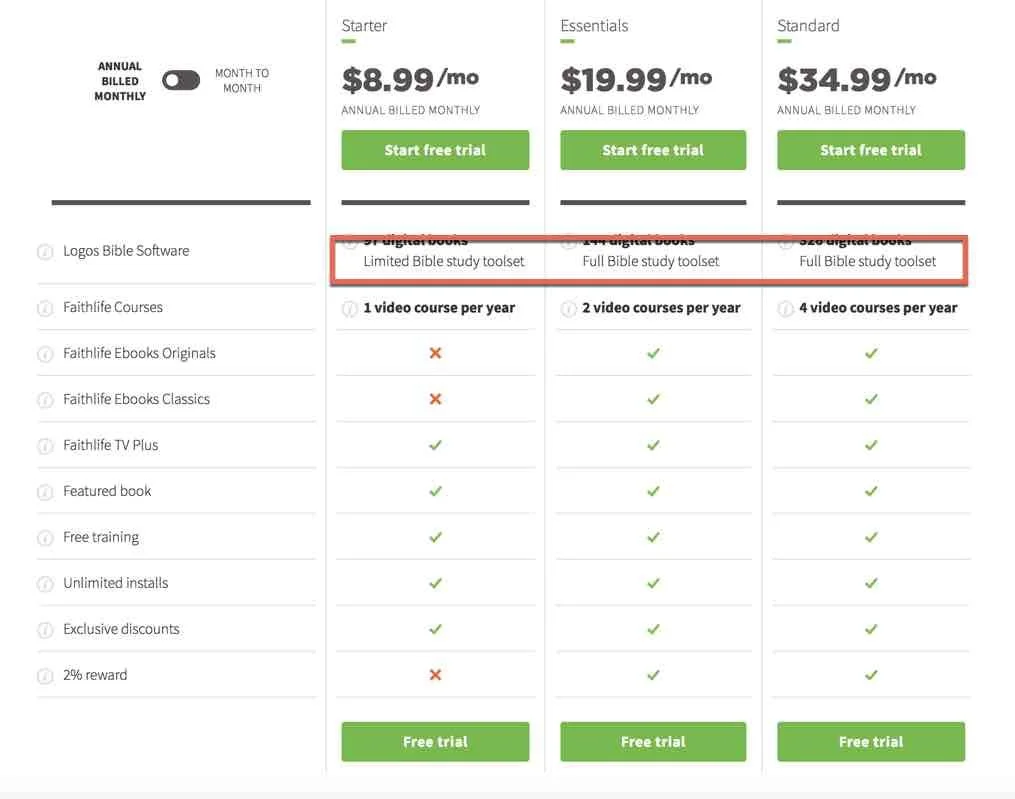
Logos Hears Outcry & Reneges on Shelving Logos Now, Mostly
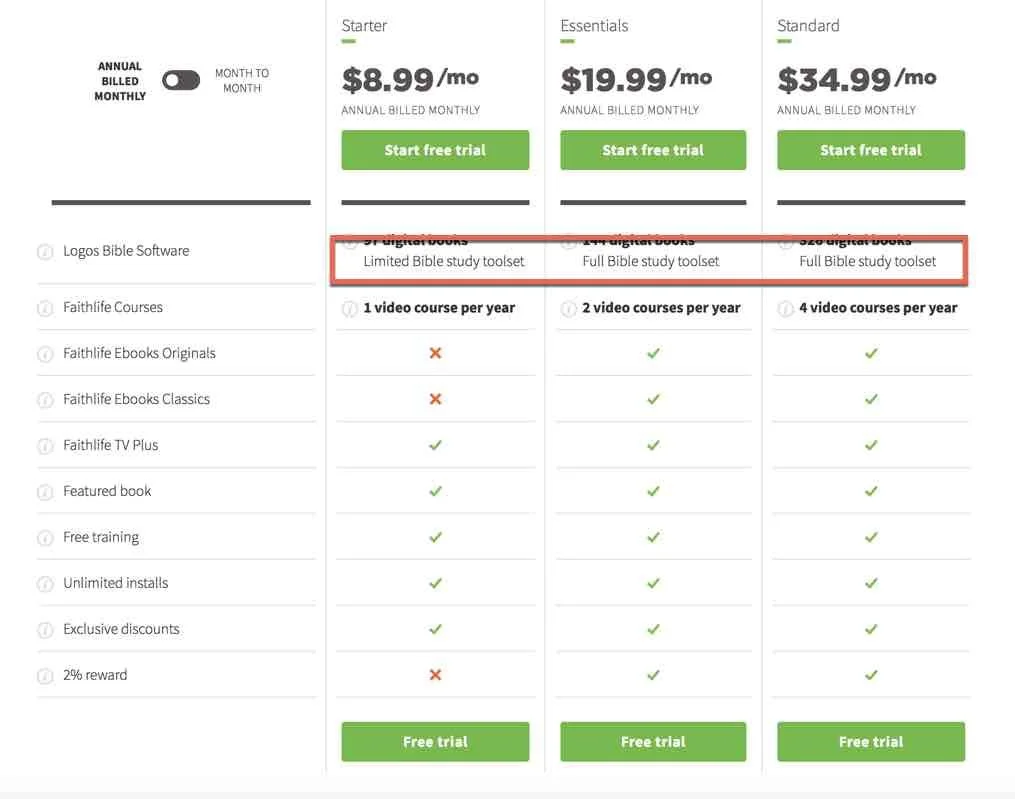
And a great outcry was heard from the Logos forums as the masses wailed and moaned the loss of Logos Now and Faithlife Connect replacing it. Then, their outcry was heard from Bellingham and grace was issued to all.A biblical writer might write the account of Logos Now that way, if we lived in those times. We don't and this doesn't rise to the level of biblical disaster, but the decision to do away with Logos Now hurt a lot of the Logos faithful and the outcry was great.
What Was Logos Now
 If you're not a Logos Bible Software user, then you may not understand what I'm talking about. The software produced by the company formerly known as Logos Bible Software and now called Faithlife, led by former Microsoft employee Bob Pritchett, began a subscription service awhile back called Logos Now. Some who disliked the idea joking called the service, "paying to beta test new features" while others liked getting the new features before a major .0 update, like the upcoming Logos 8.0, which I'd expect sometime this summer or fall.Logos Now included a bunch of things. the customers mostly like the getting new features NOW. Hence the name, Logos Now. About every 6 weeks the developers of Logos on both Mac and Windows released new tools or features in their desktop computer software.https://www.youtube.com/watch?v=aSBkxOZ1LeQPeople like me who love getting the latest greatest enjoyed the updates. It was fun to fire up your favorite Bible program and see that it was downloading something new. I'd rush over to the forums and find out what the new update included.A lof the new features that came out were a bit obscure and not something I really used. Occasionally they'd hit on something that people really liked.Included in these new features were the latest greatest version of Logos. So when version 7 came out, we didn't have to necessarily pay to get all the new tools rolled into the program. We already had some of them, but others came along for the ride in our subscription that costs about $10/month at first and then later became $99/year.To sweeten the deal, Faithlife threw in a few extras. At least that's the way we saw it. Here's what we enjoyed as subscribers:
- The new features about every 6 weeks.
- Access to a Mobile Ed course (video course on subjects; kind of like seminary inside Logos Bible Software).
- Discounts on new books.
- Access to a different resource to try each month and a discount if you wanted to keep it after the month.
- Discount when a new version of Logos comes out.
That's not a comprehensive list, but it includes the highlights. All that comes for under $100/year. I was happy.
Faithlife's Disconnect with Faithlife Connect
Then it all came crashing down. Faithlife employee Chris duMond took to the forums to announce the end of Logos Now and then introduction of Faithlife Connect. Here's what he wrote about the change from Logos Now to Faithlife Connect.
How Faithlife Connect affects Logos Now and Logos Cloud customersBecause this product includes many of the same features and benefits of both Logos Now and Logos Cloud, we’re migrating everyone who has a subscription to Logos Now and Logos Cloud to a subscription to Faithlife Connect. We’ll transition Logos Cloud and Logos Now customers into Faithlife Connect over the next day or so as we configure things on the back end. All active subscribers will retain their Logos Now/Cloud benefits through their subscription period.
 The change shocked many people, like me, who liked Logos Now. Why was this a problem? to get everything we enjoyed in Logos Now we'd have to subscribe to Faithlife Connect Essentials, a $19.99 subscription charged annually at about $240/year. So our subscription went from about $100/year to $240, a 140% price increase. They claimed it was better because it included services like...
- Faithlife TV - a kind of Netflix for Christian movies and documentaries.
- 2 video courses (Mobile Ed) per year.
- Discounts.
- Free eBooks.
- Rewards of 2% - kind of like cash back or airlines miles.
Many of us didn't see these things as a big benefit. Not enough to more than double the price. We just wanted to the new features NOW. The outcry was great, indeed. Just read the huge thread that followed the announcement.Faithlife automatically migrated Logos Now subscribers to the new Faithlife Connect. This also angered many users who made that clear in another forum thread. Another thread stated that "Faithlife Connect punishes Logos' best customers!". People got angry, probably overreacted and many of us immediately went to our subscription page and turned off our auto-renew, which Faithlife automatically turned on for all customers they migrated from Logos Now to Faithlife Connect.In defense of Faithlife, they said that all Logos Now customers would get to keep their Logos Now features until their current subscription ran out or until early November 2018 whichever lasted the longest. I saw that some had paid up through 2019, so they would get to keep Logos Now for a long time still before having to decide what to do about the new service.
Happy Ending, For Now
 Faithlife CEO Bob Pritchett took to the forums and made a new announcement on Friday, March 2 entitled "Logos Now to continue at same price (with new name)". He wrote:
I am sorry for how we communicated the Logos Now / Faithlife Connect change. This was my fault, not the team's.We have been listening to your feedback and you have caused us to change our plan.The bottom line: We are reversing this change, and you do not have to do anything. You will be automatically returned to the situation as of two weeks ago, before our announcement.We are effectively restoring Logos Now at the same price, only with more value. This configuration will be called Faithlife Connect Essentials (No Library), and will come with everything in Faithlife Connect Essentials (https://connect.faithlife.com/) except the subscription-based access to the library.This is everything Logos Now was and a bit more, and will include other (non-library) improvements/benefits to Faithlife Connect Essentials as they are released.If you were happy with Logos Now, this is the same, with no change in price. As a Logos Now subscriber, you are grandfathered into this package and price point.
The ensuing thread filled up quickly with people thanking Bob for the change.
What Should You Do?
If you were a Logos Now subscriber, you have to decide what to do next. Here's a list of possible responses to the situation.
- Nothing - just enjoy the new feature and stick with what you have enjoying the features of Logos Now in a newly named service called Faithlife Connect Essentials (No library). That's what I think most people will do. That's what I'll probably do. I went to reinstate my auto-renew status. I have until November before I have to decide since my current subscription does not run out till then.
- Migrate to Faithlife Connect - for the few people who's saw the change and loved it, take the leap and get the new Faithlife Connect at one of several levels ranging in price from the Starter package at $9/moth with no new tools unless you buy them and own them to $200/month for Faithlife Connect Ultimate which gives you everything you can get in the service.
- Stop Subscribing and Buy - some users feel the pain of subscription which can change on the whim of the software publisher. So, they decided to stop subscribing, but they won't leave their Logos library behind. Instead, they'll just buy the new features when the company releases them, usually every two years.
- Move to Another Bible Program - a few users, even though Faithlife chose to renege on killing Logos Now, sort of, feel frustrated and whipped about emotionally. They plan to switch on principle to another program, like Accordance, WORDsearch, Bibleworks or Olive Tree. Those are the best solutions and probably Accordance offers the most since it has large library options and advanced study features. If a library matters most, then consider WORDsearch or Olive Tree. People who use mobile more should definitely pick Olive Tree, the best mobile Bible app that's not made by Faithlife. Only consider WORDsearch if you really love a large library, don't use mobile much, and will run the program on Windows only.
- Stop Buying Digital Libraries - my friend and Theotek contributor LaRosa Johnson has a great blog about Bible Study in general. He recommends not building a huge digital Bible study library.
For now, I'm doing two things. First, I've decided to take the next 8 months and consider whether the new Faithlife Connect Essentials (No library) will best meet my Bible study software needs. Before all of this, I was a fairly committed Logosian. Now I'm not as sure and feel a little uneasy about the company. I was planning to jump ship entirely before they reversed their decision, so they did at least temporarily keep me as a user.Second, I plan to get more proficient with Accordance Bible Software. They seem to offer the best solution for my needs.
- Fast - starting up Accordance 12 compared to starting up Logos 7 is like racing a station wagon against a Corvette.
- Full-featured - I can do most of the things I could do in Logos 7, albeit in different ways, using the features of Accordance.
- Library - Accordance includes a huge library of Bible study tools that offer competitive prices and their tagging is often superior to Logos.
- Mac-like/Windows-like user-interface - the Accordance user-interface looks more like a native Mac or a native Windows program while Logos wants to make their user-interface look the same on both platforms. This means they have used technology that creates an overlay on top of native window drawing tools in OS X and in Windows. This is why Logos runs slower than other programs. It was a mistake made in version 4 and they've never recovered from it. It's better, but still not as native as other programs. Many Logos users see this as a strength, however, I'm not one of them.
- Trustworthy - I know many of the people who work for Accordance and know I can trust that they will not make drastic changes to their policies without considering the needs of the user first, plus they work hard to respond to user's requests, needs and concerns. Please don't see this as a slam against any other company. I'm just endorsing Accordance Bible Software as trustworthy because of my past experience.
I still struggle with a few things. Logos syncs with other platforms except their web app exceptionally well. Accordance relies on Dropbox and on mobile you have to do this manually and their Android app's too new to even include sync of notes, highlights and other user-created tools. The notes features in Logos are better than Accordance. They offer better text formatting and will automatically create Bible verse links when they're typed. I don't have to manually add the link to turn a Bible verse into a pop-up or hyperlink. The diagramming tool in Logos is great and Accordance doesn't offer an analog.
Logos Bible Software Sermon Prep Part One: Choosing a Topic to Preach
How do you use Logos Bible Software to find a good topic to preach or teach? In this first of two parts, we'll look at how to find a passage or topic to preach and we'll use Logos Bible Software to make that happen. This is the first step in preparing a sermon or Bible study using Logos Bible Software. Over next few weeks we'll cover the major steps to preparing and preaching using Logos. Now, Logos Bible Software has a bunch of built-in tools that will help you use a topic to find a passage or multiple passages to then preach or teach. In this tutorial we'll use the topic of redemption and use things like the Bible Word Study tool, the Sermon Starter Guide, and other tools to get inspiration for your sermon.We've got a couple of ways you can learn this first step. You can read the article below. You can watch this video, or better, do both. Either way, Logos Bible Software gives a number of launch boards for the sermon preparation process.https://www.youtube.com/watch?v=GZTrMB0PnuQBefore we jump in, let's look at the three primary approaches to preaching.
- Topical Preaching - If you're a topical preacher, then you often start by looking saying, "I want top reach on redemption." Usually it's more narrow than such a broad topic. Logos can help you in a few ways to get inspired to preach on a topic and in this first part we'll show users how to start finding inspiration for a sermon a topic.
- Textual Topical Preaching - Textual Topical preachers often begin with the topic in mind, but then use that to search for a specific passage of scripture to preach and then approach the sermon preparation in a textual way letting the text drive the content.
- Expository Preaching - Expository preachers start with the text, often working their way through portions of scriptures, like a book of the Bible or a passage like the Sermon on the Mount or the Psalms of Ascents. We'll approach that in part two.
Here's what's great about using Logos to find your sermon's topic.
How to Use Logos Bible Software to Find a Topic or Passage to Preach or Teach
Logos Bible Software lets preachers jump into their search from many starting places. The easiest sits on top of the Logos Home page. Click the Home button in the upper left corner, if it's not already showing. Then use the Command box that sits about a third of the way to the right from the Home button. Type the topic you're interested in here and it will run a Bible Word Study on that word. We'll use the topic, "Redemption". That link opens the Bible Word Study Guide in Logos on a computer.
Bible Word Study Guide
You can also run the Bible Word Study by clicking on the Guides button on the toolbar. Then choose Bible Word Study from the left hand column in the box the pops up. The Bible Word Study Guide will offer a few categories of searches. First, we see the title section explained above. shows your word and lets you enter a Title and some notes about the guide. Each guide in Logos has a title section. Give our search a title to save it. You might want to come back to this search, especially if you use the Notes feature under each section of the guide to save some of your discoveries or inspiration.Now, we get the Topic section next. It shows links to the topic you searched in various dictionaries, like the Lexham Theological Workbook (link opens Logos if you're on your computer).
 If you have enough dictionaries, you'll see a "more" link below the list. Click it to see the rest of the books with the topic included. Hover over the links to see a preview pop-up of that entry. Click it to open the book.Below the list of books you'll see a link to open the Topic Guide and the Sermon Starter Guide. If you click either of these links, Logos will perform a search using that guide. More on that below.
 Don't just quit after the "Topic" section. There are two sections focused on Hebrew and then Greek word studies. These will help us find the Hebrew and Greek words translated redemption or redeem or something similar. Each section has a graph showing the various words for our topic in Hebrew or Greek. Click on the graph to see the verses or over each section. You can then see a preview pop-up of that verse when you over the verse.If you preach topically or use the textual topical approach, then you might choose to include one of these verses in the sermon. If so, you've already gleaned what you need. However, the rest of the Bible Word Study Guide might still inspire you to preach on that topic. Scroll down to see the last three sections included in the guide.
- Phrases - shows the topic if it's part of a phrase, like "grace of God" if you're searching for grace.
- Lemma in Passage - shows the lemma of a word in commentaries. There's a drop-down list labelled "Settings" that will let you narrow this search to certain collections or books.
- Textual Searches - find the topic in your top Bibles. The list comes from the Bibles prioritized in the Logos library. Logos shows you how to do that.
If you search using a Greek or Hebrew word you'll see a lot of other sections, but for our purpose, we're focusing on finding a topic to preach. Most people will do that by searching in English, so we'll skip Greek or Hebrew words.
Sermon Starter Guide
Another guide will help with topic discovery. The Sermon Starter Guide works like the Bible Word Study Guide, but looks in different parts of your library. It focuses on sermon-related resources. It's probably a better place to start than the Bible Word Study Guide.Run the Sermon Starter Guide from the Guides menu. Type the word in the search box and it returns a list of links. Here's what you'll find in the guide. Again we'll run one for "redemption" which you can open in Logos on your computer by clicking this link. Again we have the title section as explained above.
- Theme - The Theme section that shows a brief definition of the topic and links to open the Logos Factbook and a Topic Guide search. Make sure to open the Factbook and learn more about your topic there. This is a great tool for using the topical approach to sermon or Bible study preparation.
- Passages - we get a sampling of "Key Passages" which cover the topic that you searched for. There are also "Pericopes" listed. Below that you can add these passages to a Passage List or open every one of the passages found.
- Sermons - If your library includes books of sermons, they'll show up here. Read some sermons to get inspired. I personally would avoid this section at this point. Do your own study first before reading what other preachers preached about your topic.
- Preaching Resources - You'll mostly find sermon illustrations in this list or sermons. You'll also find some outlines and hymns.
- Sermon Outlines - If your library includes some sermon outline books, then they'll show up here.
- Thematic Outlines - For topical preachers, this section might offer the most help. More on it below.
- Journals - Find Journal articles on your topic, which can be helpful in learning more about it, often from. scholarly level.
- Collections - Searches your Collections, which include books that you put together, like Romans Commentaries. Find out more about them from the Logos training pages. This section's not as helpful for our purpose.
- Interactives - Interactive tools like the Psalms Explorer.
- Media Resources & Media Collections - Find images related to the topic.
- Soundfaith, Faithlife Music, Bookstore and Lightstock - all sections that take you to resources you can buy related to the topic.
Take a close look at the Thematic Outlines section of the Sermon Starter Guide. If you're preparing a topical outline for a sermon, then this section might do a lot of the work for you. You'll still need to study the passages included in these outlines, but this section alone could give you your outlines. Take our topic redemption. The Thematic Outlines section offers a few subtopics. We get a list of passages about "God as Redeemer" with a synopsis of the topic first. Then a few more subtopics about that subtopic like "God as the sole redeemer of Israel" and "God redeems his people from difficult personal circumstances" to name two. Each has some passages of scripture. Hover over each passage to view a pop up in your top Bible or click to open the top Bible.
Topic Guide
The Topic Guide (click here to run one on Redemption) is another great place to start looking for inspiration to preach a particular topic. Open it from the Guides menu and enter your search in the box. Here's what Logos includes in the Topic Guide. At the top you get the title section where you can save this Guide for future use. Put an explanation of the guide and each section has a Notes section to keep notes.
- Topic - This section lists links to the topic in dictionaries. Click "more" to see the entire list. You also see a link to the Facebook, Sermon Starter Guide, Bible Sense Lexicon and links to search the library for words related tot your topic.
- Related Verses - Finds verses about the topic.
- Sermons, Illustrations, Illustrations, Interactives, Media Collections Sections - like the Sermon Starter Guide finds things in each of those kinds of resources related to our topic.
- Atlas - finds things in atlas for our topic.
- Biblical People, Places, Things and Events Sections - These tools are like a search for each of these kinds of information with visuals and books that tell us about them.
- Soundfaith - online sermon database of audio.
- Topics.Logos.com - opens links to the online Logos resource related to our topic.
- Bookstore and Lightstock - links to buy content related to our topic.
Like the Sermon Starter Guide, the Topic Guide might offer the best options for our purpose. However, since we've covered most of these sections above, we won't rehash them here.
Create Your Own Personal Guide
These guides offer a lot for a user, but you know what you want to search for. So, create your own personal guide for searching Logos for a topic. To do this, click on the Guides menu (#1 below) and choose "Make a new guide template" at the bottom of the list and then click the drop down list on the right (see #2 below). The four options will change the list of sections to include that we see along the left side of the screen (see #3 below). It begins with the list of sections already in the pre-defined guides give to us by Logos. So, if you're searching for a topic, you'll probably want to select Preaching Theme or Topic. The Preaching Theme template has more sections, so click that to get started. Here's what I'd include in my own personal topic search guide.
- Thematic Outlines
- Themes
- Passages
- Preaching Resources
- Sermons
- Faithlife Music
 Don't forget to give your guide a title in the upper left corner. Click the box with the tiny pencil icon (see above). Now it will show up in the Guides menu.
Logos Bible Software Tools for Topical Preaching
By now you probably have a lot to get started with. However, a few other tools will also help. You'll find these in the Logos Bible Software Tools Menu.
- Bible Browser - a few of the tools found in the Bible Browser will help.
- People, Places, Things and Events - great for finding passages about a person in the Bible if you want to preach on Disciples doing character studies or some other person-focused study or sermon. You could also do a study of a place or objects as jumping off points for a series on something like the Temple.
- Miracles or Parables - a great source for a series on either.
- Preaching Themes - we found this in the Sermon Starter Guide and I put it in my Personal Topic Guide.
- Topics - of course perfect if we're looking for topics to preach.
- Sacrifices - study on the various sacrifices in the Old Testament.
- Factbook - we found this mentioned above.
- Interactives - Logos includes a bunch of interactive tools and click this link with Logos on the computer and it will open to them.
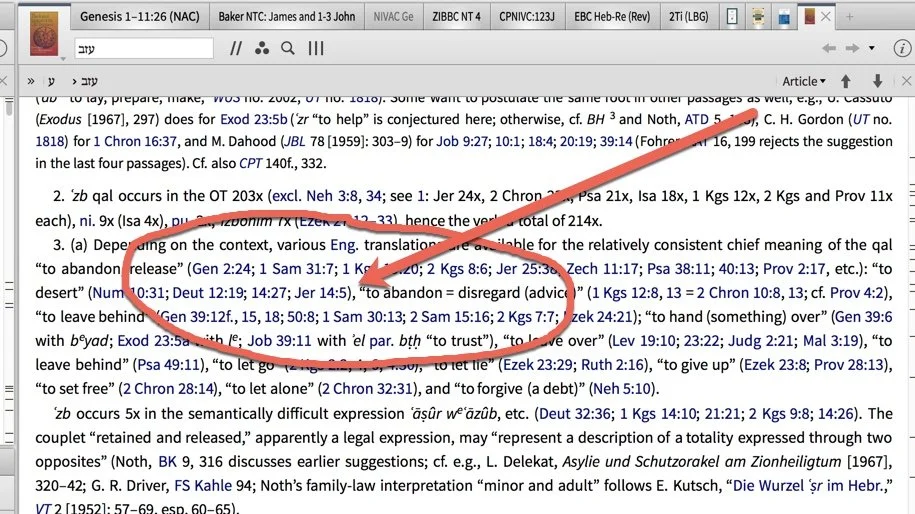
10 Ways Your Bible Software Needs to Improve
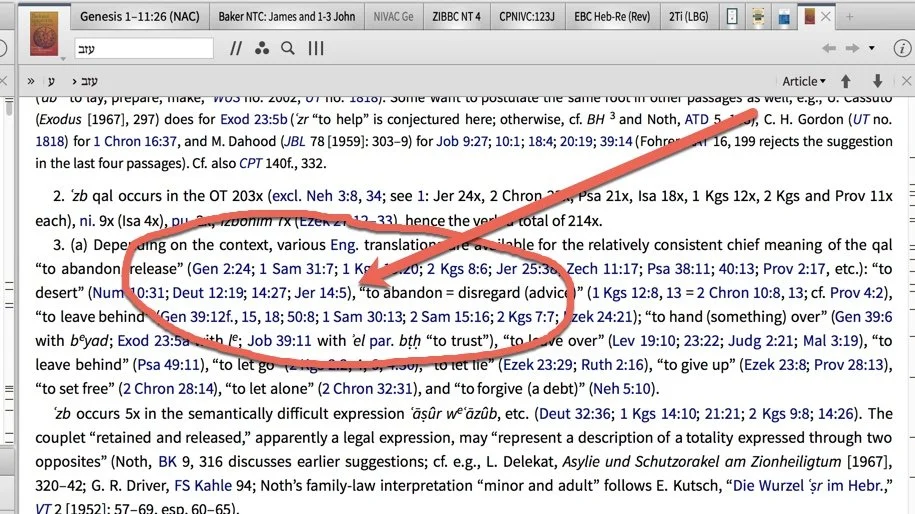
The present state of Bible software feels both amazing and terrible at the same time. I decided to propose my the top 10 ways your Bible software stinks and how I wish the Bible software and app creators should fix these problems.
Stylus Support in Bible Software
 First, Bible study software needs better stylus support. A lot of Bible study programs will run on a tablet or touchscreen and the user can point and select onscreen elements using a stylus. This includes the Apple iPad Pro and Apple Pencil or the Microsoft Surface Pro with the Surface Pen. Android apps run on the Google Pixelbook, which converts to a tablet and has a great stylus. That's not what I mean by stylus support. Instead I want to draw or write with a stylus inside the Bible software or app. Think of your paper Bible and highlighting, underlining or margin notes.
 I know of no Bible apps or software that support writing directly on the text of the Bible or in the "margins". There's one app called Bible Mark Up that lets you add a Bible verse from a few translations. You can write on the screen, but it's primarily a teaching or presentation tool. We featured the app on the Theotek Podcast.https://www.youtube.com/watch?v=7tZ2Y32OPzQThe app works a lot like Look at the Book by John Piper on YouTube. Below you'll find a Look at the Book video covering Psalm 132:2.https://www.youtube.com/watch?v=JOdXZJoqG-AI'd like to write in the margins or directly on the text. Programmers tell me this is not as easy as it sounds to add to apps. Also, Bible software makers don't seem interested in prioritizing this with their limited resources. Maybe, they could give us a kind of margin notes by adding drawings to Bible notes. For example, in Olive Tree I tap or click on the verse number. A menu offers to add a note. What if it also had a button for a "drawing"?
Better Bible Software Touchscreen Support
In addition to adding support for drawing or writing on the screen in Bible software or mobile Bible apps, I'd like better integration with touchscreen computers in Windows.Mobile Bible apps on iOS and Android handle touch with their user interfaces. They design these apps with fingers in mind, not small tips of a stylus or mouse. There isn't a touchscreen Mac and Windows Bible software doesn't make touch convenient. That's what I want. The icons on toolbars and links in books don't work well with big finger tips. I often hit the wrong tiny toolbar button while using Bible software on my Surface Pro in tablet mode. If you get multiple links in a lexicon like the one above, it's often hard to tap on the right Bible verse. The publishers could solve this by implementing a "touchscreen" mode. Tap a button or put a feature in the settings that let me turn this on with a keystroke. Even better, when the computer enters tablet mode, the software should recognize this and switch or offer to switch the Bible software display to touch mode.Tablet mode in Bible software would increase text size and buttons. The programs could also include pinch out to zoom, so that the tiny links look bigger and easier to tap.
Get My Notes Out of Your Silo
Bibleworks saves user notes in RTF format. I can open the notes in a word processor like Microsoft Word or OpenOffice. Very few other Bible software programs offer the same convenience. Most don't even let the user export their notes, unless you count printing a passage with notes or copying and pasting notes from the software to a word processor. If a company keeps the user's notes in their silo, then they're putting their own interests above the user's. They may not do so intentionally, but that's the result. Some companies might choose to do this knowing that users are less likely to leave the program behind if they can't get their user content out of the software easily. Most probably do this out of convenience or because they didn't consider the problem when they first coded the user notes feature. Now they might not have the man-power to correct it.I'm not a programmer, but is it that hard to strip away all but the bare text of the user notes? Offer an export feature that saves the text in a simple TXT file and attach the Bible reference to each note or label any notes attached to a single word or phrase with that word or phrase.
Sync Notes and User Content Between All Platforms AUTOMATICALLY!
Two programs shine and others fail at automatic syncing of user content. If I take a note in Logos or Olive Tree, the company uses their own servers to automatically sync the notes from your iPad to your Windows computer or from your Mac to your Android phone. It's great!https://vimeo.com/126882018Accordance offers a sync feature using Dropbox as the middle-man. However, notes in Accordance does not automatically sync between various platforms. That's more important now that they have apps for iOS and Android as well as programs on Windows and Mac.First, I have to save the note by hitting a button after I'm done editing it. I can set the desktop software up to sync my notes to Dropbox or from Dropbox every time I open or close the software on my Mac or PC. However, on iPad or iPhone (Android's not supported yet) you have to do this manually. Learn how to do it in a helpful blog post made by Rick Mansfield, one of our Theotek co-hosts. Watch his video above.You have manually sync by tapping on the library button on your iPad or iPhone and then tap on the sync button on the bottom toolbar. That's a strange place to hide this button. I wish it showed up on the main screen. In addition to notes, I want to sync other user-created content. Sync my highlights, bookmarks, favorites, and documents. Some programs let me create books that I can use inside the software. Few of these programs let me sync these tools to mobile.The problem gets worse when I write a bunch of important notes on my iPad and then want to use them on my Mac. If I forget to sync on the iPad and then leave it at home, then I can't access them on my Mac or PC.
Reduce Clicks for Simple Tasks
The above wish highlights another problem that many of the programs and apps suffer from, too many clicks to do simple things. For example, to sync my Accordance Mobile notes with Dropbox, I have to tap on the library button, then the sync button and then on the "Sync user content with Dropbox" button. That's too many taps for something that should work automatically without any user input. Let's not only pick on Accordance. In the Logos Bible mobile app I used to link two books together with a couple of taps. I could open the ESV and the ESV Study Bible in one pane and then link them together with a button on the main screen. When I navigate from John 1 to Genesis 25 in my Bible, the study Bible will also go to that spot.To sync two books now, I have to tap the new Logos Tabs button and then the link button and then select the panes I want to link and then tap the Done button. It went from a couple of taps to at least four taps. Granted, I can now link more than two panes at a time, but it seems that it should not take as many taps to link the two panes on-screen at that time.We don't have space to highlight every situation where we have too many taps or clicks in all the Bible apps and software programs. This problem shows up in nearly every Bible app or software where it's even worse than the apps. Developers need to make the primary features accessible in two clicks or less or go redesign their programs/apps.
Add a Note in One Tap/Click
Going back to notes, let me add a note with only a single tap or click. The app or program needs a button on the screen that I can tap on the mobile app or click on the desktop program to quickly add a note. The Accordance mobile app lets me add a note with two actions. I can select the verse number and a menu pops up with an option to add a User Note in the pop up menu (see above). Logos does the same, but to add the note to a verse I have to tap the Reference tab in the notes editor on the mobile app (see below). That's 3 actions.
 Olive Tree also adds a note with two clicks/taps. It works just like Accordance except you tap instead of select the verse number.With the Logos desktop apps you have to right-click the verse, select the reference in the pop up menu and then select your notes document listed in the same pop up menu, if it's open or you've used it recently. If you haven't used the note document in a while, you'll have to open it first for it to show up in the list.https://www.youtube.com/watch?v=G1SSoPjV9kMBibleworks and e-Sword both handle this best. Open the notes window pane and then navigate to the verse you want to add a note to. Click in it notes editor and start typing. Switch to a new verse and click in the notes editor to add a note to that new verse. See the Bibleworks notes function demonstrated in the video above. After you open Notes in these programs, you get exactly what I want - a single action to create a new note.
 Accordance on Windows and Mac will add a note using one action. Hover over a verse and a pencil icon appears to the right of the verse. Click on it and a note editor box pops up. However, in Accordance you need to save your note or you'll lose it. The editor should save it automatically each time you close it or click anywhere else in the program.As you can see, these programs still don't do what I'm asking. Accordance is close in the desktop program. e-Sword and Bibleworks work if you open the Notes editor first. However, none of the mobile apps offer this feature that I know of.
Save Space and Let Me Pick What Books to Install
I'm looking at you Logos. Almost every other Bible study program will let me choose which books to install. If I have a huge hard drive I don't care if I have to install all of my books. But a large library eats up a lot of space. What if I only have a 64GB or 128GB MacBook Air or a small 32GB Windows tablet? Logos runs horribly on these small Windows tablets if you put it on an SD card. Let me pick only the books I know I'll use instead of forcing me to download and then index every one book in my 18GB library. Thank you nearly every other Bible software or app maker.
Tagged Bible Comparison Tool for Word Studies Within the Tool
When I open an English Bible that has Hebrew and Greek tags, I can often do some simple word studying. Also, these kinds of tags show up in most of their Greek and Hebrew Bibles too.Some programs have a "reverse interlinear" that shows the English translation in the top row and then underneath that shows Greek or Hebrew words, transliterations, parsing details and a lexical form and definition. You can also hover over an English word in a regular Bible book sometimes a pop-up will show these details. Other programs let me double or triple click the word. Still others have a right-click menu to open language study tools.These tools help me do some language study, but I'd like a parallel Bible or Bible comparison tool that has the same kind of tags. You can put the various tagged English, Greek and Hebrew Bibles in parallel windows.I really like the layout of the Logos Bible Software Text Comparison tool. It has columns for each verse and shows visually the differences (see above). A verse, like John 3:16, shows up in my preferred translation on the left. See above I have the CSB in column one with the other translations in the next columns. That gives me the CSB next to ESV, NASB, NKJV, KJV and NIV. I can add or subtract any translation I want. I can also add the Greek or Hebrew Bibles.Unfortunately, the Logos Text Comparison tool doesn't include tags for language study. I can't hover over words, right-click them or double/triple click to show Greek or Hebrew info. Bibleworks will show various translations with one after another listed from top to bottom. I can get language information by hovering or clicking. I prefer the layout in the Logos tool so I wish Logos would add this.Accordance also presents the various translations with tagged words if I use the Interlinear tool. Open the Bible and then use the "Choose interlinear rows to display" button. It's next to the text tool in your Bible's window in the upper right corner (see #1 above). You can hover over the word and the Instant Detail window will show you the language details for that word (see #2 above). Triple click a word and the word will open in your favorite Greek or Hebrew lexicon based on the Strong's number of the word you triple clicked.None of the mobile tools will do what I'm asking.
Create Books Without Programming Language
The Bible software programs that let me create my own books, do not make it a simple task. I want a tool, built into the program, that lets me import a simple Word document, TXT or RTF file or even a PDF. The program should then convert that file to the format that the software uses to display their books.After I import the document, the programs should find all Bible references and turn them into links with a pop-up window to display the verse. If I click/tap the link it will open that verse in my Bible. It should let me add notes, highlights and bookmarks to the document. If I format it with the right heading styles, then it should break it up into chapters and sections for regular books. If I add a bible verse per line it should see the document as a Bible and make it work like the Bible's in their program.Many of the programs (Accordance, Logos, WORDsearch, Bibleworks, and e-Sword to name some) will let me create books to use in the program or even from within the program. But many of them seem too complicated for the average user.
Sync My User Created Books to Mobile Devices and Other Computers
Following the previous gripe, the program should then let me sync these books to my other devices automatically. I should not have to go through a manual sync process or copy it using iTunes or Dropbox, unless the program uses Dropbox or another 3rd-party server for automatic syncing.
Export Books to Kindle, Word or PDF
 The inability to export books probably isn't the fault of the Bible software companies. In fact, Logos had an export to Kindle feature before the book publishers or Amazon or both stopped them from including it.I want to open a book in my Bible software and hit export to save the book in a file on my computer that I can then open on my iPad, iPhone, Android phone or tablet or on my Kindle and read on one of those devices. Some books are more enjoyable to read this way, like Christian Living books.https://www.youtube.com/watch?v=ANfakC6QSlw&feature=youtu.beIf you want to export a book from Logos, you can follow the steps outlined in a forum post by Mark Barnes, an expert in Logos Bible Software. You can watch Mark's video from YouTube above.
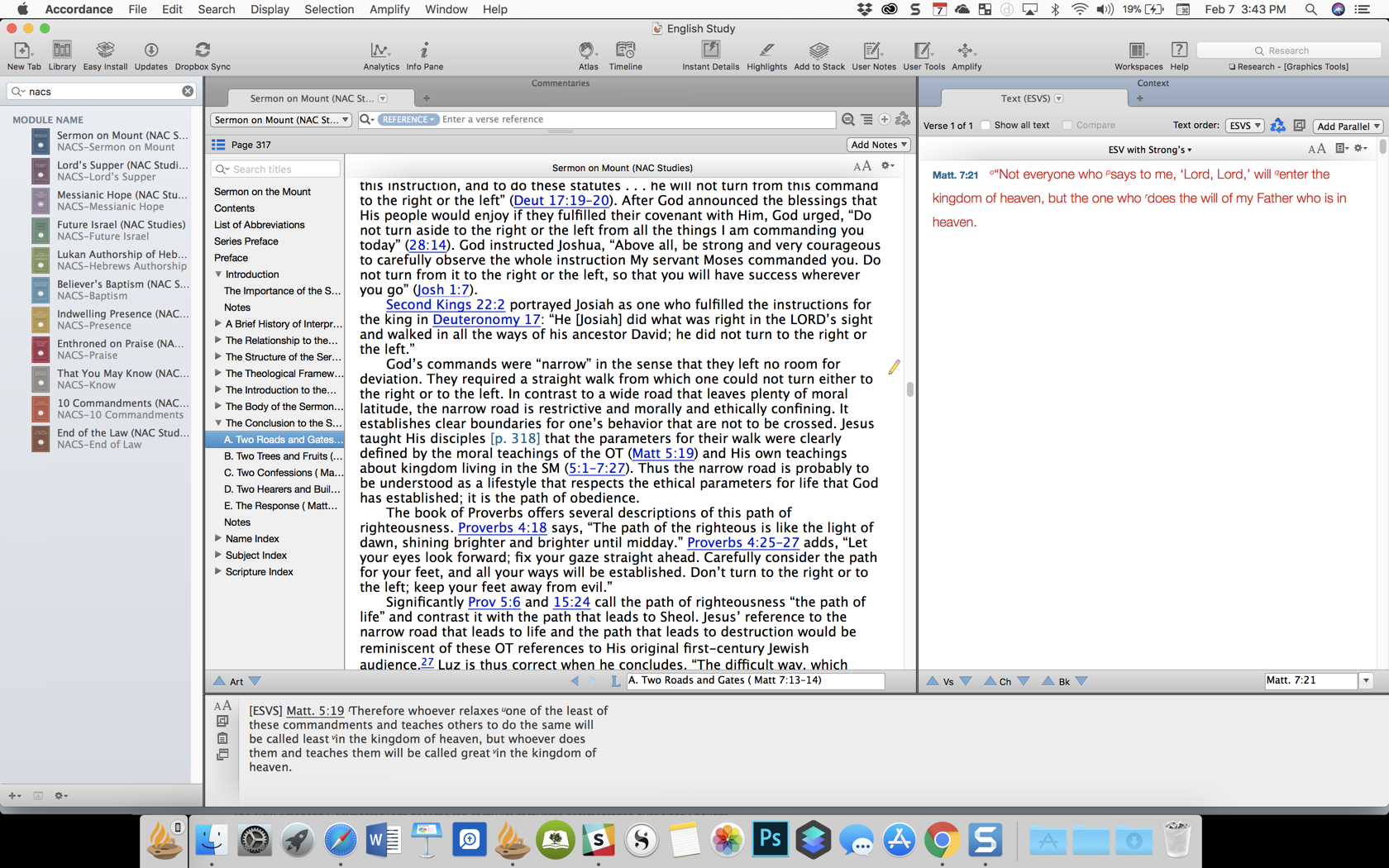
NAC Studies in Bible & Theology for Accordance Review
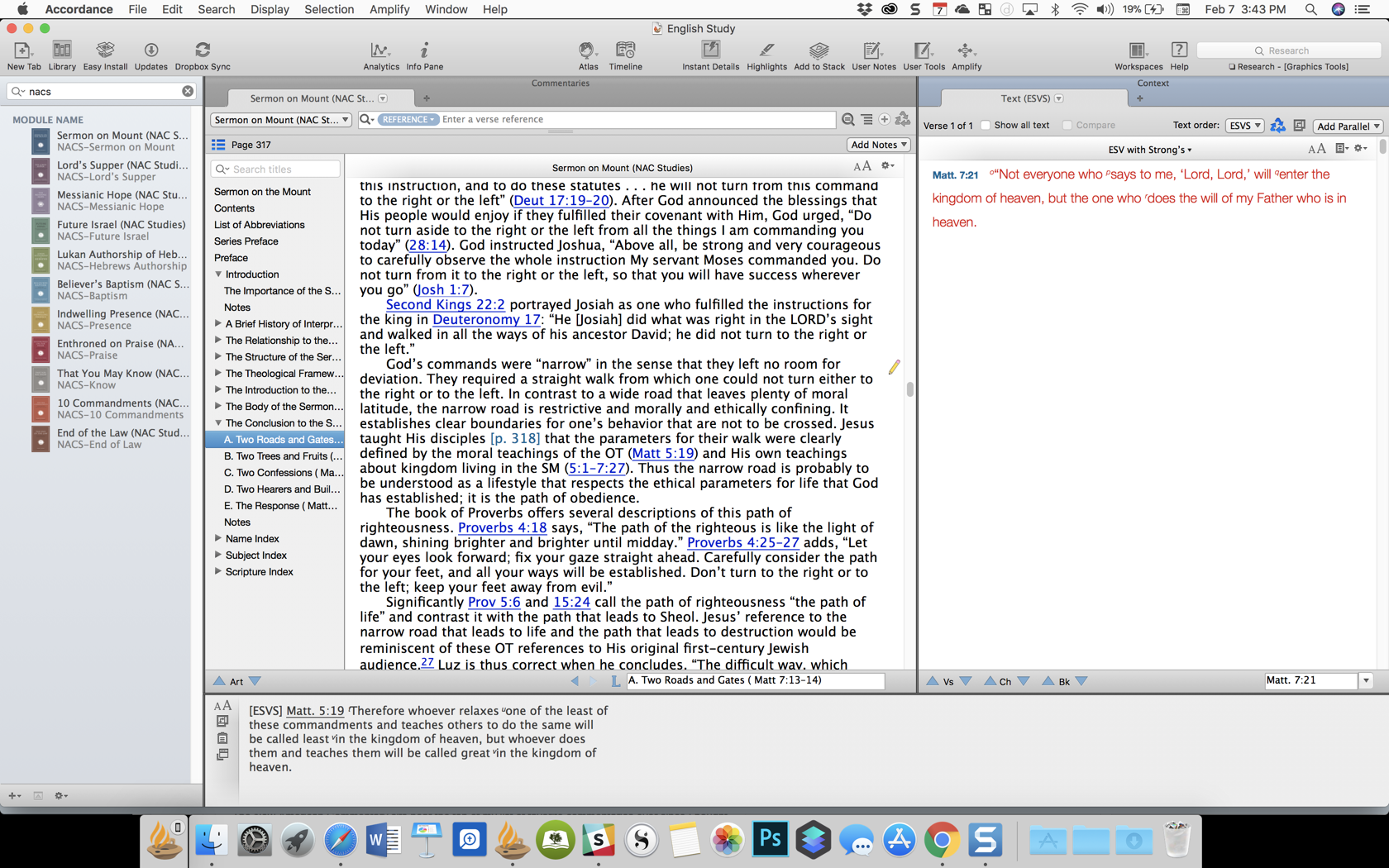
The New American Commentary sits near the top of my list of favorite commentaries ever since I bought the physical books as they first came out in the early nineties. I bought them on subscription from Broadman & Holman as the publisher released each new volume. So when Accordance asked me to review the New American Commentary Studies in Bible & Theology, I jumped at the chance.The New American Commentary creators chose to expand on 11 important subjects in Biblical studies and theology. Readers should see them as addendum to the NAC series.https://www.youtube.com/watch?v=H7OViiJWh2k&feature=youtu.be
What's Included in the NAC Studies in Bible & Theology
Accordance published the set of 11 books for Accordance Bible Software and their Mobile apps this past week. In the set you'll find 11 topics of advanced study written in a way that will stretch average Christian readers, but not so much that they can't benefit from the scholarship included.The Lukan Authorship of Hebrews by David Allen first found its way into the public as Allen's Ph.D. dissertation. He adapted it for this series and I found it extremely interesting. Allen considers the authorship of Hebrews, an often hotly debated subject. He argues for Lukan authorship based on the similarity between the language of Hebrews in Greek and the language of Luke-Acts, among other things. He supports this view by citing the early church fathers, many of whom also attributed the book to Luke.The book doesn't just jump into proving Luke's authorship. He first considers other authors, like Barnabas, Apollos and Paul. I remember listening to my New Testament professor in college tell us that he was certain Apollos wrote the book. The arguments against Apollos, Paul and Barnabas are brief, but they do show up.Chapter three to the end of the book discuss various reasons for trusting Lukan authorship in a convincing way that I look forward to finishing.The complete list of books included in the NAC Studies in Bible & Theology include:
- David L. Allen, Lukan Authorship of Hebrews
- Christopher D. Bass, That You May Know: Assurance in 1 John
- James M. Hamilton Jr., God’s Indwelling Presence: The Holy Spirit in the Old & New Testaments
- Barry E. Horner, Future Israel: Why Christian Anti-Judaism Must Be Challenged
- Jason C. Meyer, The End of the Law: Mosaic Covenant in Pauline Theology
- Timothy M. Pierce, Enthroned on Our Praise: An Old Testament Theology of Worship
- Charles Quarles, Sermon on the Mount: Restoring Christ’s Message to the Modern Church
- Mark F. Rooker, The Ten Commandments: Ethics for the Twenty-First Century
- Michael Rydelnik, The Messianic Hope: Is the Hebrew Bible Really Messianic?
- Thomas R. Schreiner & Matthew R. Crawford, The Lord’s Supper: Remembering and Proclaiming Christ Until He Comes
- Thomas R. Schreiner & Shawn D. Wright, Believer’s Baptism: Sign of the New Covenant in Christ
Seeing Mark Rooker's volume, The Ten Commandments: Ethics for the Twenty-First Century excited me since I sat under his teaching at Southeastern Theological Seminary learning Hebrew, or at least attempting to do so. He graciously gave me a pair of Bs for the two courses. There's one extremely minor complaint with Accordance's versions of these books. The titles seem a bit cryptic when you look for them in the library on the mobile app. Notice the titles of the volumes circled in red above. The real titles are That You May Know: Assurance in 1 John and Enthroned on Our Praise: An Old Testament Theology of Worship. That's nit-picky criticism, but I did have to open the books to figure out what I was looking at.
Accordance Treatment of the Series
People can read books like the NACS series another digital reader like a Kindle. There's a number of important benefits to reading Christian books in a Bible study app like Accordance. With the Kindle versions you'll miss tags that link to other books or the Bible. When the author refers to a Bible verse, you don't want to put down the Kindle and pick up a Bible or close the book and manually type in the Bible reference to find out what it says. In the Accordance Bible mobile app, you can tap on the reference to read it in a popup. Open the books in Accordance Bible Software on your Mac or Windows PC and you can put your Bible to the right and click on a reference and instantly read it. Also, just hovering over the reference shows the Bible passage in the Instant Details window. Footnotes will show up as pop ups too on the mobile app or in the Instant Details window on the desktop app.When you move to a new place in the book or to another book in the mobile app, just tap the screen to show the toolbar and hit the back arrow at the top left to go back to where you were reading in the NACS book.Aside from the pop ups and links, you can take "margin notes" in Accordance and later save those for use in a research paper or a Bible study on the topic discussed in the book. Plus, when you're studying one of the topics like Baptism, these volumes will show up as pertinent results in a search of your library for "baptism" (Believer's Baptism: Sign of the New Covenant in Christ by Thomas Schreiner and Shawn D. Wright).
 Using Stacks in Accordance lets you keep track of important information that you find as you read these books. Highlight text in the book and hit Add to Stack from the toolbar in the desktop app.
Recommendation
The whole set of NAC Studies in Bible & Theology currently costs $159. Each volume individually costs either $13.90 or $16.90 when you buy them by themselves. That introductory price lasts until February 12, so act quickly if you want to buy them. You can always use one of their payment plans to buy the set of books. For example, paying for them over 6 months will cost $41.50/month. That includes a small fee for handling the payments.Should you get them? If you are a lay scholar (pastor, serious student of scripture) then grab the volumes of interest to you. They are informative, written well, and will benefit your study. Pastors may want to get the volumes that they can use as inspiration for a study at church. You may not do a 6 week Bible study on the Lukan authorship of Hebrews, but if you're preaching or teaching through the Sermon on the Mount, then that volume by Charles Quarles would be invaluable. I just finished teaching through 1 John and wish I had That You May Know: Assurance of Salvation in 1 John by Christopher David Bass.Seminary students or professors will find them useful in their educational endeavors. In interest of full-disclosure I was given a copy of the books for this review, I would definitely choose to buy them. I'll be consulting the volumes the next time I'm studying the Ten Commandments, the Sermon on the Mount or one of the other topics addressed.You'll pay more for the Accordance versions of these books than you would on Kindle, but I still wouldn't go that route for the following reasons:
- Accordance tags gives quick links to verses, etc in Instant Details or to open in a Bible window next to the book on the desktop app.
- The mobile app will show pop ups of verses and footnotes.
- Record your thoughts using the great Accordance notes feature.
- Save to stacks important content that will help you in useful research.
- Quick back and forth navigation helps keep you reading without losing your space.
Accordance Mobile Bible App Goes Android
The Accordance Mobile Bible app for Android hit version 1.0 and it's available to download now and side load on your Android device. You can watch our latest Theotek Podcast where Mark Allison and Rick Mansfield showed off the app. Go over to our new Facebook Page and hit Like and you'll get updated each time we go live with a new podcast. Watch it below on Facebook or on YouTube under that.Here is the YouTube vide. Hit subscribe to get new videos after we record them live on Facebook.https://www.youtube.com/watch?v=82aJbwremE0You can download the app and side load it on Android. Get it from the Accordance Blog. Accordance will post it in the Google Play Store sometimes soon. You can follow the Theotek Podcast on Twitter to get an update when it's ready to God or follow Accordance on Twitter. You can also follow me.The Accordance Mobile app is only a book reader and searching tool at this point. Things like languages study, highlighting and notes will be added at a alter date.